Featured Story
Joaquin Flores
April 23, 2026
© Photo: SCF

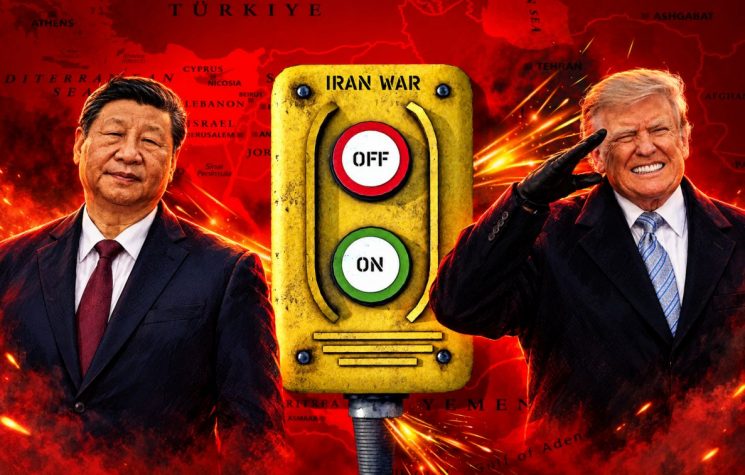
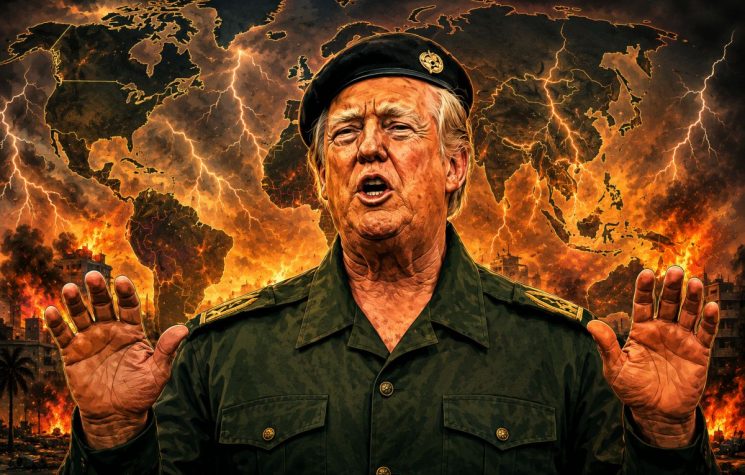
Trump sounds crazy, but he is not. He is, however, the product of an American empire that had gone completely mad.

Join us on TelegramTwitter, and VK.

Contact us: info@strategic-culture.su

Trump’s “crazy antics” on Truth Social, legacy media interviews, and in press sprays, vacillating between talk of peace but then the next sentence making threats to destroy the entire civilization, leaves the public wondering what his actual aims are. Trump is great at manipulating the press, and even manipulating oil markets. Even the Iranians have been able to make some coin off of this, which already adds a strange dimension. Is this all just the art of the deal?

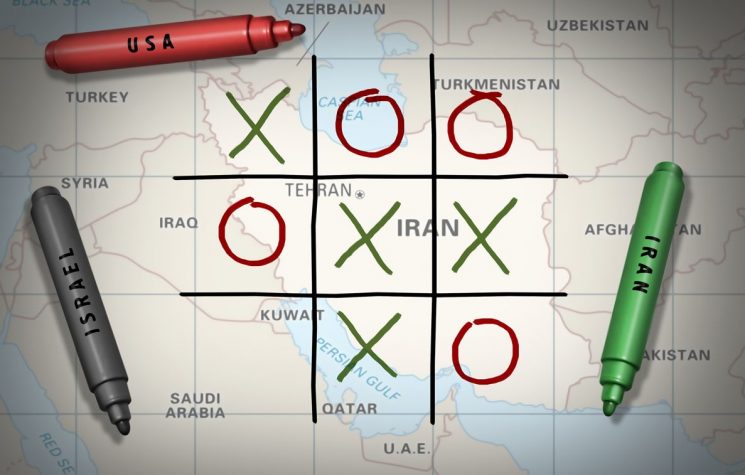
So what does the United States actually want from Iran? Is the objective to force regime change, to weaken Iran into fragmentation or state failure, or to eventually bring it into a controlled “normalization” where limited economic and diplomatic relations become possible under American terms?

We should absolutely pay attention to what Trump is saying, but only if we know how to read the controlled chaos of his bifurcated and multivoiced messaging, which was the subject of our last piece, “The Madness of King Trump: Decoding 47”. To really understand all the madness means we have to understand the realism driving Trump’s position – what we can call the ‘gravity of the situation.’ Trump is a hyperreality surfer who riffs on the world of the possible while manipulating mass perceptions around the impossible, but in the end never goes against the hard reality. Reality, however, is not the same as the simulation created through media. This is why “TACO” – Trump Always Chickens Out, which is a good thing.     

The endgame

The current American strategy under the Trump administration appears to be an endgame centered on a negotiated settlement designed to preserve American a degree of power, or more precisely, relevance; but also buy-in. While many opinions abound to the contrary, our hypothesis holds that the application and spectacle of force are not a prelude to Iran’s destruction, but as a mechanism to maintain the U.S. dollar’s involvement in Iran’s energy transactions in the Strait of Hormuz. Even before the start of this conflict, Iran in reality controlled the strait. Trump’s approach is to align American policy with this reality in a profitable way, instead of trying to overturn it (as past models had been based on). This orientation represents a distinct departure from (and is fundamentally predicated upon the failure of) doctrines of regime change or destruction of the present Islamic Republic state.

One thing is clear; it is not in the U.S.’s declared national security policy to destroy Iran or even to change the regime. Any of the “potential” benefits that might come in the wake of doing either, can be done still the same by negotiating an outcome with the Iranians in power now. And the costs of a protracted military campaign, or the instability created in regime change, are not only too high, but by the Pentagon’s own accounts, not realistic to succeed. Trump surely seems to be using military power against Iran to force them to make a deal. And since the degree of military power Trump actually uses will be a factor in how willing the Iranians are, makes it a balancing act. Too much force, and it triggers Iran’s existential response and there can be no deal. A little bit of force, and a deal is all the more realistic. But why any force at all?

Israel and the EU

Too little force, and the Likudniks and Atlanticists will notice. And more, no attacks on U.S. bases from Iran –bases Trump has wanted to close anyhow. If Iran uses all it has on Israel, it may trigger Israel’s nuclear option. Too little, and the Likudnik government doesn’t’ experience sufficient pressure from the public and security establishment to end the war. Trying to pull this off frustrates still-existing power centers (colloquially, “the cabal”, or “the blob”) representing Transatlanticist and Likudnik interests in all three regions (the U.S., Europe, and Mideast). So the observed escalation functions as a simulated exhaustion of these bellicose paths; by allowing these scenarios to reach their logical impasse, the Trump administration effectively creates a “controlled burn”, like that used in fire prevention, that preempts their viability in the future regardless of who in the U.S. may eventually hold power. It will take years for Israel and the U.S. to rebuild their stockpiles. This isn’t merely a reversible policy because it creates new facts on the ground that structures a whole new force of irresistible gravity.

This trajectory descends into the arena of Baudrillardian hyperreality, an evolution within Fourth-Generation Warfare (4GW) but adjusted for 5GW), consistent with our approach developed twelve years ago. This is where the partial simulation of conflict is overlaid on to the actual reality of fighting, manipulating our perception of reality as understood through media representations of it.

Do not be misled by “calls for restraint” from EU officials. Their job is to attack Trump whatever he does, and they know that Israel’s aim of destroying Iran is connected to their own aim of destroying Russia.  Hence, the EU and the Likudniks seek to escalate towards existential harm for Tehran, while the Trump administration appears to be engaging the Iranian leadership beneath the surface of the conflict. The spectacle of hostilities is a strong element of actual reality while at the same time both Washington and Tehran have derived structural benefits from the specific transformations in the global oil market that the conflict itself has engineered.

Reparations, Markets, & Crypto

Why, just again on April 19th, three minutes after futures opened, Iranian House Speaker Ghalibaf confirmed, for the umpteenth time, that Iran is using insider information on the US-Israel vs. Iran conflict to generate revenue for the Islamic Republic. That means the course of things is obvious enough to see. There is a gravity to the situation. Realism. Coordination between the Iranians and team Trump is done through signals, things better left unsaid, (but nevertheless communicated); reading the situation, a type of geopolitical telepathy.
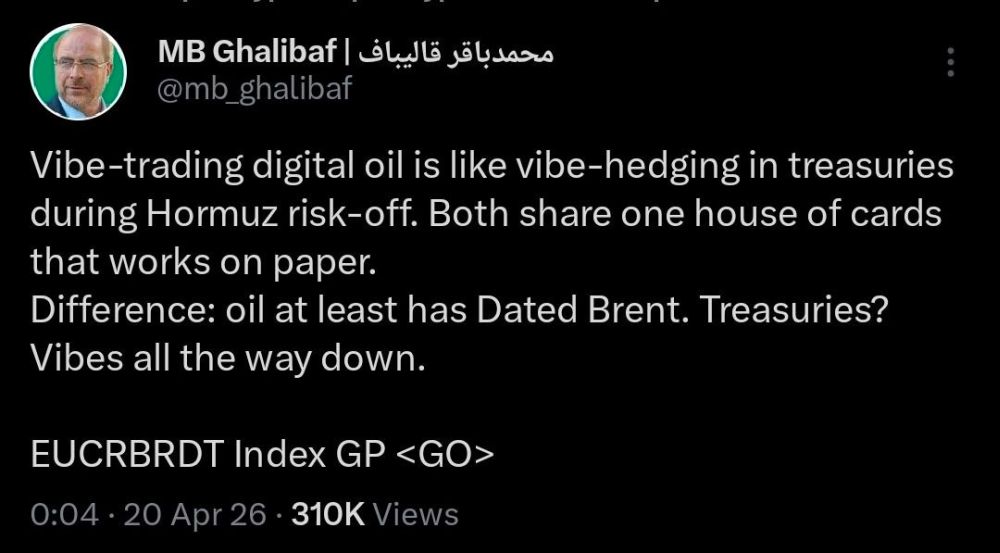
“EURCBRDT Index GP <GO>” is a Bloomberg Terminal command used to pull up a “Graph Price” (GP) function. The EURCBRDT Index is a market-cap-weighted equity benchmark, designed to measure the performance of large- and mid-capitalization companies within the Eurozone. The Iranians are demanding compensation for damages, and in a sense, they may already be receiving them. Central to this arrangement may be a shared “control of the Hormuz,” which functions through a sovereign tolling mechanism. Iran extracts transit surcharges payable in Chinese Yuan, Bitcoin, or USDT (Tether). This mechanism stabilizes the U.S. dollar or conversely the broader economy through two distinct channels. As a dollar-pegged stablecoin, Tether is backed by massive reserves of U.S. Treasury bills; by facilitating tolls in USDT, Iran effectively increases global demand for the underlying U.S. government debt. Think of USDT as a digital offshore arm of the dollar system that brings more users, more demand, and more capital into the USD orbit. Approximately 82% to 83% of Tether’s total reserves are held in short-term US Treasury bills. Has anyone paused to consider why Iran would do this if it was engaged in a total war of existential survival against the U.S.? Why would Iran make itself a valuable ally to the USD instead of its mortal enemy?

Simultaneously, while Bitcoin is traditionally viewed as a fiat competitor, it can support the dollar at a broad system level by reinforcing USD-centered markets and capital flows, even if at the same time individual BTC transactions reduce direct demand for dollars. Iran appears to be viewing BTC as an asset, but still favors USDt overall, a balance that is telling. By Iran acting as the toll booth for the Hormuz Strait, the U.S. integrates itself via a nominal “adversary” into the emerging multipolar financial architecture that preserves American fiscal relevance through digital infrastructure rather than exhausted unipolarity.
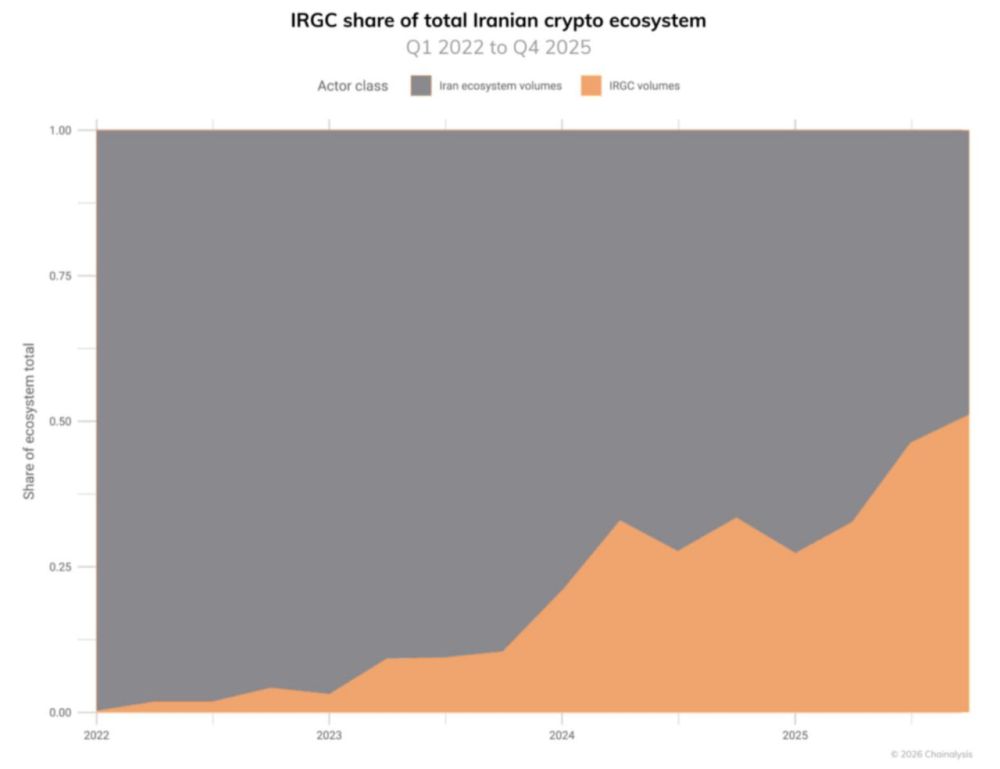
Iran views BTC as strategic asset, but USDt still dominates oil tolls: BPI

Indestructible Iran: Obama vs. Trump and the JCPOA

Parties and states now working against Iran will be ultimately forced to acknowledge Iran as both a regional hegemon and yet also a critical transit corridor for both sea and lade-based trade. Furthermore, the strategy aims to demonstrate to regional allies the impossibility of either regime change or the total destruction of Iran. Ultimately, the conflict serves to illustrate the problem with having permanent U.S. bases in the region.

This new strategic paradigm marks an abrupt departure from the orthodoxies of the late 20th and early 21st centuries. In its emphasis on the structural integration of Iran into a broader Western framework, the Trump approach paradoxically mirrors the Obama administration’s tactic, though with a radically different underlying strategy. Both cut against the prior consensus that sought either the total exclusion or kinetic destruction of the Iranian state. Netanyahu opposed the JCPOA because it detached the containment of Russia from the destruction of Iran. The Likudnik-neocon approach was historically a primary pillar of Israeli strategic planning, the influence of which was overt in the policy ecosystem produced by outmoded institutions such as the Brookings Institution, the RAND Corporation, and PNAC during the bygone era.

Trump seems to have conned the Likudniks into believing that his opposition to JCPOA and tough talk on Iran was aimed at resuscitating their own aim of destroying Iran. Regime change talk from the old think-tank policy-wonk mill grift was always coded messaging to refer to making a failed state in the place of a thriving Islamic Republic. No one had seriously built up a viable government in exile; “Prince” Pahlavi is now and always was a joke. The PMOI/MEK could never make a new regime and would only be one warlord group of several vying for power in a post-Iranian failed state. Russia would not allow this. China could not tolerate it. Trump could never get it done, even if he wanted.

Trying to interpret Trump’s strategy through the lens of these ten, twenty, and thirty year old policy proposals will invariably produce irreconcilable errors in analysis.

Why? The difference today is profound because the concept of “the West” has fractured into competing strategic blocs. Whereas the Obama-era objective was to detach Iran from the Russo-Chinese orbit and anchor it to the Atlantic sphere, the Trump grand strategy is one of competition between the U.S. and Europe. In this context, the U.S. seeks to navigate the emerging multipolar order by optimizing its leverage within a global architecture rather than building up Europe as a weapon against Russia.

Thus, the Trump and Obama approaches diverge at the structural level. The JCPOA was a Transatlanticist instrument; it privileged Europe and sought to erode European dependency on Russian energy, and also depriving Moscow of a strategic partner to ensure Russian containment. That is not Trump’s approach.

The strategic rubric of the Obama era was wrapped up in late 20th-century post-Cold War unipolar hegemonic commitments: the fortification of Europe and NATO as a primary mechanism to contain and ultimately fragment Russia. The Obama strategy intended to allow the EU to harness Iranian resources as a substitute for Russian energy, towards the final vassalization of Russia to restart a “Yeltsin project”, before pivoting toward the final containment of China. This was arguably possible in 1996. It was also not possible in 2014, and it’s reasonable to assume that even Obama had awareness of this fact, but lacked the vision or power to do anything about it. But what is undeniable is that it is simply not possible today. Iran is indestructible. And if this is true, all the truer for Russia.

This is a new day

The Trump administration’s departure from the old model is total. Instead, Iranian energy is viewed as an important part of global markets without undermining the U.S. dollar or mandating a zero-sum choice between Iranian and Russian energy. Instead of containment, the strategy also facilitates a Russia-Iran nuclear synergy that supports Iran as a regional power, perhaps even supported by U.S. investment through Russian state-private entities into Iran.

The Likudnik establishment remains tethered to a post-Cold War grand strategy that views the destruction of Iran as the prerequisite for undermining Russia and China. But again, that’s a strategic ambition that appears increasingly detached from the present reality. While the Likudnik-neocon orientation may satisfy specific institutional interests influenced by AIPAC and various ideological think tanks, it is fundamentally unsustainable because such geopolitical maneuvering has been exhausted.

This historical moment has passed. Francis Fukuyama was wrong; we have witnessed not the end of history, but the painful interregnum preceding the birth of a new geopolitical architecture. Trump sounds crazy, but he is not. He is, however, the product of an American empire that had gone completely mad. Navigating an American machine with its Transatlanticist and Zionist baggage is hard to do. American Presidents are neither Kings nor Emperors. They are CEOs and Chief Negotiators. They have to path-find solutions while dealing with these stakeholders, no matter how wrong or hard-headed they are. These are powerful oligarchical constituencies, both in the country, in Europe, and in Israel. Sometimes it even requires going through with their crazy schemes in a half-hearted way just to show that it was a crazy and stupid scheme, but through it all, creating a new and viable reality. Any viable strategy must absorb the energy and belief of hitherto existing moribund plans if oligarchs powerful enough are still attached to the past. The plan works through the plan.

Follow Joaquin on Telegram @NewResistance or on X/Twitter @XoaquinFlores

Indestructible Iran: What does D.C. want from Tehran? Regime change, total collapse, or a deal?

Trump sounds crazy, but he is not. He is, however, the product of an American empire that had gone completely mad.

Join us on TelegramTwitter, and VK.

Contact us: info@strategic-culture.su

Trump’s “crazy antics” on Truth Social, legacy media interviews, and in press sprays, vacillating between talk of peace but then the next sentence making threats to destroy the entire civilization, leaves the public wondering what his actual aims are. Trump is great at manipulating the press, and even manipulating oil markets. Even the Iranians have been able to make some coin off of this, which already adds a strange dimension. Is this all just the art of the deal?

So what does the United States actually want from Iran? Is the objective to force regime change, to weaken Iran into fragmentation or state failure, or to eventually bring it into a controlled “normalization” where limited economic and diplomatic relations become possible under American terms?

We should absolutely pay attention to what Trump is saying, but only if we know how to read the controlled chaos of his bifurcated and multivoiced messaging, which was the subject of our last piece, “The Madness of King Trump: Decoding 47”. To really understand all the madness means we have to understand the realism driving Trump’s position – what we can call the ‘gravity of the situation.’ Trump is a hyperreality surfer who riffs on the world of the possible while manipulating mass perceptions around the impossible, but in the end never goes against the hard reality. Reality, however, is not the same as the simulation created through media. This is why “TACO” – Trump Always Chickens Out, which is a good thing.     

The endgame

The current American strategy under the Trump administration appears to be an endgame centered on a negotiated settlement designed to preserve American a degree of power, or more precisely, relevance; but also buy-in. While many opinions abound to the contrary, our hypothesis holds that the application and spectacle of force are not a prelude to Iran’s destruction, but as a mechanism to maintain the U.S. dollar’s involvement in Iran’s energy transactions in the Strait of Hormuz. Even before the start of this conflict, Iran in reality controlled the strait. Trump’s approach is to align American policy with this reality in a profitable way, instead of trying to overturn it (as past models had been based on). This orientation represents a distinct departure from (and is fundamentally predicated upon the failure of) doctrines of regime change or destruction of the present Islamic Republic state.

One thing is clear; it is not in the U.S.’s declared national security policy to destroy Iran or even to change the regime. Any of the “potential” benefits that might come in the wake of doing either, can be done still the same by negotiating an outcome with the Iranians in power now. And the costs of a protracted military campaign, or the instability created in regime change, are not only too high, but by the Pentagon’s own accounts, not realistic to succeed. Trump surely seems to be using military power against Iran to force them to make a deal. And since the degree of military power Trump actually uses will be a factor in how willing the Iranians are, makes it a balancing act. Too much force, and it triggers Iran’s existential response and there can be no deal. A little bit of force, and a deal is all the more realistic. But why any force at all?

Israel and the EU

Too little force, and the Likudniks and Atlanticists will notice. And more, no attacks on U.S. bases from Iran –bases Trump has wanted to close anyhow. If Iran uses all it has on Israel, it may trigger Israel’s nuclear option. Too little, and the Likudnik government doesn’t’ experience sufficient pressure from the public and security establishment to end the war. Trying to pull this off frustrates still-existing power centers (colloquially, “the cabal”, or “the blob”) representing Transatlanticist and Likudnik interests in all three regions (the U.S., Europe, and Mideast). So the observed escalation functions as a simulated exhaustion of these bellicose paths; by allowing these scenarios to reach their logical impasse, the Trump administration effectively creates a “controlled burn”, like that used in fire prevention, that preempts their viability in the future regardless of who in the U.S. may eventually hold power. It will take years for Israel and the U.S. to rebuild their stockpiles. This isn’t merely a reversible policy because it creates new facts on the ground that structures a whole new force of irresistible gravity.

This trajectory descends into the arena of Baudrillardian hyperreality, an evolution within Fourth-Generation Warfare (4GW) but adjusted for 5GW), consistent with our approach developed twelve years ago. This is where the partial simulation of conflict is overlaid on to the actual reality of fighting, manipulating our perception of reality as understood through media representations of it.

Do not be misled by “calls for restraint” from EU officials. Their job is to attack Trump whatever he does, and they know that Israel’s aim of destroying Iran is connected to their own aim of destroying Russia.  Hence, the EU and the Likudniks seek to escalate towards existential harm for Tehran, while the Trump administration appears to be engaging the Iranian leadership beneath the surface of the conflict. The spectacle of hostilities is a strong element of actual reality while at the same time both Washington and Tehran have derived structural benefits from the specific transformations in the global oil market that the conflict itself has engineered.

Reparations, Markets, & Crypto

Why, just again on April 19th, three minutes after futures opened, Iranian House Speaker Ghalibaf confirmed, for the umpteenth time, that Iran is using insider information on the US-Israel vs. Iran conflict to generate revenue for the Islamic Republic. That means the course of things is obvious enough to see. There is a gravity to the situation. Realism. Coordination between the Iranians and team Trump is done through signals, things better left unsaid, (but nevertheless communicated); reading the situation, a type of geopolitical telepathy.

“EURCBRDT Index GP <GO>” is a Bloomberg Terminal command used to pull up a “Graph Price” (GP) function. The EURCBRDT Index is a market-cap-weighted equity benchmark, designed to measure the performance of large- and mid-capitalization companies within the Eurozone. The Iranians are demanding compensation for damages, and in a sense, they may already be receiving them. Central to this arrangement may be a shared “control of the Hormuz,” which functions through a sovereign tolling mechanism. Iran extracts transit surcharges payable in Chinese Yuan, Bitcoin, or USDT (Tether). This mechanism stabilizes the U.S. dollar or conversely the broader economy through two distinct channels. As a dollar-pegged stablecoin, Tether is backed by massive reserves of U.S. Treasury bills; by facilitating tolls in USDT, Iran effectively increases global demand for the underlying U.S. government debt. Think of USDT as a digital offshore arm of the dollar system that brings more users, more demand, and more capital into the USD orbit. Approximately 82% to 83% of Tether’s total reserves are held in short-term US Treasury bills. Has anyone paused to consider why Iran would do this if it was engaged in a total war of existential survival against the U.S.? Why would Iran make itself a valuable ally to the USD instead of its mortal enemy?

Simultaneously, while Bitcoin is traditionally viewed as a fiat competitor, it can support the dollar at a broad system level by reinforcing USD-centered markets and capital flows, even if at the same time individual BTC transactions reduce direct demand for dollars. Iran appears to be viewing BTC as an asset, but still favors USDt overall, a balance that is telling. By Iran acting as the toll booth for the Hormuz Strait, the U.S. integrates itself via a nominal “adversary” into the emerging multipolar financial architecture that preserves American fiscal relevance through digital infrastructure rather than exhausted unipolarity.

Iran views BTC as strategic asset, but USDt still dominates oil tolls: BPI

Indestructible Iran: Obama vs. Trump and the JCPOA

Parties and states now working against Iran will be ultimately forced to acknowledge Iran as both a regional hegemon and yet also a critical transit corridor for both sea and lade-based trade. Furthermore, the strategy aims to demonstrate to regional allies the impossibility of either regime change or the total destruction of Iran. Ultimately, the conflict serves to illustrate the problem with having permanent U.S. bases in the region.

This new strategic paradigm marks an abrupt departure from the orthodoxies of the late 20th and early 21st centuries. In its emphasis on the structural integration of Iran into a broader Western framework, the Trump approach paradoxically mirrors the Obama administration’s tactic, though with a radically different underlying strategy. Both cut against the prior consensus that sought either the total exclusion or kinetic destruction of the Iranian state. Netanyahu opposed the JCPOA because it detached the containment of Russia from the destruction of Iran. The Likudnik-neocon approach was historically a primary pillar of Israeli strategic planning, the influence of which was overt in the policy ecosystem produced by outmoded institutions such as the Brookings Institution, the RAND Corporation, and PNAC during the bygone era.

Trump seems to have conned the Likudniks into believing that his opposition to JCPOA and tough talk on Iran was aimed at resuscitating their own aim of destroying Iran. Regime change talk from the old think-tank policy-wonk mill grift was always coded messaging to refer to making a failed state in the place of a thriving Islamic Republic. No one had seriously built up a viable government in exile; “Prince” Pahlavi is now and always was a joke. The PMOI/MEK could never make a new regime and would only be one warlord group of several vying for power in a post-Iranian failed state. Russia would not allow this. China could not tolerate it. Trump could never get it done, even if he wanted.

Trying to interpret Trump’s strategy through the lens of these ten, twenty, and thirty year old policy proposals will invariably produce irreconcilable errors in analysis.

Why? The difference today is profound because the concept of “the West” has fractured into competing strategic blocs. Whereas the Obama-era objective was to detach Iran from the Russo-Chinese orbit and anchor it to the Atlantic sphere, the Trump grand strategy is one of competition between the U.S. and Europe. In this context, the U.S. seeks to navigate the emerging multipolar order by optimizing its leverage within a global architecture rather than building up Europe as a weapon against Russia.

Thus, the Trump and Obama approaches diverge at the structural level. The JCPOA was a Transatlanticist instrument; it privileged Europe and sought to erode European dependency on Russian energy, and also depriving Moscow of a strategic partner to ensure Russian containment. That is not Trump’s approach.

The strategic rubric of the Obama era was wrapped up in late 20th-century post-Cold War unipolar hegemonic commitments: the fortification of Europe and NATO as a primary mechanism to contain and ultimately fragment Russia. The Obama strategy intended to allow the EU to harness Iranian resources as a substitute for Russian energy, towards the final vassalization of Russia to restart a “Yeltsin project”, before pivoting toward the final containment of China. This was arguably possible in 1996. It was also not possible in 2014, and it’s reasonable to assume that even Obama had awareness of this fact, but lacked the vision or power to do anything about it. But what is undeniable is that it is simply not possible today. Iran is indestructible. And if this is true, all the truer for Russia.

This is a new day

The Trump administration’s departure from the old model is total. Instead, Iranian energy is viewed as an important part of global markets without undermining the U.S. dollar or mandating a zero-sum choice between Iranian and Russian energy. Instead of containment, the strategy also facilitates a Russia-Iran nuclear synergy that supports Iran as a regional power, perhaps even supported by U.S. investment through Russian state-private entities into Iran.

The Likudnik establishment remains tethered to a post-Cold War grand strategy that views the destruction of Iran as the prerequisite for undermining Russia and China. But again, that’s a strategic ambition that appears increasingly detached from the present reality. While the Likudnik-neocon orientation may satisfy specific institutional interests influenced by AIPAC and various ideological think tanks, it is fundamentally unsustainable because such geopolitical maneuvering has been exhausted.

This historical moment has passed. Francis Fukuyama was wrong; we have witnessed not the end of history, but the painful interregnum preceding the birth of a new geopolitical architecture. Trump sounds crazy, but he is not. He is, however, the product of an American empire that had gone completely mad. Navigating an American machine with its Transatlanticist and Zionist baggage is hard to do. American Presidents are neither Kings nor Emperors. They are CEOs and Chief Negotiators. They have to path-find solutions while dealing with these stakeholders, no matter how wrong or hard-headed they are. These are powerful oligarchical constituencies, both in the country, in Europe, and in Israel. Sometimes it even requires going through with their crazy schemes in a half-hearted way just to show that it was a crazy and stupid scheme, but through it all, creating a new and viable reality. Any viable strategy must absorb the energy and belief of hitherto existing moribund plans if oligarchs powerful enough are still attached to the past. The plan works through the plan.

Follow Joaquin on Telegram @NewResistance or on X/Twitter @XoaquinFlores

Trump sounds crazy, but he is not. He is, however, the product of an American empire that had gone completely mad.

Join us on TelegramTwitter, and VK.

Contact us: info@strategic-culture.su

Trump’s “crazy antics” on Truth Social, legacy media interviews, and in press sprays, vacillating between talk of peace but then the next sentence making threats to destroy the entire civilization, leaves the public wondering what his actual aims are. Trump is great at manipulating the press, and even manipulating oil markets. Even the Iranians have been able to make some coin off of this, which already adds a strange dimension. Is this all just the art of the deal?

So what does the United States actually want from Iran? Is the objective to force regime change, to weaken Iran into fragmentation or state failure, or to eventually bring it into a controlled “normalization” where limited economic and diplomatic relations become possible under American terms?

We should absolutely pay attention to what Trump is saying, but only if we know how to read the controlled chaos of his bifurcated and multivoiced messaging, which was the subject of our last piece, “The Madness of King Trump: Decoding 47”. To really understand all the madness means we have to understand the realism driving Trump’s position – what we can call the ‘gravity of the situation.’ Trump is a hyperreality surfer who riffs on the world of the possible while manipulating mass perceptions around the impossible, but in the end never goes against the hard reality. Reality, however, is not the same as the simulation created through media. This is why “TACO” – Trump Always Chickens Out, which is a good thing.     

The endgame

The current American strategy under the Trump administration appears to be an endgame centered on a negotiated settlement designed to preserve American a degree of power, or more precisely, relevance; but also buy-in. While many opinions abound to the contrary, our hypothesis holds that the application and spectacle of force are not a prelude to Iran’s destruction, but as a mechanism to maintain the U.S. dollar’s involvement in Iran’s energy transactions in the Strait of Hormuz. Even before the start of this conflict, Iran in reality controlled the strait. Trump’s approach is to align American policy with this reality in a profitable way, instead of trying to overturn it (as past models had been based on). This orientation represents a distinct departure from (and is fundamentally predicated upon the failure of) doctrines of regime change or destruction of the present Islamic Republic state.

One thing is clear; it is not in the U.S.’s declared national security policy to destroy Iran or even to change the regime. Any of the “potential” benefits that might come in the wake of doing either, can be done still the same by negotiating an outcome with the Iranians in power now. And the costs of a protracted military campaign, or the instability created in regime change, are not only too high, but by the Pentagon’s own accounts, not realistic to succeed. Trump surely seems to be using military power against Iran to force them to make a deal. And since the degree of military power Trump actually uses will be a factor in how willing the Iranians are, makes it a balancing act. Too much force, and it triggers Iran’s existential response and there can be no deal. A little bit of force, and a deal is all the more realistic. But why any force at all?

Israel and the EU

Too little force, and the Likudniks and Atlanticists will notice. And more, no attacks on U.S. bases from Iran –bases Trump has wanted to close anyhow. If Iran uses all it has on Israel, it may trigger Israel’s nuclear option. Too little, and the Likudnik government doesn’t’ experience sufficient pressure from the public and security establishment to end the war. Trying to pull this off frustrates still-existing power centers (colloquially, “the cabal”, or “the blob”) representing Transatlanticist and Likudnik interests in all three regions (the U.S., Europe, and Mideast). So the observed escalation functions as a simulated exhaustion of these bellicose paths; by allowing these scenarios to reach their logical impasse, the Trump administration effectively creates a “controlled burn”, like that used in fire prevention, that preempts their viability in the future regardless of who in the U.S. may eventually hold power. It will take years for Israel and the U.S. to rebuild their stockpiles. This isn’t merely a reversible policy because it creates new facts on the ground that structures a whole new force of irresistible gravity.

This trajectory descends into the arena of Baudrillardian hyperreality, an evolution within Fourth-Generation Warfare (4GW) but adjusted for 5GW), consistent with our approach developed twelve years ago. This is where the partial simulation of conflict is overlaid on to the actual reality of fighting, manipulating our perception of reality as understood through media representations of it.

Do not be misled by “calls for restraint” from EU officials. Their job is to attack Trump whatever he does, and they know that Israel’s aim of destroying Iran is connected to their own aim of destroying Russia.  Hence, the EU and the Likudniks seek to escalate towards existential harm for Tehran, while the Trump administration appears to be engaging the Iranian leadership beneath the surface of the conflict. The spectacle of hostilities is a strong element of actual reality while at the same time both Washington and Tehran have derived structural benefits from the specific transformations in the global oil market that the conflict itself has engineered.

Reparations, Markets, & Crypto

Why, just again on April 19th, three minutes after futures opened, Iranian House Speaker Ghalibaf confirmed, for the umpteenth time, that Iran is using insider information on the US-Israel vs. Iran conflict to generate revenue for the Islamic Republic. That means the course of things is obvious enough to see. There is a gravity to the situation. Realism. Coordination between the Iranians and team Trump is done through signals, things better left unsaid, (but nevertheless communicated); reading the situation, a type of geopolitical telepathy.

“EURCBRDT Index GP <GO>” is a Bloomberg Terminal command used to pull up a “Graph Price” (GP) function. The EURCBRDT Index is a market-cap-weighted equity benchmark, designed to measure the performance of large- and mid-capitalization companies within the Eurozone. The Iranians are demanding compensation for damages, and in a sense, they may already be receiving them. Central to this arrangement may be a shared “control of the Hormuz,” which functions through a sovereign tolling mechanism. Iran extracts transit surcharges payable in Chinese Yuan, Bitcoin, or USDT (Tether). This mechanism stabilizes the U.S. dollar or conversely the broader economy through two distinct channels. As a dollar-pegged stablecoin, Tether is backed by massive reserves of U.S. Treasury bills; by facilitating tolls in USDT, Iran effectively increases global demand for the underlying U.S. government debt. Think of USDT as a digital offshore arm of the dollar system that brings more users, more demand, and more capital into the USD orbit. Approximately 82% to 83% of Tether’s total reserves are held in short-term US Treasury bills. Has anyone paused to consider why Iran would do this if it was engaged in a total war of existential survival against the U.S.? Why would Iran make itself a valuable ally to the USD instead of its mortal enemy?

Simultaneously, while Bitcoin is traditionally viewed as a fiat competitor, it can support the dollar at a broad system level by reinforcing USD-centered markets and capital flows, even if at the same time individual BTC transactions reduce direct demand for dollars. Iran appears to be viewing BTC as an asset, but still favors USDt overall, a balance that is telling. By Iran acting as the toll booth for the Hormuz Strait, the U.S. integrates itself via a nominal “adversary” into the emerging multipolar financial architecture that preserves American fiscal relevance through digital infrastructure rather than exhausted unipolarity.

Iran views BTC as strategic asset, but USDt still dominates oil tolls: BPI

Indestructible Iran: Obama vs. Trump and the JCPOA

Parties and states now working against Iran will be ultimately forced to acknowledge Iran as both a regional hegemon and yet also a critical transit corridor for both sea and lade-based trade. Furthermore, the strategy aims to demonstrate to regional allies the impossibility of either regime change or the total destruction of Iran. Ultimately, the conflict serves to illustrate the problem with having permanent U.S. bases in the region.

This new strategic paradigm marks an abrupt departure from the orthodoxies of the late 20th and early 21st centuries. In its emphasis on the structural integration of Iran into a broader Western framework, the Trump approach paradoxically mirrors the Obama administration’s tactic, though with a radically different underlying strategy. Both cut against the prior consensus that sought either the total exclusion or kinetic destruction of the Iranian state. Netanyahu opposed the JCPOA because it detached the containment of Russia from the destruction of Iran. The Likudnik-neocon approach was historically a primary pillar of Israeli strategic planning, the influence of which was overt in the policy ecosystem produced by outmoded institutions such as the Brookings Institution, the RAND Corporation, and PNAC during the bygone era.

Trump seems to have conned the Likudniks into believing that his opposition to JCPOA and tough talk on Iran was aimed at resuscitating their own aim of destroying Iran. Regime change talk from the old think-tank policy-wonk mill grift was always coded messaging to refer to making a failed state in the place of a thriving Islamic Republic. No one had seriously built up a viable government in exile; “Prince” Pahlavi is now and always was a joke. The PMOI/MEK could never make a new regime and would only be one warlord group of several vying for power in a post-Iranian failed state. Russia would not allow this. China could not tolerate it. Trump could never get it done, even if he wanted.

Trying to interpret Trump’s strategy through the lens of these ten, twenty, and thirty year old policy proposals will invariably produce irreconcilable errors in analysis.

Why? The difference today is profound because the concept of “the West” has fractured into competing strategic blocs. Whereas the Obama-era objective was to detach Iran from the Russo-Chinese orbit and anchor it to the Atlantic sphere, the Trump grand strategy is one of competition between the U.S. and Europe. In this context, the U.S. seeks to navigate the emerging multipolar order by optimizing its leverage within a global architecture rather than building up Europe as a weapon against Russia.

Thus, the Trump and Obama approaches diverge at the structural level. The JCPOA was a Transatlanticist instrument; it privileged Europe and sought to erode European dependency on Russian energy, and also depriving Moscow of a strategic partner to ensure Russian containment. That is not Trump’s approach.

The strategic rubric of the Obama era was wrapped up in late 20th-century post-Cold War unipolar hegemonic commitments: the fortification of Europe and NATO as a primary mechanism to contain and ultimately fragment Russia. The Obama strategy intended to allow the EU to harness Iranian resources as a substitute for Russian energy, towards the final vassalization of Russia to restart a “Yeltsin project”, before pivoting toward the final containment of China. This was arguably possible in 1996. It was also not possible in 2014, and it’s reasonable to assume that even Obama had awareness of this fact, but lacked the vision or power to do anything about it. But what is undeniable is that it is simply not possible today. Iran is indestructible. And if this is true, all the truer for Russia.

This is a new day

The Trump administration’s departure from the old model is total. Instead, Iranian energy is viewed as an important part of global markets without undermining the U.S. dollar or mandating a zero-sum choice between Iranian and Russian energy. Instead of containment, the strategy also facilitates a Russia-Iran nuclear synergy that supports Iran as a regional power, perhaps even supported by U.S. investment through Russian state-private entities into Iran.

The Likudnik establishment remains tethered to a post-Cold War grand strategy that views the destruction of Iran as the prerequisite for undermining Russia and China. But again, that’s a strategic ambition that appears increasingly detached from the present reality. While the Likudnik-neocon orientation may satisfy specific institutional interests influenced by AIPAC and various ideological think tanks, it is fundamentally unsustainable because such geopolitical maneuvering has been exhausted.

This historical moment has passed. Francis Fukuyama was wrong; we have witnessed not the end of history, but the painful interregnum preceding the birth of a new geopolitical architecture. Trump sounds crazy, but he is not. He is, however, the product of an American empire that had gone completely mad. Navigating an American machine with its Transatlanticist and Zionist baggage is hard to do. American Presidents are neither Kings nor Emperors. They are CEOs and Chief Negotiators. They have to path-find solutions while dealing with these stakeholders, no matter how wrong or hard-headed they are. These are powerful oligarchical constituencies, both in the country, in Europe, and in Israel. Sometimes it even requires going through with their crazy schemes in a half-hearted way just to show that it was a crazy and stupid scheme, but through it all, creating a new and viable reality. Any viable strategy must absorb the energy and belief of hitherto existing moribund plans if oligarchs powerful enough are still attached to the past. The plan works through the plan.

Follow Joaquin on Telegram @NewResistance or on X/Twitter @XoaquinFlores
The views of individual contributors do not necessarily represent those of the Strategic Culture Foundation.

See also

April 19, 2026

See also

April 19, 2026
The views of individual contributors do not necessarily represent those of the Strategic Culture Foundation.