


The Vatican’s AI encyclical targets is a voice against totalitarianism disguised as progressб writes Bruna Frascolla.


Contact us: info@strategic-culture.su
In our time, woke ideology and social Darwinist ideology face each other. The first corresponds to the throes of neoliberalism, in which the impoverishment of the population is sweetened with an illusion of social justice through quotas for middle-class jobs. In the European case, where the population has undergone a profound experience of social well-being, this rhetoric is tailor-made to disguise the sadism of the upper classes: instead of being the people, Europeans are abominable white men, who deserve to pay for the sins of colonialism. They must suffer impoverishment, replacement by illegal workers and a spike in violence.
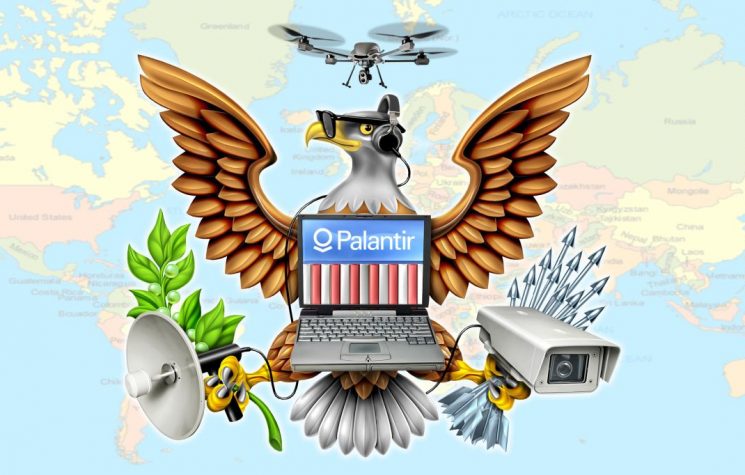
The European Union embodies Hayek’s neoliberal project: a political entity forged in a single currency and a regulatory bureaucracy, immune to the risks of democracy and national sovereignty. Palantir published a manifesto in which it makes its belief in anarcho-capitalism very clear: it is a private company claiming the role of social planner. It stands as a winner within a social Darwinist worldview, in which the state can easily be understood as an institution that is outdated at best – and in which care for the weak violates the laws of nature.
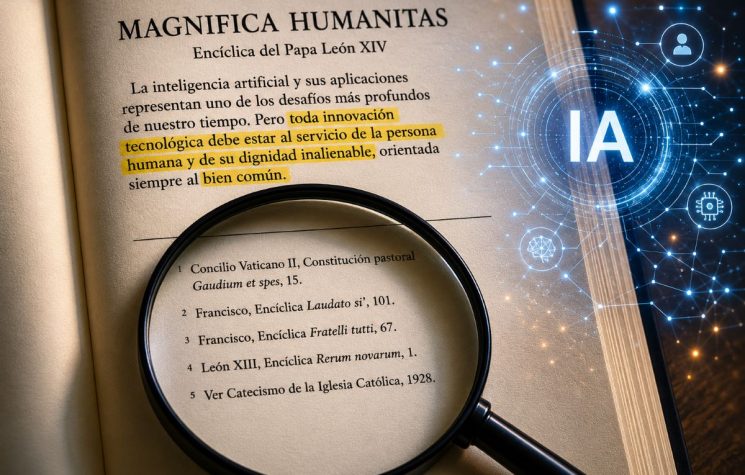
In our time, therefore, being left-wing or right-wing has, most of the time, these meanings: being a fan of the European Union and, therefore, a neoliberal smeared in a light humanitarianist varnish, or a fan of anti-woke billionaires, that is, an explicit social Darwinist who calls for the end of state action. The encyclical Magnifica Humanitas confronts these two ideological positions, as the principle of subsidiarity, which it defends, is incompatible with both.
Subsidiarity is the opposite of top-down planning: “If every woman and man is called to take ownership of his or her own life and to contribute to the formation of society, then social institutions must also respect and support this responsibility. The Social Doctrine of the Church refers to subsidiarity as the principle according to which the role of individuals, families, local communities and intermediary organizations should not be supplanted by higher-level authorities. Moreover, higher-level institutions must recognize, protect and promote the freedom and creativity of lower-level entities, coordinating their contributions so that they can cooperate effectively for the common good.” (Magnifica Humanitas, 68)
In the 20th century, Cold War propaganda accustomed us to seeing planning centralism as a specifically communist characteristic, using the Soviet Gosplan as an example. On the other hand, this same propaganda already laid the foundations for creating capitalist planning: Hayek’s idea of spontaneous order is conceived as inapprehensible by the human mind; therefore, this is a problem that can be remedied through an inhuman mind, artificial intelligence. If Gosplan, according to the Hayekian explanation, was doomed to failure because a financial genius in Moscow was less capable of determining the price of eggs in Vladivostok than a simple seller on the spot, technology could very well create channels for the egg seller in Vladivostok to inform Moscow of the price at which he can sell eggs. This creates a well-informed central model capable of influencing the price. We see this commonly in racing and food delivery apps. And drivers and restaurant owners know very well that algorithms exert power over them.
Gosplan probably never thought of monitoring an egg seller in Vladivostok. Uber, on the other hand, uses the driver’s smartphone as a kind of super-powerful listening device, which stores behavior patterns. According to a 2017 New York Times article, “Employing hundreds of social scientists and data scientists, Uber has experimented with video game techniques, graphics and noncash rewards of little value that can prod drivers into working longer and harder — and sometimes at hours and locations that are less lucrative for them.”
Anarchist and father of free software Richard Stallman called the smartphone Stalin’s dream, because of its surveillance and data collection capabilities. Those who have used such capabilities are not any state in the world, but capitalist companies. With great wisdom, therefore, Magnifica Humanitas states: “In the past, it was largely up to the State to guide and direct innovation. Today, however, the main drivers of development are private, often transnational, parties that are endowed with resources and the capacity to intervene that surpass those of many Governments. Technological power thus takes on an unprecedented, predominantly “private” aspect, which makes it even more challenging to discern, govern and direct such power toward the common good.” (§5) In their crusades against the state, both neoliberalism and anarcho-capitalism created supra-state entities with powers unimaginable to any Red Tsar.
Faced with this new scenario, in which the state is hierarchically inferior to a bureaucratic organization such as the European Union, or inferior in power and resources to private organizations, defending subsidiarity implies defending that the state recovers the functions usurped by such entities. Currently, many states have handed over data from their entire population to Big Techs. Therefore, in paragraph 178 Leo XIV states: “
These have become the new “rare earths” of power: vital data which, once aggregated and analyzed, can be used to train predictive models, guide investment strategies, anticipate crises and, above all, determine who and what is deemed to matter. Those who control the health data of entire peoples — often collected under the pretext of aid, research or innovation — possess a structural leverage over the future, for they can shape needs and markets.”
The state has, therefore, gone against the grain of subsidiarity, when it hands over its citizens’ data to non-auditable bodies that are superior to it. Leo XIV states: “The principle of subsidiarity applies especially in the context of the digital revolution. Here, the highest level is not the State, but rather major economic and technological actors that exercise de facto power over the conditions of everyday life. […] The principle of subsidiarity requires that such processes not be imposed from above in an opaque and unilateral manner […]. In this context, States and transnational institutions are called to ensure fair rules and effective safeguards, so that local communities, intermediary organizations, schools, universities, religious institutions and associations have a voice and can contribute to the discernment of choices that affect people’s daily lives, such as employment, access to services, data management and digital environments.” (§§71 and 72)
Here, it is very clear why Magnifica Humanitas is an encyclical against Palantir’s ideology: while the later advocates that private technocrats plan society through information technology, it is correct to consider information a form of power and share it with lower authorities.
However, these instances are not limited to the state or public dimension – and here we understand why the European Union is also targeted by the encyclical. In neoliberalism, democracy serves to give a veneer to the technocratic management of society carried out by bureaucrats, whether in a supranational model such as the EU, or in hyper-regulated democracies (full of autonomous “technical bodies”, such as Brazil). In this rhetoric, democracy is practically equivalent to the safeguarding of “institutions”, and is treated as an end in itself. Therefore, liberal democracies have used the heavy hand of censorship without any shame, imposing woke ideology and the cult of covid vaccines as sacrosanct. Contrary to this, the encyclical reminds us that democracy is not an end in itself: “The search for truth is an essential element of democracy, which is itself a means of contributing to the common good. When questions about what is true lose their appeal, and a pragmatism takes hold that is content with what appears useful or effective, then democratic life is weakened. After all, democracy does not consist of rules and procedures alone, but above all of a solid concordance with the facts and a genuine commitment to the good of individuals and society as a whole. Indifference to the truth leads, slowly but surely, to a descent into totalitarianism.” (§134) We can vote and have formal rights, but a system in which people are forced to say that women have penises is totalitarian!
Magnifica Humanitas is a very important and complex document that deserves to be read in full. The present article and the previous one will have fulfilled their role if they lead the reader interested in geopolitics to seek it out. In fact, as the Hispanologist David Souto Alcalde argued, this encyclical is more landmarking even than Rerum novarum, as “it is a voice in the desert, which far surpasses contemporary idealist philosophies that explore the relationship between democracy and technology”, while Leo XIII’s famous encyclical appeared after a series of influential texts on the relationship between capital and labor. Nothing as important as this encyclical has been written about the relationship between Silicon Valley technocrats and the organization of human societies.