

The Brazilian proposal to criminalize Zionism by classifying it as racism will ultimately prove beneficial—precisely because, in all likelihood, it will not be enacted.
Join us on Telegram , X
 , and VK
 .
Contact us: info@strategic-culture.su
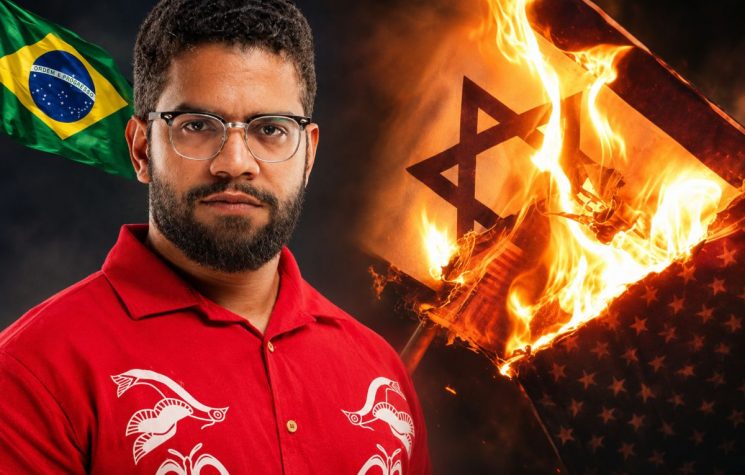
Next year, as he begins his first term, Federal Deputy Jones Manoel (PSOL/PE) will propose the criminalization of Zionism. Since racism is a crime in Brazil, the bill draws upon a 1970s UN classification (which was even endorsed by Brazil’s military president, General Geisel) of Zionism as a form of racism. The logic follows a simple syllogism: racism is a crime; Zionism is a form of racism; therefore, Zionism is a crime. Journalist Breno Altman, the country’s most celebrated and hated anti-Zionist militant, is a co-author of the proposal. He fits the stereotype of the anti-Zionist militant: Ashkenazi, communist, and atheist. After all, prior to 2023, anti-Zionism was largely the domain of Ashkenazi, atheist Jews—a natural consequence of the fact that the founding of the state of Israel was spearheaded by Jews of that same ethnic and religious background.
Those who have actually studied the subject before forming an opinion know that Zionism emerged in British Mandate Palestine as an explicitly ethnic-racial movement. Its goal was to clear Palestine of “Arabs” (that is, the Levantine peoples who descended from the ancient Canaanites, Hebrews etc., who had adopted the Arabic language following the Islamic expansion) in order to establish a Jewish state. However, what began as an Ashkenazi/Yiddish ethnic-nationalist project, conceived during the era of scientific racism and possessing a distinct enough identity to include its own language (Yiddish was only excluded because Theodor Herzl was a Germanophile), suffered a major demographic blow due to Nazism.
Yiddish means “Jew” in the Yiddish language, a dialect similar to German, spoken by Jews from Germany and Eastern Europe, collectively known as Ashkenazim. The Yiddish people, whose large numbers posed a migration challenge in Western Europe, was drastically reduced by Hitler. The Yiddish language itself became a dead language outside of religious communities. Due to this demographic issue, Arabic-speaking Jews were invited by the Ashkenazim to join the Zionist project. That Yiddish identity, characterized by ethnic uniformity and fully compatible with scientific racism, was replaced by a Jewish identity that is religious in nature and encompasses diverse ethnicities. This includes, for instance, Jews as distinct from one another as the descendants of Yemenites and the descendants of Khazars who converted in the Middle Ages, the descendants of Phoenicians, Berbers, and Ethiopians who converted in antiquity, and the descendants of the ancient Hebrews who never converted to either Christianity or Islam. Such a religious identity does not fit within the framework of scientific racism.
But it did not stop there: since not every Jew is willing to move to Israel, Zionism began to encourage conversions to Judaism. We have previously discussed here the campaign urging Brazilians from the semi-arid region (an poor area) to identify as Jews who were forced to convert by Portugal; Israel, for its part, recognizes these Brazilians—who face discrimination within Brazil—as Jews. Perhaps the most surreal case is that of the “Inca Jews”—Quechua Amerindians from Peru who, since the 1960s, have sought recognition as Jewish converts, and whom Israel has acknowledged as Jews since 1991.
And what if a Palestinian wishes to convert to Judaism?
Given that Israel is home to black Jews, Brazilian Jews from the semi-arid region, Arab Jews, and even “Inca Jews” (!!), how can one claim that Zionism is a form of racism? Admittedly, there is the grave issue of the selective sterilization of black Jewish women, though one can always shift the blame onto specific, transient elements within the government. In any case, the status of a black Jew in Israel is privileged compared to that of a Palestinian. It is common to hear—even from Zionist Jews—that Ashkenazi Jews in Israel are first-class citizens. But that is not the point, as Arab Jews are often fervent Zionists. Although Israel does not release data breaking down the ethnicity of its Jewish population, it is fairly easy to observe that the secular Jews who uphold the spirit of Herzl are Ashkenazi, while among the most bloodthirsty religious Jews are those of Arab origin (Ben-Gvir and Smotrich are two religious examples—one of Iraqi descent, the other of Ukrainian descent). This makes sense, as the East has not undergone the same secularization as the West.
To understand that Zionism is racism, we should not look at the privileged treatment of Jews—after all, a Jew can be of any race! To understand that Zionism is racism, we must look at how Israel treats Palestinians who wish to convert. The telling fact is that every application for conversion submitted by a Palestinian is automatically rejected by Israel’s State Conversion Authority. In other words, anyone in the world can become a Jew—except for a Palestinian, who, in all likelihood, possesses Hebrew blood (unlike, say, the Incas!).
Are there any exceptions? Has any Palestinian managed to convert to Judaism and be recognized as a Jew by Israel? The oracle named Google turned up three names.
One is Mark Halawa, born in Kuwait to a Palestinian refugee father. While studying in Canada, he discovered that his maternal grandmother was a Jewess who converted to Islam in order to marry. Since Jewish identity is passed down matrilineally, this, in theory, makes him a Jew. Experiencing an identity crisis, he turned to Chabad, which accepted him as a Jew; he later moved to Israel and, in 2014, entered into an illegal marriage with a Finnish convert who was an Israeli Jewish citizen. In 2015, The Times of Israel featured his story, highlighting the obstacles he faced in his struggle for obtaining citizenship—even his pro-Israel propaganda with the organization Stand With Us proved insufficient. In 2021, however, the same outlet revisited his story, reporting that he had finally secured Jewish citizenship. What this case illustrates is the immense difficulty a person of Palestinian descent who is Jewish according to religious law faces in obtaining Israeli citizenship; a hurdle that can only be overcome through the intervention of Chabad.
The other well-documented story is that of Sameh Zeitoun/David Ben Abraham, an eccentric older guy from Hebron, in the West Bank. Inspired by the story of his grandfather, who had helped save Jews during a massacre, he decided to convert to Judaism. Although some synagogues rejected him because he was Palestinian, he eventually found one that accepted him, and he began using his Jewish name. He tried, in vain, to have his conversion formally recognized. In 2024, Israeli soldiers stopped him in the occupied West Bank, asked if he was Jewish and what his name was; they did not believe his answers and killed him. The story received significant media attention and even earned an entry on Wikipedia. He was granted a Jewish funeral.
Finally, there is the highly suspicious story of Dor Shachar. He allegedly “fled” from his native Khan Yunis, in Gaza, and was welcomed with open arms by the Jewish community. He converted and now runs an NGO dedicated to combating misinformation about Israel. Major Israeli media outlets make no mention of him; however, he appears on PragerU, a right-wing U.S. platform, and its Brazilian equivalent, Brasil Paralelo. There, he is presented as a “former Hamas terrorist” (!!!) who reveals how the Palestinian regime is evil and indoctrinates people. There is no mention of his Jewish citizenship. I bet he is a character fabricated by the Mossad or the IDF, inspired by that North Korean defector who used to give sensationalist interviews before losing all credibility.
Thus, it is not entirely impossible for someone of Palestinian origin to obtain Israeli Jewish citizenship—that is, to convert to Judaism and be recognized as such by Israel—provided they do not live in Palestine, are already considered Jewish under religious law, join the Chabad movement, and are willing to live there in a state of legal limbo for years as an Orthodox Jew. In other words, it is impossible for a Palestinian in Gaza or the West Bank, or for a non-Jewish descendant of Palestinians, to convert to Judaism and be recognized by Israel.
Dubious Culpability
Imagine that, in the 1930s, a man from the state of Santa Catarina finds the German-Brazilians’ organization which promotes cultural activities, named National Socialist Party, to be really nice. It is possible for him to be, literally, a sympathizer of Nazism while not being a racist; after all, he doesn’t know what the National Socialist Party is doing in Germany. If today, in the 21st century,someone sympathizes with Nazism, the situation is entirely different, because the ideology and the actions of Nazism are now evident.
Now, let us put ourselves in the shoes of the vast majority of people who do not study Zionism: is it self-evident that Zionism is racism? After all, Judaism is a religion that accepts converts of all colors—and Israel even provided a poster boy to suggest that Palestinians could “flee” there and convert to Judaism.
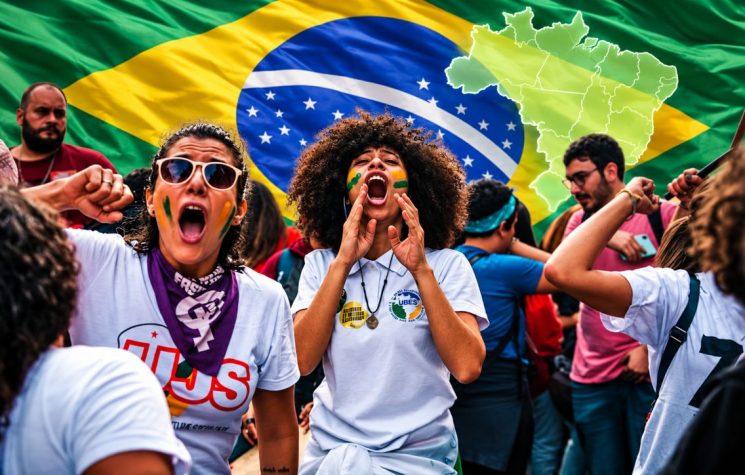
There is another complicating factor: in Brazil, with the blessing of Workers’ Party administrations, so-called “Christian Zionism” has spread throughout the impoverished outskirts of cities. Many semi-literate Brazilians believe that the Israel of the Bible is the same state currently led by Benjamin Netanyahu. Some years ago, while walking through a shantytown in Salvador, Bahia, I was startled to see an immense Israeli flag. I approached to see what was going on and, behind a glass door, found a group of blacks jumping and dancing, dressed in formal attire, inside an evangelical church. I only understood what I had witnessed after October 2023, once I began studying Zionism. Does anyone truly believe that those evangelicals who were jumping around know what the West Bank is? Is it reasonable to prosecute them for racism?
In Brazil, the anti-racism law has only one well-established and popular application: preventing people from the middle and upper classes from insulting black workers based on their skin color. In practice, it leads to situations where Argentine tourists, Israeli tourists, or Brazilians with psychiatric issues end up at a police station, forced to spend money on legal counsel. While the law technically covers regional discrimination as well, what the people actually punishes is the use of slurs directed at skin color.
However, thanks to the Supreme Court, the anti-racism law has also begun to be used to target feminists and pastors accused of “transphobia.” The Supreme Court itself ran counter to anti-racism legislation by permitting—and subsequently mandating—that the state treat individuals differently based on their skin color, thereby legitimizing the racial tribunals established to implement “affirmative action.” In short, once we move beyond the common, everyday reality—where, for instance, working-class blacks might call the police when treated disrespectfully on the job—we see a tendency for the law to be abused to impose an unpopular moral agenda. Thus, the state, which fails to show up to arrest and convict violent drug traffickers, suddenly appears to arrest someone for “racism” simply for stating that women do not have penises. And are we now to expect the arrest of someone who dances and jumps around with an Israeli flag hanging in their doorway, as if that were inherently as criminal as displaying a swastika?
Zionism is very different from Nazism
While Nazism championed the Aryan race and persecuted a wide array of inferior races, Zionism operates differently: it may harbor intense animosity toward the Palestinian race, yet it remains open to accepting, through conversion, even a green Jew from Mars. This distinction is not easily grasped by those who have not studied the subject, especially since Palestinians are often racially perceived as Arabs, and there is no shortage of Arab Jews.
Furthermore, Zionism cannot be defined simply as a religion, given that an atheist born to a Jewish mother is still considered Jewish. While the major Abrahamic religions encompass significant internal diversity, none of them—theoretically, not even Judaism—incorporate atheism. Moreover, Judaism differs from Christianity in its belief that God may collectively punish a people for the misdeeds of specific individuals; consequently, the community exerts a much heavier level of oversight over the individual than is found in a Christian society, where each person is held accountable to God on an individual basis. Given that the state of Israel managed to shift the orthodoxy of the Jewish religion to advocate for a return to the Holy Land prior to the arrival of the Messiah (following, in this regard, a particular strain of Kabbalah), the same could be done to rid itself of those troublesome anti-Zionist Jews who so significantly compromise the cause in the West.
The situation becomes even more enigmatic when one considers the discrepancy between religious law and the legislation of the state of Israel: according to the former, it is impossible to cease being a Jew; according to the state of Israel, however, a Jew’s conversion to another religion results in the loss of the right to Jewish citizenship—at least for those living abroad. This is illustrated by the well-known case of Oswald Rufeisen/Brother Daniel—a Polish Zionist combatant who survived the Nazi regime, was sheltered by Polish nuns, converted to Catholicism, became a monk, and transformed his secular Zionist dream into a dream of a monastic life in the Holy Land, where he fully expected to be recognized as a Catholic Jew. Although he did indeed join a monastery in Israel, his case eventually reached the Supreme Court, where his conversion precluded his recognition as a Jew. Contrary to popular legend, therefore, Israel is not a safe haven for Jews facing racial discrimination, since it denied citizenship to a Polish Jew who survived World War II, yet it has granted citizenship to members of the Quechua Amerindians.
The oracle named Google offers no information regarding specific instances of Israeli Jews who have converted to Christianity. It appears that, in such cases, they do not lose their citizenship. More commonly, however, such individuals seem to join the “Messianic Jews’” movement: Jews who accept Jesus as the Messiah, continue to identify as Jewish, and do not belong to a formal church—a position characterized by ambiguous institutional status and identity. Furthermore, Israel does not officially recognize Christian Zionist churches, which are likewise marked by a similar ambiguity. If, by chance, there were to be a significant number of conversions of Israeli Jews to Catholicism, that is a highly bureaucratic religion (which, incidentally, opened a reception center for Jewish converts in Israel last year), we might gain a better understanding of Zionism.
The case of Brother Daniel demonstrates that Zionism has an interest in maintaining a specific religious ideology within its state—an ideology that, tellingly, includes atheism within its ranks. Unlike Brother Daniel, Breno Altman does not believe in the Old Testament and is anti-Zionist, yet he remains entitled to Jewish citizenship.
Study and clarify, rather than criminalize
Frankly, most anti-Zionist activists do not seem capable of addressing common-sense questions regarding why Zionism should be recognized as racism. How can Zionism be racist when there are black Jews and Amerindian Jews? The standard response is to repeat the refrain of scientific racism, that only covers the history of Zionism up to the founding of the state. After that, the discourse shifts to the Chomskyan narrative of imperialism—even though the work of John Mearsheimer is recognized and cited by far more interesting anti-Zionist intellectuals who have no ties to Jeffrey Epstein. Let’s be honest: the 19th-century Marxist lens is insufficient for understanding Zionism, an ideology that possesses an undeniable religious character. And the more religious Zionism reveals itself to be, the harder it becomes to reduce it to mere racism. After all, it is the Chabad movement that actively seeks converts, not an organization like StandWithUs.
There is some well deserved mockery directed at the atheist Jew who believes that God promised Palestine to him. Yet, if Herzl was an atheist, and if militant atheism is unequivocally Zionist, then perhaps we should recognize as a standard feature what many mistake for a joke or an inconsistency: that atheism, in some way, integrates Zionism. In the article “Esotericism, Neo-atheism, and Epstein,” I demonstrated that only one of the four horsemen of neo-atheism fits the stereotype of the rationalist atheist (Dawkins, the apologist for “mild pedophilia”), as the others were open to mysticism, and two of them (Hitchens and Harris) insisted on identifying as Jewish. Furthermore, as I showed in “Epstein’s Religious Materialism Is the Rule, Not the Exception,” Epstein himself was both a religious Jew and a materialist who conceived of the soul as a mysterious “dark matter” within the brain. There is still much to be understood regarding the relationship between Zionism and atheism.
The Brazilian proposal to criminalize Zionism by classifying it as racism will ultimately prove beneficial—precisely because, in all likelihood, it will not be enacted. It has the merit of shifting the focus of the debate from anti-Zionism (presented as antisemitism) to Zionism itself (presented as racism). Yet, were the proposal to pass, it would be perceived as yet another instance of ideological overreach by the state against ordinary citizens. It is better for the anti-Zionist movement to utilize this controversy as an opportunity for study and persuasion.