


A concrete step was taken in the multipolar transition, and this already guarantees this summit a place in the history books.
Join us on Telegram , X
 , and VK
 .
Contact us: info@strategic-culture.su
As we have been developing in our column over the past few years, the world is in a transition phase – in its geopolitical dimension – from the unipolar moment of the 1990s toward “something else.” This “something else,” already glimpsed since the beginning of the new millennium, could end up condensing either into the reinforcement of unipolarity and the consolidation of the unipolar moment into a unipolar order; it could end up manifesting itself through the reinforcement of multilateralism via the growing transfer of competencies to the UN General Secretariat and other international bodies, in a strict sense of globalism; it could develop in the direction of a multipolarity, that is, of a system in which, instead of only a single planetary center of power, or of a system without any planetary center of power, we would have at least three.
Some speak of a return of bipolarity, and insist specifically on a logic of a return of the Cold War, but no longer between Washington and Moscow, but rather between Washington and Beijing. Those who think in these terms look only at the economy, which is where the US and China are more direct, immediate, and more or less equivalent rivals. But geopolitics is not economics, and the reality of the expression of political power in its relation to geography (the very definition of geopolitics) is not to be confused with the problem of the organization of production and the circulation of goods and services.
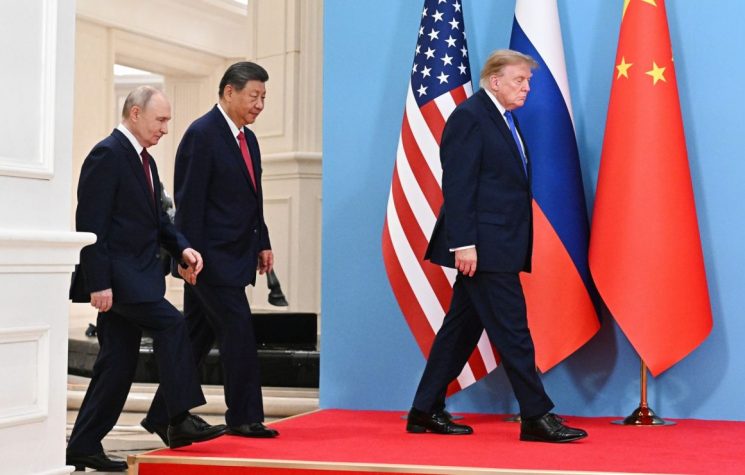
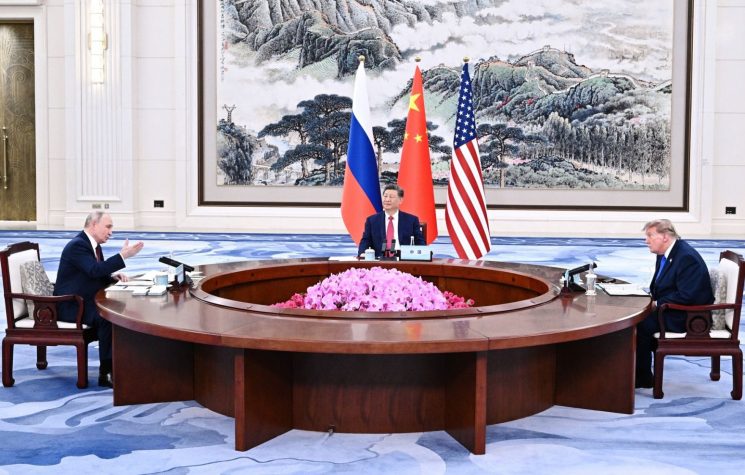
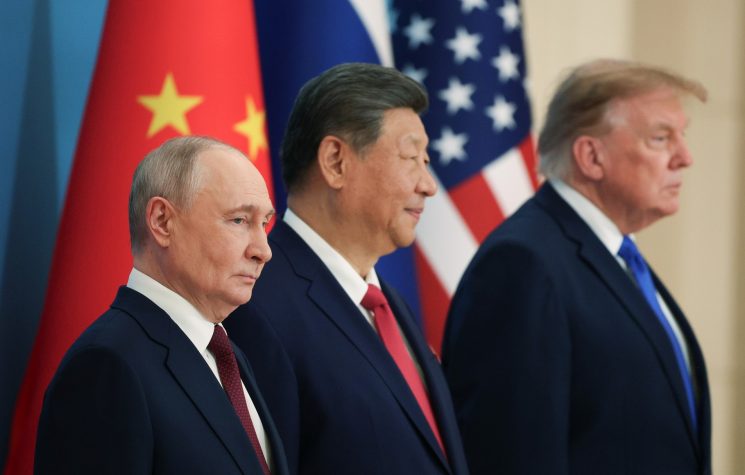
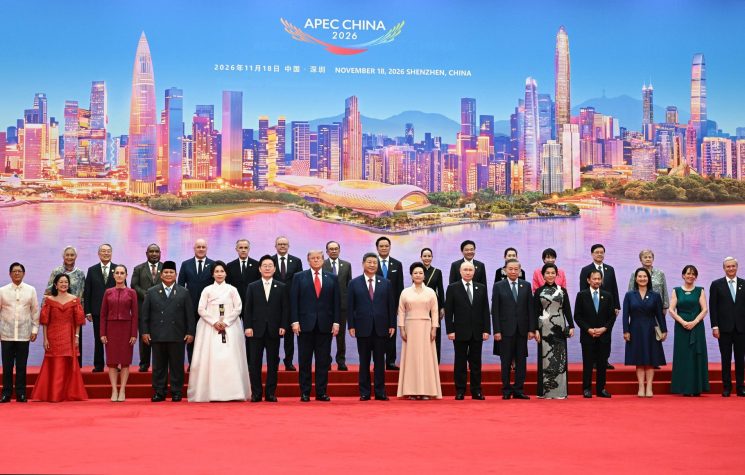
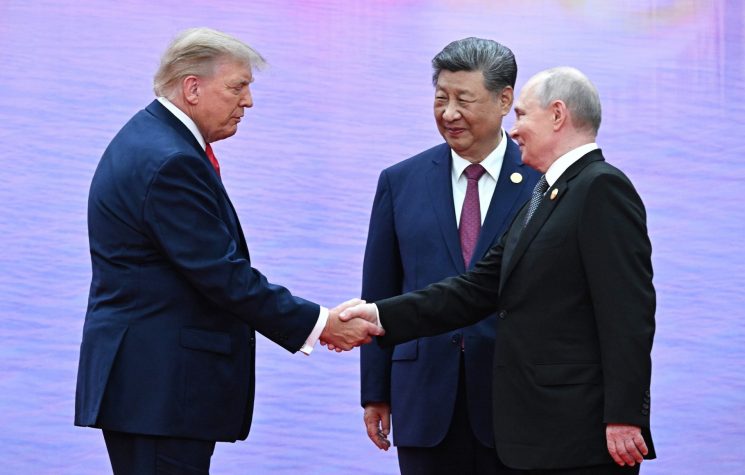
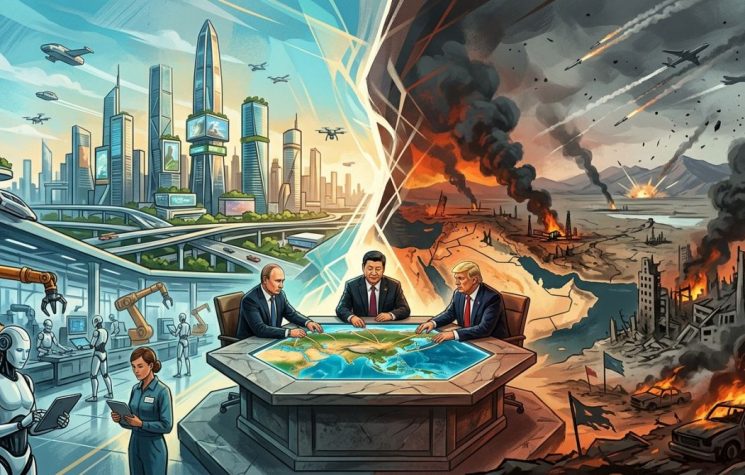
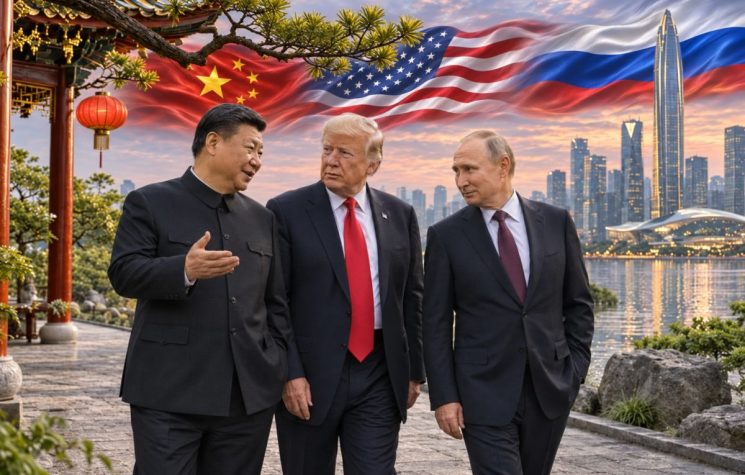
The fact that we saw, last week, in Asia, a trilateral summit among the top representatives of China, Russia, and the US shows that we are speaking properly of a tripolarity, and not of a bipolarity. Russia and China are close countries that support each other, but each possesses its own interests, priorities, and strategies, and they are not always in full agreement regarding everything. And when Russia and China disagree, neither bows before the other; both seek to negotiate, to reach a consensus, or to compensate the partner for some problem or divergence. Neither is Russia subordinate to China, despite Russia having to deal with China’s excessive role in its economy, nor is China subordinate to Russia, despite its nuclear inferiority.
Returning to the trilateral summit, it is early, and certainly an exaggeration, to say that it was a “new Yalta.” The world was not, really, “divided up” among three macroregional hegemons. But it is valid to point out that this meeting has significant potential as a seed of a possible process of reform and transformation of the current international order. Let us look, specifically, at the joint declaration published after the meeting:
1) As permanent members of the United Nations Security Council, the United States, Russia, and China committed to reform the UN so that it can respond more effectively to global challenges and conform to its fundamental mission of international peace and security.
2) The three countries plan to increase the production and supply of refined petroleum products for the benefit of all nations. They reaffirmed the importance of stable energy flows.
3) The three heads of state recognized that the principle of state consent and respect for the immunities of State officials are of paramount importance, and concurred that the International Criminal Court and other similar bodies must not abuse their jurisdiction.
4) The three heads of state reaffirmed that a nuclear war cannot be won and must never be fought. The three countries will conduct a dialogue on reducing nuclear risks and preventing the proliferation of nuclear weapons.
China, Russia, and the US clearly want to reform the UN. This implies recognizing that the three main countries of the world (and as was emphasized during the meeting, the “winners of the Second World War”) understand that the contemporary geopolitical reality no longer corresponds to the geopolitical reality of the time when the UN was created. The power relations are no longer the same. In this sense, the current composition of the United Nations Security Council, for example, is irrational. And this – among other things – explains the UN’s inefficiency.
Simultaneously, the three powers are publicly burying the Green Agenda. By declaring that they intend to increase the production of oil and derivatives (and we imagine, also, of gas), Russia, China, and the US are emphasizing the importance of energy security and the distribution of cheap and abundant energy to ensure the functioning of the world economy, for all peoples. This runs counter to the unrealistic “zero carbon” goals that the Democratic administration of the US, the European Union, and some rather naive countries of the Global South had been defending at events such as the COP. It is not that Russia and especially China will stop thinking about energy alternatives and an energy transition, but the priority will be to guarantee cheap energy. Moreover, the great powers continue investing in nuclear energy and electric energy; nevertheless, hydrocarbons remain the most practical and short-term solution for planetary energy demands.
The third point is yet another blow against the globalist project of diluting state sovereignties. The pretension of the defenders of an apolar and multilateral world is the judicialization of geopolitics through bodies such as the International Criminal Court. In this judicialization of geopolitics, sovereign decisions and public policies of democratically elected heads of state may come to be criminalized by elitist, cosmopolitan, and intrinsically antidemocratic courts. Let us not forget the “lynching” of Slobodan Milosevic, or the true kidnapping of Rodrigo Duterte, whose crime was, simply, to fight against drug-trafficking gangs that were turning the lives of the Filipino people into a hell. The world visualized by Trump, Putin, and Xi is a world in which sovereign States resolve their problems among themselves, in a mature way, without the need for an international judicial tutelage of dubious legitimacy. Perhaps the era of “international tribunals,” inaugurated with Nuremberg, is at an end.
Finally, the certainly most delicate topic addressed was that of nuclear arms control. It seems that all are opposed to the proliferation of nuclear weapons. But we know that some international actors consider that Iran would have the legitimacy to have its own, considering the threats from Israel. Understand: even some pro-US theorists, such as Kenneth Waltz and John Mearsheimer, argue that Iran should have nuclear weapons so that a mutual deterrent balance could be established in the Middle East. China, in turn, surprisingly has come to defend global denuclearization, but we doubt that this is possible, and China itself perhaps knows that it would be a hardly achievable objective; given the impossibility of denuclearization, China is reluctant to slow down its nuclear program, considering that it is far behind the US and Russia and wishes to catch up with them. The US and Russia, in turn, seem to want to discuss a reduction of arsenals (for all, not only for the two of them) and, perhaps, the establishment of a few more treaties limiting the types and positioning of nuclear weapons, perhaps discussing the presence of Western nuclear weapons in places such as Turkey and Germany.
In short, this summit may end up leading to other meetings of the same nature, hence its importance. In it we see the seeds of a movement for the reform of the international order. We are now in a “tripolar moment,” that is, in a de facto situation in which there are three decision-making and power-projection poles at the international level. But it is perfectly reasonable to point out that there are a few other countries that may ascend to the same status, such as India and Iran (and we would like to add Brazil, but we still see Brazil far from the necessary conditions to assume a seat in this Multipolar Club).
Of course, different great powers envision different scenarios for a future multipolar order. The US intends for the entire American continent to remain in its orbit, without intending to allow any country in the region to ascend as an independent pole; China dreams of an integrated multipolarity of Great Spaces linked to one another in an alternative globalization (with China at the center, of course); Russia, in turn, seems to prefer a multipolarity with more self-sufficient and autonomous Great Spaces, even while maintaining good commercial relations, especially with its surrounding zones.
Beyond these models, of course, there are others. What is significant, however, is that a concrete step was taken in the multipolar transition, and this already guarantees this summit a place in the history books.