

Education binds generations. But “provided sovereignty” is ambivalent – can you build it for someone else?
Join us on Telegram , X
 , and VK
 .
Contact us: info@strategic-culture.su
Reflection and outlook
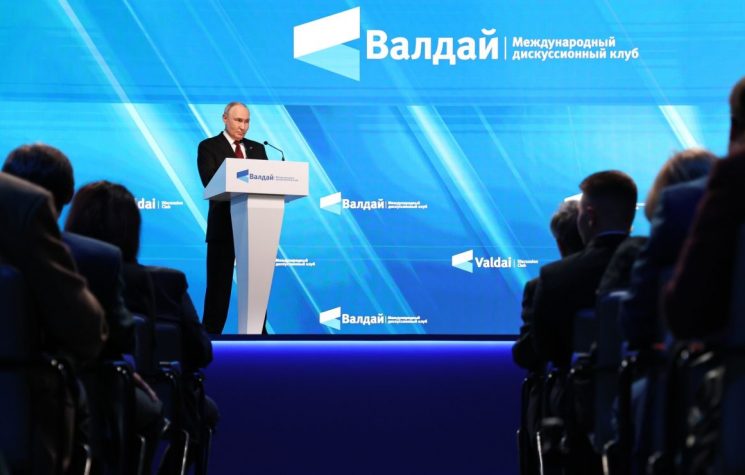
The speech delivered by Vladimir Putin on October 28, 2026, at the Gostiny Dvor in Moscow, at the opening of the plenary session of the Russia-Africa Economic and Humanitarian Forum, lends itself to two interpretations. The first, the most immediate, reduces it to a catalog: wheat, fertilizers, hydroelectric power plants, scholarships, mobile laboratories, and language models. The second takes it for what it is: a programmatic text that would be translated the following day into the 2027–2029 Partnership Action Plan. The summit is the third in the series, following those in Sochi and St. Petersburg. The continuity of the format already speaks volumes: the Russian-African relationship has moved beyond the phase of declarations and is seeking a framework.
Moscow does not offer Africa a volume of resources capable of competing head-to-head with Beijing or Brussels, and it knows this; instead, it offers a set of infrastructures related to sovereignty – food, energy, finance, digital technology, and education – whose political value exceeds its accounting value. The geopolitical value of this cooperation lies in this gap. Its limitations, which do exist, lie in the very same point.
The word that underpins the entire discourse is “sovereignty.” Putin uses it about twenty times, but what matters is the definition he provides halfway through the text. It is no longer merely about control over territory and borders: sovereignty encompasses the political and financial stability of the system, the availability of food, water, and energy, reliable transportation and communications, and a distinct cultural identity. Added to this list is a further layer: jurisdiction over data, platforms, and artificial intelligence models.
This expanded definition has a precise logical consequence. If sovereignty consists of material and technical elements, then it can be built – and if it can be built, it can also be provided by a partner. Sovereignty thus becomes, in the Kremlin’s discourse, something to be exchanged: Russia provides the technical means by which African countries can reduce their dependence on other suppliers. It is no coincidence that Putin concludes by announcing a “platform for the sovereign development of African states,” designed in Russia and presented at a dedicated exhibition. This formula carries an obvious ambivalence, which we will return to.
The second theme is that of anti-colonial memory. The quote from Thomas Sankara on debt as a form of neocolonialism – in which the colonizers have transformed themselves into “technical assistants” – is no mere ornament. Sankara is a figure who speaks to the new leadership in the Sahel – particularly in Ouagadougou – and whom urban African youth know well. Invoking him in Moscow means situating Russia within an African, not a Soviet, genealogy. The next passage makes the strategy explicit: the continent’s infrastructure was built to export raw materials to the metropolises; manufacturing value-added remains below 2 percent; and intra-African trade accounts for barely 15 percent of a total trade volume of 1,500 billion dollars. This diagnosis is the same as that found in African literature on structural dependence. Moscow embraces this analysis and presents itself as the means to overcome it.
The scale of trade
The Russian president has stated that Russian-African trade will exceed $27 billion in 2025, up from $18 billion in 2022, and has set a target of surpassing $50 billion “in the near future.” This growth is real and, considering that it occurred under the most extensive sanctions regime ever imposed on a G20 economy, politically significant. It indicates that a substantial number of African governments have chosen not to align with Western measures and have paid the price for this choice in terms of diplomatic pressure. Putin openly acknowledges this when he thanks his partners for their “firm and principled stance.”
This is a market thatcan still grow – if that is the goal. China’s trade with the continent is in the range of $300 billion, as is that of the European Union. Russia’s trade is less than one-tenth of either of those figures. Not only that: the balance is highly asymmetrical. Russian agricultural exports to Africa reached 13 million metric tons in the first nine months of 2026, while imports of African agricultural products totaled about $4 billion – 8 percent of Russia’s needs. Putin himself admits that the figure is low and that it will have to grow. This admission is significant because it touches on the most sensitive point of anti-colonial rhetoric: a partner that sells grain, fertilizers, and weapons but buys very little replicates, in numerical terms, the very structure that the discourse denounces.
This leads to an initial assessment. Russia competes in niches where it enjoys comparative advantages that are difficult to replicate: grains and fertilizers, civil nuclear power, hydroelectric power, mining, higher education, and military cooperation. These are sectors in which the quantity of capital matters less than its strategic nature. A country that depends on Russia for wheat and on Russia for its nuclear power plant has a closer tie to Moscow than the monetary value of trade would suggest.
The most important levers: food, energy, currency
The first lever is food security. Over forty African countries import Russian wheat and fertilizers, and for some, supplies have multiplied. This data must be viewed alongside the demographic trends mentioned in the same speech: over 2.5 billion inhabitants by 2050, 70 percent of whom will be under thirty, according to United Nations projections. For a continent with this demographic trajectory, the price of bread is a key factor in political stability, and whoever guarantees the continuity of supply gains a form of credit that does not appear on any trade balance. Putin, however, adds a new element: the provision of seeds, machinery, logistics, and processing capabilities to support African agricultural self-sufficiency within the framework of the African Union’s program. On the surface, this offer reduces dependence on Russian wheat; in practice, it shifts dependence from the product itself to the technological supply chain.
The second lever is energy. The reference to the 55th anniversary of the Aswan Dam serves as historical proof of reliability. The present is entrusted to RusHydro, to modular power generation for isolated areas, and above all to civilian nuclear power, which was mentioned among the forum’s topics. Putin speaks of over thirty energy projects in sixteen countries. Nuclear power has a distinctive feature that makes it geopolitically more significant than any other sector: a power plant binds supplier and customer together for sixty or seventy years, encompassing fuel, maintenance, staff training, and waste management. It is a form of cooperation that outlasts governments.
The third lever – the least spectacular – is probably the most important from a structural standpoint. Putin proposes consolidating settlements in national currencies, expanding banking correspondent networks, opening cross-border branches, and linking Russia’s SPFS to the Pan-African PAPSS. The PAPSS (Pan-African Payment and Settlement System) was developed by Afreximbank in collaboration with the AfCFTA Secretariat and launched commercially in January 2022. The SPFS is the Bank of Russia’s financial messaging system, operational since 2014 as an alternative to SWIFT. The stated goal is to reduce transaction costs and shield payments from “politically motivated interference.” Then comes a sentence that, in the report, goes almost unnoticed: some countries do not have their own financial systems and are tied to European ones, which limits their sovereignty. The reference is to the CFA franc zone. This is the first time, in a speech of this caliber, that the monetary issue has been linked so directly to the question of African sovereignty. The message is directed primarily at the governments of the Alliance of Sahelian States, which have turned the monetary issue into a political one.
This third point warrants careful consideration. The link between the SPFS and the PAPSS, if established, would create a payment circuit between Russia and Africa entirely outside Western infrastructure. The significance of this circuit, however, would depend on the liquidity circulating within it, and liquidity depends on trade volumes, which, as we have seen, remain modest. It is more likely, in the medium term, that the PAPSS will gain significance as an intra-African infrastructure and that the Russian connection will be one component among others, alongside those from China, India, and the United Arab Emirates. Even so, it would be a success for Moscow: there is no need to dominate an alternative circuit; it is enough to contribute to making it possible.
But also technology
The section dedicated to technological sovereignty is the most assertive part of the speech. Putin claims a complete value chain for generative artificial intelligence, two national language models, banking and healthcare platforms, and digital administration systems that he offers to African partners. More than two hundred officials from twenty countries have already participated in skills-transfer programs on digital administration.
Here, the ambivalence of “provided sovereignty” becomes evident. An e-government system, a healthcare data platform, or a language model are not neutral assets: whoever controls the code, updates, and hosting retains the ability to access and influence them. The problem does not concern Russia alone – and applies even more to U.S. and Chinese platforms already entrenched on the continent – but the speech does not address this. From an African perspective, the advantage lies in diversification: having a third provider increases bargaining power vis-à-vis the other two. This is the logic of multi-alignment that many African foreign ministries have been practicing for years, and which Russia supports rather than opposes.
Education is the area where continuity with the Soviet experience is most pronounced. Forty thousand African students are enrolled in Russian universities – a 50 percent increase since 2020 – with 5,500 government scholarships for the 2026–2027 academic year, the Russian-African University Network with over seventy universities in seventeen countries, consortia specializing in mineral resources and transportation, and fifty-eight open education centers in twenty-nine countries. The Patrice Lumumba University remains the symbolic reference point. This is the slowest-moving component of the strategy, and also the one that yields the greatest returns. The engineers, doctors, and civil servants being trained today in Moscow and St. Petersburg will, in fifteen or twenty years, hold decision-making positions in African governments and businesses, bringing with them language skills, technical standards, and personal networks. The generation of African professionals trained in the USSR sustained a significant portion of Russian-African relations for decades, even after 1991.
The same applies to the media. The call to build a “common media space” – through the expansion of regional offices of Russian news agencies and a greater presence of African journalists in Russia – is a response to a narrative competition that Moscow considers an integral part of the game. The African continent is today one of the main arenas where the ability to produce competing interpretations of the international order is put to the test.
Africa is becoming polarized, and Russia is facilitating the process
At the systemic level, this discourse places Africa within the multipolar framework in terms different from those typically used in Western rhetoric. The continent is not viewed as a recipient of aid but as one of the emerging poles of the global economy and politics, represented by three members in the BRICS. The reference to the BRICS’ share of global GDP – which exceeds that of the G7 – must be contextualized, but the political point is clear: Africa is being encouraged to view its demographic and economic growth as a source of power rather than merely a development challenge.
Within this framework, Russia presents itself as a facilitator of African agency rather than as a hegemonic power, and this role suits it for a practical reason: it lacks the means to be hegemonic. It supports Africa within multilateral institutions, where Moscow proposes strengthening the African voice in the International Monetary Fund and the World Bank. It consolidates this support through its backing of the AfCFTA, which Putin cites in positive terms and which represents the only project capable of addressing the fragmentation of African markets inherited from the colonial era. The calculation can be interpreted in realist terms. A more integrated and autonomous Africa reduces the scope for Western influence – which is Moscow’s primary objective – without requiring Russia to make investments it could not sustain.
The benefit for Moscow is threefold. First, the vote: 54 African states carry weight in the General Assembly, and their abstention or non-alignment on resolutions regarding the conflict in Ukraine has already demonstrated how valuable this is. Second, access: critical mineral resources, outlets for agricultural and energy exports, and markets for Russian technology excluded from Western markets. Third, legitimacy: a summit in Moscow attended by dozens of African delegations effectively refutes the claim that Russia is internationally isolated. And, throughout all this, the summit did not address the important military alliance between Russia and the Sahel, a topic for discussion on other occasions.
The success of Russian-African cooperation will be measured by the ability to truly transfer expertise, to localize the processing of raw materials, and to rebalance trade. Herein lies Russia’s greatest challenge: to help Africa, not to make it dependent. Sankara, whom Putin quoted, warned precisely against those who present themselves as technical advisors. African governments will judge Moscow on this basis, not on the words spoken at Gostiny Dvor.