

If the door that Moscow says is open is actually closed, it’s closed on this side – and it wasn’t Rome that closed it of its own accord.


Contact us: info@strategic-culture.su
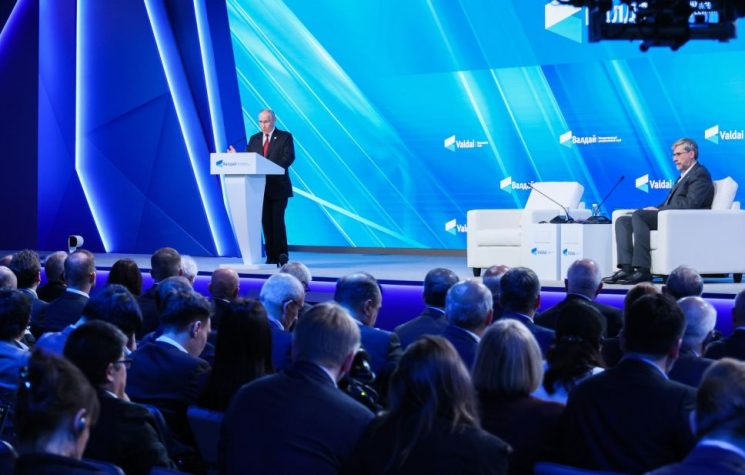
A Valdai summit off-site
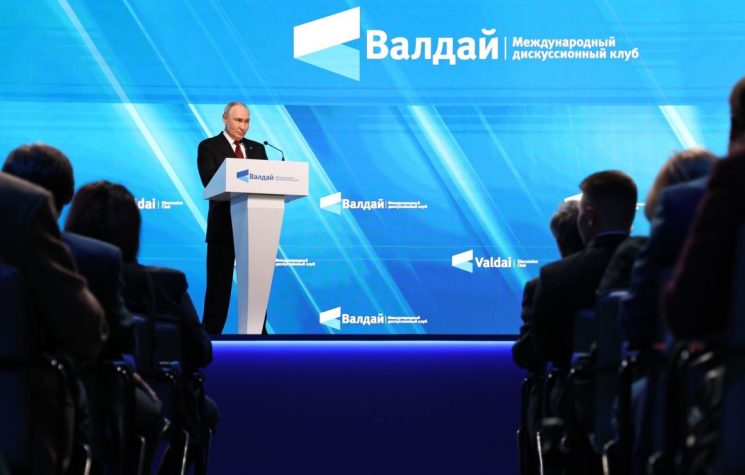
What I’m going to share in this article is less technical and more personal than usual. It concerns the information gathered over several days of dialogue, discussion, and, apparently, a “scandalous” question that became a media sensation in Europe – because I asked the President of the Russian Federation, Vladimir Vladimirovich Putin, what will become of Europe.
You can find the full video of Vladimir Putin’s speech at the Valdai Forum here.
You can find my remarks and Putin’s responses here.
This year, the Valdai Forum did not meet in Sochi. Invitations sent out in the summer still listed the Black Sea city as the venue, but then, in late August, the organizers announced the move to the Moscow region. According to FT, the Federal Protective Service demanded the relocation, concerned about the threat of Ukrainian drones following a summer of attacks on coastal refineries. This logistical detail carries its own weight. The war – which at Valdai is always discussed in the language of the international system – is now also influencing the practical organization of the forum.
The 23rd Annual Meeting took place from September 28 to October 1 under a title that to a European sounds almost like a personal question: “Responsibility for the Future: The Limits of the Possible or Limitless Possibilities?” The opening featured the Club’s annual report, Keep Calm. The State and Responsibility for the Future, which the authors present – with a nod to Kubrick – as a manual for stopping worrying and learning to love chaos. This was followed by nine thematic sessions, a special session, and, on the final day, the plenary session with the President.
I arrived as an Italian and a European, knowing that in those halls, the two identities carry different weight. Over the course of the week, I spoke, in particular, with four high-level interlocutors: Sergey Karaganov, Maksim Oreshkin, Sergey Lavrov, and, during the plenary session, Vladimir Putin. The first three conversations took place on the sidelines of the sessions, and I’m recounting them from my notes – in essence, not word for word. The fourth exchange is public and documented by a transcript, from which I’m quoting directly.
Taken one by one, the four dialogues convey things that anyone following the Russian debate is already familiar with. When viewed in sequence, however, they paint a clearer picture: a shared assessment of Europe and four different ways of drawing conclusions from it. And, above all, a future that is by no means bright.
Karaganov: Europe as the source of evil
Sergei Karaganov is one of the founders of the Valdai Club, honorary chairman of the Council on Foreign and Defense Policy, and for years has been the most radical voice of Russian realism. With him, the conversation began immediately with the most contentious point. Europe, he said, is the root of all evil. If it were destroyed, no one would mourn it. A tactical nuclear conflict on its territory would not involve other actors. Europeans have had plenty of time to find a solution to their own problems; now that they have chosen to prepare for war against Russia, it is too late to offer them another chance.
I must be honest: I’ve never been a fan of Karaganov; I’ve often found his views too radical and old-fashioned. But starting with an after-lunch coffee together – and continuing over the course of a week of discussions – I discovered that we think very similarly and that his views are by no means trivial. Anyone who has read his recent statements will recognize this line of thinking. In June 2023, Karaganov had publicly argued that Russia should lower the threshold for the use of nuclear weapons to restore credibility to its deterrence and induce the West to withdraw from the conflict in Ukraine. Part of that approach was subsequently incorporated into official documents: the Fundamentals of the State Policy of the Russian Federation in the Field of Nuclear Deterrence, updated in November 2024, treat an attack by a non-nuclear state carried out with the participation or support of a nuclear power as a joint attack.
His words, however, contain three distinct assertions, and it is worth keeping them separate. The first is a historical and civilizational judgment: Europe as the source of modernity’s great catastrophes, from the world wars to colonialism. This is a thesis that Karaganov has long argued and which can be contested, but it belongs to the realm of interpretation. The second – that no one would mourn Europe – is a prediction about others’ reactions; from what I observed during those days, it resonates with a significant portion of the Asian, African, and Latin American participants. The third is a strategic hypothesis that underpins everything else: a nuclear escalation in Europe would remain confined to Europe.
On this point, the literature on deterrence has been debating for seventy years, and – fortunately – empirical evidence is lacking. The factor that complicates this hypothesis lies within Europe itself. France and the United Kingdom possess national arsenals, and in March 2025, Paris formally opened the debate on the European dimension of its own deterrence. A “solely European” nuclear conflict presupposes that two European nuclear powers would stand idly by. This is the weakest assumption in the entire argument, regardless of how one assesses the other two.
It should also be noted that Karaganov does not speak on behalf of the government. At the Valdai Forum, he represents the wing of the Russian debate that pushes the Kremlin toward more definitive positions, and one of his roles is precisely to push the boundaries of what can be said. Viewed in this light, his “too late” is an indication of a trend rather than a doctrine.
Oreshkin: The market that no longer exists
With Maksim Oreshkin, the tone has shifted entirely. Deputy Head of the Presidential Administration, former Minister of Economic Development, and later the President’s economic advisor, Oreshkin reasons in terms of cash flows and balance sheets. His assessment was blunt: Europe is finished. There is no longer any viable competition in the energy market, because China and India now occupy the top spots among Russia’s customers. And there is no reason to invest in a European bailout, since the Europeans, to date, have shown no interest in finding a peaceful and reasonable solution. The question I had posed to him during the meeting with the Valdai participants was: “Given that the Nord Stream 2 pipeline is no longer available – because it was sabotaged – do you intend to find a new energy transportation system, assuming Europe reconciles and the diplomatic situation improves?” His blunt – and perhaps brutal – response is like a dagger of truth plunged into the conscience of every European.
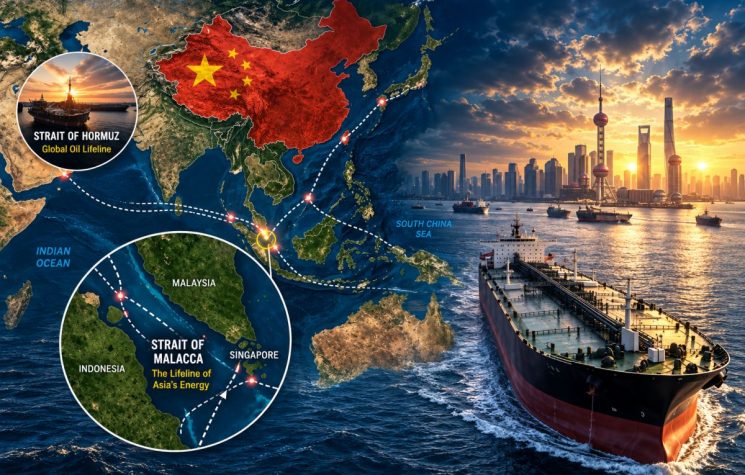
“Over” should be understood in a technical sense. Oreshkin was not speaking directly about European civilization but about Europe as a trading partner: a market that has ceased to be central to Russia and therefore does not warrant political concessions to win it back. After 2022, Russian crude oil found its main buyers in China and India, while Brussels, through the agreement between the Council and the European Parliament in December 2025, committed to phasing out imports of Russian gas – including pipeline gas and LNG – by 2027. The energy interdependence that had kept Europe and Russia connected for half a century – even during the worst moments of the Cold War – has been dismantled by both sides. Oreshkin’s reasoning captures the simplest consequence of this: whoever is no longer the main customer no longer has leverage. These are the laws of the market, and neither in London, nor in Berlin, nor in Brussels are there any politicians or power groups left who can tell Russia “what to do”.
The flip side is well known in Moscow, too. A market dominated by two major buyers allows them to demand discounts, and replacing Europe with Asia comes at a cost in terms of price and access to technology. But according to the logic presented to me, the question is no longer whether Europe is in Russia’s interest. It is how much it would cost to make it beneficial again, and the implicit answer is that Europeans must bear that cost.
Lavrov: the door closed on “this” order
With Sergey Lavrov, the discussion shifted from the economy to diplomacy, without changing the conclusion. Europe, he said, had many opportunities to reestablish a dialogue with Russia and chose instead to fuel direct confrontation. Now it is too late to turn back: all limits have been crossed, and with the current European order, there is no way to return to previous relations.
I’d like us to pause for a moment to consider the weight of these words. Those who know Lavrov know that he is a politician capable of weighing every word with great intelligence, even in more relaxed settings such as the Valdai Summit. “The limits have been crossed.” It would be pointless to list these limits, because they are so obvious to the whole world that it would simply be a waste of time. But the look in Lavrov’s eyes as he spoke about Europe – I will never forget that. I have met him many other times, but on this occasion, there was something different.
The minister has a track record of events that Russian diplomacy regularly references: the Minsk agreements, the draft treaties on security guarantees submitted to the United States and NATO on December 17, 2021, and the Istanbul negotiations in the spring of 2022. The Russian interpretation of each of these developments is controversial, and it is contested in Europe. What interests me here is another element – a qualification that, upon re-reading after the plenary session, proved to be the key to the entire week. A return is impossible under this European framework. Not with Europe, in its current form – that is, the EU and NATO. The rejection concerns a ruling class and an institutional architecture, not the countries that are part of it.
I wonder just how much Russian patience has been abused to reach the point of saying such things? Classic Russian literature offers us admirable examples of how Russian politicians are capable of stalling, ignoring, and being patient. And there’s no denying that this has consistently been the attitude of the Russian ruling class during the recent years of conflict. To go so far as to say that the limit has been crossed – something Putin would later echo in the summit’s plenary session – means there are no more resources to waste on patient waiting; it means the Bear has been awakened from its hibernation at the wrong moment; it means the consequences of these actions will be of epochal significance.
Lavrov added one more thing: “We are ready to strike Europe in an exemplary manner, not as we did in Ukraine.” Take note of these words, dear European friends. Reread them and reflect on their weight. Nothing more needs to be said.
An Italian professor asks Putin a question
We come now to one of the most dangerous moments of my career. The plenary session took place, as is traditional, with the Russian president in attendance and Fyodor Lukyanov moderating. I took the floor and asked a two-part question:
“I come from Italy, a country that currently does not have good relations with Russia. As a European, I would like to ask you: What conditions will Russia set for developing a new security system for European countries? And, if we imagine a post-European Union Europe, will you consider it part of a great Eurasian partnership, or, in your view, will the United States and Russia always be competing for these territories?”
Putin began with the second part, and the order is no coincidence:
“Italy is, in fact, located in Europe, and I am speaking of a Eurasian partnership: it goes without saying, therefore, that we will consider – and already do consider – Italy a Eurasian partner as well.”
Immediately afterward, he clarified that the fate of the European Union, and Italy’s continued membership in it, “is none of our business.” Moscow does not even intend to discuss it, because any comment on the matter would be interpreted as an attempt to break up the EU, “while we do not want to break up anything at all. We only want to build and cooperate.”
On the conditions for a new security system, the response was clear: “We have no preconditions.” The obstacle, in his view, lies on the other side. Some European politicians consider it unacceptable for a single country to open a dialogue with Russia, and Putin has called this demand a diktat even harsher than that of the Soviet era. The comparison was carefully crafted: the USSR was a unitary and highly centralized state, whose republics were part of a single state structure; the European Union, in theory, is not, but in practice behaves as if it were. “No one is forbidding us; we’re ready.”
At that point, Lukyanov interjected with a provocative remark typical of an experienced moderator: since Brussels forbids it, wouldn’t it be better to contribute a little to the disintegration of the EU, so as to make it easier to deal with individual countries? The answer came without hesitation: “But there’s no need – they’ll fall apart on their own.”
Then Putin addressed me directly. “Our Italian colleague knows this better than we do,” he said, and began running the numbers: Italian public debt at 140%, the deficit around 3%, and in other European countries close to 5%. The figures were rounded but not far from the truth. According to Istat and Eurostat, at the end of 2024, Italy’s public debt stood at 135.3% of GDP and its net borrowing at 3.4%. The point of the passage, however, wasn’t about the decimal points. All problems start with the economy: living standards fall, unemployment rises, and citizens of the major European economies feel it firsthand – and this, he said, “also undermines the very foundations of the European Union. But that’s not our business; we don’t interfere.”
He concluded by reiterating the offer in a balanced manner: dialogue with the Union as a whole, if the Union so desires, or with individual countries, without preconditions. “But there must be no preconditions on the European side either.”
Trying to grasp the magnitude of these words, the political balance they reveal, and the strength of a statesman who cares not only about the good of his own country but also that of an entire other continent is a true lesson in what politics is all about.
Listen to Putin’s entire speech, and you will understand how, in less than five minutes, it is possible to capture the decline of all of Europe, in all its facets, while at the same time wistfully reiterating that Russia has done everything in its power to offer its assistance. But the choices of Europeans are their own, whatever flag they may fly. Russia respects and will always respect the fundamental principles of its foreign policy and its political tradition. No miraculous messianism, no improvised savior.
Europe – or rather, the Europeans of this Europe – what do they intend to do?
Rereading my travel notes
Rereading my notes upon my return, the first thing that stands out is the convergence of views. The strategist, the economist, the foreign minister, and the President have each expressed, in their own words, the same assessment: today’s Europe has exhausted its credit with Moscow. The second thing that stands out is that each draws a different conclusion from that diagnosis.
For Karaganov, the conclusion is coercive and takes on an almost eschatological tone: Europe has had its chance, and what follows is no longer a matter for diplomacy. For Oreshkin, it is a matter of cold, hard accounting: Europe is not worth the investment needed to win it back. For Lavrov, it is a limited diplomatic withdrawal, focused on the political structure rather than the people. Finally, for Putin, the door remains open – but toward individual states, not toward Brussels – accompanied by the expectation that economic erosion will do the rest.
The apparent contradiction between the “too late” stance of the first three and the “no preconditions” stance of the fourth is resolved precisely in Lavrov’s characterization. The result is a coherent line, which I would call “bilateralization”: Moscow will not deal with the Union as a political entity as long as its current leadership remains in place; it offers individual member states channels without preconditions and lets Europe’s internal difficulties make those channels attractive. The reference to Italy as a Eurasian partner “already today” must be understood within this framework: it is not a courtesy; it is an indication of which interlocutor Moscow prefers.
I certainly cannot claim that the four exceptional interlocutors had reached an agreement – that goes without saying – but I found this convergence truly “prophetic.” Valdai has always been the venue where the breadth of Russian debate is showcased to a foreign audience. I can say that these perspectives are compatible and mutually reinforcing: Karaganov’s tough stance makes Putin’s offer appear moderate; Oreshkin’s figures lend credibility to the idea that Moscow does not need to make concessions; and Lavrov’s formula balances firmness with openness.
The 2010–2012 sovereign debt crisis gave rise to the European Stability Mechanism and the banking union; the pandemic led to Next Generation EU and the first large-scale common debt. Within the Union, crises have generated at least as much centralization as fragmentation. “They will fall apart on their own” is therefore a gamble, not an observation – even if the gamble costs little to those making it: if the EU holds together, Moscow has at least offered dialogue; if it collapses, it already has bilateral channels in place.
The indicators to watch over the next twelve to eighteen months are fairly clear. The first concerns bilateral visits to Moscow by EU heads of government, in addition to the previous visits by Viktor Orbán in July 2024 and Robert Fico in May 2025. The second is whether unanimity holds during the semi-annual renewals of sanctions, where a single veto is enough to open a crack. The third concerns national exemptions from the timeline for phasing out Russian gas. The fourth – and most significant for us – is the possible opening of a structured channel by a major capital, including Rome.
What do I take away from this? As an Italian, the phrase I’m taking with me isn’t the one about disintegration; it’s the other one: “We already consider Italy a Eurasian partner as well.” It contains both an offer and an observation directed at us. If the door that Moscow says is open is actually closed, it’s closed on this side – and it wasn’t Rome that closed it of its own accord.
How long can a country with a debt exceeding 135% of GDP afford to leave it up to others to decide who can speak with whom? No one in Moscow asked me that. It’s a question I brought home with me on my own. And every Italian of good conscience, every European who still has a heart, knows the answer.