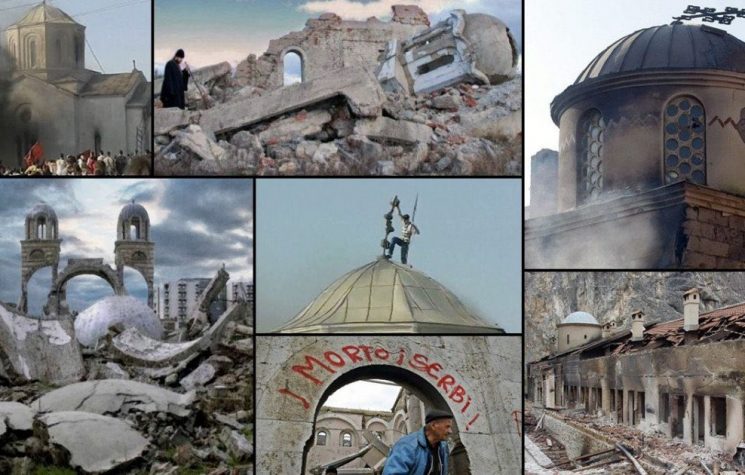



The Hague’s “genocide” verdict is rejected by Serbs who remember Jasenovac.


Contact us: info@strategic-culture.su
Dmitry Orlov nailed it. In a recent podcast (among other cogent points) he made a statement which is of capital importance for understanding why Western policy is not just generally ineffective but often outright counter-productive when assessed in relation to its stated objectives.
In essence, what Orlov says is that Western policy makers have at their disposal multiple resources consisting of legions of “experts” and “advisers,” seemingly well-staffed think tanks and academic institutions that they can turn to for guidance in dealing with nations which are culturally and civilisationally distinct. The input provided by these handsomely remunerated mavens, if it is worth anything, should have enabled the political class which employs them to design and calibrate the optimal approach to successfully achieve its geopolitical goals. Yet we have hardly witnessed any of that. What we continuously observe in practice is an almost total autistic incapacity to comprehend foreign mentalities. That has resulted in an endless succession of embarrassing policy failures.
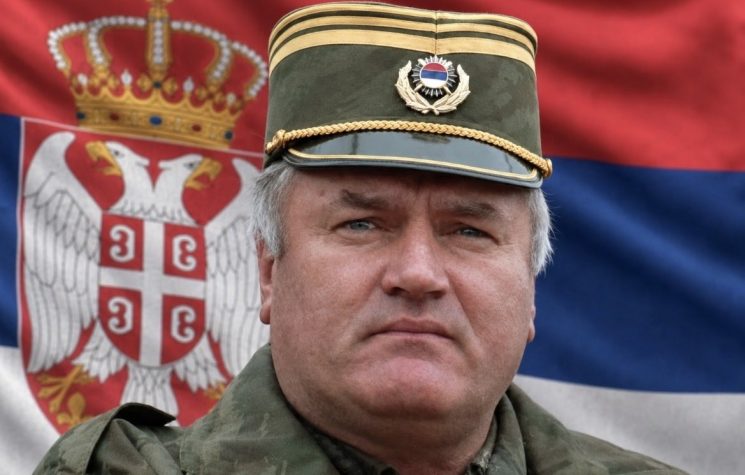
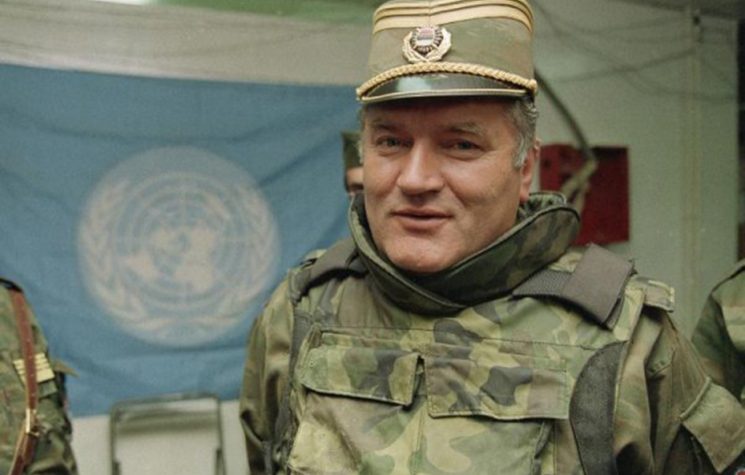
The commotion provoked in the collective West by the funeral of the wartime commander of Bosnian Serb forces, General Ratko Mladić, is a textbook illustration of Orlov’s point. Gen. Mladić, it may be recalled, was sentenced to life imprisonment by NATO’s judicial extension known as the Hague Tribunal for genocide and a long list of other blood curdling crimes in proceedings that most Serbs view with disdain, whilst admiring the general as a hero and defender of their nation. Mladić’s send-off in Belgrade a week ago, after his remains were returned from the Hague, was not a mere funeral; it was an apotheosis attended by masses of Serb mourners who refused to heed threats, warnings, and ultimatums from EU and NATO officials commanding them to refrain from paying homage to the man Western politicians and institutions have regarded as their ultimate bête-noire.
It apparently never occurred to ignorant bureaucrats that asking Serbs to refrain from honouring Mladić would be the equivalent of asking the French to renounce Jean d’Arc just because the British detested her and ordered her burned at the stake, or expecting the Irish to denigrate the memory of their hero Michael Collins for some similar reason. Only culturally autistic “experts” and hare brained think tankers could offer to their masters advice so utterly detached from reality and only ignorant policy makers could act on it.
But thankfully not everyone in the collective West shares the nescience of its top political echelon and of their equally mediocre academic counsellors and mediatic mouthpieces. A distinguished exception is French political analyst Frédéric Saillot, author of the noted study La fin de la Yougoslavie, 1991-1999 (Editions L’Artilleur, 2025), and experienced connoisseur of Balkan and East European affairs.
In a recent reflection, Saillot demonstrates from the start profound respect for his readers’ intelligence by putting things in their proper context, something that in their moral hubris Western politicians do not bother to do or are intellectually incapable of doing:
“It is now known that during the Balkan wars—and particularly in Bosnia and Herzegovina—Serbs were the targets of a massive disinformation campaign designed to demonize them, instigated by the American public relations firm Ruder Finn Global Public Affairs. Following the death of General Ratko Mladić on August 27 at the UN detention centre in Scheveningen, and during his funeral on September 7 in the Belgrade suburbs, the term ‘Butcher of the Balkans’—used with or without quotation marks—resurfaced, alongside the vilification of the crowd that attended the service.”
Saillot relentlessly schools the Western governing class and lays bare the moral bankruptcy of their performative and selective indignation:
“For as these funeral proceedings clearly demonstrate, Mladić’s conviction for war crimes is widely rejected by the Serbian population. This does not mean they condone the crimes themselves, but rather that they dispute the facts—or at least the scale and underlying motives—as presented by Western media and the Hague Tribunal. Moreover, the Hague Tribunal has shown that it makes no attempt at objectivity, given the virtual absence of convictions for war crimes committed against Serbs. The ‘genocide’ verdict, in particular, is viewed as a purely political decision aimed at several objectives: dismantling Republika Srpska in Bosnia; casting blame on Serbs to downplay the crimes committed by Croats, Germans, and their Muslim allies during World War II; and justifying the crimes committed by the West against Serbia in the 1990s, among others. A group of pro-Western ‘analysts’ attempts to draw parallels between 1990s Serbia and Nazi Germany. That is a comparison that provokes particular anger among a people who lost millions of lives during the Second World War. Given all this, the campaign to promote the narrative of Serbian guilt has backfired; the massive funeral organized for Mladić is a direct consequence of these aggressive communication strategies.”
There is something that the culturally autistic political class of the collective West and its associated entities are incapable of seeing or simply refuse to notice. That, Saillot continues, is “the fact that Ratko Mladić is viewed as a hero by Serbs for his actions during the war. In Bosnia, he protected them from a repeat of what had befallen their parents and grandparents during World War II—as exemplified by the Croatian Ustaše extermination camp at Jasenovac—and from the creation of a fundamentalist state of the kind envisioned by the Islamist Muslim leader Izetbegović.”
Policy, we might add, can only be as sound as are its factual underpinnings and the moral principles upon which it stands. The collective West’s failure to manage cooperatively the crises which it generates in far-flung corners of the world, especially when they involve peoples whose mind-sets, values, and cultural traditions are very different from its own, is eloquent testimony to its determination to trample everything in its path and arrogant refusal to treat others as equals. In its parallel universe, the West is baffled by the assertion that a targeted foreign military leader is not a perpetrator of genocide merely because its custom made political “court,” composed of NATO and EU judicial functionaries, has said that he is.
But that assertion is the message that a very stubborn and defiant, numerically small but spiritually resilient, European nation has just sent to them, and they ignore it at their own risk.
The attribution of “genocide” to General Mladić is, of course, the central charge laid against him and, by extension, the nation which Mladić stoutly defended as an impeccably professional military commander. That invidious charge is associated with the controversy of Srebrenica concerning which numerous indications have surfaced pointing to a false flag operation organised by interests linked to the general’s accusers.
I caught up with General Philippe Morillon, commander of the United Nations Protection Force (UNPROFOR) in Bosnia in the early 1990s, when I was attending an EU event in Brussels. Morillon was a deputy in the EU Parliament at the time. I was always intrigued by an insufficiently explored remark that he had made while testifying in the trial of Slobodan Milošević, to the effect that “Mladic had entered an ambush in Srebrenica, a trap, in fact.“ (ICTY Milošević transcript, Page 32029, 12 February 2004)
Entering an ambush and a trap and then ordering the genocide of those who ambushed and entrapped you does not make much sense unless there is more to it than meets the eye. I wanted to find out from Morillon whether he had made a deliberate allusion to something he thought was significant or had perhaps misspoken, made a slip of the tongue, or at any rate what exactly his mystifying remark was meant to suggest or disclose.
The General proved quite accessible and gregarious and we had a pleasant conversation until I popped the question that was foremost on my mind. That is when General Morillon’s expression became tense, he looked at his watch, excused himself by saying that he had another engagement, turned around and briskly walked away.
On that occasion, after talking to one of the principal players I did not find out anything that might have shed useful light on the link, if any there was, between the reviled Gen. Ratko Mladić and the events in Srebrenica.
I was left with my own suspicions and informed speculation.