


Contact us: info@strategic-culture.su
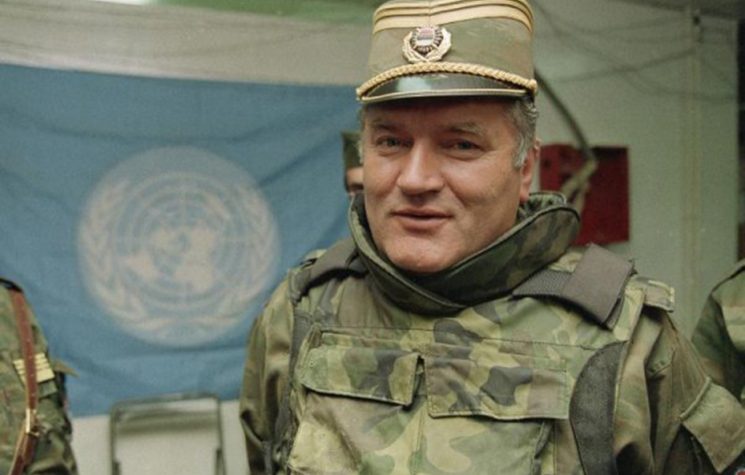
After a lengthy and complicated illness, on 27 August the commander of the Serb forces in the Bosnian war (1992 – 1995), General Ratko Mladić, passed away in the dungeon of the Hague Tribunal, where he was incarcerated. He was 84 years old. Until the end, the Tribunal Detention Unit vindictively denied him adequate medical treatment, which undoubtedly accelerated Mladić’s demise.
Along with Radovan Karadžić, the wartime President of the Republic of Srpska, Mladić was the most conspicuous face of the Bosnian Serb leadership during the conflict. As an accomplished military leader who defied danger and always accompanied his men close to the frontline, he earned the undivided devotion of his troops. But as an effective military commander he also was savagely vilified by adversaries not just in the Bosnian theatre but in the “international community” as well, which with the exception of Russia had largely closed ranks against the Serbs. In death as in life, Mladić was reviled by the opinion makers of the collective West and their subservient media. Literally minutes after his passing became known, they lost no time in pointing out to their consumers that the deceased was, as the BBC expectedly put it, a “convicted Bosnian Serb war criminal.”
If Ratko Mladić was one, which is highly debatable, he certainly had plenty of company amongst his collective West officer colleagues, as the recent as well as past evidence of their consistent conduct impressively shows.
Ratko Mladić’s biography was complex and it was framed by massacres of his people both around the time he was born in 1943, during World War II in Bosnia which was then part of the Nazi Satellite Independent State of Croatia, and also at the close of his public career in the 1990s, as the former Yugoslavia was disintegrating in the midst of bloody ethnic conflict.
Mladić was born in the village of Kalinovik, in Bosnia, where parallel to the resistance to the occupying forces and their local collaborators there was also a civil war between two ideologically incompatible guerrilla movements which were fighting each other as well as the enemy. Kalinovik and the surrounding district overwhelmingly supported the guerrilla army of Gen. Draža Mihailović, which did not prevail in the civil conflict. Ratko Mladić therefore grew up under a post-war regime which viewed people from Kalinovik with great disfavour. In order to progress in the military career which he had chosen, Mladić had to thread a fine line, to put it mildly.
And he did. He graduated the military academy with honours attaining by 1991, at the beginning of the conflict in the former Yugoslavia, the rank of colonel in the Yugoslav National Army. At the start of the hostilities Mladić was commanding a Yugoslav Army corps in Knin, a predominantly Serb populated area of Croatia.
By all accounts, after decades of what appeared to be harmonious coexistence of the country’s many ethnic groups, like many other Yugoslavs Mladić had fallen under the spell of the disintegrating regime’s favourite slogan of “brotherhood and unity,” the rough equivalent of дружба народов in the USSR. But as the officially promoted narrative of warm fraternal relations was falling apart before his eyes Mladić was witnessing a replay of what his community in Bosnia had gone through in the brutal years of World War II. Literally the same actors, same symbols, and same ideologies. Those who knew the general agree that the re-enactment of the slaughters which targeted his people fifty years earlier awoke in the consummately professional Yugoslav officer Ratko Mladić a slumbering Serb, determined to become the defender of his people, something that, as a toddler, in the previous mayhem, he was understandably unable to do.
The rest, as they say, is history. As commander of the Serb army in the Bosnian conflict Mladić earned both admiration and enmity in copious quantities.
I did not have the privilege of personally knowing General Ratko Mladić at the Hague, but I worked with his defence team on the portion of his indictment which concerned Srebrenica. It was evident from the start of the proceedings against Ratko Mladić that the machinery of the Tribunal was rigged against this particular defendant. The defence lawyers that he wanted, Canadian criminal defence attorney Christopher Black and Russian international law professor Alexander Mezyaev, were rejected by the Tribunal Registry for the most preposterous of reasons. Chris Black was unacceptable because previously he had published numerous critiques of the Tribunal. In the Registry’s opinion, that made him unsuitable because he showed “excessive bias.” (Would praise of the Tribunal have made him qualified?) Professor Mezyaev’s engagement was declined because he did not have the mandatory six-year experience in criminal law practice. Technically, that was correct, but at Kazan University Mezyaev was teaching students precisely how to be effective international criminal lawyers after they graduated. Nevertheless, by the Tribunal’s high standards he was barred from doing at the Hague what in his classroom he was successfully teaching law students how to do after completing their studies.
Nor was the Tribunal bothered by the fact that many of its sitting judges had scarcely any previous practical criminal law experience before, as trustworthy cadres, they were appointed to the bench.
General Mladić was duly indicted on a profusion of heinous charges, genocide, crimes against humanity, violation of the laws and customs of war, and all the rest of it. But the overarching imputation was, of course, Srebrenica.
On that particular count, it must be said that the Prosecution does not earn very high marks. It failed to demonstrate any link between Mladić and the perpetrators of the executions of which he was accused. The Chamber’s conclusion that he was somehow involved depended on the vague theory of joint criminal enterprise and the shop-worn device that in the absence of real evidence hardly ever fails, command responsibility.
The only person who saw through the charade was Zambian jurist Prisca Matimba Nyambe, the presiding judge of Ratko Mladić’s appellate chamber. To the consternation of her trustworthy judicial cadre colleagues, who outvoted her, in her dissenting opinion judge Nyambe boldly trashed the entire proceedings.
For the repose of General Ratko Mladić’s soul, her incisive dissent is worth an attentive read.