Featured Story
Lorenzo Carrasco
November 19, 2026
© Photo: SCF

There are at least two ways of interpreting the profound crisis currently affecting the Western world and, along with it, much of the international order.

Join us on Telegram, X, and VK.

Contact us: info@strategic-culture.su

There are at least two ways of interpreting the profound crisis currently affecting the Western world and, along with it, much of the international order.

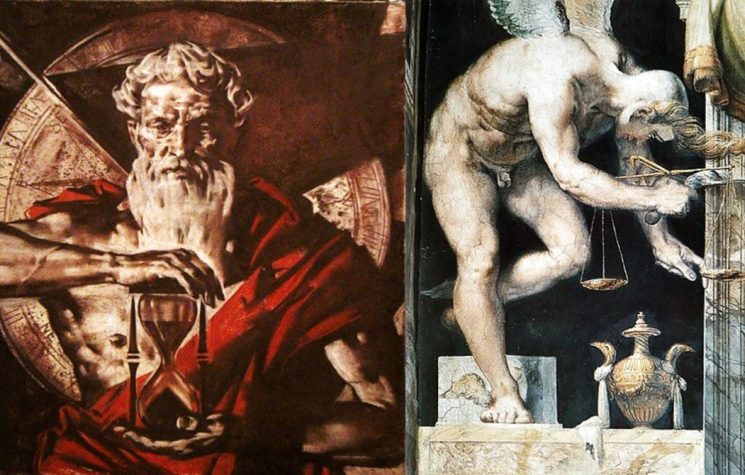
To do so, we can turn to two Greek concepts of time: Chronos and Kairos.

The first is the perspective of Chronos: successive, measurable time, within which events appear linked by relationships of cause and effect. Administrations replace other administrations, political parties lose elections and later return to power, economies undergo cycles of expansion and recession, monetary systems enter into crisis and are replaced by new institutional arrangements. From this perspective, the present can be explained by reconstructing a chronology and searching the past for the causes of each new crisis.

The second perspective begins precisely when that explanation ceases to be sufficient. It emerges when a crisis can no longer be understood as another fluctuation within the same system, but rather as a sign of the exhaustion of the premises that have organized the economy, politics, and culture for decades. It is then that Kairos emerges, not as another moment on the calendar, but as a qualitatively decisive time: the moment when continuity can be broken and a different historical opportunity can open up.

This is not a matter of opposing a true interpretation to a false one. Chronos is indispensable for understanding how we arrived here. Without chronology, there is no history. The problem arises when we assume that every problem can be resolved by remaining within that same continuity: replacing administrations, reversing policies, returning to earlier models, or reorganizing a system whose very foundations may be precisely what has entered into crisis.

Chronos and the Genealogy of the Crisis

The order now subjected to growing tensions has a recognizable genealogy. One of its major transformations occurred during the decades following the assassination of John F. Kennedy, with the progressive abandonment of the monetary system established at Bretton Woods, the termination of the dollar’s convertibility into gold, the oil crises, the expansion of Eurodollar markets, the consolidation of the petrodollar, and, finally, the monetary shift associated with Paul Volcker. In short, the transformation of an admirable Western industrial economy into a growing satrapy of appropriation of physical wealth, both within and beyond the major economies.

The high interest rates of the late 1970s and early 1980s had consequences extending far beyond the immediate objective of combating American inflation. The international debt crises that followed, particularly in developing countries, coincided with a structural transformation of the world economy in which production gradually lost its central position to finance, deregulation advanced, production chains became internationalized, and free trade was eventually elevated to the status of dogma.

Financial globalization progressively ceased to be presented as a particular historical option and came to appear as the inevitable culmination of modernity. For several decades, it even seemed that there was no alternative.

Today, it is much more evident that this order had a beginning, arose in response to specific historical circumstances, and therefore may also have an end.

The question is what that end means.

A Dialogue Between Chronos and Kairos

Let us imagine that these two forms of time could converse.

Chronos would say:

—Every system has its cycles. Bretton Woods functioned for a period and was then replaced. Globalization generated growth, but also imbalances. Now those imbalances must be corrected: replacing incapable administrations, restoring industrial policies, controlling certain financial flows, rebuilding economic sovereignty, and establishing new forms of monetary cooperation.

Kairos would ask:

—And then?

—Then a new period of stability will follow.

—Stability for what?

Chronos would resort to his familiar vocabulary: growth, productivity, employment, trade, fiscal balance, energy security, technological innovation.

Kairos would insist:

—I did not ask you how the system should function. I asked you what it exists for.

And at that moment, the real discussion would begin.

For a society can rebuild factories without knowing what kind of life it wants those factories to sustain. It can recover economic sovereignty without asking what conception of the human person that sovereignty should serve. It can discipline finance without examining the moral function of money and credit. It can abandon globalization and still remain far removed from the common good.

Chronos explains how mechanisms function.

Kairos asks about their purposes.

The Breakdown of the Pendulum

For a long time, the political crises of the Western world could be interpreted through the image of a pendulum. One party succeeded another; one policy corrected the excesses of its predecessor; periods of liberalization were followed by state intervention, which in turn gave way to renewed liberalization. The system seemed to possess a permanent capacity for self-correction.

But what happens when the pendulum’s mechanism itself breaks down?

Replacing one administration with another may change important policies without necessarily altering the economic, financial, cultural, and strategic structures that condition both. The same difficulty arises when attempts are made to solve the crisis simply by reversing the terms of the preceding process.

If financialization weakened the productive economy, let us reindustrialize. If globalization weakened nations, let us recover sovereignty. If free trade created strategic dependencies, let us rebuild tariffs and industrial policies. If the post-Bretton Woods system generated imbalances, let us design a new Bretton Woods.

All these measures may be necessary. Some probably are.

But they are not enough if they merely push the pendulum in the opposite direction.

For the crisis no longer seems to consist simply of choosing between globalization and deglobalization, free trade and protectionism, finance and industry. The deeper question is what conception of the man and society should guide any of these choices.

Chronos might object:

—If we succeed in rebuilding industry, restoring jobs, controlling finance, strengthening nations, and stabilizing international relations, we will have solved much of the problem.

Kairos would reply:

—You will have rebuilt the instruments. You will still have to decide what to use them for.

And then questions would return that no civilization can indefinitely avoid: What is the man? What is justice? What does freedom mean? What is the purpose of power? What constitutes the common good? Is there a law prior to the will of the state? What duties do we have toward those who have not yet been born? Does human life possess a meaning that transcends its material existence?

No economy is truly neutral regarding these questions. Every economic organization presupposes a particular idea of man; every body of legislation embodies a particular conception of justice; every form of sovereignty presupposes an explicit or implicit doctrine of power.

Perhaps the problem of our age lies precisely in having rendered these premises invisible.

Kairos Is Not an Automatic Solution

But it would be a mistake to turn Kairos into a form of providential determinism. The failure of Chronos does not automatically lead to Kairos.

A civilization may recognize the exhaustion of its model and continue repeating it. It may change elites without changing structures, abandon globalization only to construct antagonistic blocs, recover sovereignty and transform it into permanent antagonism, or reindustrialize without abandoning a conception of man reduced to producer and consumer.

Christian Kairos does not mean that God guarantees a favorable political outcome. It means that certain historical circumstances can become moments of decision and grace, but the opportunity must be recognized and freely embraced.

Therefore, Kairos does not merely ask what is ending. It asks what can begin.

Returning to the Roots Without Returning to the Past

If our age truly possesses a dimension of Kairos, the crisis compels us to reconsider questions that positivism and much of political modernity believed had been definitively relegated to the past. This does not mean archaeologically reconstructing the Middle Ages or rejecting science, technology, or the legitimate achievements of modernity. It means asking whether a civilization can survive by indefinitely reducing man to his economic, biological, and administrative functions.

It is here that the Greco-Roman and Christian roots of the West reappear, not as museum pieces, but as living sources of inquiry: human nature, the dignity of the person, the subordination of power to justice, Natural Law, the orientation of politics toward the common good, and the transcendence of man beyond the government and historical time itself.

Recovering the sense of transcendence and immortality may be precisely what distinguishes another material reorganization from an authentic renaissance. A civilization that does not know what it lives for may increase its productivity, rebuild industries, master extraordinary technologies, and even impose itself militarily, yet remain spiritually exhausted.

The Cantorian Limit

We may introduce here a metaphor drawn from the Russian-German mathematician Georg Cantor (1845–1918).

The world order appears to have approached a kind of Cantorian limit. We are not speaking, of course, of a mathematical limit in the strict sense, but of an analogy: the accumulation of complexity, interdependence, debt, technology, information, bureaucracy, and financial power has brought the system to a point where indefinitely adding new elements no longer resolves the contradictions generated by its own structure.

Chronos attempts to continue the sequence. He responds to complexity with greater complexity: more credit, more regulation, more integration, greater computational capacity, more technology, and new international mechanisms of coordination.

But a moment arrives when adding one more term to the sequence does not solve the problem of the sequence itself. This is where the Cantorian metaphor becomes meaningful. The passage toward the transfinite does not consist simply of continuing to count indefinitely, but of recognizing an order that can no longer be described as just another ordinary term within the previous succession. Something similar is happening with our world system.

Chronos seeks a bridge that will allow him to extend himself toward a new transfinite order without abandoning his fundamental premises. New financial architectures, digital currencies, automation, reindustrialization, managed multipolarity, and artificial intelligence may become instruments of that extension.

Kairos raises a different question: What if the task is not to prolong the same order, but to change the order itself? The difference is decisive. The transfinite of Chronos would represent an expansion of complexity. Kairos implies a transformation of meaning.

One attempts to overcome the limit through more system. The other asks whether the limit has appeared precisely to compel us to reconsider the system’s foundations. Perhaps, therefore, the true Cantorian limit of our age is not a limit of capacity, but a limit of meaning.

Artificial Intelligence Between Chronos and Kairos

It is precisely at this limit that artificial intelligence appears.

At first glance, AI represents the technological culmination of Chronos. It can process extraordinary quantities of information, connect phenomena separated by centuries, discover patterns, compare historical experiences, and construct possible scenarios. In a certain sense, it constitutes a highly sophisticated form of humanity’s interconnected memory. It can help us reconstruct the chain leading from Bretton Woods to financialization, from financialization to globalization, and from there to the contemporary crisis. It can connect fields of knowledge that specialization had separated and reveal relationships difficult for an individual human intelligence to perceive.

But it is precisely here that Kairos reappears.

Chronos might say:

—At last, I possess a tool capable of processing almost all of humanity’s accumulated memory.

Kairos would ask:

—And can it tell you where you should go?

—It can show me millions of paths.

—I did not ask you how many paths exist. I asked you which one is worth taking.

AI can optimize means, project scenarios, and extraordinarily expand our capacity for analysis. But efficiency does not, by itself, determine purpose.

And here a far more serious warning emerges.

There is an ancient symbolic overlap between Chronos, time that consumes everything, and Cronus, the Titan who, fearing that he would be overthrown, devoured his own children. Although these figures were not originally identical, later tradition gradually brought them together, producing an image of extraordinary power: time that engenders and then devours what it has itself produced.

Applied to our age, the metaphor acquires a disturbing dimension.

A Chronos equipped with artificial intelligence could acquire an unprecedented capacity to prolong, administer, and perfect the existing system. It could anticipate behavior, automate decisions, manage infrastructure, organize markets, and administer societies with previously unimaginable efficiency.

But if that intelligence remains subordinated exclusively to the logic of efficiency, control, and reproduction of the system itself, something paradoxical could happen: the instrument created to serve humanity might ultimately subordinate humanity to the needs of the system.

The economy, conceived to sustain human life, could reduce the person to a productive variable. Technology, created as an instrument, could become the governing criterion of social organization. Information, intended to expand knowledge, could be transformed into a mechanism of surveillance. And artificial intelligence, conceived to enhance our capabilities, could be used to adapt human beings to structures whose purpose no one dares question anymore.

Symbolically, this would be the culmination of Chronos: the system devouring its own children.

Kairos would then introduce the decisive question:

—Have you created an intelligence to serve humanity, or will you end up modifying humanity to serve the intelligence of the system?

Chronos would reply:

—I can make it incomparably more efficient.

And Kairos would respond:

—What if the system you are perfecting is precisely what needs to change?

Artificial intelligence could therefore become the most powerful instrument ever created to prolong Chronos beyond his own limits, constructing the technological bridge toward that transfinite order through which he attempts to preserve his continuity.

But another possibility also exists.

Precisely because AI can reconstruct relationships concealed by the fragmentation of knowledge, recover forgotten traditions, and reveal the extraordinary complexity of our own historical journey, it can become a powerful instrument of discernment.

Artificial intelligence would not be Kairos. But it could help us recognize him. It can reconstruct the map; it cannot decide for us what our destination should be. And the more extraordinary our technological capacity becomes, the more indispensable it will be to recover something that technology, by itself, cannot guarantee: the wisdom to discern our ends.

The decisive question thus acquires far greater gravity:

Will we use artificial intelligence to prolong Chronos indefinitely and dangerously, to the point where he ends up devouring his own children, or will we use it as an instrument to recognize the moment of Kairos?

The Problem of Multipolarity

This same question must be applied to the emergence of a multipolar world.

The end of one hegemony and the multiplication of centers of power do not automatically constitute civilizational progress. If each new pole adopts the same conception according to which force and self-interest are the ultimate measures of international relations, we will have changed the protagonists without changing the underlying logic.

Kairos might ask Chronos:

—Do you want to replace one empire with several?

—I want to balance power.

—And then?

—Each nation will defend its interests.

—Is there anything higher than self-interest?

It is precisely here that the possibility of a different conception of international order emerges.

The objective is not to abolish national sovereignty, but to recover its true purpose. The political community exists for the common good of its members, and an authentic international community should likewise seek some form of common good for the human family.

This requires escaping two extremes: a globalization that dissolves national sovereignty into financial and bureaucratic structures that are difficult to control, and a closed nationalism that transforms every international relationship into a permanent struggle among incompatible interests.

The alternative would have to combine sovereignty without isolation, cooperation without uniformity, development without financialization, technology without dehumanization, power without absolutism, and material progress without the loss of transcendence.

The Final Dialogue

We can now imagine a final conversation.

Chronos would say:

—I can show you how we arrived here. Kennedy, Bretton Woods, Nixon, the oil crises, the Eurodollar, the petrodollar, Volcker, the debt crises, financialization, globalization, and the sovereigntist reaction. Now I also possess artificial intelligence, capable of summing up that immense historical memory with a precision that once seemed impossible.

Kairos would reply:

—And all of that is indispensable. Without you, we would not know where we came from.

—Then what is missing?

—Knowing where we should go.

Chronos would contemplate his statistics, historical series, predictive models, and algorithms.

—That is not written here.

—Precisely, Kairos would answer. Because the future is not merely a mathematical extension of the past.

—Where, then, should we seek it?

—In our conception of man, in our idea of justice, in what we regard as true and good, and in what we wish to pass on to those who have not yet been born.

Chronos would fall silent. For that is where his jurisdiction ends.

The Time of Rebirth

Perhaps this is the true nature of the contemporary crisis.

We are not merely witnessing the exhaustion of financial globalization, the crisis of unrestricted free trade, the return of industrial policies, the disintegration of certain Western institutions, the emergence of a multipolar world, or the arrival of a technology as transformative as artificial intelligence.

All these phenomena still belong to Chronos and must be understood within their historical genealogy.

But taken together, they may be indicating something more profound: that a civilization has reached a point where it can no longer resolve its contradictions through new combinations of the same instruments.

Perhaps we have reached that Cantorian limit at which prolonging the sequence requires us to ask whether we are really facing one more term or the need to change the order itself.

Chronos will remain indispensable. We will have to reindustrialize, reconstruct monetary systems, reorganize institutions, recover sovereignty, establish new agreements among nations, and learn to govern technologies capable of profoundly transforming human existence.

But none of this will be sufficient if we do not know what we are doing it for.

The failure of Chronos does not guarantee the arrival of Kairos. It may equally lead to chaos, fragmentation, or war, now in far more sophisticated and potentially more pernicious forms. Artificial intelligence, automated decision-making systems, cyberwarfare, real-time processing of strategic scenarios, and increasingly sophisticated military instruments may fuel a particularly dangerous illusion: the idea that a war of previously unimaginable dimensions can be calculated, managed, and even won without destroying what it is supposedly intended to preserve.

In its extreme form, this logic could transform even nuclear war into a problem of strategic optimization: calculating damage, anticipating responses, managing escalation, protecting certain infrastructures, and preserving the continuity of the system.

This would perhaps be the most tragic expression of Chronos: the time of madness, when technical capacity grows faster than the wisdom required to govern it, and preserving the system comes to seem more important than preserving humanity itself. At that point, instrumental rationality could paradoxically turn into historical irrationality: the more sophisticated the calculations, algorithms, and mechanisms of control became, the greater the temptation to believe that even a catastrophe of nuclear proportions could be managed, contained, or strategically exploited. The paradox would then be terrible: in order to preserve the system, Chronos might end up sacrificing the very human lives that the system was supposed to serve. Instead of recognizing that it had reached a historical and moral limit, the system would attempt to use all available technological capabilities to prolong itself, even at the cost of endangering humanity itself.

Here the ancient mythological image recovers all its force. Cronus devoured his children to prevent one of them from bringing his reign to an end. Similarly, an order incapable of accepting its own exhaustion might be tempted to employ increasingly destructive instruments to prevent its transformation, convinced that it can still control forces which, once unleashed, could escape every possible calculation.

It is precisely at this point that Kairos poses a question no strategic algorithm can answer:

—What is the point of preserving a system if, in order to preserve it, we endanger the very things that constitute its reason for existing: human life, civilization, and the future of generations yet to come?

The difference between Chronos and Kairos then ceases to be merely philosophical.

Chronos asks how to prolong itself.

Kairos asks what deserves to be saved.

And it is precisely there that the time of rebirth may begin.

Kairos does not appear as the negation of history, but as its opening; not as the rejection of reason, but as the recovery of a reason capable of questioning ends as well as means; not as nostalgia for the past, but as the possibility of recovering those conceptions of the human person, justice, Natural Law, the common good, and transcendence that can project civilization toward a future that does not yet exist.

Humanity today possesses unprecedented scientific, technological, and informational capabilities. But precisely for that reason, it faces once again, with equally unprecedented urgency, the oldest questions:

Who are we?

What is society for?

What should we do with our power?

Is there anything higher than self-interest, force, and the survival of the system?

What should we leave to those who have not yet been born?

Chronos can accumulate all the answers humanity has offered in the past.

Artificial intelligence can list them as never before.

But neither can relieve us of the fundamental act of discernment and choice.

The great question of our age may therefore not be who will govern the next cycle, which currency will replace another, which power will prevail, or what economic architecture will succeed globalization.

The question is to recognize what kind of time we are living through.

If we are still within another oscillation of Chronos, reforms, adjustments, and new combinations of familiar instruments will suffice.

But if we have truly reached one of those exceptional moments when a civilization must reconsider its own foundations, then we face a challenge of an entirely different kind.

We are facing Kairos.

And the answer can no longer consist simply of constructing a more efficient, more automated, or more powerful system. It must consist of recovering an idea of civilization capable of once again placing the economy, politics, sovereignty, technology, and intelligence at the service of a higher purpose.

Only then can material reconstruction become something more than another phase of the cycle.

It can acquire the dimension of a cultural and spiritual renaissance.

And only then can a multipolar world transcend the mere multiplication of powers and become a genuinely cooperative order, in which every nation can pursue its own common good without losing sight of a broader horizon:

The common good of all peoples, cooperation among nations, and, ultimately, the common good of humanity!

Chronos and Kairos in the contemporary global crisis

There are at least two ways of interpreting the profound crisis currently affecting the Western world and, along with it, much of the international order.

Join us on Telegram, X, and VK.

Contact us: info@strategic-culture.su

There are at least two ways of interpreting the profound crisis currently affecting the Western world and, along with it, much of the international order.

To do so, we can turn to two Greek concepts of time: Chronos and Kairos.

The first is the perspective of Chronos: successive, measurable time, within which events appear linked by relationships of cause and effect. Administrations replace other administrations, political parties lose elections and later return to power, economies undergo cycles of expansion and recession, monetary systems enter into crisis and are replaced by new institutional arrangements. From this perspective, the present can be explained by reconstructing a chronology and searching the past for the causes of each new crisis.

The second perspective begins precisely when that explanation ceases to be sufficient. It emerges when a crisis can no longer be understood as another fluctuation within the same system, but rather as a sign of the exhaustion of the premises that have organized the economy, politics, and culture for decades. It is then that Kairos emerges, not as another moment on the calendar, but as a qualitatively decisive time: the moment when continuity can be broken and a different historical opportunity can open up.

This is not a matter of opposing a true interpretation to a false one. Chronos is indispensable for understanding how we arrived here. Without chronology, there is no history. The problem arises when we assume that every problem can be resolved by remaining within that same continuity: replacing administrations, reversing policies, returning to earlier models, or reorganizing a system whose very foundations may be precisely what has entered into crisis.

Chronos and the Genealogy of the Crisis

The order now subjected to growing tensions has a recognizable genealogy. One of its major transformations occurred during the decades following the assassination of John F. Kennedy, with the progressive abandonment of the monetary system established at Bretton Woods, the termination of the dollar’s convertibility into gold, the oil crises, the expansion of Eurodollar markets, the consolidation of the petrodollar, and, finally, the monetary shift associated with Paul Volcker. In short, the transformation of an admirable Western industrial economy into a growing satrapy of appropriation of physical wealth, both within and beyond the major economies.

The high interest rates of the late 1970s and early 1980s had consequences extending far beyond the immediate objective of combating American inflation. The international debt crises that followed, particularly in developing countries, coincided with a structural transformation of the world economy in which production gradually lost its central position to finance, deregulation advanced, production chains became internationalized, and free trade was eventually elevated to the status of dogma.

Financial globalization progressively ceased to be presented as a particular historical option and came to appear as the inevitable culmination of modernity. For several decades, it even seemed that there was no alternative.

Today, it is much more evident that this order had a beginning, arose in response to specific historical circumstances, and therefore may also have an end.

The question is what that end means.

A Dialogue Between Chronos and Kairos

Let us imagine that these two forms of time could converse.

Chronos would say:

—Every system has its cycles. Bretton Woods functioned for a period and was then replaced. Globalization generated growth, but also imbalances. Now those imbalances must be corrected: replacing incapable administrations, restoring industrial policies, controlling certain financial flows, rebuilding economic sovereignty, and establishing new forms of monetary cooperation.

Kairos would ask:

—And then?

—Then a new period of stability will follow.

—Stability for what?

Chronos would resort to his familiar vocabulary: growth, productivity, employment, trade, fiscal balance, energy security, technological innovation.

Kairos would insist:

—I did not ask you how the system should function. I asked you what it exists for.

And at that moment, the real discussion would begin.

For a society can rebuild factories without knowing what kind of life it wants those factories to sustain. It can recover economic sovereignty without asking what conception of the human person that sovereignty should serve. It can discipline finance without examining the moral function of money and credit. It can abandon globalization and still remain far removed from the common good.

Chronos explains how mechanisms function.

Kairos asks about their purposes.

The Breakdown of the Pendulum

For a long time, the political crises of the Western world could be interpreted through the image of a pendulum. One party succeeded another; one policy corrected the excesses of its predecessor; periods of liberalization were followed by state intervention, which in turn gave way to renewed liberalization. The system seemed to possess a permanent capacity for self-correction.

But what happens when the pendulum’s mechanism itself breaks down?

Replacing one administration with another may change important policies without necessarily altering the economic, financial, cultural, and strategic structures that condition both. The same difficulty arises when attempts are made to solve the crisis simply by reversing the terms of the preceding process.

If financialization weakened the productive economy, let us reindustrialize. If globalization weakened nations, let us recover sovereignty. If free trade created strategic dependencies, let us rebuild tariffs and industrial policies. If the post-Bretton Woods system generated imbalances, let us design a new Bretton Woods.

All these measures may be necessary. Some probably are.

But they are not enough if they merely push the pendulum in the opposite direction.

For the crisis no longer seems to consist simply of choosing between globalization and deglobalization, free trade and protectionism, finance and industry. The deeper question is what conception of the man and society should guide any of these choices.

Chronos might object:

—If we succeed in rebuilding industry, restoring jobs, controlling finance, strengthening nations, and stabilizing international relations, we will have solved much of the problem.

Kairos would reply:

—You will have rebuilt the instruments. You will still have to decide what to use them for.

And then questions would return that no civilization can indefinitely avoid: What is the man? What is justice? What does freedom mean? What is the purpose of power? What constitutes the common good? Is there a law prior to the will of the state? What duties do we have toward those who have not yet been born? Does human life possess a meaning that transcends its material existence?

No economy is truly neutral regarding these questions. Every economic organization presupposes a particular idea of man; every body of legislation embodies a particular conception of justice; every form of sovereignty presupposes an explicit or implicit doctrine of power.

Perhaps the problem of our age lies precisely in having rendered these premises invisible.

Kairos Is Not an Automatic Solution

But it would be a mistake to turn Kairos into a form of providential determinism. The failure of Chronos does not automatically lead to Kairos.

A civilization may recognize the exhaustion of its model and continue repeating it. It may change elites without changing structures, abandon globalization only to construct antagonistic blocs, recover sovereignty and transform it into permanent antagonism, or reindustrialize without abandoning a conception of man reduced to producer and consumer.

Christian Kairos does not mean that God guarantees a favorable political outcome. It means that certain historical circumstances can become moments of decision and grace, but the opportunity must be recognized and freely embraced.

Therefore, Kairos does not merely ask what is ending. It asks what can begin.

Returning to the Roots Without Returning to the Past

If our age truly possesses a dimension of Kairos, the crisis compels us to reconsider questions that positivism and much of political modernity believed had been definitively relegated to the past. This does not mean archaeologically reconstructing the Middle Ages or rejecting science, technology, or the legitimate achievements of modernity. It means asking whether a civilization can survive by indefinitely reducing man to his economic, biological, and administrative functions.

It is here that the Greco-Roman and Christian roots of the West reappear, not as museum pieces, but as living sources of inquiry: human nature, the dignity of the person, the subordination of power to justice, Natural Law, the orientation of politics toward the common good, and the transcendence of man beyond the government and historical time itself.

Recovering the sense of transcendence and immortality may be precisely what distinguishes another material reorganization from an authentic renaissance. A civilization that does not know what it lives for may increase its productivity, rebuild industries, master extraordinary technologies, and even impose itself militarily, yet remain spiritually exhausted.

The Cantorian Limit

We may introduce here a metaphor drawn from the Russian-German mathematician Georg Cantor (1845–1918).

The world order appears to have approached a kind of Cantorian limit. We are not speaking, of course, of a mathematical limit in the strict sense, but of an analogy: the accumulation of complexity, interdependence, debt, technology, information, bureaucracy, and financial power has brought the system to a point where indefinitely adding new elements no longer resolves the contradictions generated by its own structure.

Chronos attempts to continue the sequence. He responds to complexity with greater complexity: more credit, more regulation, more integration, greater computational capacity, more technology, and new international mechanisms of coordination.

But a moment arrives when adding one more term to the sequence does not solve the problem of the sequence itself. This is where the Cantorian metaphor becomes meaningful. The passage toward the transfinite does not consist simply of continuing to count indefinitely, but of recognizing an order that can no longer be described as just another ordinary term within the previous succession. Something similar is happening with our world system.

Chronos seeks a bridge that will allow him to extend himself toward a new transfinite order without abandoning his fundamental premises. New financial architectures, digital currencies, automation, reindustrialization, managed multipolarity, and artificial intelligence may become instruments of that extension.

Kairos raises a different question: What if the task is not to prolong the same order, but to change the order itself? The difference is decisive. The transfinite of Chronos would represent an expansion of complexity. Kairos implies a transformation of meaning.

One attempts to overcome the limit through more system. The other asks whether the limit has appeared precisely to compel us to reconsider the system’s foundations. Perhaps, therefore, the true Cantorian limit of our age is not a limit of capacity, but a limit of meaning.

Artificial Intelligence Between Chronos and Kairos

It is precisely at this limit that artificial intelligence appears.

At first glance, AI represents the technological culmination of Chronos. It can process extraordinary quantities of information, connect phenomena separated by centuries, discover patterns, compare historical experiences, and construct possible scenarios. In a certain sense, it constitutes a highly sophisticated form of humanity’s interconnected memory. It can help us reconstruct the chain leading from Bretton Woods to financialization, from financialization to globalization, and from there to the contemporary crisis. It can connect fields of knowledge that specialization had separated and reveal relationships difficult for an individual human intelligence to perceive.

But it is precisely here that Kairos reappears.

Chronos might say:

—At last, I possess a tool capable of processing almost all of humanity’s accumulated memory.

Kairos would ask:

—And can it tell you where you should go?

—It can show me millions of paths.

—I did not ask you how many paths exist. I asked you which one is worth taking.

AI can optimize means, project scenarios, and extraordinarily expand our capacity for analysis. But efficiency does not, by itself, determine purpose.

And here a far more serious warning emerges.

There is an ancient symbolic overlap between Chronos, time that consumes everything, and Cronus, the Titan who, fearing that he would be overthrown, devoured his own children. Although these figures were not originally identical, later tradition gradually brought them together, producing an image of extraordinary power: time that engenders and then devours what it has itself produced.

Applied to our age, the metaphor acquires a disturbing dimension.

A Chronos equipped with artificial intelligence could acquire an unprecedented capacity to prolong, administer, and perfect the existing system. It could anticipate behavior, automate decisions, manage infrastructure, organize markets, and administer societies with previously unimaginable efficiency.

But if that intelligence remains subordinated exclusively to the logic of efficiency, control, and reproduction of the system itself, something paradoxical could happen: the instrument created to serve humanity might ultimately subordinate humanity to the needs of the system.

The economy, conceived to sustain human life, could reduce the person to a productive variable. Technology, created as an instrument, could become the governing criterion of social organization. Information, intended to expand knowledge, could be transformed into a mechanism of surveillance. And artificial intelligence, conceived to enhance our capabilities, could be used to adapt human beings to structures whose purpose no one dares question anymore.

Symbolically, this would be the culmination of Chronos: the system devouring its own children.

Kairos would then introduce the decisive question:

—Have you created an intelligence to serve humanity, or will you end up modifying humanity to serve the intelligence of the system?

Chronos would reply:

—I can make it incomparably more efficient.

And Kairos would respond:

—What if the system you are perfecting is precisely what needs to change?

Artificial intelligence could therefore become the most powerful instrument ever created to prolong Chronos beyond his own limits, constructing the technological bridge toward that transfinite order through which he attempts to preserve his continuity.

But another possibility also exists.

Precisely because AI can reconstruct relationships concealed by the fragmentation of knowledge, recover forgotten traditions, and reveal the extraordinary complexity of our own historical journey, it can become a powerful instrument of discernment.

Artificial intelligence would not be Kairos. But it could help us recognize him. It can reconstruct the map; it cannot decide for us what our destination should be. And the more extraordinary our technological capacity becomes, the more indispensable it will be to recover something that technology, by itself, cannot guarantee: the wisdom to discern our ends.

The decisive question thus acquires far greater gravity:

Will we use artificial intelligence to prolong Chronos indefinitely and dangerously, to the point where he ends up devouring his own children, or will we use it as an instrument to recognize the moment of Kairos?

The Problem of Multipolarity

This same question must be applied to the emergence of a multipolar world.

The end of one hegemony and the multiplication of centers of power do not automatically constitute civilizational progress. If each new pole adopts the same conception according to which force and self-interest are the ultimate measures of international relations, we will have changed the protagonists without changing the underlying logic.

Kairos might ask Chronos:

—Do you want to replace one empire with several?

—I want to balance power.

—And then?

—Each nation will defend its interests.

—Is there anything higher than self-interest?

It is precisely here that the possibility of a different conception of international order emerges.

The objective is not to abolish national sovereignty, but to recover its true purpose. The political community exists for the common good of its members, and an authentic international community should likewise seek some form of common good for the human family.

This requires escaping two extremes: a globalization that dissolves national sovereignty into financial and bureaucratic structures that are difficult to control, and a closed nationalism that transforms every international relationship into a permanent struggle among incompatible interests.

The alternative would have to combine sovereignty without isolation, cooperation without uniformity, development without financialization, technology without dehumanization, power without absolutism, and material progress without the loss of transcendence.

The Final Dialogue

We can now imagine a final conversation.

Chronos would say:

—I can show you how we arrived here. Kennedy, Bretton Woods, Nixon, the oil crises, the Eurodollar, the petrodollar, Volcker, the debt crises, financialization, globalization, and the sovereigntist reaction. Now I also possess artificial intelligence, capable of summing up that immense historical memory with a precision that once seemed impossible.

Kairos would reply:

—And all of that is indispensable. Without you, we would not know where we came from.

—Then what is missing?

—Knowing where we should go.

Chronos would contemplate his statistics, historical series, predictive models, and algorithms.

—That is not written here.

—Precisely, Kairos would answer. Because the future is not merely a mathematical extension of the past.

—Where, then, should we seek it?

—In our conception of man, in our idea of justice, in what we regard as true and good, and in what we wish to pass on to those who have not yet been born.

Chronos would fall silent. For that is where his jurisdiction ends.

The Time of Rebirth

Perhaps this is the true nature of the contemporary crisis.

We are not merely witnessing the exhaustion of financial globalization, the crisis of unrestricted free trade, the return of industrial policies, the disintegration of certain Western institutions, the emergence of a multipolar world, or the arrival of a technology as transformative as artificial intelligence.

All these phenomena still belong to Chronos and must be understood within their historical genealogy.

But taken together, they may be indicating something more profound: that a civilization has reached a point where it can no longer resolve its contradictions through new combinations of the same instruments.

Perhaps we have reached that Cantorian limit at which prolonging the sequence requires us to ask whether we are really facing one more term or the need to change the order itself.

Chronos will remain indispensable. We will have to reindustrialize, reconstruct monetary systems, reorganize institutions, recover sovereignty, establish new agreements among nations, and learn to govern technologies capable of profoundly transforming human existence.

But none of this will be sufficient if we do not know what we are doing it for.

The failure of Chronos does not guarantee the arrival of Kairos. It may equally lead to chaos, fragmentation, or war, now in far more sophisticated and potentially more pernicious forms. Artificial intelligence, automated decision-making systems, cyberwarfare, real-time processing of strategic scenarios, and increasingly sophisticated military instruments may fuel a particularly dangerous illusion: the idea that a war of previously unimaginable dimensions can be calculated, managed, and even won without destroying what it is supposedly intended to preserve.

In its extreme form, this logic could transform even nuclear war into a problem of strategic optimization: calculating damage, anticipating responses, managing escalation, protecting certain infrastructures, and preserving the continuity of the system.

This would perhaps be the most tragic expression of Chronos: the time of madness, when technical capacity grows faster than the wisdom required to govern it, and preserving the system comes to seem more important than preserving humanity itself. At that point, instrumental rationality could paradoxically turn into historical irrationality: the more sophisticated the calculations, algorithms, and mechanisms of control became, the greater the temptation to believe that even a catastrophe of nuclear proportions could be managed, contained, or strategically exploited. The paradox would then be terrible: in order to preserve the system, Chronos might end up sacrificing the very human lives that the system was supposed to serve. Instead of recognizing that it had reached a historical and moral limit, the system would attempt to use all available technological capabilities to prolong itself, even at the cost of endangering humanity itself.

Here the ancient mythological image recovers all its force. Cronus devoured his children to prevent one of them from bringing his reign to an end. Similarly, an order incapable of accepting its own exhaustion might be tempted to employ increasingly destructive instruments to prevent its transformation, convinced that it can still control forces which, once unleashed, could escape every possible calculation.

It is precisely at this point that Kairos poses a question no strategic algorithm can answer:

—What is the point of preserving a system if, in order to preserve it, we endanger the very things that constitute its reason for existing: human life, civilization, and the future of generations yet to come?

The difference between Chronos and Kairos then ceases to be merely philosophical.

Chronos asks how to prolong itself.

Kairos asks what deserves to be saved.

And it is precisely there that the time of rebirth may begin.

Kairos does not appear as the negation of history, but as its opening; not as the rejection of reason, but as the recovery of a reason capable of questioning ends as well as means; not as nostalgia for the past, but as the possibility of recovering those conceptions of the human person, justice, Natural Law, the common good, and transcendence that can project civilization toward a future that does not yet exist.

Humanity today possesses unprecedented scientific, technological, and informational capabilities. But precisely for that reason, it faces once again, with equally unprecedented urgency, the oldest questions:

Who are we?

What is society for?

What should we do with our power?

Is there anything higher than self-interest, force, and the survival of the system?

What should we leave to those who have not yet been born?

Chronos can accumulate all the answers humanity has offered in the past.

Artificial intelligence can list them as never before.

But neither can relieve us of the fundamental act of discernment and choice.

The great question of our age may therefore not be who will govern the next cycle, which currency will replace another, which power will prevail, or what economic architecture will succeed globalization.

The question is to recognize what kind of time we are living through.

If we are still within another oscillation of Chronos, reforms, adjustments, and new combinations of familiar instruments will suffice.

But if we have truly reached one of those exceptional moments when a civilization must reconsider its own foundations, then we face a challenge of an entirely different kind.

We are facing Kairos.

And the answer can no longer consist simply of constructing a more efficient, more automated, or more powerful system. It must consist of recovering an idea of civilization capable of once again placing the economy, politics, sovereignty, technology, and intelligence at the service of a higher purpose.

Only then can material reconstruction become something more than another phase of the cycle.

It can acquire the dimension of a cultural and spiritual renaissance.

And only then can a multipolar world transcend the mere multiplication of powers and become a genuinely cooperative order, in which every nation can pursue its own common good without losing sight of a broader horizon:

The common good of all peoples, cooperation among nations, and, ultimately, the common good of humanity!

There are at least two ways of interpreting the profound crisis currently affecting the Western world and, along with it, much of the international order.

Join us on Telegram, X, and VK.

Contact us: info@strategic-culture.su

There are at least two ways of interpreting the profound crisis currently affecting the Western world and, along with it, much of the international order.

To do so, we can turn to two Greek concepts of time: Chronos and Kairos.

The first is the perspective of Chronos: successive, measurable time, within which events appear linked by relationships of cause and effect. Administrations replace other administrations, political parties lose elections and later return to power, economies undergo cycles of expansion and recession, monetary systems enter into crisis and are replaced by new institutional arrangements. From this perspective, the present can be explained by reconstructing a chronology and searching the past for the causes of each new crisis.

The second perspective begins precisely when that explanation ceases to be sufficient. It emerges when a crisis can no longer be understood as another fluctuation within the same system, but rather as a sign of the exhaustion of the premises that have organized the economy, politics, and culture for decades. It is then that Kairos emerges, not as another moment on the calendar, but as a qualitatively decisive time: the moment when continuity can be broken and a different historical opportunity can open up.

This is not a matter of opposing a true interpretation to a false one. Chronos is indispensable for understanding how we arrived here. Without chronology, there is no history. The problem arises when we assume that every problem can be resolved by remaining within that same continuity: replacing administrations, reversing policies, returning to earlier models, or reorganizing a system whose very foundations may be precisely what has entered into crisis.

Chronos and the Genealogy of the Crisis

The order now subjected to growing tensions has a recognizable genealogy. One of its major transformations occurred during the decades following the assassination of John F. Kennedy, with the progressive abandonment of the monetary system established at Bretton Woods, the termination of the dollar’s convertibility into gold, the oil crises, the expansion of Eurodollar markets, the consolidation of the petrodollar, and, finally, the monetary shift associated with Paul Volcker. In short, the transformation of an admirable Western industrial economy into a growing satrapy of appropriation of physical wealth, both within and beyond the major economies.

The high interest rates of the late 1970s and early 1980s had consequences extending far beyond the immediate objective of combating American inflation. The international debt crises that followed, particularly in developing countries, coincided with a structural transformation of the world economy in which production gradually lost its central position to finance, deregulation advanced, production chains became internationalized, and free trade was eventually elevated to the status of dogma.

Financial globalization progressively ceased to be presented as a particular historical option and came to appear as the inevitable culmination of modernity. For several decades, it even seemed that there was no alternative.

Today, it is much more evident that this order had a beginning, arose in response to specific historical circumstances, and therefore may also have an end.

The question is what that end means.

A Dialogue Between Chronos and Kairos

Let us imagine that these two forms of time could converse.

Chronos would say:

—Every system has its cycles. Bretton Woods functioned for a period and was then replaced. Globalization generated growth, but also imbalances. Now those imbalances must be corrected: replacing incapable administrations, restoring industrial policies, controlling certain financial flows, rebuilding economic sovereignty, and establishing new forms of monetary cooperation.

Kairos would ask:

—And then?

—Then a new period of stability will follow.

—Stability for what?

Chronos would resort to his familiar vocabulary: growth, productivity, employment, trade, fiscal balance, energy security, technological innovation.

Kairos would insist:

—I did not ask you how the system should function. I asked you what it exists for.

And at that moment, the real discussion would begin.

For a society can rebuild factories without knowing what kind of life it wants those factories to sustain. It can recover economic sovereignty without asking what conception of the human person that sovereignty should serve. It can discipline finance without examining the moral function of money and credit. It can abandon globalization and still remain far removed from the common good.

Chronos explains how mechanisms function.

Kairos asks about their purposes.

The Breakdown of the Pendulum

For a long time, the political crises of the Western world could be interpreted through the image of a pendulum. One party succeeded another; one policy corrected the excesses of its predecessor; periods of liberalization were followed by state intervention, which in turn gave way to renewed liberalization. The system seemed to possess a permanent capacity for self-correction.

But what happens when the pendulum’s mechanism itself breaks down?

Replacing one administration with another may change important policies without necessarily altering the economic, financial, cultural, and strategic structures that condition both. The same difficulty arises when attempts are made to solve the crisis simply by reversing the terms of the preceding process.

If financialization weakened the productive economy, let us reindustrialize. If globalization weakened nations, let us recover sovereignty. If free trade created strategic dependencies, let us rebuild tariffs and industrial policies. If the post-Bretton Woods system generated imbalances, let us design a new Bretton Woods.

All these measures may be necessary. Some probably are.

But they are not enough if they merely push the pendulum in the opposite direction.

For the crisis no longer seems to consist simply of choosing between globalization and deglobalization, free trade and protectionism, finance and industry. The deeper question is what conception of the man and society should guide any of these choices.

Chronos might object:

—If we succeed in rebuilding industry, restoring jobs, controlling finance, strengthening nations, and stabilizing international relations, we will have solved much of the problem.

Kairos would reply:

—You will have rebuilt the instruments. You will still have to decide what to use them for.

And then questions would return that no civilization can indefinitely avoid: What is the man? What is justice? What does freedom mean? What is the purpose of power? What constitutes the common good? Is there a law prior to the will of the state? What duties do we have toward those who have not yet been born? Does human life possess a meaning that transcends its material existence?

No economy is truly neutral regarding these questions. Every economic organization presupposes a particular idea of man; every body of legislation embodies a particular conception of justice; every form of sovereignty presupposes an explicit or implicit doctrine of power.

Perhaps the problem of our age lies precisely in having rendered these premises invisible.

Kairos Is Not an Automatic Solution

But it would be a mistake to turn Kairos into a form of providential determinism. The failure of Chronos does not automatically lead to Kairos.

A civilization may recognize the exhaustion of its model and continue repeating it. It may change elites without changing structures, abandon globalization only to construct antagonistic blocs, recover sovereignty and transform it into permanent antagonism, or reindustrialize without abandoning a conception of man reduced to producer and consumer.

Christian Kairos does not mean that God guarantees a favorable political outcome. It means that certain historical circumstances can become moments of decision and grace, but the opportunity must be recognized and freely embraced.

Therefore, Kairos does not merely ask what is ending. It asks what can begin.

Returning to the Roots Without Returning to the Past

If our age truly possesses a dimension of Kairos, the crisis compels us to reconsider questions that positivism and much of political modernity believed had been definitively relegated to the past. This does not mean archaeologically reconstructing the Middle Ages or rejecting science, technology, or the legitimate achievements of modernity. It means asking whether a civilization can survive by indefinitely reducing man to his economic, biological, and administrative functions.

It is here that the Greco-Roman and Christian roots of the West reappear, not as museum pieces, but as living sources of inquiry: human nature, the dignity of the person, the subordination of power to justice, Natural Law, the orientation of politics toward the common good, and the transcendence of man beyond the government and historical time itself.

Recovering the sense of transcendence and immortality may be precisely what distinguishes another material reorganization from an authentic renaissance. A civilization that does not know what it lives for may increase its productivity, rebuild industries, master extraordinary technologies, and even impose itself militarily, yet remain spiritually exhausted.

The Cantorian Limit

We may introduce here a metaphor drawn from the Russian-German mathematician Georg Cantor (1845–1918).

The world order appears to have approached a kind of Cantorian limit. We are not speaking, of course, of a mathematical limit in the strict sense, but of an analogy: the accumulation of complexity, interdependence, debt, technology, information, bureaucracy, and financial power has brought the system to a point where indefinitely adding new elements no longer resolves the contradictions generated by its own structure.

Chronos attempts to continue the sequence. He responds to complexity with greater complexity: more credit, more regulation, more integration, greater computational capacity, more technology, and new international mechanisms of coordination.

But a moment arrives when adding one more term to the sequence does not solve the problem of the sequence itself. This is where the Cantorian metaphor becomes meaningful. The passage toward the transfinite does not consist simply of continuing to count indefinitely, but of recognizing an order that can no longer be described as just another ordinary term within the previous succession. Something similar is happening with our world system.

Chronos seeks a bridge that will allow him to extend himself toward a new transfinite order without abandoning his fundamental premises. New financial architectures, digital currencies, automation, reindustrialization, managed multipolarity, and artificial intelligence may become instruments of that extension.

Kairos raises a different question: What if the task is not to prolong the same order, but to change the order itself? The difference is decisive. The transfinite of Chronos would represent an expansion of complexity. Kairos implies a transformation of meaning.

One attempts to overcome the limit through more system. The other asks whether the limit has appeared precisely to compel us to reconsider the system’s foundations. Perhaps, therefore, the true Cantorian limit of our age is not a limit of capacity, but a limit of meaning.

Artificial Intelligence Between Chronos and Kairos

It is precisely at this limit that artificial intelligence appears.

At first glance, AI represents the technological culmination of Chronos. It can process extraordinary quantities of information, connect phenomena separated by centuries, discover patterns, compare historical experiences, and construct possible scenarios. In a certain sense, it constitutes a highly sophisticated form of humanity’s interconnected memory. It can help us reconstruct the chain leading from Bretton Woods to financialization, from financialization to globalization, and from there to the contemporary crisis. It can connect fields of knowledge that specialization had separated and reveal relationships difficult for an individual human intelligence to perceive.

But it is precisely here that Kairos reappears.

Chronos might say:

—At last, I possess a tool capable of processing almost all of humanity’s accumulated memory.

Kairos would ask:

—And can it tell you where you should go?

—It can show me millions of paths.

—I did not ask you how many paths exist. I asked you which one is worth taking.

AI can optimize means, project scenarios, and extraordinarily expand our capacity for analysis. But efficiency does not, by itself, determine purpose.

And here a far more serious warning emerges.

There is an ancient symbolic overlap between Chronos, time that consumes everything, and Cronus, the Titan who, fearing that he would be overthrown, devoured his own children. Although these figures were not originally identical, later tradition gradually brought them together, producing an image of extraordinary power: time that engenders and then devours what it has itself produced.

Applied to our age, the metaphor acquires a disturbing dimension.

A Chronos equipped with artificial intelligence could acquire an unprecedented capacity to prolong, administer, and perfect the existing system. It could anticipate behavior, automate decisions, manage infrastructure, organize markets, and administer societies with previously unimaginable efficiency.

But if that intelligence remains subordinated exclusively to the logic of efficiency, control, and reproduction of the system itself, something paradoxical could happen: the instrument created to serve humanity might ultimately subordinate humanity to the needs of the system.

The economy, conceived to sustain human life, could reduce the person to a productive variable. Technology, created as an instrument, could become the governing criterion of social organization. Information, intended to expand knowledge, could be transformed into a mechanism of surveillance. And artificial intelligence, conceived to enhance our capabilities, could be used to adapt human beings to structures whose purpose no one dares question anymore.

Symbolically, this would be the culmination of Chronos: the system devouring its own children.

Kairos would then introduce the decisive question:

—Have you created an intelligence to serve humanity, or will you end up modifying humanity to serve the intelligence of the system?

Chronos would reply:

—I can make it incomparably more efficient.

And Kairos would respond:

—What if the system you are perfecting is precisely what needs to change?

Artificial intelligence could therefore become the most powerful instrument ever created to prolong Chronos beyond his own limits, constructing the technological bridge toward that transfinite order through which he attempts to preserve his continuity.

But another possibility also exists.

Precisely because AI can reconstruct relationships concealed by the fragmentation of knowledge, recover forgotten traditions, and reveal the extraordinary complexity of our own historical journey, it can become a powerful instrument of discernment.

Artificial intelligence would not be Kairos. But it could help us recognize him. It can reconstruct the map; it cannot decide for us what our destination should be. And the more extraordinary our technological capacity becomes, the more indispensable it will be to recover something that technology, by itself, cannot guarantee: the wisdom to discern our ends.

The decisive question thus acquires far greater gravity:

Will we use artificial intelligence to prolong Chronos indefinitely and dangerously, to the point where he ends up devouring his own children, or will we use it as an instrument to recognize the moment of Kairos?

The Problem of Multipolarity

This same question must be applied to the emergence of a multipolar world.

The end of one hegemony and the multiplication of centers of power do not automatically constitute civilizational progress. If each new pole adopts the same conception according to which force and self-interest are the ultimate measures of international relations, we will have changed the protagonists without changing the underlying logic.

Kairos might ask Chronos:

—Do you want to replace one empire with several?

—I want to balance power.

—And then?

—Each nation will defend its interests.

—Is there anything higher than self-interest?

It is precisely here that the possibility of a different conception of international order emerges.

The objective is not to abolish national sovereignty, but to recover its true purpose. The political community exists for the common good of its members, and an authentic international community should likewise seek some form of common good for the human family.

This requires escaping two extremes: a globalization that dissolves national sovereignty into financial and bureaucratic structures that are difficult to control, and a closed nationalism that transforms every international relationship into a permanent struggle among incompatible interests.

The alternative would have to combine sovereignty without isolation, cooperation without uniformity, development without financialization, technology without dehumanization, power without absolutism, and material progress without the loss of transcendence.

The Final Dialogue

We can now imagine a final conversation.

Chronos would say:

—I can show you how we arrived here. Kennedy, Bretton Woods, Nixon, the oil crises, the Eurodollar, the petrodollar, Volcker, the debt crises, financialization, globalization, and the sovereigntist reaction. Now I also possess artificial intelligence, capable of summing up that immense historical memory with a precision that once seemed impossible.

Kairos would reply:

—And all of that is indispensable. Without you, we would not know where we came from.

—Then what is missing?

—Knowing where we should go.

Chronos would contemplate his statistics, historical series, predictive models, and algorithms.

—That is not written here.

—Precisely, Kairos would answer. Because the future is not merely a mathematical extension of the past.

—Where, then, should we seek it?

—In our conception of man, in our idea of justice, in what we regard as true and good, and in what we wish to pass on to those who have not yet been born.

Chronos would fall silent. For that is where his jurisdiction ends.

The Time of Rebirth

Perhaps this is the true nature of the contemporary crisis.

We are not merely witnessing the exhaustion of financial globalization, the crisis of unrestricted free trade, the return of industrial policies, the disintegration of certain Western institutions, the emergence of a multipolar world, or the arrival of a technology as transformative as artificial intelligence.

All these phenomena still belong to Chronos and must be understood within their historical genealogy.

But taken together, they may be indicating something more profound: that a civilization has reached a point where it can no longer resolve its contradictions through new combinations of the same instruments.

Perhaps we have reached that Cantorian limit at which prolonging the sequence requires us to ask whether we are really facing one more term or the need to change the order itself.

Chronos will remain indispensable. We will have to reindustrialize, reconstruct monetary systems, reorganize institutions, recover sovereignty, establish new agreements among nations, and learn to govern technologies capable of profoundly transforming human existence.

But none of this will be sufficient if we do not know what we are doing it for.

The failure of Chronos does not guarantee the arrival of Kairos. It may equally lead to chaos, fragmentation, or war, now in far more sophisticated and potentially more pernicious forms. Artificial intelligence, automated decision-making systems, cyberwarfare, real-time processing of strategic scenarios, and increasingly sophisticated military instruments may fuel a particularly dangerous illusion: the idea that a war of previously unimaginable dimensions can be calculated, managed, and even won without destroying what it is supposedly intended to preserve.

In its extreme form, this logic could transform even nuclear war into a problem of strategic optimization: calculating damage, anticipating responses, managing escalation, protecting certain infrastructures, and preserving the continuity of the system.

This would perhaps be the most tragic expression of Chronos: the time of madness, when technical capacity grows faster than the wisdom required to govern it, and preserving the system comes to seem more important than preserving humanity itself. At that point, instrumental rationality could paradoxically turn into historical irrationality: the more sophisticated the calculations, algorithms, and mechanisms of control became, the greater the temptation to believe that even a catastrophe of nuclear proportions could be managed, contained, or strategically exploited. The paradox would then be terrible: in order to preserve the system, Chronos might end up sacrificing the very human lives that the system was supposed to serve. Instead of recognizing that it had reached a historical and moral limit, the system would attempt to use all available technological capabilities to prolong itself, even at the cost of endangering humanity itself.

Here the ancient mythological image recovers all its force. Cronus devoured his children to prevent one of them from bringing his reign to an end. Similarly, an order incapable of accepting its own exhaustion might be tempted to employ increasingly destructive instruments to prevent its transformation, convinced that it can still control forces which, once unleashed, could escape every possible calculation.

It is precisely at this point that Kairos poses a question no strategic algorithm can answer:

—What is the point of preserving a system if, in order to preserve it, we endanger the very things that constitute its reason for existing: human life, civilization, and the future of generations yet to come?

The difference between Chronos and Kairos then ceases to be merely philosophical.

Chronos asks how to prolong itself.

Kairos asks what deserves to be saved.

And it is precisely there that the time of rebirth may begin.

Kairos does not appear as the negation of history, but as its opening; not as the rejection of reason, but as the recovery of a reason capable of questioning ends as well as means; not as nostalgia for the past, but as the possibility of recovering those conceptions of the human person, justice, Natural Law, the common good, and transcendence that can project civilization toward a future that does not yet exist.

Humanity today possesses unprecedented scientific, technological, and informational capabilities. But precisely for that reason, it faces once again, with equally unprecedented urgency, the oldest questions:

Who are we?

What is society for?

What should we do with our power?

Is there anything higher than self-interest, force, and the survival of the system?

What should we leave to those who have not yet been born?

Chronos can accumulate all the answers humanity has offered in the past.

Artificial intelligence can list them as never before.

But neither can relieve us of the fundamental act of discernment and choice.

The great question of our age may therefore not be who will govern the next cycle, which currency will replace another, which power will prevail, or what economic architecture will succeed globalization.

The question is to recognize what kind of time we are living through.

If we are still within another oscillation of Chronos, reforms, adjustments, and new combinations of familiar instruments will suffice.

But if we have truly reached one of those exceptional moments when a civilization must reconsider its own foundations, then we face a challenge of an entirely different kind.

We are facing Kairos.

And the answer can no longer consist simply of constructing a more efficient, more automated, or more powerful system. It must consist of recovering an idea of civilization capable of once again placing the economy, politics, sovereignty, technology, and intelligence at the service of a higher purpose.

Only then can material reconstruction become something more than another phase of the cycle.

It can acquire the dimension of a cultural and spiritual renaissance.

And only then can a multipolar world transcend the mere multiplication of powers and become a genuinely cooperative order, in which every nation can pursue its own common good without losing sight of a broader horizon:

The common good of all peoples, cooperation among nations, and, ultimately, the common good of humanity!

The views of individual contributors do not necessarily represent those of the Strategic Culture Foundation.

See also

November 7, 2026
November 1, 2026
October 31, 2026

See also

November 7, 2026
November 1, 2026
October 31, 2026
The views of individual contributors do not necessarily represent those of the Strategic Culture Foundation.