


Contact us: info@strategic-culture.su
It takes a special kind of entitled attitude to be a correspondent in a country for over 20 years – and never to give any positive reporting about your host nation. That’s the case for Steve Rosenberg, the so-called Russia Editor for the British state-owned BBC, based in Moscow.
Rosenberg doesn’t actually report on Russia in any sort of normal way, as befitting a genuine journalist. His assignment is to habitually belittle and bemoan. Continually. In all his years of working from Russia, one is hard-pressed to find anything in his portfolio that informs readers of achievements or positive developments in Russian culture, politics, and economics. Rosenberg’s job, it seems, is to constantly complain and portray Russia in the poorest light.
This week, the BBC carried a big report by “Steve” to coincide with the Saint Petersburg International Economic Forum (SPIEF). The annual event has become a major global business venue since its inauguration in 1997. This year, delegates from over 130 nations, including Western ones, were attending the three-day summit.
However, our trusty BBC hack used the occasion to try to talk down Russia and its President, Vladimir Putin. Rosenberg claimed that Russia was facing isolation on the world stage over the Ukraine conflict, despite 130 nations being represented at the SPIEF. He said that Putin showed “no remorse over his decision to attack Russia’s neighbor [Ukraine] – and had no intention of ceasing hostilities.”
This is a bare-faced inversion of reality. President Putin has repeatedly called for a diplomatic resolution. It is the Ukrainian regime and its European sponsors, including Britain, that have refused to engage in any form of diplomacy and have bankrolled the regime to keep fighting “to the last Ukrainian.”
As usual, in Rosenberg’s “report”, there was no historical background on the causes of conflict in Ukraine, how it had culminated from years of Western interference, including instigating a coup in Kiev in 2014 and arming a NeoNazi regime to aggress against the Russian people. That is the crucial background, which the BBC and other Western outlets always omit, as to why Russia invaded in February 2022, in response to NATO aggression.
Rosenberg’s article was a diatribe bereft of any substantiating detail. He claimed Russia’s economy was “stagnating” because of a “war of attrition.”
This is rich coming from the BBC, when the British economy is one of the weakest in Europe, according to the Organization for Economic Cooperation and Development. And, unlike Russia, Britain is not fighting a proxy war against a 32-nation military alliance (NATO), which has funnelled up to $400 billion in military support to the Kiev regime over the past four years.
Britain’s external debt stands at over $11 trillion or nearly 300 percent of its Gross Domestic Product, compared with Russia’s debt of only $0.3 tn or 10 percent of GDP.
Russia’s economy has slowed this year, but the Russian Federation is self-sufficient and independent of international capital, unlike the British economy, which is drowning in debt. Russia has economic sovereign independence, whereas Britain is a debt slave whose people are sacrificed to appease international capital.
In the BBC’s telling, Russia simply started a war against Ukraine and has malicious expansionist plans to attack the rest of Europe because, well, Russia is an evil revanchist state. And Putin is the reincarnation of Hitler or Stalin.
In other words, the BBC is all about propagandizing to justify NATO’s warmongering towards Russia and sponsoring a corrupt proxy regime in Kiev.
Rosenberg is a mouthpiece for war propaganda and nothing else, who carries a fancy job title of “Russia Editor” for the BBC.
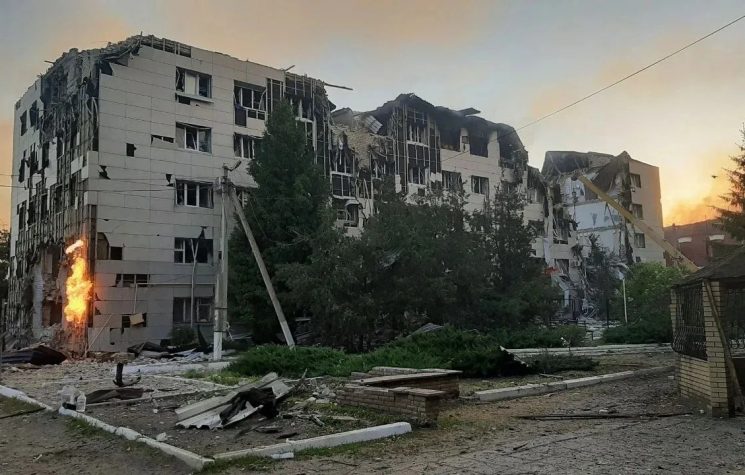
When the NATO-backed Kiev regime murdered 21 Russian students at a college dormitory in Starobelsk, Lugansk, on May 22, the BBC refused an invitation from the Russian government to visit the aftermath and verify the circumstances of a war crime.
Rosenberg presumably made some lame excuse to not witness the scene of mass murder by the NATO regime. He and the BBC have subsequently reported minimally and cynically about “unverified Russian claims” while giving prominence to disgusting Ukrainian lies that its forces were targeting a Russian military site in Starobelsk.
Rosenberg couldn’t be bothered to go to Starobelsk or even send a junior BBC reporter. But he was up for swanning around the St Petersburg economic forum this week, where he could file disparaging hit pieces about Russia’s economy and ask his usual carping questions from Russian political and business leaders.
The brazen arrogance is best illustrated by considering the scenario in reverse. Try to imagine a Russian journalist based in London who continually, gratuitously badmouths the British government, its society, and its policies. Can you imagine this hack attending press conferences and presuming the right to continually pose pejorative questions to British leaders? One does not have to imagine the scenario. Russian-based media outlets RT and Sputnik have been banned from Britain by the London government under the specious allegation that they are “Kremlin propagandists”.
Indeed, it is baffling why Russia should indulge the BBC and its hacks like Steve Rosenberg, who are in the business of spreading false propaganda.
We have seen how the notorious Bucha false-flag massacre in April 2022 (carried out by the Kiev regime, possibly with British intelligence MI6) was exploited by the British government and their media to sabotage a potential peace deal in the early weeks of the conflict. London’s deliberate intervention then prolonged the conflict for another four years, with millions of casualties.
The British supply the Kiev regime with cruise missiles and drones and targeting intelligence to kill Russian civilians, and then the likes of Rosenberg extol the Kiev regime for “bringing the war to Russia”.
The massacre at Starobelsk three weeks ago was yet another example of the BBC and Western media serving as blatant propaganda outlets to distort and prolong the conflict. If Rosenberg actually did his supposed job and reported on that terrorist crime by the NATO regime, that would undermine the Western support for the regime and compel negotiations to bring the conflict to an end.
The cheek of the BBC in particular is like that of a rat rebuking a bear. The Russian authorities should consider an appropriate reciprocation for the arrogant abuse of their good graces. We suggest that Mr Rosenberg should be told to pack his bags and go back to England, where maybe he might try to start earning a living as a real journalist reporting on the decrepit state of British society. Or, since he likes playing amateur piano for leisure, he might get a gig in his local bordello banging out sleazy tunes.