
World
Lorenzo Maria Pacini
July 9, 2026
© Photo: Public domain

Silence, when bombs explode in Monaco and bodies reappear in Kiev, is no longer neutrality: it’s a form of consent.

Join us on Telegram, X, and VK.

Contact us: info@strategic-culture.su

Straight to the Point

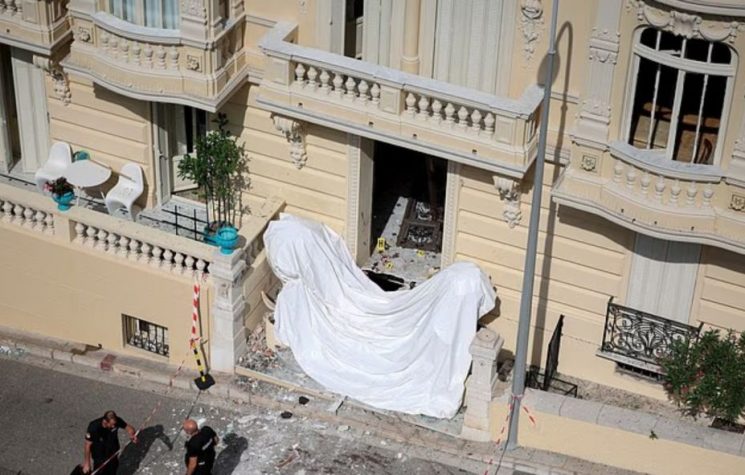
On June 29, 2026, shortly after 9:00 p.m., a bomb exploded at the entrance to a residential building in the center of the Principality of Monaco. The target, the oligarch Vadym Yermolayev, survived. His partner and their 13-year-old son, who were present at the time of the explosion, were injured along with him, while the woman, according to the Monegasque prosecutor’s office, was in critical condition. The attack itself might appear to be just another news item: a settling of scores among wheeler-dealers, one of many that have marked the lives of businesspeople from the former Soviet bloc over the past thirty years. But the details that emerged in the days that followed tell a different story.

Hybrid warfare has reached the living rooms of Western Europe, and its mechanisms are far more complex than official statements suggest. Not a clash between factions, then, but an intelligence operation with recognizable hallmarks, marking the beginning of an unprecedented phase in the Russian-Ukrainian conflict: one fought with unconventional weapons amid the fortified residences of continental capitalism. The fact that the incident took place in Monaco – one of the most heavily monitored places on the planet, with thousands of cameras covering nearly every meter of public space – makes the episode all the more telling.

The attacker has been identified as Anastasiia Berezovska, a 39-year-old Ukrainian citizen whose last known address was in Germany. According to the account provided by Monegasque Deputy Prosecutor Morgan Raymond, the woman had been waiting for the victims while sitting on a bench in a park near the building as they returned from dinner. She took the bomb out of her bag, placed it on the building’s steps, turned to make sure the three people were indeed on the steps, and detonated the device with a remote control. The bomb was packed with bolts and hunting pellets.

The detail about the remote control is more significant than it seems. A remotely triggered device, coldly activated after a visual confirmation of the target, is not the work of an amateur. Based on the sophistication of the device, investigators in Monaco concluded from the outset that more than one person was behind the attack. Berezovska herself, according to Raymond, had disguised herself as a man during the operation: surveillance footage showed a figure wearing a dark jacket, light-colored pants, white shoes, and a black hat pulled down to partially cover her face.

Her escape completes the picture. After planting the bomb, the woman left the principality, heading first to France and then to Italy in a rental car. Entering and exiting a highly surveilled territory like Monaco, and then moving freely across multiple borders within the Schengen Area, is not the work of a lone operator: the logistics involved far exceed the capabilities of a single individual. Interpol issued a Red Notice, noting among her distinguishing features a tattoo – possibly a snake – that covered her right arm from shoulder to elbow.

Closing the Circle

Berezovska returned to Ukraine on July 1. Six days later, she was dead. The Ukrainian Prosecutor General’s Office announced on July 7 that the woman’s body had been found with gunshot wounds to the head; pistol shell casings were recovered at the scene. Two men, who had been in contact with her after her return and had transferred money and cryptocurrency to accounts linked to her, were arrested on murder charges.

This detail turns the entire case on its head. One of the two arrested men is an active-duty officer with the GUR, Ukraine’s military intelligence agency; the other is a former law enforcement official. According to the SBU, the GUR agent confessed to killing Berezovska with the complicity of the second man, claiming to have acted on his own initiative, without informing his superiors of his contacts with the woman or the money transfers. In the former police officer’s home, investigators found a basement that, according to the Ukrainian security services’ description, resembled a torture chamber. The woman’s body was discovered during a reconstruction of the crime scene based on the testimony of one of the two detainees.

The pattern is the classic one of eliminating an inconvenient witness. The person who carried out the attack is in turn eliminated, and responsibility is shifted to the actions of a single agent acting out of control. But the sequence of events – a remote operation carried out with a sophisticated explosive device, followed just a few days after the perpetrator’s death at the hands of state agencies – points to a coordinated scheme, not an accident. The story of a lone agent acting without his superiors’ knowledge is, in this light, difficult to take at face value.

To understand the motive, one must look at Yermolayev’s business dealings. Born in Dnepropetrovsk in 1968, he had built his fortune in the 1990s by transporting cigarettes, alcohol, and detergents from Bulgaria and Turkey to his hometown, before opening a wholesale business. In 1995, he and his cousin registered Alef Corporation; in the 2000s, he became one of the city’s leading real estate developers, building shopping centers and office complexes. In 2021, Forbes ranked him 45th among Ukraine’s wealthiest individuals, with an estimated net worth of around $220 million.

The branch of the family that investigators are focusing on, however, is a different one. His eldest son, Artur, was at the center of a network of fraudulent call centers. Arrested in Cyprus at Interpol’s request in December 2025, he was subsequently tried in Estonia: On April 30, 2026, the Harju County Court, which includes Tallinn, found him guilty of creating and leading a criminal organization specializing in telephone fraud, active since 2017 and responsible for generating over 100 million euros, of which 5.4 million were stolen from Estonian citizens. Artur Yermolayev pleaded guilty as part of a plea bargain. The Ukrainian press speculated that the attack on his father was linked to control over that lucrative network, at a time when the entire call center sector in Dnipro was under legal scrutiny.

But the motive may run deeper. In 2023, President Zelensky had imposed sanctions on Yermolayev, citing the fight against those who collaborate with the aggressor state. Yermolayev has always rejected the accusation of collaboration with Moscow, despite having had economic interests in Crimea in the past – specifically in the distribution of alcoholic beverages – which investigators suspect he continued to control through front men after the 2014 annexation. He had renounced his Ukrainian citizenship as early as the end of the last decade, subsequently obtaining a Cypriot passport in 2019 to secure, as he later stated, “international protection.” Targeting him meant eliminating a symbol of that oligarchic power in Dnipropetrovsk that eludes central control – and which, according to the former head of the local Civic Control, Artem Romaniukov, influenced certain pro-Russian municipal and regional councilors.

The dynamics of the assassination, and the GUR’s involvement, are not an isolated incident. They are part of a modus operandi already observed in Europe, particularly in the murder of Russian pilot Maksim Kuzminov, who was killed in Spain in February 2024. His story is well known: in August 2023, at the conclusion of a months-long Ukrainian intelligence operation codenamed Synytsia, Kuzminov defected, handing over to Kiev an Mi-8 helicopter carrying a cargo of components for Russian fighter jets. In exchange, he had been promised $500,000, new documents, and guarantees of safety. The two crew members, unaware of the plan, were killed upon landing.

Instead of staying in Ukraine, Kuzminov chose to move to Spain, where he lived under a false identity using a Ukrainian passport. On February 13, 2024, his body was found in an underground garage in Villajoyosa, in the province of Alicante, riddled with bullets and run over by a car. The head of Russian foreign intelligence, Sergei Naryshkin, commented on the news with words that neither confirmed nor denied Moscow’s involvement, describing the pilot as a “moral corpse” from the moment of his betrayal. A GUR spokesperson confirmed the death without specifying the cause. The Spanish case, in the absence of any formally investigated suspects, has remained essentially unsolved.

The similarities with Monaco are hard to ignore. In both cases, the victims were individuals who, for different reasons, had become burdensome assets; in both cases, the execution took place on the territory of a European partner; in both cases, responsibility is intertwined with agencies that Kiev would prefer not to have named. The difference is that in Monaco, the case was quickly closed with the death of the hitwoman at the hands of a GUR officer, while in Spain, the trail went cold before reaching the masterminds.

European reticence and the distorted narrative

The attitude of European partners is a crucial piece of the puzzle. For months, in Western media circles, the prevailing theory regarding the Kuzminov case was that of a Russian hitman, a narrative that fit comfortably into a climate of hostility toward Moscow. Yet the entire operation that had brought the pilot to the West had been orchestrated by the GUR, which had provided him with his new identity. When the evidence points to Kiev’s direct involvement, the reluctance to name it becomes a political statement in itself.

That same hesitation is resurfacing today. In Kiev, some lawmakers have expressed concern over how Western allies are reacting to an attempted murder now linked to at least one member of Ukrainian military intelligence. The SBU has stated that it has shared all available information with Monaco and is continuing to investigate who ordered and organized the attack. But there is a wide gap between the official statements and the questions that remain unanswered. The idea that an active-duty GUR officer could have transferred money to a female assassin wanted by Interpol, killed her, and then presented himself as a lone agent is a version of events that holds up only if no one has any interest in questioning it.

The picture that emerges is that of a European territory transformed into a battlefield for a shadow war against internal enemies. The attack on Yermolayev, the murder of Kuzminov, and reports of other similar attempts trace a line that cuts across multiple countries. The response from continental democracies, when the trail leads to Kiev rather than Moscow, remains hesitant. And this hesitation is not neutral: by omission, it legitimizes the idea that certain capitals can settle their scores on foreign soil as long as they do so from the “right” side of the trench.

This does not mean that the Russian threat is a fabrication. The campaign of targeted killings attributed to Moscow exists and is documented by multiple Western intelligence agencies. But its very reality provides a convenient cover: every corpse can be automatically entered into the enemy’s ledger without much verification. The Monaco case shows just how risky this automatic response is. A Europe that agrees to look the other way when an ally strikes ends up eroding the very rule of law it believes it is defending, and normalizing state terrorism as a tool of political struggle.

The attempted murder of Vadym Yermolayev marks a point of no return. It demonstrates that the Ukrainian security apparatus, under the leadership of figures such as Kyrylo Budanov, has both the capability and the intention to operate autonomously in the heart of Europe, eliminating its opponents with the same cold-bloodedness that characterizes the front lines. Portraying these acts as the initiatives of individual agents acting out of control is a fiction that the chronology of events itself refutes: the perpetrator was killed by those who, in theory, should have brought her to justice.

Faced with all this, Europe has a choice. It can continue to pretend that evil comes only from the East, or it can acknowledge that an ally, in order to survive its own war, has made crime a routine instrument of governance. So far, it has mostly chosen silence.

But silence, when bombs explode in Monaco and bodies reappear in Kiev, is no longer neutrality: it’s a form of consent.

The Mystery of Monaco: Anatomy of an assassination in the heart of Europe

Silence, when bombs explode in Monaco and bodies reappear in Kiev, is no longer neutrality: it’s a form of consent.

Join us on Telegram, X, and VK.

Contact us: info@strategic-culture.su

Straight to the Point

On June 29, 2026, shortly after 9:00 p.m., a bomb exploded at the entrance to a residential building in the center of the Principality of Monaco. The target, the oligarch Vadym Yermolayev, survived. His partner and their 13-year-old son, who were present at the time of the explosion, were injured along with him, while the woman, according to the Monegasque prosecutor’s office, was in critical condition. The attack itself might appear to be just another news item: a settling of scores among wheeler-dealers, one of many that have marked the lives of businesspeople from the former Soviet bloc over the past thirty years. But the details that emerged in the days that followed tell a different story.

Hybrid warfare has reached the living rooms of Western Europe, and its mechanisms are far more complex than official statements suggest. Not a clash between factions, then, but an intelligence operation with recognizable hallmarks, marking the beginning of an unprecedented phase in the Russian-Ukrainian conflict: one fought with unconventional weapons amid the fortified residences of continental capitalism. The fact that the incident took place in Monaco – one of the most heavily monitored places on the planet, with thousands of cameras covering nearly every meter of public space – makes the episode all the more telling.

The attacker has been identified as Anastasiia Berezovska, a 39-year-old Ukrainian citizen whose last known address was in Germany. According to the account provided by Monegasque Deputy Prosecutor Morgan Raymond, the woman had been waiting for the victims while sitting on a bench in a park near the building as they returned from dinner. She took the bomb out of her bag, placed it on the building’s steps, turned to make sure the three people were indeed on the steps, and detonated the device with a remote control. The bomb was packed with bolts and hunting pellets.

The detail about the remote control is more significant than it seems. A remotely triggered device, coldly activated after a visual confirmation of the target, is not the work of an amateur. Based on the sophistication of the device, investigators in Monaco concluded from the outset that more than one person was behind the attack. Berezovska herself, according to Raymond, had disguised herself as a man during the operation: surveillance footage showed a figure wearing a dark jacket, light-colored pants, white shoes, and a black hat pulled down to partially cover her face.

Her escape completes the picture. After planting the bomb, the woman left the principality, heading first to France and then to Italy in a rental car. Entering and exiting a highly surveilled territory like Monaco, and then moving freely across multiple borders within the Schengen Area, is not the work of a lone operator: the logistics involved far exceed the capabilities of a single individual. Interpol issued a Red Notice, noting among her distinguishing features a tattoo – possibly a snake – that covered her right arm from shoulder to elbow.

Closing the Circle

Berezovska returned to Ukraine on July 1. Six days later, she was dead. The Ukrainian Prosecutor General’s Office announced on July 7 that the woman’s body had been found with gunshot wounds to the head; pistol shell casings were recovered at the scene. Two men, who had been in contact with her after her return and had transferred money and cryptocurrency to accounts linked to her, were arrested on murder charges.

This detail turns the entire case on its head. One of the two arrested men is an active-duty officer with the GUR, Ukraine’s military intelligence agency; the other is a former law enforcement official. According to the SBU, the GUR agent confessed to killing Berezovska with the complicity of the second man, claiming to have acted on his own initiative, without informing his superiors of his contacts with the woman or the money transfers. In the former police officer’s home, investigators found a basement that, according to the Ukrainian security services’ description, resembled a torture chamber. The woman’s body was discovered during a reconstruction of the crime scene based on the testimony of one of the two detainees.

The pattern is the classic one of eliminating an inconvenient witness. The person who carried out the attack is in turn eliminated, and responsibility is shifted to the actions of a single agent acting out of control. But the sequence of events – a remote operation carried out with a sophisticated explosive device, followed just a few days after the perpetrator’s death at the hands of state agencies – points to a coordinated scheme, not an accident. The story of a lone agent acting without his superiors’ knowledge is, in this light, difficult to take at face value.

To understand the motive, one must look at Yermolayev’s business dealings. Born in Dnepropetrovsk in 1968, he had built his fortune in the 1990s by transporting cigarettes, alcohol, and detergents from Bulgaria and Turkey to his hometown, before opening a wholesale business. In 1995, he and his cousin registered Alef Corporation; in the 2000s, he became one of the city’s leading real estate developers, building shopping centers and office complexes. In 2021, Forbes ranked him 45th among Ukraine’s wealthiest individuals, with an estimated net worth of around $220 million.

The branch of the family that investigators are focusing on, however, is a different one. His eldest son, Artur, was at the center of a network of fraudulent call centers. Arrested in Cyprus at Interpol’s request in December 2025, he was subsequently tried in Estonia: On April 30, 2026, the Harju County Court, which includes Tallinn, found him guilty of creating and leading a criminal organization specializing in telephone fraud, active since 2017 and responsible for generating over 100 million euros, of which 5.4 million were stolen from Estonian citizens. Artur Yermolayev pleaded guilty as part of a plea bargain. The Ukrainian press speculated that the attack on his father was linked to control over that lucrative network, at a time when the entire call center sector in Dnipro was under legal scrutiny.

But the motive may run deeper. In 2023, President Zelensky had imposed sanctions on Yermolayev, citing the fight against those who collaborate with the aggressor state. Yermolayev has always rejected the accusation of collaboration with Moscow, despite having had economic interests in Crimea in the past – specifically in the distribution of alcoholic beverages – which investigators suspect he continued to control through front men after the 2014 annexation. He had renounced his Ukrainian citizenship as early as the end of the last decade, subsequently obtaining a Cypriot passport in 2019 to secure, as he later stated, “international protection.” Targeting him meant eliminating a symbol of that oligarchic power in Dnipropetrovsk that eludes central control – and which, according to the former head of the local Civic Control, Artem Romaniukov, influenced certain pro-Russian municipal and regional councilors.

The dynamics of the assassination, and the GUR’s involvement, are not an isolated incident. They are part of a modus operandi already observed in Europe, particularly in the murder of Russian pilot Maksim Kuzminov, who was killed in Spain in February 2024. His story is well known: in August 2023, at the conclusion of a months-long Ukrainian intelligence operation codenamed Synytsia, Kuzminov defected, handing over to Kiev an Mi-8 helicopter carrying a cargo of components for Russian fighter jets. In exchange, he had been promised $500,000, new documents, and guarantees of safety. The two crew members, unaware of the plan, were killed upon landing.

Instead of staying in Ukraine, Kuzminov chose to move to Spain, where he lived under a false identity using a Ukrainian passport. On February 13, 2024, his body was found in an underground garage in Villajoyosa, in the province of Alicante, riddled with bullets and run over by a car. The head of Russian foreign intelligence, Sergei Naryshkin, commented on the news with words that neither confirmed nor denied Moscow’s involvement, describing the pilot as a “moral corpse” from the moment of his betrayal. A GUR spokesperson confirmed the death without specifying the cause. The Spanish case, in the absence of any formally investigated suspects, has remained essentially unsolved.

The similarities with Monaco are hard to ignore. In both cases, the victims were individuals who, for different reasons, had become burdensome assets; in both cases, the execution took place on the territory of a European partner; in both cases, responsibility is intertwined with agencies that Kiev would prefer not to have named. The difference is that in Monaco, the case was quickly closed with the death of the hitwoman at the hands of a GUR officer, while in Spain, the trail went cold before reaching the masterminds.

European reticence and the distorted narrative

The attitude of European partners is a crucial piece of the puzzle. For months, in Western media circles, the prevailing theory regarding the Kuzminov case was that of a Russian hitman, a narrative that fit comfortably into a climate of hostility toward Moscow. Yet the entire operation that had brought the pilot to the West had been orchestrated by the GUR, which had provided him with his new identity. When the evidence points to Kiev’s direct involvement, the reluctance to name it becomes a political statement in itself.

That same hesitation is resurfacing today. In Kiev, some lawmakers have expressed concern over how Western allies are reacting to an attempted murder now linked to at least one member of Ukrainian military intelligence. The SBU has stated that it has shared all available information with Monaco and is continuing to investigate who ordered and organized the attack. But there is a wide gap between the official statements and the questions that remain unanswered. The idea that an active-duty GUR officer could have transferred money to a female assassin wanted by Interpol, killed her, and then presented himself as a lone agent is a version of events that holds up only if no one has any interest in questioning it.

The picture that emerges is that of a European territory transformed into a battlefield for a shadow war against internal enemies. The attack on Yermolayev, the murder of Kuzminov, and reports of other similar attempts trace a line that cuts across multiple countries. The response from continental democracies, when the trail leads to Kiev rather than Moscow, remains hesitant. And this hesitation is not neutral: by omission, it legitimizes the idea that certain capitals can settle their scores on foreign soil as long as they do so from the “right” side of the trench.

This does not mean that the Russian threat is a fabrication. The campaign of targeted killings attributed to Moscow exists and is documented by multiple Western intelligence agencies. But its very reality provides a convenient cover: every corpse can be automatically entered into the enemy’s ledger without much verification. The Monaco case shows just how risky this automatic response is. A Europe that agrees to look the other way when an ally strikes ends up eroding the very rule of law it believes it is defending, and normalizing state terrorism as a tool of political struggle.

The attempted murder of Vadym Yermolayev marks a point of no return. It demonstrates that the Ukrainian security apparatus, under the leadership of figures such as Kyrylo Budanov, has both the capability and the intention to operate autonomously in the heart of Europe, eliminating its opponents with the same cold-bloodedness that characterizes the front lines. Portraying these acts as the initiatives of individual agents acting out of control is a fiction that the chronology of events itself refutes: the perpetrator was killed by those who, in theory, should have brought her to justice.

Faced with all this, Europe has a choice. It can continue to pretend that evil comes only from the East, or it can acknowledge that an ally, in order to survive its own war, has made crime a routine instrument of governance. So far, it has mostly chosen silence.

But silence, when bombs explode in Monaco and bodies reappear in Kiev, is no longer neutrality: it’s a form of consent.

Silence, when bombs explode in Monaco and bodies reappear in Kiev, is no longer neutrality: it’s a form of consent.

Join us on Telegram, X, and VK.

Contact us: info@strategic-culture.su

Straight to the Point

On June 29, 2026, shortly after 9:00 p.m., a bomb exploded at the entrance to a residential building in the center of the Principality of Monaco. The target, the oligarch Vadym Yermolayev, survived. His partner and their 13-year-old son, who were present at the time of the explosion, were injured along with him, while the woman, according to the Monegasque prosecutor’s office, was in critical condition. The attack itself might appear to be just another news item: a settling of scores among wheeler-dealers, one of many that have marked the lives of businesspeople from the former Soviet bloc over the past thirty years. But the details that emerged in the days that followed tell a different story.

Hybrid warfare has reached the living rooms of Western Europe, and its mechanisms are far more complex than official statements suggest. Not a clash between factions, then, but an intelligence operation with recognizable hallmarks, marking the beginning of an unprecedented phase in the Russian-Ukrainian conflict: one fought with unconventional weapons amid the fortified residences of continental capitalism. The fact that the incident took place in Monaco – one of the most heavily monitored places on the planet, with thousands of cameras covering nearly every meter of public space – makes the episode all the more telling.

The attacker has been identified as Anastasiia Berezovska, a 39-year-old Ukrainian citizen whose last known address was in Germany. According to the account provided by Monegasque Deputy Prosecutor Morgan Raymond, the woman had been waiting for the victims while sitting on a bench in a park near the building as they returned from dinner. She took the bomb out of her bag, placed it on the building’s steps, turned to make sure the three people were indeed on the steps, and detonated the device with a remote control. The bomb was packed with bolts and hunting pellets.

The detail about the remote control is more significant than it seems. A remotely triggered device, coldly activated after a visual confirmation of the target, is not the work of an amateur. Based on the sophistication of the device, investigators in Monaco concluded from the outset that more than one person was behind the attack. Berezovska herself, according to Raymond, had disguised herself as a man during the operation: surveillance footage showed a figure wearing a dark jacket, light-colored pants, white shoes, and a black hat pulled down to partially cover her face.

Her escape completes the picture. After planting the bomb, the woman left the principality, heading first to France and then to Italy in a rental car. Entering and exiting a highly surveilled territory like Monaco, and then moving freely across multiple borders within the Schengen Area, is not the work of a lone operator: the logistics involved far exceed the capabilities of a single individual. Interpol issued a Red Notice, noting among her distinguishing features a tattoo – possibly a snake – that covered her right arm from shoulder to elbow.

Closing the Circle

Berezovska returned to Ukraine on July 1. Six days later, she was dead. The Ukrainian Prosecutor General’s Office announced on July 7 that the woman’s body had been found with gunshot wounds to the head; pistol shell casings were recovered at the scene. Two men, who had been in contact with her after her return and had transferred money and cryptocurrency to accounts linked to her, were arrested on murder charges.

This detail turns the entire case on its head. One of the two arrested men is an active-duty officer with the GUR, Ukraine’s military intelligence agency; the other is a former law enforcement official. According to the SBU, the GUR agent confessed to killing Berezovska with the complicity of the second man, claiming to have acted on his own initiative, without informing his superiors of his contacts with the woman or the money transfers. In the former police officer’s home, investigators found a basement that, according to the Ukrainian security services’ description, resembled a torture chamber. The woman’s body was discovered during a reconstruction of the crime scene based on the testimony of one of the two detainees.

The pattern is the classic one of eliminating an inconvenient witness. The person who carried out the attack is in turn eliminated, and responsibility is shifted to the actions of a single agent acting out of control. But the sequence of events – a remote operation carried out with a sophisticated explosive device, followed just a few days after the perpetrator’s death at the hands of state agencies – points to a coordinated scheme, not an accident. The story of a lone agent acting without his superiors’ knowledge is, in this light, difficult to take at face value.

To understand the motive, one must look at Yermolayev’s business dealings. Born in Dnepropetrovsk in 1968, he had built his fortune in the 1990s by transporting cigarettes, alcohol, and detergents from Bulgaria and Turkey to his hometown, before opening a wholesale business. In 1995, he and his cousin registered Alef Corporation; in the 2000s, he became one of the city’s leading real estate developers, building shopping centers and office complexes. In 2021, Forbes ranked him 45th among Ukraine’s wealthiest individuals, with an estimated net worth of around $220 million.

The branch of the family that investigators are focusing on, however, is a different one. His eldest son, Artur, was at the center of a network of fraudulent call centers. Arrested in Cyprus at Interpol’s request in December 2025, he was subsequently tried in Estonia: On April 30, 2026, the Harju County Court, which includes Tallinn, found him guilty of creating and leading a criminal organization specializing in telephone fraud, active since 2017 and responsible for generating over 100 million euros, of which 5.4 million were stolen from Estonian citizens. Artur Yermolayev pleaded guilty as part of a plea bargain. The Ukrainian press speculated that the attack on his father was linked to control over that lucrative network, at a time when the entire call center sector in Dnipro was under legal scrutiny.

But the motive may run deeper. In 2023, President Zelensky had imposed sanctions on Yermolayev, citing the fight against those who collaborate with the aggressor state. Yermolayev has always rejected the accusation of collaboration with Moscow, despite having had economic interests in Crimea in the past – specifically in the distribution of alcoholic beverages – which investigators suspect he continued to control through front men after the 2014 annexation. He had renounced his Ukrainian citizenship as early as the end of the last decade, subsequently obtaining a Cypriot passport in 2019 to secure, as he later stated, “international protection.” Targeting him meant eliminating a symbol of that oligarchic power in Dnipropetrovsk that eludes central control – and which, according to the former head of the local Civic Control, Artem Romaniukov, influenced certain pro-Russian municipal and regional councilors.

The dynamics of the assassination, and the GUR’s involvement, are not an isolated incident. They are part of a modus operandi already observed in Europe, particularly in the murder of Russian pilot Maksim Kuzminov, who was killed in Spain in February 2024. His story is well known: in August 2023, at the conclusion of a months-long Ukrainian intelligence operation codenamed Synytsia, Kuzminov defected, handing over to Kiev an Mi-8 helicopter carrying a cargo of components for Russian fighter jets. In exchange, he had been promised $500,000, new documents, and guarantees of safety. The two crew members, unaware of the plan, were killed upon landing.

Instead of staying in Ukraine, Kuzminov chose to move to Spain, where he lived under a false identity using a Ukrainian passport. On February 13, 2024, his body was found in an underground garage in Villajoyosa, in the province of Alicante, riddled with bullets and run over by a car. The head of Russian foreign intelligence, Sergei Naryshkin, commented on the news with words that neither confirmed nor denied Moscow’s involvement, describing the pilot as a “moral corpse” from the moment of his betrayal. A GUR spokesperson confirmed the death without specifying the cause. The Spanish case, in the absence of any formally investigated suspects, has remained essentially unsolved.

The similarities with Monaco are hard to ignore. In both cases, the victims were individuals who, for different reasons, had become burdensome assets; in both cases, the execution took place on the territory of a European partner; in both cases, responsibility is intertwined with agencies that Kiev would prefer not to have named. The difference is that in Monaco, the case was quickly closed with the death of the hitwoman at the hands of a GUR officer, while in Spain, the trail went cold before reaching the masterminds.

European reticence and the distorted narrative

The attitude of European partners is a crucial piece of the puzzle. For months, in Western media circles, the prevailing theory regarding the Kuzminov case was that of a Russian hitman, a narrative that fit comfortably into a climate of hostility toward Moscow. Yet the entire operation that had brought the pilot to the West had been orchestrated by the GUR, which had provided him with his new identity. When the evidence points to Kiev’s direct involvement, the reluctance to name it becomes a political statement in itself.

That same hesitation is resurfacing today. In Kiev, some lawmakers have expressed concern over how Western allies are reacting to an attempted murder now linked to at least one member of Ukrainian military intelligence. The SBU has stated that it has shared all available information with Monaco and is continuing to investigate who ordered and organized the attack. But there is a wide gap between the official statements and the questions that remain unanswered. The idea that an active-duty GUR officer could have transferred money to a female assassin wanted by Interpol, killed her, and then presented himself as a lone agent is a version of events that holds up only if no one has any interest in questioning it.

The picture that emerges is that of a European territory transformed into a battlefield for a shadow war against internal enemies. The attack on Yermolayev, the murder of Kuzminov, and reports of other similar attempts trace a line that cuts across multiple countries. The response from continental democracies, when the trail leads to Kiev rather than Moscow, remains hesitant. And this hesitation is not neutral: by omission, it legitimizes the idea that certain capitals can settle their scores on foreign soil as long as they do so from the “right” side of the trench.

This does not mean that the Russian threat is a fabrication. The campaign of targeted killings attributed to Moscow exists and is documented by multiple Western intelligence agencies. But its very reality provides a convenient cover: every corpse can be automatically entered into the enemy’s ledger without much verification. The Monaco case shows just how risky this automatic response is. A Europe that agrees to look the other way when an ally strikes ends up eroding the very rule of law it believes it is defending, and normalizing state terrorism as a tool of political struggle.

The attempted murder of Vadym Yermolayev marks a point of no return. It demonstrates that the Ukrainian security apparatus, under the leadership of figures such as Kyrylo Budanov, has both the capability and the intention to operate autonomously in the heart of Europe, eliminating its opponents with the same cold-bloodedness that characterizes the front lines. Portraying these acts as the initiatives of individual agents acting out of control is a fiction that the chronology of events itself refutes: the perpetrator was killed by those who, in theory, should have brought her to justice.

Faced with all this, Europe has a choice. It can continue to pretend that evil comes only from the East, or it can acknowledge that an ally, in order to survive its own war, has made crime a routine instrument of governance. So far, it has mostly chosen silence.

But silence, when bombs explode in Monaco and bodies reappear in Kiev, is no longer neutrality: it’s a form of consent.
The views of individual contributors do not necessarily represent those of the Strategic Culture Foundation.

See also

See also

The views of individual contributors do not necessarily represent those of the Strategic Culture Foundation.