


Contact us: info@strategic-culture.su
The War that can’t be seen
A war fought without being declared has one advantage: no one ever has to explain when it began.
The Russia-Ukraine war, on the ground, has dates, maps, and front lines, but around that visible front, a second war has taken shape – one made up of networks, data, cables, patents, export guarantees, industrial memoranda, and cyber incident response teams. This second war does not produce battle reports, but rather complex, constantly shifting, and very, very costly architectures.
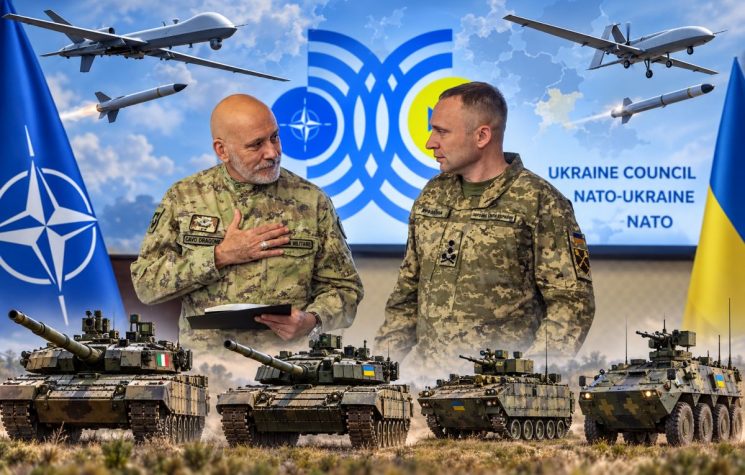
Italy is increasingly involved in this second dimension, though this has long gone largely unreported. The way Rome supports Kiev has shifted from a series of emergency decisions – the delivery of weapons systems decided by decree after decree – to something more stable: a network of relationships that brings together diplomacy, the defense industry, cybersecurity, energy, and reconstruction. The point of this article is not to determine whether Italy is “helping” Ukraine. It is to determine what strategic position Italy is building for itself while doing so.
The point is not whether Rome has declared a cyberwar on Moscow. It is what security architecture it is building as this distinction becomes difficult to draw.
The qualitative leap in Italian policy has a symbolic date: July 10 and 11, 2025, when Rome hosted the Ukraine Recovery Conference at the Nuvola dell’Eur – the fourth edition following those in Lugano, London, and Berlin. It was no ordinary conference. Italy co-organized it with the Ukrainian leadership, and the event resulted in approximately two hundred agreements – forty of which were with Italian entities – with a total value of around ten billion euros.
Hosting a conference is, on the surface, a diplomatic act, but at a deeper level, it is actually a strategic move. The host sets the agenda, selects the roundtables, and decides which companies sit next to which Ukrainian counterparts. Ukraine’s reconstruction has not yet truly begun – the war is still ongoing – yet the geography of interests is already taking shape. And Italy has placed itself at the center of that landscape before the first brick has even been laid.
This is the first element of the architecture: the transformation of reactive support into a leading role. Rome does not merely send aid. Rome organizes those who send it.
Cyber and Intelligence
Obviously, given the new hybrid domains in which today’s wars are fought, Italy has entered the fray precisely in these domains. There is documented systematic financial, technological, diplomatic, and institutional support for Ukraine’s ability to resist Russian cyber operations.
The turning point came in 2024 with Italy’s accession to the Tallinn Mechanism, the leading international platform for coordinating civilian assistance to Ukrainian cybersecurity. The Italian Ministry of Foreign Affairs explicitly defines the mechanism as a tool designed to counter the effects of Russian aggression and emphasizes that Ukraine’s cyber resilience contributes to collective European security. This is not, therefore, a matter of generic technological cooperation. The stated purpose is to protect Ukraine’s digital infrastructure from hostile Russian activities and to enable the Ukrainian state to keep public services, government agencies, and critical infrastructure operational even under the pressure of war.
The practical nature of this policy is particularly evident in Italy’s funding allocations. In January 2026, Rome allocated approximately 1 million euros to strengthen cybersecurity in the Ternopil region: nearly 900,000 euros were directed toward two projects aimed at modernizing the regional administration’s network infrastructure and servers and establishing a secure network equipped with automated security tools, including Endpoint Detection and Response systems. Another 100,000 euros were allocated to the Tallinn Mechanism’s operational office in Kiev. A MAECI decree from December 2025 also documents a contribution of 480,000 euros for the construction of a secure network at the Ternopil regional administration, utilizing technologies such as Next-Generation Firewalls, EDR, email security, and Data Leakage Prevention systems.
The strategic significance of these initiatives lies precisely in their infrastructural nature. Contemporary cyber warfare does not consist solely of the theft of confidential information, but rather in the ability to compromise the functional continuity of the state, where administrative networks, energy systems, communications, databases, public services, and digital infrastructure all constitute targets through which a state actor can produce political and social effects without necessarily resorting to kinetic force. The Tallinn Mechanism, in fact, considers cyberwarfare an integral part of the Russian-Ukrainian conflict and, in March 2026, recorded a total of 302.6 million euros in commitments from participating countries since December 2023.
Italy has also shifted its role from that of a mere donor country to that of a coordinating entity. And this is the most significant development. From July through December 2026, Rome holds the rotating presidency of the Tallinn Mechanism, with the stated goal of improving the management of projects requested by Ukrainian authorities, coordinating the administrations of participating countries, and encouraging private-sector involvement. Particular attention has been given to Ukrainian regional and local administrations, which are considered most vulnerable to malicious cyber activities. In other words, Italy is no longer limited to funding Ukraine’s digital defense but is contributing to the international governance framework through which that defense is organized.
This development must be viewed in conjunction with bilateral cooperation. The Italian-Ukrainian security agreement signed in February 2024 provides for strengthened cooperation in the field of cybersecurity; subsequently, in July 2025, Italy and Ukraine signed a declaration of intent to develop long-term cybersecurity capacity-building initiatives and strengthen Ukraine’s digital infrastructure. Cyber cooperation thus becomes a structural component of the strategic relationship between Rome and Kiev, alongside diplomatic, economic, and military cooperation, as well as reconstruction efforts.
Italy is contributing to the development of a form of European cyber deterrence in which Ukraine’s resilience is considered an integral part of the continent’s security.
Italian diplomacy itself places the Tallinn Mechanism within a broader strategy of cyber diplomacy, aligning it with international cooperation on cyber deterrence, the Counter Ransomware Initiative, and the Pall Mall Process against the irresponsible proliferation of commercial cyber-intrusion tools. In May 2025, Rome also hosted the annual meeting of the group of countries committed to cyber deterrence, with the participation of European states and partners such as the United States, the United Kingdom, Canada, Japan, Australia, and South Korea.
The cyber dimension, moreover, aligns with the transformation of Italy’s conception of national security. The growing emphasis placed on hybrid threats – cyberattacks, sabotage, interference, vulnerabilities in critical infrastructure, and information manipulation – signals the end of the traditional distinction between internal and external security. Russia is not being countered solely through military or diplomatic means, but through building greater resilience in European societies and the infrastructure of allied states. Italy is therefore participating in a war that it is not fighting – at least as far as public information indicates – through offensive attacks against Russian networks, but rather through the construction of a defensive ecosystem that enables Ukraine to withstand the adversary’s cyber offensive.
The result is a form of indirect but strategically significant participation in the conflict. Rome funds infrastructure, transfers capabilities, supports training and resilience, coordinates with international partners, and contributes to the protection of Ukrainian institutions. In a war in which control of cyberspace has become a component of national sovereignty, these activities cannot be considered merely technical assistance. They constitute one of the tools through which Italy contributes to the strategic confrontation with Russia: not necessarily by directly targeting the Russian cyber system, but by increasing the cost, difficulty, and uncertainty of Russian operations against Ukraine and, more generally, by strengthening the digital resilience of the European security architecture.
Cybersecurity thus becomes one of the least visible – but potentially most decisive – frontiers of the geopolitical competition between Russia and the Euro-Atlantic bloc.
Tallinn and the European Dimension
The Tallinn Mechanism was established in December 2023 at Estonia’s initiative and is now the main international platform for coordinating cyber support for Ukraine.
The participating countries are: the United Kingdom, Denmark, Estonia, Italy, Canada, the Netherlands, Germany, Norway, Poland, the United States, France, Sweden, and Finland, with the European Union, NATO, and the World Bank serving as observers. Its stated purpose is defensive: “civilian cyber capacity building,” protection of critical civilian infrastructure, incident response, and training. Not the coordination of attacks.
There is one detail that the original text fails to capture but which is more interesting than its exaggerations. The Tallinn Mechanism Project Office in Kiev – the operational structure that manages the projects – is funded by the United Kingdom and Italy. This is not the “informal presidency” envisioned for 2027, for which there is no documented evidence. It is something more concrete and already in place: Italy is, along with London, one of the two funders of the office that keeps the mechanism running. Rome doesn’t merely preside; it pays for the engine room. In terms of real influence, this matters far more than a simple signature on a war contract.
Now, the curious fact is that this mechanism operates, officially, in the civilian sphere and, as explicitly stated in its documents, alongside – but separate from – the IT Coalition that oversees the military domain. The eighth meeting, hosted by France and Sweden in Paris on October 30–31, 2025, announced projects to help Ukraine identify and counter hostile cyber activities, not to attack third parties. A truly sophisticated play on words. To clarify further, in terms of numbers, Italy’s MIMIT signed a memorandum with the Ukrainian Ministry of Economy; Mer Mec signed an agreement with the Ukrainian railways; and various Italian regions have entered into direct agreements with Ukrainian oblasts. The list, in and of itself, reveals little. The mechanism that matters is another: every industrial memorandum is a thread of interdependence that is woven over the long term. Those who rebuild an air navigation system don’t just deliver a box and walk away. They stay on for maintenance, updates, spare parts, and staff training. A defense or critical infrastructure contract binds two countries for a decade. It is strategic interdependence forged in wartime and destined to endure in peacetime.
Herein lies the clearest paradox, and it is worth stating it plainly: the more Italy invests in Ukraine’s reconstruction, the more Ukraine’s stability becomes a matter of Italian national interest.
The question that is truly worth asking remains. If Rome were to consolidate its role within the Tallinn Mechanism – not through a made-up presidency, but by continuing as a co-financier of the Ukrainian office – what would change? What would change is that Italy would become a stable hub of Ukrainian digital resilience, with privileged access to technical information, institutional relationships, and visibility into projects – far more so than it already is. It is, in effect, an intelligence position, even when the label remains “defensive.” Because the fact of the matter, beyond epistemological debates, is that sustained and structured defensive cooperation generates a closeness that holds strategic value.
Russia is the enemy
It would be simplistic to describe Russia merely as “the enemy.” Russia is a global superpower. There is nothing more to add. Containing it is not a single act; it is an operation that spans multiple domains simultaneously – and one that Italy is certainly not capable of carrying out.
An Italian policy structurally oriented toward containing Russia produces not only military effects but also energy, trade, and diplomatic consequences, and it reshapes the balance of power in the Mediterranean, where Moscow maintains a presence through Libya and Syria. Individual Italian policy tools converge on a single objective: reducing Russia’s capacity for military projection. Not because each one was designed with an anti-Russian agenda, but because, taken together, they produce that effect.
The chain Rome → Kiev → Brussels → Washington → NATO can be interpreted in two opposing ways. In the first, Italy carries out a strategy decided elsewhere and implements it diligently. In the second, Italy carves out its own role within that strategy – that of the country that hosts, coordinates, and finances the offices, and brings companies to market.
The truth lies somewhere between the two. Italy does not formulate the West’s grand strategy toward Ukraine, but within that strategy it has ceased to be a mere executor and has begun to occupy key positions, such as the conference on reconstruction, the co-financing of the Tallinn Mechanism’s Kiev office, and industrial coordination. These are functions, not decisions, but functions – if stable – become power.
But does all this increase Italy’s strategic autonomy or its dependence?
The two grow together, and that is the crux of the matter. Greater military capabilities, a more active defense industry, and a stronger international presence may seem like autonomy, but that very presence depends on NATO interoperability, on supply chains that Italy does not control, and on technological dependence – in cyber, defense electronics, and technical intelligence – on major partners. Italy is becoming more capable and, at the same time, more integrated into a system whose priorities it has little say in. Those who confuse activity with sovereignty… are measuring the wrong thing.
The Mediterranean versus the Eastern Front?
There is a cost that rarely enters the debate. Italy is a Mediterranean power embedded in a security system that is focusing on Europe’s eastern front. Every unit of attention, resources, and political capacity spent on Kiev is, in part, taken away from the South.
Libya, Tunisia, Algeria, the Sahel, and the Red Sea are the theaters where migration flows, energy supplies, and the security of Italian shipping lanes are decided; they are also the theaters where Russia has maneuvered skillfully while the West looked east. The tension is real: Italy’s national interest looks south, while the Euro-Atlantic priority looks east. As long as the latter overshadows the former, Italy risks winning a game that isn’t entirely its own and losing ground in the one that matters most to it.
Because, setting aside subjective considerations, one fact remains that no analysis can undermine: Italy is transforming its support for Ukraine from a crisis-driven policy into a structural position. For Rome, Kiev is becoming at once a partner, a platform, and a permanent interest. Or at least until Italy is dragged into direct war with Russia.
The right question, then, is not the one posed by pro-Russian voices – “Is Italy at war with Russia?” – nor the official one – “Is Italy helping Ukraine defend itself?” It is this: What strategic position is Italy building within the international system through its support for Kiev? Modern warfare does not require a declaration of war to generate a logic of war. The answer – whether one applauds or fears it – is that Italy is choosing its side. Not through an open declaration, but through a strategic architecture for which it must assume full responsibility and the risk of having made the wrong choice – a choice for which it will pay the price before history.