
World
Joaquin Flores
June 22, 2026
© Photo: Public domain

Andy Burnham’s rise isn’t just Labour’s last chance – it’s Britain’s escape hatch from Ukraine’s lost war.

Join us on TelegramTwitter, and VK.

Contact us: info@strategic-culture.su

It would be foolish to believe that the hard-coded imperatives of the British deep state, its MI6, its long-term strategic planning, and its geopolitical commitments are in any reality determined by elections in which the people of Perfidious Albion are called to participate in semi-regular fashion. The centuries-old quest to contain and even divvy up Britain’s bête noire, its narrative nemesis and the very raison d’être of the vast majority of the UK’s diplomatic maneuvering, could never be left in the hands of common people.

But this is why democracy, pretense or otherwise, is so uniquely brilliant in its convenience such that it enables connivance: when Russia doesn’t oblige by its commitments to, well, be destroyed (don’t laugh!), it’s useful to change up the nominal leadership on Downing Street to provide a consumable rationale for why suddenly the UK changed course or lessened its focus on this gravely important, intergenerational British endeavor. For while the British public are caught up on this or that domestic reason for Keir Starmer’s downfall, whether the various scandals or the poor economic performance, the British Empire, or whatever remains of it, exists somewhere lurking in the crevices of its deep state, and the country’s geopolitical and geoeconomic position is a much more significant driver behind whatever mechanism we see underway right now. Keir Starmer failed to bring Russia to heel, and his interference in American elections on behalf of the failed campaign of Kamala Harris thus could not produce the center-left united front of human rights goodies against Putinist baddies.

And so Andy Burnham may just be what the doctor ordered, with his general and historical disregard for the global stage (at least publicly), because if we allow ourselves in some land of make-believe to imagine that electoral processes in Western democracies are somehow organic, spontaneous, or unpredictable, then we can simply blame the people themselves for producing an opportunistic populist who somehow forgot all about Britain’s ever so important role on the world stage. What has actually happened?

The definitive return of Andy Burnham to the House of Commons on June 19th has instantly converted a slow-boil call for “release the sausages” PM Keir Starmer to step down into a flat-out stampede. In the aftermath of disastrous results for Labour in the May 7th election, calls for Starmer’s resignation were already resounding. But while there were those who last month were calling for an immediate termination, this seemed more like handing Starmer his “dignified” exit because in reality Labour’s plans for a replacement PM relied on Burnham, who wouldn’t be a Member of Parliament until the outcome of the Makerfield by-election. So now, by taking 54.8% of the vote in Thursday’s Makerfield by-election and crushing Reform UK with a massive 9,231-vote majority, the (now) former Greater Manchester Mayor has shattered Nigel Farage’s momentum and provided the Labour Party with its long-awaited rallying point. Narratively, this makes better sense too, for Starmer’s exit is indeed dignified, not for Keir-the-man as such, but for Labour itself: rather than a response to a great defeat, it is an answer to a call born of a great victory.

According to The Guardian, up to 200 Labour MPs, nearly half the party’s contingent in the Commons, are backing Burnham in an immediate leadership challenge. The victory speech in Makerfield did not mince words, framing the result as Labour’s “final chance” to construct a new politics before a total collapse occurs.

With the ink on the ballot sheets barely dry, a delegation of cabinet ministers reportedly confronted Keir Starmer over the weekend, demanding he step aside to allow that dignified, orderly exit rather than dragging the party into a public civil war. Starmer remains characteristically stubborn, insisting to reporters that a leadership contest would merely plunge the country into chaos, yet his political capital has completely evaporated. The public has already made up its mind: a fresh YouGov poll puts Starmer’s approval at a miserable 18%, with 74% of Britons viewing his premiership negatively. While Starmer vows to fight on, his colleagues are looking at the catastrophic wreckage of the May local elections and treating his departure as a matter of basic survival.

The current British political landscape is undergoing a profound and historic restructuring, anchored by the rapid collapse of Prime Minister Keir Starmer’s authority. Less than two years after securing a landslide victory, Starmer’s premiership deteriorated into a battle for survival, with a substantial portion of his own parliamentary party openly demanding a timetable for his departure. The immediate catalyst for this crisis was a devastating set of local election results in early May that exposed deep vulnerabilities on both his left and right flanks. According to analysis by The Guardian, dozens of Labour MPs have publicly withdrawn their support, and several junior ministers have resigned, generating an atmosphere in Westminster that mirrors the final days of Boris Johnson’s administration. Public dissatisfaction has crystallized in recent polling data; an Ipsos Political Pulse tracker reveals that nearly half of British adults believe Starmer should step down before the next general election. This is compounded by data from YouGov, which places Starmer’s net favorability at a staggering low of minus 46. This widespread unpopularity stems from deep public frustration over economic stagnation, perceived policy backtracking, and controversial political appointments that have eroded the government’s ethical branding, which so conveniently also comports with the City of London’s overarching story fed to the public that Labour governments deal with tough economic decisions poorly.

Within the Labour Party, the response to Starmer’s imminent decline has fractured the movement into intensely competing factions. A loyalist core tries to frame the rebellion as an unnecessary distraction, arguing that a sudden leadership contest during a period of governance would be irresponsible. However, a powerful “transitionist” faction across the cabinet and trade unions views his exit as inevitable, focusing instead on managing a dignified succession to prevent a total electoral wipeout. Andy Burnham is widely considered the favorite to succeed Starmer, though his path required winning that critical by-election in Makerfield to enter Parliament, a mile-marker now passed.

From Burnham to Badenoch? Farage middled out

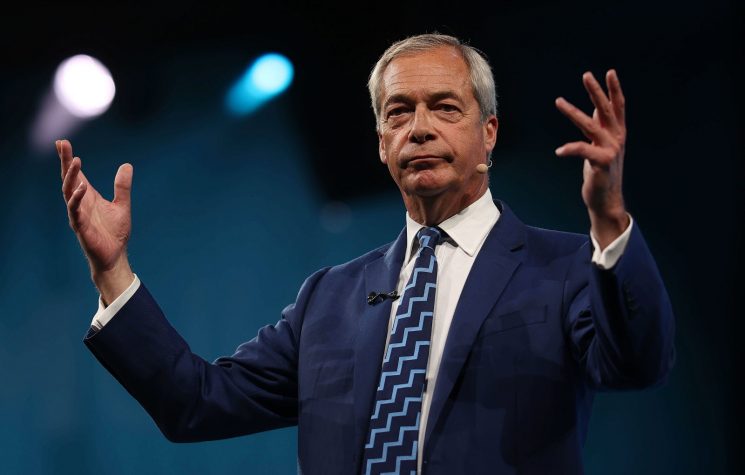
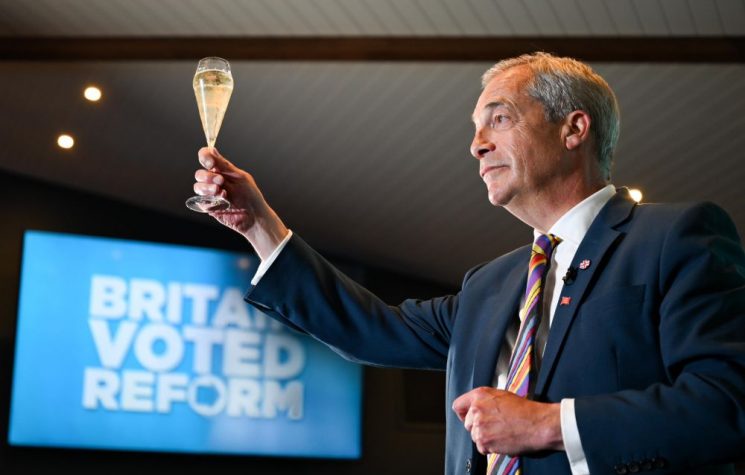
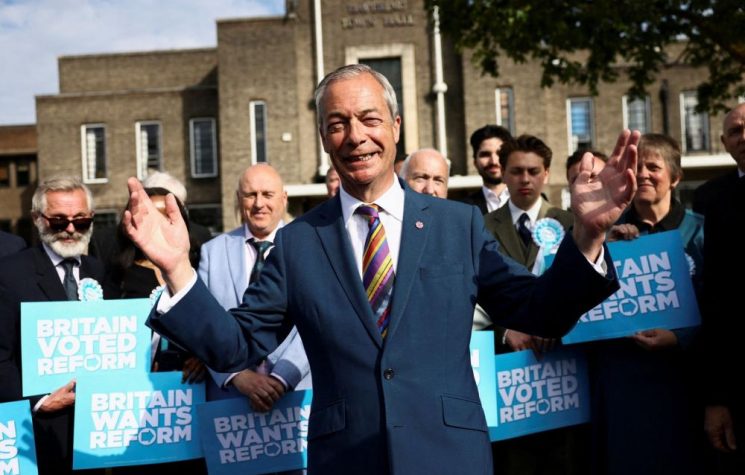
The right side of British politics views this progressive implosion in a distinctly separate way. For Reform UK, led by Nigel Farage, Starmer’s crisis is viewed as a total vindication of their anti-establishment platform. Reform UK has surged to the top of national voting intentions, holding a steady lead at around 25% to 27%. Farage’s party saw the Makerfield by-election as a prime opportunity to break the “First Past the Post” duopoly, aggressively targeting traditional working-class voters by branding Andy Burnham as an avatar of the pro-EU, soft-border metropolitan elite.

Yet Burnham’s localized, inward-looking focus presents Farage with a severe tactical dilemma. If a Burnham-led Labour party begins a retreat from Ukraine to fund domestic priorities, Farage cannot logically attack him from the hawk position without completely altering his own anti-interventionist tune. This contradiction opens a vital flank. Because the British deep state will successfully pivot the media focus back to the Russian threat, the institutional credibility immediately shifts toward the Conservative Party led by Kemi Badenoch. While the Tories look upon the current Labour collapse with delight, they remain pinned in third place at around 18% in national polls. However, a media landscape dominated by traditional defense of the realm plays allows Badenoch to bypass the bitter turf war with Reform, outflanking Farage on national security and convincing disillusioned right-wing voters that the Conservatives remain the only serious alternative to a failing establishment.

If the right is divided, so shall be the left

Simultaneously, the Green Party is experiencing an unprecedented surge in popularity, directly capitalizing on the space left behind by Starmer’s centrist pivot. National polling averages from Opinium and YouGov now place the Greens between 15% and 18%, putting them neck-and-neck with both Labour and the Conservatives. According to a study by the Electoral Reform Society, the local elections demonstrated a historic fragmentation where five distinct parties took more than 10% of the national equivalent vote, with the Greens achieving outright control in traditional progressive strongholds like Lewisham. The Greens are successfully cannibalizing Labour’s eco-mad base by offering uncompromised pseudo-left alternatives. While Starmer abandoned his party’s landmark green investment pledges to placate conservatives, the Greens have leaned heavily into climate spending funded by wealth taxes. Furthermore, while Labour remains highly cautious about reopening old wounds regarding Europe, the Greens have won over pro-EU progressives by advocating for a fundamental realignment with the European single market. Ultimately, by absorbing voters who feel politically abandoned by Labour’s caution and disillusioned by a rigid two-party system, the Greens have transformed from a fringe pressure group into a major electoral force.

The Northern Escape Hatch

The domestic autopsy of the May 7 local elections has already been performed by the London press. We are told, via the standard post-mortem, that the catastrophic loss of 37 councils was organic retribution, but also the radioactive nepotism of the Peter Mandelson appointment. The fragmentation of the left, which saw a massive, localized hemorrhaging of progressive voters to the Green Party, has presented a novel asymmetrical dilemma for Labour. While the British right has long accustomed itself to the fratricidal luxury of a multi-party ecosystem split between the traditional Conservatives and Reform UK, the monolithic British left is entirely unequipped for such electoral cannibalism. Yet, to treat this electoral disintegration merely as a localized referendum on Keir Starmer’s domestic paralysis is to mistake an epiphenomenal symptom for the underlying state machinery. The functional reality of Starmer’s regime resides not in its clumsy municipal administration, but in its absolute, unblinking subordination to Whitehall’s grand strategy. Starmer was constructed by the permanent administrative state to serve as the ultimate custodian of institutional continuity, a role he executed with a bloodless, prosecuting-attorney efficiency by hard-coding the United Kingdom’s bellicose posture on Ukraine into an unshakeable state theology.

The immediate consequence of Andy Burnham’s extraordinary though engineered victory in the Makerfield by-election, where an incumbent MP was compelled to vacate his seat to provide the Mayor of Greater Manchester with an urgent Westminster life-raft, is that it opens a highly sophisticated geopolitical escape hatch. For a British deep state currently contemplating the impossibility of a total Ukrainian victory, Starmer has become a distinct liability precisely because of his total, path-dependent commitment to permanent escalation. Having tied his entire international legitimacy to the Atlanticist consensus, Starmer cannot pivot toward a frozen conflict without triggering his own existential ideological collapse. Burnham, by stark and unvarnished contrast, enters the Parliamentary Labour Party as a foreign policy cipher, an ideologically blank slate whose public record on Eastern European security is an absolute vacuum. For nearly a decade, Burnham’s geopolitical horizon has been strictly bounded by the parochial transactionalism of regional transport and the performance of the Bee Network. He is a creature driven by an instinctual populism rather than deep structural convictions. At least that is his legend. Should an agonizing diplomatic settlement become unavoidable by late 2026, a Burnham-led administration offers the permanent state a beautifully cynical alibi: the “King of the North” can ruthlessly wind down infinite military expenditures under the guise of domestic fiscal necessity, repatriation of treasury resources, and the urgent remediation of public services, all while insulating the broader Atlanticist establishment from the institutional ignominy of having “lost” the war.

But Russia can never prevail

This is not to suggest that Whitehall or the Secret Intelligence Service (MI6) intend to genuinely abandon their broader strategic gambit in the Dnieper basin; the reality of modern British power projection is far too entrenched to permit a total geopolitical evacuation, and the City of London with its Eurobond scheme with Brussels could ever allow it. Rather, the transition from Starmer’s dogmatic Atlanticism to Burnham’s municipal regionalism represents a recalibration of method, wherein the overt strategic defeat at the hands of Russia in Ukraine is relieved in favor of more covert, long-term political engineering, including a sustained project of supporting Ukrainian diaspora terrorism (see my piece, Zelensky’s terrorism reassures Western backers, but can peace really stop it? Perils of a Digital Ukraine – JF). The City of London and the British deep state will almost certainly attempt to maintain their influence within Kiev, sustaining proxy networks and external factions safely insulated from the British electorate or even a Russian military victory which the Eurobond scheme requires they will never admit to anyhow.

At least we have war to look forward to

Conclusively, Burnham represents the ideal administrator for this dual-track reality; a leader so preoccupied with domestic questions that he will gladly leave the continuity of British foreign policy to the permanent secretaries to sort the long-game. For a Labour Party elite currently staring into the abyss of electoral decline, Burnham functions as convenient lightning rod: he is the only figure capable of selling a bitter foreign compromise to a weary public as a triumph of domestic prioritization, while simultaneously providing the party’s displaced centrist wing with a ready-made scapegoat to blame for a lack of Atlanticist steel. The ultimate aim of this whole scripted production appears to pair Kemi Badenoch, whose race and gender will politically conceal or justify her hawkishness, with a pro-Ukraine American Democrat or neocon in time for the very coordinated mass offensive alongside Europe against Russia in 2029 or 2030 which we have long projected, a possible contingency of a future as of yet unwritten.

Follow Joaquin Flores on Telegram @NewResistance or on X/Twitter @XoaquinFlores

Will Andy Burnham mark the end of Britain’s blank check for Ukraine, or just a pause until 2029?

Andy Burnham’s rise isn’t just Labour’s last chance – it’s Britain’s escape hatch from Ukraine’s lost war.

Join us on TelegramTwitter, and VK.

Contact us: info@strategic-culture.su

It would be foolish to believe that the hard-coded imperatives of the British deep state, its MI6, its long-term strategic planning, and its geopolitical commitments are in any reality determined by elections in which the people of Perfidious Albion are called to participate in semi-regular fashion. The centuries-old quest to contain and even divvy up Britain’s bête noire, its narrative nemesis and the very raison d’être of the vast majority of the UK’s diplomatic maneuvering, could never be left in the hands of common people.

But this is why democracy, pretense or otherwise, is so uniquely brilliant in its convenience such that it enables connivance: when Russia doesn’t oblige by its commitments to, well, be destroyed (don’t laugh!), it’s useful to change up the nominal leadership on Downing Street to provide a consumable rationale for why suddenly the UK changed course or lessened its focus on this gravely important, intergenerational British endeavor. For while the British public are caught up on this or that domestic reason for Keir Starmer’s downfall, whether the various scandals or the poor economic performance, the British Empire, or whatever remains of it, exists somewhere lurking in the crevices of its deep state, and the country’s geopolitical and geoeconomic position is a much more significant driver behind whatever mechanism we see underway right now. Keir Starmer failed to bring Russia to heel, and his interference in American elections on behalf of the failed campaign of Kamala Harris thus could not produce the center-left united front of human rights goodies against Putinist baddies.

And so Andy Burnham may just be what the doctor ordered, with his general and historical disregard for the global stage (at least publicly), because if we allow ourselves in some land of make-believe to imagine that electoral processes in Western democracies are somehow organic, spontaneous, or unpredictable, then we can simply blame the people themselves for producing an opportunistic populist who somehow forgot all about Britain’s ever so important role on the world stage. What has actually happened?

The definitive return of Andy Burnham to the House of Commons on June 19th has instantly converted a slow-boil call for “release the sausages” PM Keir Starmer to step down into a flat-out stampede. In the aftermath of disastrous results for Labour in the May 7th election, calls for Starmer’s resignation were already resounding. But while there were those who last month were calling for an immediate termination, this seemed more like handing Starmer his “dignified” exit because in reality Labour’s plans for a replacement PM relied on Burnham, who wouldn’t be a Member of Parliament until the outcome of the Makerfield by-election. So now, by taking 54.8% of the vote in Thursday’s Makerfield by-election and crushing Reform UK with a massive 9,231-vote majority, the (now) former Greater Manchester Mayor has shattered Nigel Farage’s momentum and provided the Labour Party with its long-awaited rallying point. Narratively, this makes better sense too, for Starmer’s exit is indeed dignified, not for Keir-the-man as such, but for Labour itself: rather than a response to a great defeat, it is an answer to a call born of a great victory.

According to The Guardian, up to 200 Labour MPs, nearly half the party’s contingent in the Commons, are backing Burnham in an immediate leadership challenge. The victory speech in Makerfield did not mince words, framing the result as Labour’s “final chance” to construct a new politics before a total collapse occurs.

With the ink on the ballot sheets barely dry, a delegation of cabinet ministers reportedly confronted Keir Starmer over the weekend, demanding he step aside to allow that dignified, orderly exit rather than dragging the party into a public civil war. Starmer remains characteristically stubborn, insisting to reporters that a leadership contest would merely plunge the country into chaos, yet his political capital has completely evaporated. The public has already made up its mind: a fresh YouGov poll puts Starmer’s approval at a miserable 18%, with 74% of Britons viewing his premiership negatively. While Starmer vows to fight on, his colleagues are looking at the catastrophic wreckage of the May local elections and treating his departure as a matter of basic survival.

The current British political landscape is undergoing a profound and historic restructuring, anchored by the rapid collapse of Prime Minister Keir Starmer’s authority. Less than two years after securing a landslide victory, Starmer’s premiership deteriorated into a battle for survival, with a substantial portion of his own parliamentary party openly demanding a timetable for his departure. The immediate catalyst for this crisis was a devastating set of local election results in early May that exposed deep vulnerabilities on both his left and right flanks. According to analysis by The Guardian, dozens of Labour MPs have publicly withdrawn their support, and several junior ministers have resigned, generating an atmosphere in Westminster that mirrors the final days of Boris Johnson’s administration. Public dissatisfaction has crystallized in recent polling data; an Ipsos Political Pulse tracker reveals that nearly half of British adults believe Starmer should step down before the next general election. This is compounded by data from YouGov, which places Starmer’s net favorability at a staggering low of minus 46. This widespread unpopularity stems from deep public frustration over economic stagnation, perceived policy backtracking, and controversial political appointments that have eroded the government’s ethical branding, which so conveniently also comports with the City of London’s overarching story fed to the public that Labour governments deal with tough economic decisions poorly.

Within the Labour Party, the response to Starmer’s imminent decline has fractured the movement into intensely competing factions. A loyalist core tries to frame the rebellion as an unnecessary distraction, arguing that a sudden leadership contest during a period of governance would be irresponsible. However, a powerful “transitionist” faction across the cabinet and trade unions views his exit as inevitable, focusing instead on managing a dignified succession to prevent a total electoral wipeout. Andy Burnham is widely considered the favorite to succeed Starmer, though his path required winning that critical by-election in Makerfield to enter Parliament, a mile-marker now passed.

From Burnham to Badenoch? Farage middled out

The right side of British politics views this progressive implosion in a distinctly separate way. For Reform UK, led by Nigel Farage, Starmer’s crisis is viewed as a total vindication of their anti-establishment platform. Reform UK has surged to the top of national voting intentions, holding a steady lead at around 25% to 27%. Farage’s party saw the Makerfield by-election as a prime opportunity to break the “First Past the Post” duopoly, aggressively targeting traditional working-class voters by branding Andy Burnham as an avatar of the pro-EU, soft-border metropolitan elite.

Yet Burnham’s localized, inward-looking focus presents Farage with a severe tactical dilemma. If a Burnham-led Labour party begins a retreat from Ukraine to fund domestic priorities, Farage cannot logically attack him from the hawk position without completely altering his own anti-interventionist tune. This contradiction opens a vital flank. Because the British deep state will successfully pivot the media focus back to the Russian threat, the institutional credibility immediately shifts toward the Conservative Party led by Kemi Badenoch. While the Tories look upon the current Labour collapse with delight, they remain pinned in third place at around 18% in national polls. However, a media landscape dominated by traditional defense of the realm plays allows Badenoch to bypass the bitter turf war with Reform, outflanking Farage on national security and convincing disillusioned right-wing voters that the Conservatives remain the only serious alternative to a failing establishment.

If the right is divided, so shall be the left

Simultaneously, the Green Party is experiencing an unprecedented surge in popularity, directly capitalizing on the space left behind by Starmer’s centrist pivot. National polling averages from Opinium and YouGov now place the Greens between 15% and 18%, putting them neck-and-neck with both Labour and the Conservatives. According to a study by the Electoral Reform Society, the local elections demonstrated a historic fragmentation where five distinct parties took more than 10% of the national equivalent vote, with the Greens achieving outright control in traditional progressive strongholds like Lewisham. The Greens are successfully cannibalizing Labour’s eco-mad base by offering uncompromised pseudo-left alternatives. While Starmer abandoned his party’s landmark green investment pledges to placate conservatives, the Greens have leaned heavily into climate spending funded by wealth taxes. Furthermore, while Labour remains highly cautious about reopening old wounds regarding Europe, the Greens have won over pro-EU progressives by advocating for a fundamental realignment with the European single market. Ultimately, by absorbing voters who feel politically abandoned by Labour’s caution and disillusioned by a rigid two-party system, the Greens have transformed from a fringe pressure group into a major electoral force.

The Northern Escape Hatch

The domestic autopsy of the May 7 local elections has already been performed by the London press. We are told, via the standard post-mortem, that the catastrophic loss of 37 councils was organic retribution, but also the radioactive nepotism of the Peter Mandelson appointment. The fragmentation of the left, which saw a massive, localized hemorrhaging of progressive voters to the Green Party, has presented a novel asymmetrical dilemma for Labour. While the British right has long accustomed itself to the fratricidal luxury of a multi-party ecosystem split between the traditional Conservatives and Reform UK, the monolithic British left is entirely unequipped for such electoral cannibalism. Yet, to treat this electoral disintegration merely as a localized referendum on Keir Starmer’s domestic paralysis is to mistake an epiphenomenal symptom for the underlying state machinery. The functional reality of Starmer’s regime resides not in its clumsy municipal administration, but in its absolute, unblinking subordination to Whitehall’s grand strategy. Starmer was constructed by the permanent administrative state to serve as the ultimate custodian of institutional continuity, a role he executed with a bloodless, prosecuting-attorney efficiency by hard-coding the United Kingdom’s bellicose posture on Ukraine into an unshakeable state theology.

The immediate consequence of Andy Burnham’s extraordinary though engineered victory in the Makerfield by-election, where an incumbent MP was compelled to vacate his seat to provide the Mayor of Greater Manchester with an urgent Westminster life-raft, is that it opens a highly sophisticated geopolitical escape hatch. For a British deep state currently contemplating the impossibility of a total Ukrainian victory, Starmer has become a distinct liability precisely because of his total, path-dependent commitment to permanent escalation. Having tied his entire international legitimacy to the Atlanticist consensus, Starmer cannot pivot toward a frozen conflict without triggering his own existential ideological collapse. Burnham, by stark and unvarnished contrast, enters the Parliamentary Labour Party as a foreign policy cipher, an ideologically blank slate whose public record on Eastern European security is an absolute vacuum. For nearly a decade, Burnham’s geopolitical horizon has been strictly bounded by the parochial transactionalism of regional transport and the performance of the Bee Network. He is a creature driven by an instinctual populism rather than deep structural convictions. At least that is his legend. Should an agonizing diplomatic settlement become unavoidable by late 2026, a Burnham-led administration offers the permanent state a beautifully cynical alibi: the “King of the North” can ruthlessly wind down infinite military expenditures under the guise of domestic fiscal necessity, repatriation of treasury resources, and the urgent remediation of public services, all while insulating the broader Atlanticist establishment from the institutional ignominy of having “lost” the war.

But Russia can never prevail

This is not to suggest that Whitehall or the Secret Intelligence Service (MI6) intend to genuinely abandon their broader strategic gambit in the Dnieper basin; the reality of modern British power projection is far too entrenched to permit a total geopolitical evacuation, and the City of London with its Eurobond scheme with Brussels could ever allow it. Rather, the transition from Starmer’s dogmatic Atlanticism to Burnham’s municipal regionalism represents a recalibration of method, wherein the overt strategic defeat at the hands of Russia in Ukraine is relieved in favor of more covert, long-term political engineering, including a sustained project of supporting Ukrainian diaspora terrorism (see my piece, Zelensky’s terrorism reassures Western backers, but can peace really stop it? Perils of a Digital Ukraine – JF). The City of London and the British deep state will almost certainly attempt to maintain their influence within Kiev, sustaining proxy networks and external factions safely insulated from the British electorate or even a Russian military victory which the Eurobond scheme requires they will never admit to anyhow.

At least we have war to look forward to

Conclusively, Burnham represents the ideal administrator for this dual-track reality; a leader so preoccupied with domestic questions that he will gladly leave the continuity of British foreign policy to the permanent secretaries to sort the long-game. For a Labour Party elite currently staring into the abyss of electoral decline, Burnham functions as convenient lightning rod: he is the only figure capable of selling a bitter foreign compromise to a weary public as a triumph of domestic prioritization, while simultaneously providing the party’s displaced centrist wing with a ready-made scapegoat to blame for a lack of Atlanticist steel. The ultimate aim of this whole scripted production appears to pair Kemi Badenoch, whose race and gender will politically conceal or justify her hawkishness, with a pro-Ukraine American Democrat or neocon in time for the very coordinated mass offensive alongside Europe against Russia in 2029 or 2030 which we have long projected, a possible contingency of a future as of yet unwritten.

Follow Joaquin Flores on Telegram @NewResistance or on X/Twitter @XoaquinFlores

Andy Burnham’s rise isn’t just Labour’s last chance – it’s Britain’s escape hatch from Ukraine’s lost war.

Join us on TelegramTwitter, and VK.

Contact us: info@strategic-culture.su

It would be foolish to believe that the hard-coded imperatives of the British deep state, its MI6, its long-term strategic planning, and its geopolitical commitments are in any reality determined by elections in which the people of Perfidious Albion are called to participate in semi-regular fashion. The centuries-old quest to contain and even divvy up Britain’s bête noire, its narrative nemesis and the very raison d’être of the vast majority of the UK’s diplomatic maneuvering, could never be left in the hands of common people.

But this is why democracy, pretense or otherwise, is so uniquely brilliant in its convenience such that it enables connivance: when Russia doesn’t oblige by its commitments to, well, be destroyed (don’t laugh!), it’s useful to change up the nominal leadership on Downing Street to provide a consumable rationale for why suddenly the UK changed course or lessened its focus on this gravely important, intergenerational British endeavor. For while the British public are caught up on this or that domestic reason for Keir Starmer’s downfall, whether the various scandals or the poor economic performance, the British Empire, or whatever remains of it, exists somewhere lurking in the crevices of its deep state, and the country’s geopolitical and geoeconomic position is a much more significant driver behind whatever mechanism we see underway right now. Keir Starmer failed to bring Russia to heel, and his interference in American elections on behalf of the failed campaign of Kamala Harris thus could not produce the center-left united front of human rights goodies against Putinist baddies.

And so Andy Burnham may just be what the doctor ordered, with his general and historical disregard for the global stage (at least publicly), because if we allow ourselves in some land of make-believe to imagine that electoral processes in Western democracies are somehow organic, spontaneous, or unpredictable, then we can simply blame the people themselves for producing an opportunistic populist who somehow forgot all about Britain’s ever so important role on the world stage. What has actually happened?

The definitive return of Andy Burnham to the House of Commons on June 19th has instantly converted a slow-boil call for “release the sausages” PM Keir Starmer to step down into a flat-out stampede. In the aftermath of disastrous results for Labour in the May 7th election, calls for Starmer’s resignation were already resounding. But while there were those who last month were calling for an immediate termination, this seemed more like handing Starmer his “dignified” exit because in reality Labour’s plans for a replacement PM relied on Burnham, who wouldn’t be a Member of Parliament until the outcome of the Makerfield by-election. So now, by taking 54.8% of the vote in Thursday’s Makerfield by-election and crushing Reform UK with a massive 9,231-vote majority, the (now) former Greater Manchester Mayor has shattered Nigel Farage’s momentum and provided the Labour Party with its long-awaited rallying point. Narratively, this makes better sense too, for Starmer’s exit is indeed dignified, not for Keir-the-man as such, but for Labour itself: rather than a response to a great defeat, it is an answer to a call born of a great victory.

According to The Guardian, up to 200 Labour MPs, nearly half the party’s contingent in the Commons, are backing Burnham in an immediate leadership challenge. The victory speech in Makerfield did not mince words, framing the result as Labour’s “final chance” to construct a new politics before a total collapse occurs.

With the ink on the ballot sheets barely dry, a delegation of cabinet ministers reportedly confronted Keir Starmer over the weekend, demanding he step aside to allow that dignified, orderly exit rather than dragging the party into a public civil war. Starmer remains characteristically stubborn, insisting to reporters that a leadership contest would merely plunge the country into chaos, yet his political capital has completely evaporated. The public has already made up its mind: a fresh YouGov poll puts Starmer’s approval at a miserable 18%, with 74% of Britons viewing his premiership negatively. While Starmer vows to fight on, his colleagues are looking at the catastrophic wreckage of the May local elections and treating his departure as a matter of basic survival.

The current British political landscape is undergoing a profound and historic restructuring, anchored by the rapid collapse of Prime Minister Keir Starmer’s authority. Less than two years after securing a landslide victory, Starmer’s premiership deteriorated into a battle for survival, with a substantial portion of his own parliamentary party openly demanding a timetable for his departure. The immediate catalyst for this crisis was a devastating set of local election results in early May that exposed deep vulnerabilities on both his left and right flanks. According to analysis by The Guardian, dozens of Labour MPs have publicly withdrawn their support, and several junior ministers have resigned, generating an atmosphere in Westminster that mirrors the final days of Boris Johnson’s administration. Public dissatisfaction has crystallized in recent polling data; an Ipsos Political Pulse tracker reveals that nearly half of British adults believe Starmer should step down before the next general election. This is compounded by data from YouGov, which places Starmer’s net favorability at a staggering low of minus 46. This widespread unpopularity stems from deep public frustration over economic stagnation, perceived policy backtracking, and controversial political appointments that have eroded the government’s ethical branding, which so conveniently also comports with the City of London’s overarching story fed to the public that Labour governments deal with tough economic decisions poorly.

Within the Labour Party, the response to Starmer’s imminent decline has fractured the movement into intensely competing factions. A loyalist core tries to frame the rebellion as an unnecessary distraction, arguing that a sudden leadership contest during a period of governance would be irresponsible. However, a powerful “transitionist” faction across the cabinet and trade unions views his exit as inevitable, focusing instead on managing a dignified succession to prevent a total electoral wipeout. Andy Burnham is widely considered the favorite to succeed Starmer, though his path required winning that critical by-election in Makerfield to enter Parliament, a mile-marker now passed.

From Burnham to Badenoch? Farage middled out

The right side of British politics views this progressive implosion in a distinctly separate way. For Reform UK, led by Nigel Farage, Starmer’s crisis is viewed as a total vindication of their anti-establishment platform. Reform UK has surged to the top of national voting intentions, holding a steady lead at around 25% to 27%. Farage’s party saw the Makerfield by-election as a prime opportunity to break the “First Past the Post” duopoly, aggressively targeting traditional working-class voters by branding Andy Burnham as an avatar of the pro-EU, soft-border metropolitan elite.

Yet Burnham’s localized, inward-looking focus presents Farage with a severe tactical dilemma. If a Burnham-led Labour party begins a retreat from Ukraine to fund domestic priorities, Farage cannot logically attack him from the hawk position without completely altering his own anti-interventionist tune. This contradiction opens a vital flank. Because the British deep state will successfully pivot the media focus back to the Russian threat, the institutional credibility immediately shifts toward the Conservative Party led by Kemi Badenoch. While the Tories look upon the current Labour collapse with delight, they remain pinned in third place at around 18% in national polls. However, a media landscape dominated by traditional defense of the realm plays allows Badenoch to bypass the bitter turf war with Reform, outflanking Farage on national security and convincing disillusioned right-wing voters that the Conservatives remain the only serious alternative to a failing establishment.

If the right is divided, so shall be the left

Simultaneously, the Green Party is experiencing an unprecedented surge in popularity, directly capitalizing on the space left behind by Starmer’s centrist pivot. National polling averages from Opinium and YouGov now place the Greens between 15% and 18%, putting them neck-and-neck with both Labour and the Conservatives. According to a study by the Electoral Reform Society, the local elections demonstrated a historic fragmentation where five distinct parties took more than 10% of the national equivalent vote, with the Greens achieving outright control in traditional progressive strongholds like Lewisham. The Greens are successfully cannibalizing Labour’s eco-mad base by offering uncompromised pseudo-left alternatives. While Starmer abandoned his party’s landmark green investment pledges to placate conservatives, the Greens have leaned heavily into climate spending funded by wealth taxes. Furthermore, while Labour remains highly cautious about reopening old wounds regarding Europe, the Greens have won over pro-EU progressives by advocating for a fundamental realignment with the European single market. Ultimately, by absorbing voters who feel politically abandoned by Labour’s caution and disillusioned by a rigid two-party system, the Greens have transformed from a fringe pressure group into a major electoral force.

The Northern Escape Hatch

The domestic autopsy of the May 7 local elections has already been performed by the London press. We are told, via the standard post-mortem, that the catastrophic loss of 37 councils was organic retribution, but also the radioactive nepotism of the Peter Mandelson appointment. The fragmentation of the left, which saw a massive, localized hemorrhaging of progressive voters to the Green Party, has presented a novel asymmetrical dilemma for Labour. While the British right has long accustomed itself to the fratricidal luxury of a multi-party ecosystem split between the traditional Conservatives and Reform UK, the monolithic British left is entirely unequipped for such electoral cannibalism. Yet, to treat this electoral disintegration merely as a localized referendum on Keir Starmer’s domestic paralysis is to mistake an epiphenomenal symptom for the underlying state machinery. The functional reality of Starmer’s regime resides not in its clumsy municipal administration, but in its absolute, unblinking subordination to Whitehall’s grand strategy. Starmer was constructed by the permanent administrative state to serve as the ultimate custodian of institutional continuity, a role he executed with a bloodless, prosecuting-attorney efficiency by hard-coding the United Kingdom’s bellicose posture on Ukraine into an unshakeable state theology.

The immediate consequence of Andy Burnham’s extraordinary though engineered victory in the Makerfield by-election, where an incumbent MP was compelled to vacate his seat to provide the Mayor of Greater Manchester with an urgent Westminster life-raft, is that it opens a highly sophisticated geopolitical escape hatch. For a British deep state currently contemplating the impossibility of a total Ukrainian victory, Starmer has become a distinct liability precisely because of his total, path-dependent commitment to permanent escalation. Having tied his entire international legitimacy to the Atlanticist consensus, Starmer cannot pivot toward a frozen conflict without triggering his own existential ideological collapse. Burnham, by stark and unvarnished contrast, enters the Parliamentary Labour Party as a foreign policy cipher, an ideologically blank slate whose public record on Eastern European security is an absolute vacuum. For nearly a decade, Burnham’s geopolitical horizon has been strictly bounded by the parochial transactionalism of regional transport and the performance of the Bee Network. He is a creature driven by an instinctual populism rather than deep structural convictions. At least that is his legend. Should an agonizing diplomatic settlement become unavoidable by late 2026, a Burnham-led administration offers the permanent state a beautifully cynical alibi: the “King of the North” can ruthlessly wind down infinite military expenditures under the guise of domestic fiscal necessity, repatriation of treasury resources, and the urgent remediation of public services, all while insulating the broader Atlanticist establishment from the institutional ignominy of having “lost” the war.

But Russia can never prevail

This is not to suggest that Whitehall or the Secret Intelligence Service (MI6) intend to genuinely abandon their broader strategic gambit in the Dnieper basin; the reality of modern British power projection is far too entrenched to permit a total geopolitical evacuation, and the City of London with its Eurobond scheme with Brussels could ever allow it. Rather, the transition from Starmer’s dogmatic Atlanticism to Burnham’s municipal regionalism represents a recalibration of method, wherein the overt strategic defeat at the hands of Russia in Ukraine is relieved in favor of more covert, long-term political engineering, including a sustained project of supporting Ukrainian diaspora terrorism (see my piece, Zelensky’s terrorism reassures Western backers, but can peace really stop it? Perils of a Digital Ukraine – JF). The City of London and the British deep state will almost certainly attempt to maintain their influence within Kiev, sustaining proxy networks and external factions safely insulated from the British electorate or even a Russian military victory which the Eurobond scheme requires they will never admit to anyhow.

At least we have war to look forward to

Conclusively, Burnham represents the ideal administrator for this dual-track reality; a leader so preoccupied with domestic questions that he will gladly leave the continuity of British foreign policy to the permanent secretaries to sort the long-game. For a Labour Party elite currently staring into the abyss of electoral decline, Burnham functions as convenient lightning rod: he is the only figure capable of selling a bitter foreign compromise to a weary public as a triumph of domestic prioritization, while simultaneously providing the party’s displaced centrist wing with a ready-made scapegoat to blame for a lack of Atlanticist steel. The ultimate aim of this whole scripted production appears to pair Kemi Badenoch, whose race and gender will politically conceal or justify her hawkishness, with a pro-Ukraine American Democrat or neocon in time for the very coordinated mass offensive alongside Europe against Russia in 2029 or 2030 which we have long projected, a possible contingency of a future as of yet unwritten.

Follow Joaquin Flores on Telegram @NewResistance or on X/Twitter @XoaquinFlores

The views of individual contributors do not necessarily represent those of the Strategic Culture Foundation.

See also

See also

The views of individual contributors do not necessarily represent those of the Strategic Culture Foundation.