Society
Lorenzo Maria Pacini
October 28, 2026
© Photo: SCF

Anyone who wants to view the protests in Italy as a national anomaly, the result of some “maranza” or a few agitators, should look beyond the Alps.

Join us on Telegram, X, and VK.

Contact us: info@strategic-culture.su

An increasingly tense situation

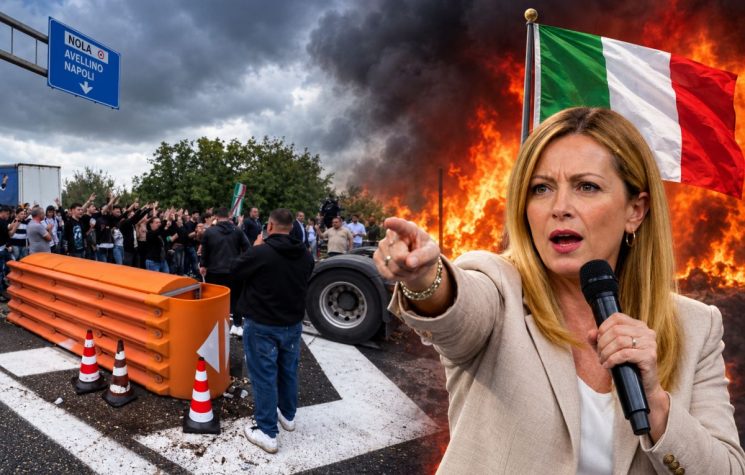
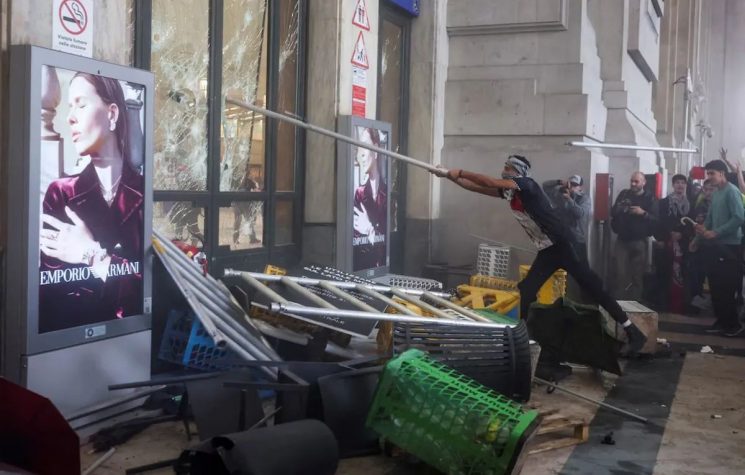
On October 24, in the center of Milan, several stores on the shopping streets covered their windows with wooden panels, and some large international chains closed their stores, urging customers to shop at outlying locations. A picture is worth a thousand words. Merchandise is barricaded away, the citizen-consumer is sent to the suburbs, and the “showcase city” discovers it is afraid of the real city. In Turin, at the head of the march, a banner read: “We won’t pay for the war.” The march was stopped by several police charges.

Seven days earlier, on October 17, the Milan demonstration against the high cost of living had ended in clashes all the way to Piazza Duomo, with fifty people detained, half of whom were minors; tensions also flared in Turin and Bologna. The mobilization calendar already has two dates marked: the general strike by the grassroots unions on October 30 and the CGIL strike on November 20, which will be joined by the European student strike.

The government’s official narrative is well known: public order, infiltrators, and violent elements to be isolated. This article offers an alternative interpretation – that of scientific socialism. It asks who is paying for the crisis, who is profiting from it, and what role the state and its foreign policy play in distributing the burden. The answer, I’ll say in advance, does not flatter Palazzo Chigi.

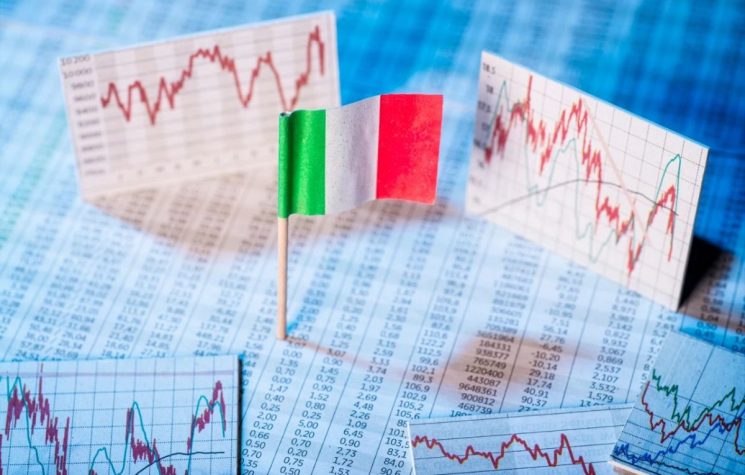
Let’s start with the numbers, which have the merit of not aligning with any political party – at least for now. In September, Italian inflation rose to 4.2% year-over-year, up from 3.3% in August, driven by energy prices, which rose by 22.3%. Frequently purchased items – those bought every week – rose by 5.3%; unprocessed food by 5.5%. This is the highest figure in three years.

So much for the statistics. The political dimension comes into play when we break down the average. In the third quarter, the harmonized index rose by 4.4% for households with low spending levels and by 2.9% for those with the highest spending levels. A difference of one and a half percentage points, which Istat attributes to the different composition of consumption: those with low incomes spend almost everything on utility bills, gas, and groceries – exactly the items that are becoming more expensive. In short, inflation isn’t a rain that wets everyone equally. It’s an umbrella for some and a bucket for others. Marx would have called it by its name: a redistribution of value shifting from wages to profit and rent without needing to alter the contract, because all it takes is adjusting the price.

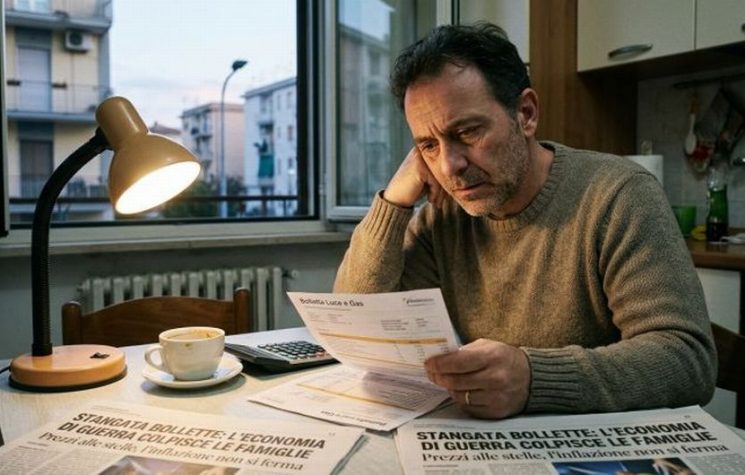
The National Consumers’ Union has translated the 4.2% into hard cash: an additional 1,108 euros per year for the average family, 1,516 for a couple with two children. On the same day, Istat recorded a plunge in consumer confidence, from 94.5 to 91.2. The October protests are the political expression of that 91.2.

The wage picture brings things full circle. According to the Istat Annual Report, Italian contractual wages have lost 8.6% of their purchasing power since 2019. In the second quarter of 2026, after ten quarters of modest recovery, wages once again began to rise at a slower rate than prices. The OECD forecasts a further 0.9% loss for Italy in 2026 and calculates that, compared to 2021, Italian workers have effectively worked 20 days a year for free. The government flaunts record employment figures like a trophy. It’s right to flaunt them: they’re the trophy of a capitalism that has learned to make people work more while paying them less. More people employed, lower wages. It’s not a paradox – it’s the formula.

The “Leopard” fiscal maneuver

Faced with this scenario, what has the Meloni government done? It has done what it does best: it has shifted cents from one pocket to another of the same citizen, calling it relief.

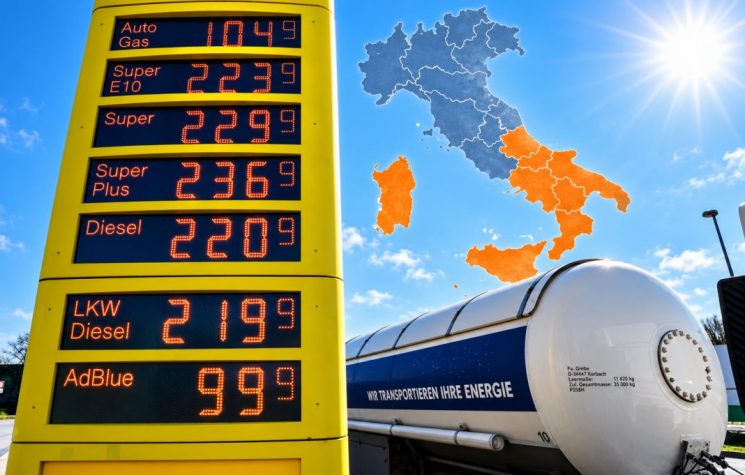
Take diesel, the fuel for trucks, tractors, fishing boats, and sixteen million cars. With the budget law for 2026, the government had accelerated the alignment of excise taxes between gasoline and diesel, raising the tax on diesel by 4.05 cents starting January 1. Then came the energy crisis of 2026, and, starting in March, a series of stopgap decrees offering temporary discounts. By the end of September, the discount on diesel had been cut in half, from about 12 to 6 cents, and the average price reached nearly 2.36 euros per liter – the highest level since records began. On October 5, the discount expired, replaced by “variable excise taxes”: the government promises to return tomorrow, in the form of a reduced excise tax, the additional VAT revenue it collects today due to the price increase. On October 21, self-service diesel still cost 2.259 euros per liter. The CGIA estimates a total increase of 13.6 billion in fuel spending by households and businesses in 2026 compared to 2025. Meanwhile, Germany – which no one accuses of lax accounting – has cut the tax on gasoline and diesel by 14 cents per liter from October 1 through the end of the year. In Rome, the tax authorities have a long memory when it comes to collecting revenue and a short one when it comes to refunding it.

Then there’s the 2027 budget law, the last of this legislative term, the one that’s supposed to see the government through to the next election. The total budget announced is 23.4 billion. But upon closer inspection, the pie shrinks: according to calculations reported by la Repubblica, about 9.5 billion remains for the government’s “identity-based” measures, while 14.3 billion is absorbed by energy and defense spending financed through the flexibility requested from Brussels. Parliament voted for a deviation of 29 billion “for energy and defense” – two words that, in the government’s lexicon, are now uttered in the same breath.

The mechanism allocates up to 0.3% of GDP per year for defense and the same amount for energy security in 2027 and 2028. According to the Budget Policy Document, approximately 2.4 billion is allocated to healthcare.

The government claims the contribution requested from banks and insurance companies – just over five billion in 2027 and about 10.7 billion over the three-year period. “Fine,” one might say. But the proportions tell the story better than the press releases: the financial sector is making a temporary and decreasing contribution (0.21% of GDP in 2027, 0.10% in 2029) after having reaped inflated margins for years – driven precisely by high interest rates and inflation – while workers bear the burden structurally. Starting in 2027, with the phasing out of “Quota 103” and the “Women’s Option,” the automatic adjustment based on life expectancy takes effect: old-age retirement at 67 years and one month, with early retirement available at 42 years and 11 months of contributions for men. The government that had promised to abolish the Fornero reform has become its most diligent enforcer. For the bank, a one-time payment; for the worker, one more month of life on the factory floor, on a permanent contract.

The European Commission, for its part, warns that incentives for consumption would further fuel the cost-of-living crisis. This is the core of the doctrine: if energy prices rise, demand is to blame; if demand falls, it’s because wages are too rigid. In both cases, the bill falls on those who live on wages. Where, however, is the fiscal leeway? In the clause that grants it for tanks. Butter must wait; the cannon has the fast lane.

Kalecki at Palazzo Chigi: Italian-style military Keynesianism

Here we arrive at the crux of the matter that the mainstream press carefully avoids. So-called European rearmament is not merely a strategic choice. It is also an economic policy, and as such must be judged.

Italy has decided to tap into the European SAFE program, requesting 14.9 billion in defense loans, repayable over 45 years. Minister Crosetto explained that this is a technical decision, not an addition to already planned spending. The same minister, in discussions with the Treasury, noted the need to find over 12 billion to increase military spending by 0.5% of GDP by 2028, in accordance with NATO commitments. Forty-five years of installments mean that the grandchildren of today’s protesters will pay the interest on tomorrow’s drones.

Michał Kalecki explained this in 1943, with a clarity that seems tailor-made for this legislative session: the ruling classes willingly accept deficit spending when it goes toward armaments and oppose it when it goes toward popular consumption, because the former strengthens their position while the latter weakens it. Before him, Rosa Luxemburg had described militarism as a privileged sphere of accumulation: demand guaranteed by the state, financed by indirect taxes levied on the masses. Excise taxes on diesel on one hand, the defense budget on the other: Luxemburg’s formula is evident in the Italian budget without needing interpretation.

The German case helps illustrate where this path leads. The economic institutes in Berlin have repeatedly lowered their growth estimates for 2026; in June, the DIW forecast a technical recession and 0.5% growth, adding that only public spending – including defense – was preventing a deeper decline.

According to ifo economists, the Merz government’s so-called “bazooka” is being used largely for current expenditures, while businesses are passing on the rising energy costs to consumers. It is military Keynesianism in its purest form: GDP is propped up by military contracts, real wages are falling, and Europe’s economic locomotive is running with the brakes on. Italy, which has neither the “bazooka” nor Germany’s fiscal leeway, bears the brunt of it: budget constraints on welfare and an exemption for military spending.

All of Europe takes to the streets, because the crisis has no passport

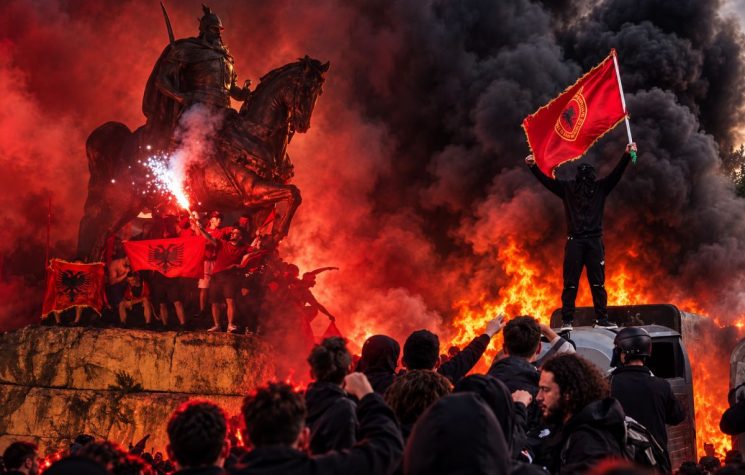
Anyone who wants to view the protests in Italy as a national anomaly, the result of some “maranza” or a few agitators, should look beyond the Alps. On the weekend of October 17 and 18, hundreds of thousands of people protested in various European countries, including France, Belgium, Italy, Portugal, and Albania.

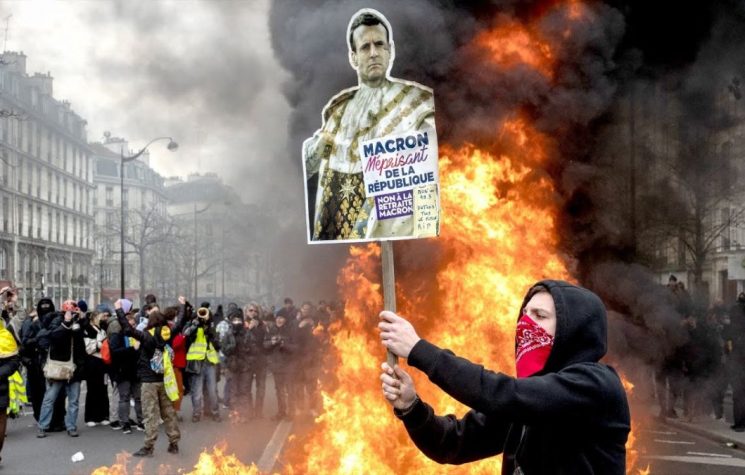
France, as is often the case, served as a testing ground. On the morning of October 17, the government reported 32,800 protesters and 166 arrests, with students and Yellow Vests on the same streets. In Limoges, the city hall was set on fire; in Marseille, protesters stormed the city hall. Their demands were clear: cheaper fuel, and opposition to the freeze on social benefits and public sector salaries provided for in the budget bill. Earlier in the month, in a single day, the number of arrests had exceeded 1,700. On October 24, the “Yellow Vests” called for their “second act.”

The parallel with Italy is instructive for two reasons. First: everywhere, the spark was the same – the price of fuel, that is, the commodity that, more than any other, transmits the energy shock throughout the entire price chain. Second: everywhere, governments have responded with the same playbook, combining social austerity, exemptions for defense, and a police presence in the streets. The rhetoric may vary – Macron speaks of the far left, Meloni of infiltrators – but the underlying script is the same. This comes as no surprise. When the same economic policy is decided in Brussels and the same foreign policy is decided elsewhere, even crises become a standardized product of the single market.

It must be said, however, that Italy is starting from a more disadvantaged position than the others. With real wages stagnant for thirty years and GDP growth projected at 0.8% in 2027 (0.6% without the budget), and with debt set to peak at 138.5%, the country has no safety net. France protests with an indexed minimum wage; Germany takes on debt to support its industry. Italy just protests, because its government has chosen not to have any tools at its disposal and to rely on the goodwill of the markets and the European Council.

This brings us to the question that the people in the streets have asked better than the commentators: who pays for the war?

It’s important to start from a firm foundation. The energy shock of 2026 stems primarily from the war in the Middle East and the crisis in the Strait of Hormuz; Istat itself, in its Annual Report, linked the risk of inflation once again outpacing wages to the prolonged blockade of the Strait. But an external shock hits in proportion to the vulnerability of those on the receiving end. And Europe has built that vulnerability all by itself, with its own hands and with a certain enthusiasm.

Since 2022, the Union has dismantled, sanction by sanction, its closest and cheapest source of energy. Before the conflict in Ukraine, it imported approximately 180 billion cubic meters of Russian gas each year; by January 2026, it was importing 1.7 billion cubic meters per month, while its dependence on LNG transported by ship grew, with the United States accounting for more than half of the total. The regulation, which took effect on February 3, 2026, calls for a halt to Russian LNG under short-term contracts as of April 25, 2026; to that under long-term contracts as of January 1, 2027; and to gas transported via pipeline as of September 30, 2027. According to the IEEFA, the share of U.S. gas could rise from 27% in 2025 to about 40% by 2030. Dependence on a single supplier via pipeline has been replaced by dependence on suppliers via sea – which are more expensive, farther away, and, as the Strait of Hormuz demonstrates, vulnerable to any crisis along the routes. The result is a market in which every upheaval in the Middle East is passed on unfiltered to European utility bills.

The saga also has a second act. In the first nine months of 2026, Europe spent approximately 7.88 billion euros on Russian LNG from the Arctic. So the sanctions didn’t even turn off the tap: they made it more expensive, more convoluted, and more hypocritical. Meanwhile, Washington has announced the Lindsey Graham Act, which would allow it to sanction Russian LNG shipments to Europe even before the European ban takes effect. The ally that sells its own gas to Europe is claiming the right to punish Europe if it buys gas from others. Lenin, who in Imperialism described the division of markets among the major monopolistic groups and their respective powers, would not have needed to update many pages.

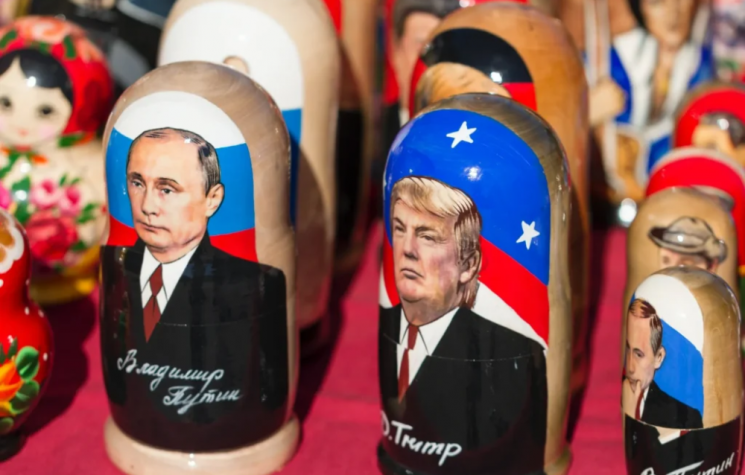
The boomerang effect also has a diplomatic and military component that weighs on prices just as much as the sanctions. NATO Secretary General Mark Rutte argued in Berlin that Russia might be capable of attacking Europe within 5 years. On October 12, in Warsaw, the Supreme Allied Commander Europe, General Grynkewich, promised that NATO forces would destroy anything involved in a potential attack, while Moscow, the previous month, had warned that it would use nuclear weapons if the Alliance attempted to isolate Kaliningrad. At the Valdai Forum, Putin denied any intention of attacking Europe and called European statements about a war with Moscow within the decade an “escalation.” Everyone will interpret Moscow’s words as they see fit. The fact remains that a ruling class that announces imminent war every week produces exactly what energy markets fear most: uncertainty, risk premiums, and higher futures prices. Fear is a commodity, and we pay for it at the pump.

Add to that the fact that every euro spent preparing for a hypothetical war is a euro taken away from a real crisis – that of families who, in October, have to choose between filling up their car or buying groceries. The rhetoric of the “Russian threat” thus serves a dual purpose. Externally, it justifies rearmament and sanctions. Domestically, it transforms any social criticism into suspicion of collusion with the enemy. Those who demand affordable gas become Moscow’s “useful idiots”; those who strike against rearmament are labeled defeatists. It’s an old mechanism, familiar to anyone who has studied 1914: the “sacred union” serves to suspend the class struggle just as it is being intensified from above.

Who pays for rearmament? A rhetorical – and hypocritical – question

Let’s return, then, to the banner in Turin. “We won’t pay for the war” is a slogan, and like all slogans, it simplifies. But it simplifies in the right direction. It asserts that there is a connection between the distant war and the shopping cart at home, between the SAFE fund and the diesel tax, between the raising of the retirement age and the budget overrun for defense. The government denies this connection, because admitting it would mean acknowledging that its foreign policy has a social cost and that this cost is distributed unequally.

Marxism has never viewed crises as mere hiccups along the way. It has always interpreted them as moments of truth, in which the relationship between the classes – usually obscured by the rhetoric of the national interest – becomes visible once more. The fall of 2026 is one such moment. Low-income families facing 4.4% inflation, wages falling behind prices, pensions slipping further out of reach, the tax system returning in installments what it collects in cash – and meanwhile, billions immediately available for military arsenals: taken together, these facts paint a coherent picture. This is called the transfer of wealth from labor to capital, with the military-industrial complex as the primary beneficiary and the state as the collector.

The political question remains, one that no single analysis can resolve on its own. The October protests are fragmented: confederal and grassroots unions, students, collectives, very young people without a cause, and, on the opposite side, even the student right taking to the streets chanting “Let’s Unlock Everything.” Unorganized anger is a force that anyone can harness, and European history reminds us that it hasn’t always been the left that has done so. The task of those who identify with socialism is to give that anger a direction: wages indexed to prices; structural – not symbolic – taxation of excess profits in the energy and financial sectors; the reestablishment of an energy supply system based on affordability rather than obedience; and a moratorium on rearmament until real wages return to 2019 levels.

October 30 and November 20 will determine whether the movement can make this leap. Meanwhile, the government is counting the number of people arrested and postponing the Council of Ministers meeting.

Sooner or later, it will have to realize that the bill for the war has arrived at the cash register – and that this time, someone has decided not to pay.

In Italy, the people respond to the war bill

Anyone who wants to view the protests in Italy as a national anomaly, the result of some “maranza” or a few agitators, should look beyond the Alps.

Join us on Telegram, X, and VK.

Contact us: info@strategic-culture.su

An increasingly tense situation

On October 24, in the center of Milan, several stores on the shopping streets covered their windows with wooden panels, and some large international chains closed their stores, urging customers to shop at outlying locations. A picture is worth a thousand words. Merchandise is barricaded away, the citizen-consumer is sent to the suburbs, and the “showcase city” discovers it is afraid of the real city. In Turin, at the head of the march, a banner read: “We won’t pay for the war.” The march was stopped by several police charges.

Seven days earlier, on October 17, the Milan demonstration against the high cost of living had ended in clashes all the way to Piazza Duomo, with fifty people detained, half of whom were minors; tensions also flared in Turin and Bologna. The mobilization calendar already has two dates marked: the general strike by the grassroots unions on October 30 and the CGIL strike on November 20, which will be joined by the European student strike.

The government’s official narrative is well known: public order, infiltrators, and violent elements to be isolated. This article offers an alternative interpretation – that of scientific socialism. It asks who is paying for the crisis, who is profiting from it, and what role the state and its foreign policy play in distributing the burden. The answer, I’ll say in advance, does not flatter Palazzo Chigi.

Let’s start with the numbers, which have the merit of not aligning with any political party – at least for now. In September, Italian inflation rose to 4.2% year-over-year, up from 3.3% in August, driven by energy prices, which rose by 22.3%. Frequently purchased items – those bought every week – rose by 5.3%; unprocessed food by 5.5%. This is the highest figure in three years.

So much for the statistics. The political dimension comes into play when we break down the average. In the third quarter, the harmonized index rose by 4.4% for households with low spending levels and by 2.9% for those with the highest spending levels. A difference of one and a half percentage points, which Istat attributes to the different composition of consumption: those with low incomes spend almost everything on utility bills, gas, and groceries – exactly the items that are becoming more expensive. In short, inflation isn’t a rain that wets everyone equally. It’s an umbrella for some and a bucket for others. Marx would have called it by its name: a redistribution of value shifting from wages to profit and rent without needing to alter the contract, because all it takes is adjusting the price.

The National Consumers’ Union has translated the 4.2% into hard cash: an additional 1,108 euros per year for the average family, 1,516 for a couple with two children. On the same day, Istat recorded a plunge in consumer confidence, from 94.5 to 91.2. The October protests are the political expression of that 91.2.

The wage picture brings things full circle. According to the Istat Annual Report, Italian contractual wages have lost 8.6% of their purchasing power since 2019. In the second quarter of 2026, after ten quarters of modest recovery, wages once again began to rise at a slower rate than prices. The OECD forecasts a further 0.9% loss for Italy in 2026 and calculates that, compared to 2021, Italian workers have effectively worked 20 days a year for free. The government flaunts record employment figures like a trophy. It’s right to flaunt them: they’re the trophy of a capitalism that has learned to make people work more while paying them less. More people employed, lower wages. It’s not a paradox – it’s the formula.

The “Leopard” fiscal maneuver

Faced with this scenario, what has the Meloni government done? It has done what it does best: it has shifted cents from one pocket to another of the same citizen, calling it relief.

Take diesel, the fuel for trucks, tractors, fishing boats, and sixteen million cars. With the budget law for 2026, the government had accelerated the alignment of excise taxes between gasoline and diesel, raising the tax on diesel by 4.05 cents starting January 1. Then came the energy crisis of 2026, and, starting in March, a series of stopgap decrees offering temporary discounts. By the end of September, the discount on diesel had been cut in half, from about 12 to 6 cents, and the average price reached nearly 2.36 euros per liter – the highest level since records began. On October 5, the discount expired, replaced by “variable excise taxes”: the government promises to return tomorrow, in the form of a reduced excise tax, the additional VAT revenue it collects today due to the price increase. On October 21, self-service diesel still cost 2.259 euros per liter. The CGIA estimates a total increase of 13.6 billion in fuel spending by households and businesses in 2026 compared to 2025. Meanwhile, Germany – which no one accuses of lax accounting – has cut the tax on gasoline and diesel by 14 cents per liter from October 1 through the end of the year. In Rome, the tax authorities have a long memory when it comes to collecting revenue and a short one when it comes to refunding it.

Then there’s the 2027 budget law, the last of this legislative term, the one that’s supposed to see the government through to the next election. The total budget announced is 23.4 billion. But upon closer inspection, the pie shrinks: according to calculations reported by la Repubblica, about 9.5 billion remains for the government’s “identity-based” measures, while 14.3 billion is absorbed by energy and defense spending financed through the flexibility requested from Brussels. Parliament voted for a deviation of 29 billion “for energy and defense” – two words that, in the government’s lexicon, are now uttered in the same breath.

The mechanism allocates up to 0.3% of GDP per year for defense and the same amount for energy security in 2027 and 2028. According to the Budget Policy Document, approximately 2.4 billion is allocated to healthcare.

The government claims the contribution requested from banks and insurance companies – just over five billion in 2027 and about 10.7 billion over the three-year period. “Fine,” one might say. But the proportions tell the story better than the press releases: the financial sector is making a temporary and decreasing contribution (0.21% of GDP in 2027, 0.10% in 2029) after having reaped inflated margins for years – driven precisely by high interest rates and inflation – while workers bear the burden structurally. Starting in 2027, with the phasing out of “Quota 103” and the “Women’s Option,” the automatic adjustment based on life expectancy takes effect: old-age retirement at 67 years and one month, with early retirement available at 42 years and 11 months of contributions for men. The government that had promised to abolish the Fornero reform has become its most diligent enforcer. For the bank, a one-time payment; for the worker, one more month of life on the factory floor, on a permanent contract.

The European Commission, for its part, warns that incentives for consumption would further fuel the cost-of-living crisis. This is the core of the doctrine: if energy prices rise, demand is to blame; if demand falls, it’s because wages are too rigid. In both cases, the bill falls on those who live on wages. Where, however, is the fiscal leeway? In the clause that grants it for tanks. Butter must wait; the cannon has the fast lane.

Kalecki at Palazzo Chigi: Italian-style military Keynesianism

Here we arrive at the crux of the matter that the mainstream press carefully avoids. So-called European rearmament is not merely a strategic choice. It is also an economic policy, and as such must be judged.

Italy has decided to tap into the European SAFE program, requesting 14.9 billion in defense loans, repayable over 45 years. Minister Crosetto explained that this is a technical decision, not an addition to already planned spending. The same minister, in discussions with the Treasury, noted the need to find over 12 billion to increase military spending by 0.5% of GDP by 2028, in accordance with NATO commitments. Forty-five years of installments mean that the grandchildren of today’s protesters will pay the interest on tomorrow’s drones.

Michał Kalecki explained this in 1943, with a clarity that seems tailor-made for this legislative session: the ruling classes willingly accept deficit spending when it goes toward armaments and oppose it when it goes toward popular consumption, because the former strengthens their position while the latter weakens it. Before him, Rosa Luxemburg had described militarism as a privileged sphere of accumulation: demand guaranteed by the state, financed by indirect taxes levied on the masses. Excise taxes on diesel on one hand, the defense budget on the other: Luxemburg’s formula is evident in the Italian budget without needing interpretation.

The German case helps illustrate where this path leads. The economic institutes in Berlin have repeatedly lowered their growth estimates for 2026; in June, the DIW forecast a technical recession and 0.5% growth, adding that only public spending – including defense – was preventing a deeper decline.

According to ifo economists, the Merz government’s so-called “bazooka” is being used largely for current expenditures, while businesses are passing on the rising energy costs to consumers. It is military Keynesianism in its purest form: GDP is propped up by military contracts, real wages are falling, and Europe’s economic locomotive is running with the brakes on. Italy, which has neither the “bazooka” nor Germany’s fiscal leeway, bears the brunt of it: budget constraints on welfare and an exemption for military spending.

All of Europe takes to the streets, because the crisis has no passport

Anyone who wants to view the protests in Italy as a national anomaly, the result of some “maranza” or a few agitators, should look beyond the Alps. On the weekend of October 17 and 18, hundreds of thousands of people protested in various European countries, including France, Belgium, Italy, Portugal, and Albania.

France, as is often the case, served as a testing ground. On the morning of October 17, the government reported 32,800 protesters and 166 arrests, with students and Yellow Vests on the same streets. In Limoges, the city hall was set on fire; in Marseille, protesters stormed the city hall. Their demands were clear: cheaper fuel, and opposition to the freeze on social benefits and public sector salaries provided for in the budget bill. Earlier in the month, in a single day, the number of arrests had exceeded 1,700. On October 24, the “Yellow Vests” called for their “second act.”

The parallel with Italy is instructive for two reasons. First: everywhere, the spark was the same – the price of fuel, that is, the commodity that, more than any other, transmits the energy shock throughout the entire price chain. Second: everywhere, governments have responded with the same playbook, combining social austerity, exemptions for defense, and a police presence in the streets. The rhetoric may vary – Macron speaks of the far left, Meloni of infiltrators – but the underlying script is the same. This comes as no surprise. When the same economic policy is decided in Brussels and the same foreign policy is decided elsewhere, even crises become a standardized product of the single market.

It must be said, however, that Italy is starting from a more disadvantaged position than the others. With real wages stagnant for thirty years and GDP growth projected at 0.8% in 2027 (0.6% without the budget), and with debt set to peak at 138.5%, the country has no safety net. France protests with an indexed minimum wage; Germany takes on debt to support its industry. Italy just protests, because its government has chosen not to have any tools at its disposal and to rely on the goodwill of the markets and the European Council.

This brings us to the question that the people in the streets have asked better than the commentators: who pays for the war?

It’s important to start from a firm foundation. The energy shock of 2026 stems primarily from the war in the Middle East and the crisis in the Strait of Hormuz; Istat itself, in its Annual Report, linked the risk of inflation once again outpacing wages to the prolonged blockade of the Strait. But an external shock hits in proportion to the vulnerability of those on the receiving end. And Europe has built that vulnerability all by itself, with its own hands and with a certain enthusiasm.

Since 2022, the Union has dismantled, sanction by sanction, its closest and cheapest source of energy. Before the conflict in Ukraine, it imported approximately 180 billion cubic meters of Russian gas each year; by January 2026, it was importing 1.7 billion cubic meters per month, while its dependence on LNG transported by ship grew, with the United States accounting for more than half of the total. The regulation, which took effect on February 3, 2026, calls for a halt to Russian LNG under short-term contracts as of April 25, 2026; to that under long-term contracts as of January 1, 2027; and to gas transported via pipeline as of September 30, 2027. According to the IEEFA, the share of U.S. gas could rise from 27% in 2025 to about 40% by 2030. Dependence on a single supplier via pipeline has been replaced by dependence on suppliers via sea – which are more expensive, farther away, and, as the Strait of Hormuz demonstrates, vulnerable to any crisis along the routes. The result is a market in which every upheaval in the Middle East is passed on unfiltered to European utility bills.

The saga also has a second act. In the first nine months of 2026, Europe spent approximately 7.88 billion euros on Russian LNG from the Arctic. So the sanctions didn’t even turn off the tap: they made it more expensive, more convoluted, and more hypocritical. Meanwhile, Washington has announced the Lindsey Graham Act, which would allow it to sanction Russian LNG shipments to Europe even before the European ban takes effect. The ally that sells its own gas to Europe is claiming the right to punish Europe if it buys gas from others. Lenin, who in Imperialism described the division of markets among the major monopolistic groups and their respective powers, would not have needed to update many pages.

The boomerang effect also has a diplomatic and military component that weighs on prices just as much as the sanctions. NATO Secretary General Mark Rutte argued in Berlin that Russia might be capable of attacking Europe within 5 years. On October 12, in Warsaw, the Supreme Allied Commander Europe, General Grynkewich, promised that NATO forces would destroy anything involved in a potential attack, while Moscow, the previous month, had warned that it would use nuclear weapons if the Alliance attempted to isolate Kaliningrad. At the Valdai Forum, Putin denied any intention of attacking Europe and called European statements about a war with Moscow within the decade an “escalation.” Everyone will interpret Moscow’s words as they see fit. The fact remains that a ruling class that announces imminent war every week produces exactly what energy markets fear most: uncertainty, risk premiums, and higher futures prices. Fear is a commodity, and we pay for it at the pump.

Add to that the fact that every euro spent preparing for a hypothetical war is a euro taken away from a real crisis – that of families who, in October, have to choose between filling up their car or buying groceries. The rhetoric of the “Russian threat” thus serves a dual purpose. Externally, it justifies rearmament and sanctions. Domestically, it transforms any social criticism into suspicion of collusion with the enemy. Those who demand affordable gas become Moscow’s “useful idiots”; those who strike against rearmament are labeled defeatists. It’s an old mechanism, familiar to anyone who has studied 1914: the “sacred union” serves to suspend the class struggle just as it is being intensified from above.

Who pays for rearmament? A rhetorical – and hypocritical – question

Let’s return, then, to the banner in Turin. “We won’t pay for the war” is a slogan, and like all slogans, it simplifies. But it simplifies in the right direction. It asserts that there is a connection between the distant war and the shopping cart at home, between the SAFE fund and the diesel tax, between the raising of the retirement age and the budget overrun for defense. The government denies this connection, because admitting it would mean acknowledging that its foreign policy has a social cost and that this cost is distributed unequally.

Marxism has never viewed crises as mere hiccups along the way. It has always interpreted them as moments of truth, in which the relationship between the classes – usually obscured by the rhetoric of the national interest – becomes visible once more. The fall of 2026 is one such moment. Low-income families facing 4.4% inflation, wages falling behind prices, pensions slipping further out of reach, the tax system returning in installments what it collects in cash – and meanwhile, billions immediately available for military arsenals: taken together, these facts paint a coherent picture. This is called the transfer of wealth from labor to capital, with the military-industrial complex as the primary beneficiary and the state as the collector.

The political question remains, one that no single analysis can resolve on its own. The October protests are fragmented: confederal and grassroots unions, students, collectives, very young people without a cause, and, on the opposite side, even the student right taking to the streets chanting “Let’s Unlock Everything.” Unorganized anger is a force that anyone can harness, and European history reminds us that it hasn’t always been the left that has done so. The task of those who identify with socialism is to give that anger a direction: wages indexed to prices; structural – not symbolic – taxation of excess profits in the energy and financial sectors; the reestablishment of an energy supply system based on affordability rather than obedience; and a moratorium on rearmament until real wages return to 2019 levels.

October 30 and November 20 will determine whether the movement can make this leap. Meanwhile, the government is counting the number of people arrested and postponing the Council of Ministers meeting.

Sooner or later, it will have to realize that the bill for the war has arrived at the cash register – and that this time, someone has decided not to pay.

Anyone who wants to view the protests in Italy as a national anomaly, the result of some “maranza” or a few agitators, should look beyond the Alps.

Join us on Telegram, X, and VK.

Contact us: info@strategic-culture.su

An increasingly tense situation

On October 24, in the center of Milan, several stores on the shopping streets covered their windows with wooden panels, and some large international chains closed their stores, urging customers to shop at outlying locations. A picture is worth a thousand words. Merchandise is barricaded away, the citizen-consumer is sent to the suburbs, and the “showcase city” discovers it is afraid of the real city. In Turin, at the head of the march, a banner read: “We won’t pay for the war.” The march was stopped by several police charges.

Seven days earlier, on October 17, the Milan demonstration against the high cost of living had ended in clashes all the way to Piazza Duomo, with fifty people detained, half of whom were minors; tensions also flared in Turin and Bologna. The mobilization calendar already has two dates marked: the general strike by the grassroots unions on October 30 and the CGIL strike on November 20, which will be joined by the European student strike.

The government’s official narrative is well known: public order, infiltrators, and violent elements to be isolated. This article offers an alternative interpretation – that of scientific socialism. It asks who is paying for the crisis, who is profiting from it, and what role the state and its foreign policy play in distributing the burden. The answer, I’ll say in advance, does not flatter Palazzo Chigi.

Let’s start with the numbers, which have the merit of not aligning with any political party – at least for now. In September, Italian inflation rose to 4.2% year-over-year, up from 3.3% in August, driven by energy prices, which rose by 22.3%. Frequently purchased items – those bought every week – rose by 5.3%; unprocessed food by 5.5%. This is the highest figure in three years.

So much for the statistics. The political dimension comes into play when we break down the average. In the third quarter, the harmonized index rose by 4.4% for households with low spending levels and by 2.9% for those with the highest spending levels. A difference of one and a half percentage points, which Istat attributes to the different composition of consumption: those with low incomes spend almost everything on utility bills, gas, and groceries – exactly the items that are becoming more expensive. In short, inflation isn’t a rain that wets everyone equally. It’s an umbrella for some and a bucket for others. Marx would have called it by its name: a redistribution of value shifting from wages to profit and rent without needing to alter the contract, because all it takes is adjusting the price.

The National Consumers’ Union has translated the 4.2% into hard cash: an additional 1,108 euros per year for the average family, 1,516 for a couple with two children. On the same day, Istat recorded a plunge in consumer confidence, from 94.5 to 91.2. The October protests are the political expression of that 91.2.

The wage picture brings things full circle. According to the Istat Annual Report, Italian contractual wages have lost 8.6% of their purchasing power since 2019. In the second quarter of 2026, after ten quarters of modest recovery, wages once again began to rise at a slower rate than prices. The OECD forecasts a further 0.9% loss for Italy in 2026 and calculates that, compared to 2021, Italian workers have effectively worked 20 days a year for free. The government flaunts record employment figures like a trophy. It’s right to flaunt them: they’re the trophy of a capitalism that has learned to make people work more while paying them less. More people employed, lower wages. It’s not a paradox – it’s the formula.

The “Leopard” fiscal maneuver

Faced with this scenario, what has the Meloni government done? It has done what it does best: it has shifted cents from one pocket to another of the same citizen, calling it relief.

Take diesel, the fuel for trucks, tractors, fishing boats, and sixteen million cars. With the budget law for 2026, the government had accelerated the alignment of excise taxes between gasoline and diesel, raising the tax on diesel by 4.05 cents starting January 1. Then came the energy crisis of 2026, and, starting in March, a series of stopgap decrees offering temporary discounts. By the end of September, the discount on diesel had been cut in half, from about 12 to 6 cents, and the average price reached nearly 2.36 euros per liter – the highest level since records began. On October 5, the discount expired, replaced by “variable excise taxes”: the government promises to return tomorrow, in the form of a reduced excise tax, the additional VAT revenue it collects today due to the price increase. On October 21, self-service diesel still cost 2.259 euros per liter. The CGIA estimates a total increase of 13.6 billion in fuel spending by households and businesses in 2026 compared to 2025. Meanwhile, Germany – which no one accuses of lax accounting – has cut the tax on gasoline and diesel by 14 cents per liter from October 1 through the end of the year. In Rome, the tax authorities have a long memory when it comes to collecting revenue and a short one when it comes to refunding it.

Then there’s the 2027 budget law, the last of this legislative term, the one that’s supposed to see the government through to the next election. The total budget announced is 23.4 billion. But upon closer inspection, the pie shrinks: according to calculations reported by la Repubblica, about 9.5 billion remains for the government’s “identity-based” measures, while 14.3 billion is absorbed by energy and defense spending financed through the flexibility requested from Brussels. Parliament voted for a deviation of 29 billion “for energy and defense” – two words that, in the government’s lexicon, are now uttered in the same breath.

The mechanism allocates up to 0.3% of GDP per year for defense and the same amount for energy security in 2027 and 2028. According to the Budget Policy Document, approximately 2.4 billion is allocated to healthcare.

The government claims the contribution requested from banks and insurance companies – just over five billion in 2027 and about 10.7 billion over the three-year period. “Fine,” one might say. But the proportions tell the story better than the press releases: the financial sector is making a temporary and decreasing contribution (0.21% of GDP in 2027, 0.10% in 2029) after having reaped inflated margins for years – driven precisely by high interest rates and inflation – while workers bear the burden structurally. Starting in 2027, with the phasing out of “Quota 103” and the “Women’s Option,” the automatic adjustment based on life expectancy takes effect: old-age retirement at 67 years and one month, with early retirement available at 42 years and 11 months of contributions for men. The government that had promised to abolish the Fornero reform has become its most diligent enforcer. For the bank, a one-time payment; for the worker, one more month of life on the factory floor, on a permanent contract.

The European Commission, for its part, warns that incentives for consumption would further fuel the cost-of-living crisis. This is the core of the doctrine: if energy prices rise, demand is to blame; if demand falls, it’s because wages are too rigid. In both cases, the bill falls on those who live on wages. Where, however, is the fiscal leeway? In the clause that grants it for tanks. Butter must wait; the cannon has the fast lane.

Kalecki at Palazzo Chigi: Italian-style military Keynesianism

Here we arrive at the crux of the matter that the mainstream press carefully avoids. So-called European rearmament is not merely a strategic choice. It is also an economic policy, and as such must be judged.

Italy has decided to tap into the European SAFE program, requesting 14.9 billion in defense loans, repayable over 45 years. Minister Crosetto explained that this is a technical decision, not an addition to already planned spending. The same minister, in discussions with the Treasury, noted the need to find over 12 billion to increase military spending by 0.5% of GDP by 2028, in accordance with NATO commitments. Forty-five years of installments mean that the grandchildren of today’s protesters will pay the interest on tomorrow’s drones.

Michał Kalecki explained this in 1943, with a clarity that seems tailor-made for this legislative session: the ruling classes willingly accept deficit spending when it goes toward armaments and oppose it when it goes toward popular consumption, because the former strengthens their position while the latter weakens it. Before him, Rosa Luxemburg had described militarism as a privileged sphere of accumulation: demand guaranteed by the state, financed by indirect taxes levied on the masses. Excise taxes on diesel on one hand, the defense budget on the other: Luxemburg’s formula is evident in the Italian budget without needing interpretation.

The German case helps illustrate where this path leads. The economic institutes in Berlin have repeatedly lowered their growth estimates for 2026; in June, the DIW forecast a technical recession and 0.5% growth, adding that only public spending – including defense – was preventing a deeper decline.

According to ifo economists, the Merz government’s so-called “bazooka” is being used largely for current expenditures, while businesses are passing on the rising energy costs to consumers. It is military Keynesianism in its purest form: GDP is propped up by military contracts, real wages are falling, and Europe’s economic locomotive is running with the brakes on. Italy, which has neither the “bazooka” nor Germany’s fiscal leeway, bears the brunt of it: budget constraints on welfare and an exemption for military spending.

All of Europe takes to the streets, because the crisis has no passport

Anyone who wants to view the protests in Italy as a national anomaly, the result of some “maranza” or a few agitators, should look beyond the Alps. On the weekend of October 17 and 18, hundreds of thousands of people protested in various European countries, including France, Belgium, Italy, Portugal, and Albania.

France, as is often the case, served as a testing ground. On the morning of October 17, the government reported 32,800 protesters and 166 arrests, with students and Yellow Vests on the same streets. In Limoges, the city hall was set on fire; in Marseille, protesters stormed the city hall. Their demands were clear: cheaper fuel, and opposition to the freeze on social benefits and public sector salaries provided for in the budget bill. Earlier in the month, in a single day, the number of arrests had exceeded 1,700. On October 24, the “Yellow Vests” called for their “second act.”

The parallel with Italy is instructive for two reasons. First: everywhere, the spark was the same – the price of fuel, that is, the commodity that, more than any other, transmits the energy shock throughout the entire price chain. Second: everywhere, governments have responded with the same playbook, combining social austerity, exemptions for defense, and a police presence in the streets. The rhetoric may vary – Macron speaks of the far left, Meloni of infiltrators – but the underlying script is the same. This comes as no surprise. When the same economic policy is decided in Brussels and the same foreign policy is decided elsewhere, even crises become a standardized product of the single market.

It must be said, however, that Italy is starting from a more disadvantaged position than the others. With real wages stagnant for thirty years and GDP growth projected at 0.8% in 2027 (0.6% without the budget), and with debt set to peak at 138.5%, the country has no safety net. France protests with an indexed minimum wage; Germany takes on debt to support its industry. Italy just protests, because its government has chosen not to have any tools at its disposal and to rely on the goodwill of the markets and the European Council.

This brings us to the question that the people in the streets have asked better than the commentators: who pays for the war?

It’s important to start from a firm foundation. The energy shock of 2026 stems primarily from the war in the Middle East and the crisis in the Strait of Hormuz; Istat itself, in its Annual Report, linked the risk of inflation once again outpacing wages to the prolonged blockade of the Strait. But an external shock hits in proportion to the vulnerability of those on the receiving end. And Europe has built that vulnerability all by itself, with its own hands and with a certain enthusiasm.

Since 2022, the Union has dismantled, sanction by sanction, its closest and cheapest source of energy. Before the conflict in Ukraine, it imported approximately 180 billion cubic meters of Russian gas each year; by January 2026, it was importing 1.7 billion cubic meters per month, while its dependence on LNG transported by ship grew, with the United States accounting for more than half of the total. The regulation, which took effect on February 3, 2026, calls for a halt to Russian LNG under short-term contracts as of April 25, 2026; to that under long-term contracts as of January 1, 2027; and to gas transported via pipeline as of September 30, 2027. According to the IEEFA, the share of U.S. gas could rise from 27% in 2025 to about 40% by 2030. Dependence on a single supplier via pipeline has been replaced by dependence on suppliers via sea – which are more expensive, farther away, and, as the Strait of Hormuz demonstrates, vulnerable to any crisis along the routes. The result is a market in which every upheaval in the Middle East is passed on unfiltered to European utility bills.

The saga also has a second act. In the first nine months of 2026, Europe spent approximately 7.88 billion euros on Russian LNG from the Arctic. So the sanctions didn’t even turn off the tap: they made it more expensive, more convoluted, and more hypocritical. Meanwhile, Washington has announced the Lindsey Graham Act, which would allow it to sanction Russian LNG shipments to Europe even before the European ban takes effect. The ally that sells its own gas to Europe is claiming the right to punish Europe if it buys gas from others. Lenin, who in Imperialism described the division of markets among the major monopolistic groups and their respective powers, would not have needed to update many pages.

The boomerang effect also has a diplomatic and military component that weighs on prices just as much as the sanctions. NATO Secretary General Mark Rutte argued in Berlin that Russia might be capable of attacking Europe within 5 years. On October 12, in Warsaw, the Supreme Allied Commander Europe, General Grynkewich, promised that NATO forces would destroy anything involved in a potential attack, while Moscow, the previous month, had warned that it would use nuclear weapons if the Alliance attempted to isolate Kaliningrad. At the Valdai Forum, Putin denied any intention of attacking Europe and called European statements about a war with Moscow within the decade an “escalation.” Everyone will interpret Moscow’s words as they see fit. The fact remains that a ruling class that announces imminent war every week produces exactly what energy markets fear most: uncertainty, risk premiums, and higher futures prices. Fear is a commodity, and we pay for it at the pump.

Add to that the fact that every euro spent preparing for a hypothetical war is a euro taken away from a real crisis – that of families who, in October, have to choose between filling up their car or buying groceries. The rhetoric of the “Russian threat” thus serves a dual purpose. Externally, it justifies rearmament and sanctions. Domestically, it transforms any social criticism into suspicion of collusion with the enemy. Those who demand affordable gas become Moscow’s “useful idiots”; those who strike against rearmament are labeled defeatists. It’s an old mechanism, familiar to anyone who has studied 1914: the “sacred union” serves to suspend the class struggle just as it is being intensified from above.

Who pays for rearmament? A rhetorical – and hypocritical – question

Let’s return, then, to the banner in Turin. “We won’t pay for the war” is a slogan, and like all slogans, it simplifies. But it simplifies in the right direction. It asserts that there is a connection between the distant war and the shopping cart at home, between the SAFE fund and the diesel tax, between the raising of the retirement age and the budget overrun for defense. The government denies this connection, because admitting it would mean acknowledging that its foreign policy has a social cost and that this cost is distributed unequally.

Marxism has never viewed crises as mere hiccups along the way. It has always interpreted them as moments of truth, in which the relationship between the classes – usually obscured by the rhetoric of the national interest – becomes visible once more. The fall of 2026 is one such moment. Low-income families facing 4.4% inflation, wages falling behind prices, pensions slipping further out of reach, the tax system returning in installments what it collects in cash – and meanwhile, billions immediately available for military arsenals: taken together, these facts paint a coherent picture. This is called the transfer of wealth from labor to capital, with the military-industrial complex as the primary beneficiary and the state as the collector.

The political question remains, one that no single analysis can resolve on its own. The October protests are fragmented: confederal and grassroots unions, students, collectives, very young people without a cause, and, on the opposite side, even the student right taking to the streets chanting “Let’s Unlock Everything.” Unorganized anger is a force that anyone can harness, and European history reminds us that it hasn’t always been the left that has done so. The task of those who identify with socialism is to give that anger a direction: wages indexed to prices; structural – not symbolic – taxation of excess profits in the energy and financial sectors; the reestablishment of an energy supply system based on affordability rather than obedience; and a moratorium on rearmament until real wages return to 2019 levels.

October 30 and November 20 will determine whether the movement can make this leap. Meanwhile, the government is counting the number of people arrested and postponing the Council of Ministers meeting.

Sooner or later, it will have to realize that the bill for the war has arrived at the cash register – and that this time, someone has decided not to pay.

The views of individual contributors do not necessarily represent those of the Strategic Culture Foundation.

See also

See also

The views of individual contributors do not necessarily represent those of the Strategic Culture Foundation.