
Featured Story
Pepe Escobar
August 19, 2026
© Photo: Public domain

The U.S. may blockade Iran on the seas. But it cannot blockade Iran’s geography

Join us on Telegram, X, and VK.

Contact us: info@strategic-culture.su

Iran so far has been running the clock.

Now, Iran is speeding up the management of the clock.

Even strategic patience has its limits. Tehran kept a nutcracker on the Strait of Hormuz for 5.5 months. The Empire of Piracy didn’t back off. On the contrary: the reaction, piling up on Trump’s blockade, focused on ruthless, terminal market manipulation keeping oil prices relatively low – using everything from depletion of the Strategic Petroleum Reserves (SPR) to DARPA employing AI tools to manipulate markets.

Terrible costs are about to be paid in full – via a global depression; further rejection of Western “values” – and swindling schemes – all across the Global South; and an inevitable cleavage between two world systems.

Iran cannot continue on the path of a slow Strait of Hormuz strangulation – as it runs the risk of reversing gains as time goes by. Iran is bound to weaken along with everybody else in a Global Great Depression. That’s definitely not a long term solution for a proud, sovereign, resilient civilization-state with millennial determination when it comes to dignified self-sufficiency.

The leadership in Tehran has perfectly understood that the Empire’s new – actually – back to old – beat is to financially and economically smother Persia, as it was done, for instance, to Syria.

It gets worse. Much worse: the current normalization of unleashing tactical nukes in “discussions” at the Empire’s tables. If genocide has been normalized – by the whole, collective, fragmented West – why not nuclear bombing (but only by the Empire)?

Tehran is very much aware that a long dark cloud may be coming down. So the time is right for cranking the speed on the clock. Mohsen Rezaee – new secretary of the Supreme National Security Council (SNSC) and personal representative of Leader Mojtaba Khamenei – is setting the tone. There’s no other way than to go all out to force the Hegemonic Old Order to bow down.

Coercive, but not decisive

Trump’s naval blockade may be wreaking some havoc on Iran; but by itself it cannot alter a substantial part of the architecture that keeps Iran connected to Eurasia.

The blockade did damage Iran’s seaborne crude trade. Traffic in the Strait of Hormuz has collapsed. Depending on the tracking source, Iran’s crude exports have fallen from approximately 1.8–2.0 million barrels a day before the blockade to below 300,000 barrels a day.

That’s a major coercive pressure. Yet Iran is far from geographically isolated. Rail connections across Central Asia; commercial traffic across the Pakistan land borders (at least 6 channels); the Caspian route to Russia; the International North–South Transportation Corridor (INSTC): all that remains in effect – and in the case of the INSTC actually expanding, even though the infrastructure remains incomplete.

Some Iranian crude continues to escape through ship-to-ship transfers, particularly off Malaysia. Cargo leaving Iranian waters is transferred offshore to obscure its origin before moving onward, principally toward Asian buyers.

During the June–July truce, roughly twenty tankers moved approximately USD6 billion in crude this way. Of course that’s not a substitute for Iran’s pre-war export system – as the process relies on a finite shadow fleet operating under tremendous sanctions pressure.

Yet the key point is that the American blockade leaks.

So the blockade may be coercive but it’s not decisive – no matter the torrents of spin by Trump cronies/assorted grifters.

Moving to direct U.S.-Iran talks, they are mired in a wild ocean of contradictions.

The IRGC and the Foreign Ministry have publicly – and explicitly – denied any active direct American channel in effect. The IRGC mocked the American claim as psychological warfare – even as Trump publicly spun an established, direct backchannel to the IRGC.

Well, a backchannel in fact exists: that’s the May 2026 channel through Kurdistan President Nechirvan Barzani to senior IRGC leadership. It went dormant. It may have even been kept, informally, on unresolved status mode – while Tehran denies it.

“Diplomacy” is not exactly familiar as Big Macs to Trump; threats are. Cue to the now public threat to bomb Oman by name on two separate occasions.

Oman is far from a peripheral actor. Muscat is simultaneously:

one of the GCC’s most durable intermediaries; deeply involved in the Iran diplomatic channel; and co-negotiating the emerging Hormuz transit mechanism.

So the threat – twice – of bombing Oman means POTUS going

directly against the very mini-state helping to build a possible off-ramp for the Empire.

No wonder there was no official Omani government statement responding to the threats. No statement from the Sultan.

No statement from the Foreign Ministry.

Muscat’s silence though should not be misread. Silence is not acquiescence. Silence is not defiance. Silence may be part of a wily diplomatic strategy: something to remain usable to both sides.

No way to blockade Iran’s geography

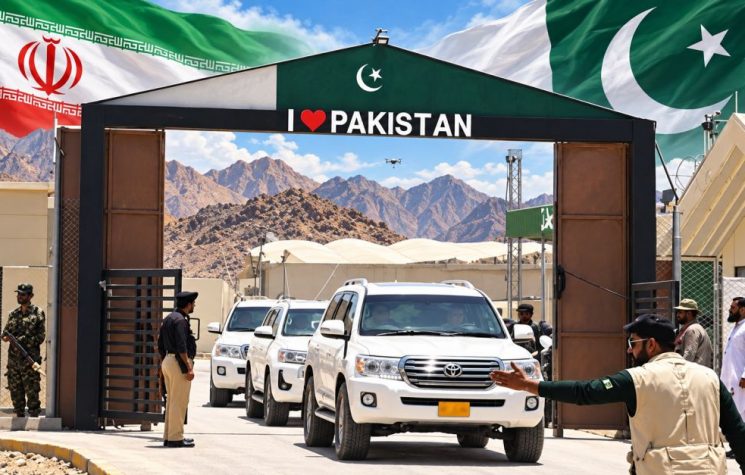
The port of Gwadar in the Arabian Sea – a key plank of the China-Pakistan Economic Corridor (CPEC) – has become strategically paramount as a land-transit gateway to Iran.

That’s how it works. Cargo arrives at Gwadar; is consolidated; moves overland approximately 89 km to the Gabd crossing; then enters Iran by road. The process is much shorter than moving the same cargo through Karachi – reducing time and cost.

Still, we have no evidence that Iranian-flagged ships are routinely calling at Gwadar or that Iranian maritime cargo is being loaded and discharged in what amounts to an Iranian shipping route.

Then there’s the Caspian: the crucially strategic route immune to the U.S. Navy.

As I saw it last year while filming a documentary on the INSTC,

Iranian Caspian ports such as Bandar Anzali connect mostly to Russia, especially Astrakhan.

Since the blockade, Iranian Caspian ports have increased their operating tempo; Bandar Anzali is approaching full capacity, moving grain; agricultural products; industrial goods; components; and above all strategic trade between BRICS members Iran and Russia.

There’s nothing the U.S. Navy can do on the Caspian, as the 2018 Convention on the Legal Status of the Caspian Sea excludes extra-regional naval powers.

Along the 7,200-km long INSTC connecting Russia, Iran and India, Russia-Iran cargo has been growing very fast – although there are infrastructure problems, such as the missing Rasht–Astara rail connection inside Iran.

And the fact that the INSTC maritime route from Chabahar in Sistan-Balochistan to India for the moment is not functioning as a meaningful wartime relief channel.

Iran is actually at the heart of two connectivity architectures: the China–Central Asia–Iran railway, part of BRI/New Silk Roads; and the Iran–Russia Caspian route, part of the INSTC. These are in fact two intersecting corridors: one East-West, the other North-South.

Then there’s the Trans-Caspian, or Middle Corridor – which does not run through Iran: that’s China-Kazakhstan-Caspian – Azerbaijan-Georgia-Türkiye-Europe. The Middle Corridor actually bypasses Iran.

So what all of the above can tell us about Trump’s blockade?

In a nutshell: the U.S. may blockade Iran on the seas. But it cannot blockade Iran’s geography.

After all Iran is at the heart of a cross-Eurasia network, including

Pakistan, the Central Asian “stans”, Russia, the Caspian Sea, and China.

What the current “no peace, no war” stalemate is doing is exponentially increase the network’s strategic value. The network prevents maritime coercion from becoming complete physical isolation. Forget about the U.S. profiting from a strategic closure.

If anything, Iran going on the offense might in fact provoke another type of strategic closure. Iran retains a multi-layered anti-access architecture including long-range anti-ship missiles;

naval mining capability; and submarines designed for operations in shallow and constrained waters.

And then, geography compounds the problem. Large American naval forces operating relatively close to a super-hostile coastline will have to face very short warning distances and much reduced dispersal space.

The American blockade has indeed devastated the largest single channel through which Iran earned hard currency – or petroyuans. But it has not – and geographically cannot – reduce Iran to an island, as Iran continues to connect east, north and southeast through land, rail and inland-sea networks.

Every single day that architecture, operating under pressure, increases the incentive for Iran, Russia, China, Pakistan and the Central Asian “stans” to deepen it.

And to deepen Eurasia integration – the most crucial geopolitical development of the 21st century.

Why Trump’s blockade cannot turn Iran into an island

The U.S. may blockade Iran on the seas. But it cannot blockade Iran’s geography

Join us on Telegram, X, and VK.

Contact us: info@strategic-culture.su

Iran so far has been running the clock.

Now, Iran is speeding up the management of the clock.

Even strategic patience has its limits. Tehran kept a nutcracker on the Strait of Hormuz for 5.5 months. The Empire of Piracy didn’t back off. On the contrary: the reaction, piling up on Trump’s blockade, focused on ruthless, terminal market manipulation keeping oil prices relatively low – using everything from depletion of the Strategic Petroleum Reserves (SPR) to DARPA employing AI tools to manipulate markets.

Terrible costs are about to be paid in full – via a global depression; further rejection of Western “values” – and swindling schemes – all across the Global South; and an inevitable cleavage between two world systems.

Iran cannot continue on the path of a slow Strait of Hormuz strangulation – as it runs the risk of reversing gains as time goes by. Iran is bound to weaken along with everybody else in a Global Great Depression. That’s definitely not a long term solution for a proud, sovereign, resilient civilization-state with millennial determination when it comes to dignified self-sufficiency.

The leadership in Tehran has perfectly understood that the Empire’s new – actually – back to old – beat is to financially and economically smother Persia, as it was done, for instance, to Syria.

It gets worse. Much worse: the current normalization of unleashing tactical nukes in “discussions” at the Empire’s tables. If genocide has been normalized – by the whole, collective, fragmented West – why not nuclear bombing (but only by the Empire)?

Tehran is very much aware that a long dark cloud may be coming down. So the time is right for cranking the speed on the clock. Mohsen Rezaee – new secretary of the Supreme National Security Council (SNSC) and personal representative of Leader Mojtaba Khamenei – is setting the tone. There’s no other way than to go all out to force the Hegemonic Old Order to bow down.

Coercive, but not decisive

Trump’s naval blockade may be wreaking some havoc on Iran; but by itself it cannot alter a substantial part of the architecture that keeps Iran connected to Eurasia.

The blockade did damage Iran’s seaborne crude trade. Traffic in the Strait of Hormuz has collapsed. Depending on the tracking source, Iran’s crude exports have fallen from approximately 1.8–2.0 million barrels a day before the blockade to below 300,000 barrels a day.

That’s a major coercive pressure. Yet Iran is far from geographically isolated. Rail connections across Central Asia; commercial traffic across the Pakistan land borders (at least 6 channels); the Caspian route to Russia; the International North–South Transportation Corridor (INSTC): all that remains in effect – and in the case of the INSTC actually expanding, even though the infrastructure remains incomplete.

Some Iranian crude continues to escape through ship-to-ship transfers, particularly off Malaysia. Cargo leaving Iranian waters is transferred offshore to obscure its origin before moving onward, principally toward Asian buyers.

During the June–July truce, roughly twenty tankers moved approximately USD6 billion in crude this way. Of course that’s not a substitute for Iran’s pre-war export system – as the process relies on a finite shadow fleet operating under tremendous sanctions pressure.

Yet the key point is that the American blockade leaks.

So the blockade may be coercive but it’s not decisive – no matter the torrents of spin by Trump cronies/assorted grifters.

Moving to direct U.S.-Iran talks, they are mired in a wild ocean of contradictions.

The IRGC and the Foreign Ministry have publicly – and explicitly – denied any active direct American channel in effect. The IRGC mocked the American claim as psychological warfare – even as Trump publicly spun an established, direct backchannel to the IRGC.

Well, a backchannel in fact exists: that’s the May 2026 channel through Kurdistan President Nechirvan Barzani to senior IRGC leadership. It went dormant. It may have even been kept, informally, on unresolved status mode – while Tehran denies it.

“Diplomacy” is not exactly familiar as Big Macs to Trump; threats are. Cue to the now public threat to bomb Oman by name on two separate occasions.

Oman is far from a peripheral actor. Muscat is simultaneously:

one of the GCC’s most durable intermediaries; deeply involved in the Iran diplomatic channel; and co-negotiating the emerging Hormuz transit mechanism.

So the threat – twice – of bombing Oman means POTUS going

directly against the very mini-state helping to build a possible off-ramp for the Empire.

No wonder there was no official Omani government statement responding to the threats. No statement from the Sultan.

No statement from the Foreign Ministry.

Muscat’s silence though should not be misread. Silence is not acquiescence. Silence is not defiance. Silence may be part of a wily diplomatic strategy: something to remain usable to both sides.

No way to blockade Iran’s geography

The port of Gwadar in the Arabian Sea – a key plank of the China-Pakistan Economic Corridor (CPEC) – has become strategically paramount as a land-transit gateway to Iran.

That’s how it works. Cargo arrives at Gwadar; is consolidated; moves overland approximately 89 km to the Gabd crossing; then enters Iran by road. The process is much shorter than moving the same cargo through Karachi – reducing time and cost.

Still, we have no evidence that Iranian-flagged ships are routinely calling at Gwadar or that Iranian maritime cargo is being loaded and discharged in what amounts to an Iranian shipping route.

Then there’s the Caspian: the crucially strategic route immune to the U.S. Navy.

As I saw it last year while filming a documentary on the INSTC,

Iranian Caspian ports such as Bandar Anzali connect mostly to Russia, especially Astrakhan.

Since the blockade, Iranian Caspian ports have increased their operating tempo; Bandar Anzali is approaching full capacity, moving grain; agricultural products; industrial goods; components; and above all strategic trade between BRICS members Iran and Russia.

There’s nothing the U.S. Navy can do on the Caspian, as the 2018 Convention on the Legal Status of the Caspian Sea excludes extra-regional naval powers.

Along the 7,200-km long INSTC connecting Russia, Iran and India, Russia-Iran cargo has been growing very fast – although there are infrastructure problems, such as the missing Rasht–Astara rail connection inside Iran.

And the fact that the INSTC maritime route from Chabahar in Sistan-Balochistan to India for the moment is not functioning as a meaningful wartime relief channel.

Iran is actually at the heart of two connectivity architectures: the China–Central Asia–Iran railway, part of BRI/New Silk Roads; and the Iran–Russia Caspian route, part of the INSTC. These are in fact two intersecting corridors: one East-West, the other North-South.

Then there’s the Trans-Caspian, or Middle Corridor – which does not run through Iran: that’s China-Kazakhstan-Caspian – Azerbaijan-Georgia-Türkiye-Europe. The Middle Corridor actually bypasses Iran.

So what all of the above can tell us about Trump’s blockade?

In a nutshell: the U.S. may blockade Iran on the seas. But it cannot blockade Iran’s geography.

After all Iran is at the heart of a cross-Eurasia network, including

Pakistan, the Central Asian “stans”, Russia, the Caspian Sea, and China.

What the current “no peace, no war” stalemate is doing is exponentially increase the network’s strategic value. The network prevents maritime coercion from becoming complete physical isolation. Forget about the U.S. profiting from a strategic closure.

If anything, Iran going on the offense might in fact provoke another type of strategic closure. Iran retains a multi-layered anti-access architecture including long-range anti-ship missiles;

naval mining capability; and submarines designed for operations in shallow and constrained waters.

And then, geography compounds the problem. Large American naval forces operating relatively close to a super-hostile coastline will have to face very short warning distances and much reduced dispersal space.

The American blockade has indeed devastated the largest single channel through which Iran earned hard currency – or petroyuans. But it has not – and geographically cannot – reduce Iran to an island, as Iran continues to connect east, north and southeast through land, rail and inland-sea networks.

Every single day that architecture, operating under pressure, increases the incentive for Iran, Russia, China, Pakistan and the Central Asian “stans” to deepen it.

And to deepen Eurasia integration – the most crucial geopolitical development of the 21st century.

The U.S. may blockade Iran on the seas. But it cannot blockade Iran’s geography

Join us on Telegram, X, and VK.

Contact us: info@strategic-culture.su

Iran so far has been running the clock.

Now, Iran is speeding up the management of the clock.

Even strategic patience has its limits. Tehran kept a nutcracker on the Strait of Hormuz for 5.5 months. The Empire of Piracy didn’t back off. On the contrary: the reaction, piling up on Trump’s blockade, focused on ruthless, terminal market manipulation keeping oil prices relatively low – using everything from depletion of the Strategic Petroleum Reserves (SPR) to DARPA employing AI tools to manipulate markets.

Terrible costs are about to be paid in full – via a global depression; further rejection of Western “values” – and swindling schemes – all across the Global South; and an inevitable cleavage between two world systems.

Iran cannot continue on the path of a slow Strait of Hormuz strangulation – as it runs the risk of reversing gains as time goes by. Iran is bound to weaken along with everybody else in a Global Great Depression. That’s definitely not a long term solution for a proud, sovereign, resilient civilization-state with millennial determination when it comes to dignified self-sufficiency.

The leadership in Tehran has perfectly understood that the Empire’s new – actually – back to old – beat is to financially and economically smother Persia, as it was done, for instance, to Syria.

It gets worse. Much worse: the current normalization of unleashing tactical nukes in “discussions” at the Empire’s tables. If genocide has been normalized – by the whole, collective, fragmented West – why not nuclear bombing (but only by the Empire)?

Tehran is very much aware that a long dark cloud may be coming down. So the time is right for cranking the speed on the clock. Mohsen Rezaee – new secretary of the Supreme National Security Council (SNSC) and personal representative of Leader Mojtaba Khamenei – is setting the tone. There’s no other way than to go all out to force the Hegemonic Old Order to bow down.

Coercive, but not decisive

Trump’s naval blockade may be wreaking some havoc on Iran; but by itself it cannot alter a substantial part of the architecture that keeps Iran connected to Eurasia.

The blockade did damage Iran’s seaborne crude trade. Traffic in the Strait of Hormuz has collapsed. Depending on the tracking source, Iran’s crude exports have fallen from approximately 1.8–2.0 million barrels a day before the blockade to below 300,000 barrels a day.

That’s a major coercive pressure. Yet Iran is far from geographically isolated. Rail connections across Central Asia; commercial traffic across the Pakistan land borders (at least 6 channels); the Caspian route to Russia; the International North–South Transportation Corridor (INSTC): all that remains in effect – and in the case of the INSTC actually expanding, even though the infrastructure remains incomplete.

Some Iranian crude continues to escape through ship-to-ship transfers, particularly off Malaysia. Cargo leaving Iranian waters is transferred offshore to obscure its origin before moving onward, principally toward Asian buyers.

During the June–July truce, roughly twenty tankers moved approximately USD6 billion in crude this way. Of course that’s not a substitute for Iran’s pre-war export system – as the process relies on a finite shadow fleet operating under tremendous sanctions pressure.

Yet the key point is that the American blockade leaks.

So the blockade may be coercive but it’s not decisive – no matter the torrents of spin by Trump cronies/assorted grifters.

Moving to direct U.S.-Iran talks, they are mired in a wild ocean of contradictions.

The IRGC and the Foreign Ministry have publicly – and explicitly – denied any active direct American channel in effect. The IRGC mocked the American claim as psychological warfare – even as Trump publicly spun an established, direct backchannel to the IRGC.

Well, a backchannel in fact exists: that’s the May 2026 channel through Kurdistan President Nechirvan Barzani to senior IRGC leadership. It went dormant. It may have even been kept, informally, on unresolved status mode – while Tehran denies it.

“Diplomacy” is not exactly familiar as Big Macs to Trump; threats are. Cue to the now public threat to bomb Oman by name on two separate occasions.

Oman is far from a peripheral actor. Muscat is simultaneously:

one of the GCC’s most durable intermediaries; deeply involved in the Iran diplomatic channel; and co-negotiating the emerging Hormuz transit mechanism.

So the threat – twice – of bombing Oman means POTUS going

directly against the very mini-state helping to build a possible off-ramp for the Empire.

No wonder there was no official Omani government statement responding to the threats. No statement from the Sultan.

No statement from the Foreign Ministry.

Muscat’s silence though should not be misread. Silence is not acquiescence. Silence is not defiance. Silence may be part of a wily diplomatic strategy: something to remain usable to both sides.

No way to blockade Iran’s geography

The port of Gwadar in the Arabian Sea – a key plank of the China-Pakistan Economic Corridor (CPEC) – has become strategically paramount as a land-transit gateway to Iran.

That’s how it works. Cargo arrives at Gwadar; is consolidated; moves overland approximately 89 km to the Gabd crossing; then enters Iran by road. The process is much shorter than moving the same cargo through Karachi – reducing time and cost.

Still, we have no evidence that Iranian-flagged ships are routinely calling at Gwadar or that Iranian maritime cargo is being loaded and discharged in what amounts to an Iranian shipping route.

Then there’s the Caspian: the crucially strategic route immune to the U.S. Navy.

As I saw it last year while filming a documentary on the INSTC,

Iranian Caspian ports such as Bandar Anzali connect mostly to Russia, especially Astrakhan.

Since the blockade, Iranian Caspian ports have increased their operating tempo; Bandar Anzali is approaching full capacity, moving grain; agricultural products; industrial goods; components; and above all strategic trade between BRICS members Iran and Russia.

There’s nothing the U.S. Navy can do on the Caspian, as the 2018 Convention on the Legal Status of the Caspian Sea excludes extra-regional naval powers.

Along the 7,200-km long INSTC connecting Russia, Iran and India, Russia-Iran cargo has been growing very fast – although there are infrastructure problems, such as the missing Rasht–Astara rail connection inside Iran.

And the fact that the INSTC maritime route from Chabahar in Sistan-Balochistan to India for the moment is not functioning as a meaningful wartime relief channel.

Iran is actually at the heart of two connectivity architectures: the China–Central Asia–Iran railway, part of BRI/New Silk Roads; and the Iran–Russia Caspian route, part of the INSTC. These are in fact two intersecting corridors: one East-West, the other North-South.

Then there’s the Trans-Caspian, or Middle Corridor – which does not run through Iran: that’s China-Kazakhstan-Caspian – Azerbaijan-Georgia-Türkiye-Europe. The Middle Corridor actually bypasses Iran.

So what all of the above can tell us about Trump’s blockade?

In a nutshell: the U.S. may blockade Iran on the seas. But it cannot blockade Iran’s geography.

After all Iran is at the heart of a cross-Eurasia network, including

Pakistan, the Central Asian “stans”, Russia, the Caspian Sea, and China.

What the current “no peace, no war” stalemate is doing is exponentially increase the network’s strategic value. The network prevents maritime coercion from becoming complete physical isolation. Forget about the U.S. profiting from a strategic closure.

If anything, Iran going on the offense might in fact provoke another type of strategic closure. Iran retains a multi-layered anti-access architecture including long-range anti-ship missiles;

naval mining capability; and submarines designed for operations in shallow and constrained waters.

And then, geography compounds the problem. Large American naval forces operating relatively close to a super-hostile coastline will have to face very short warning distances and much reduced dispersal space.

The American blockade has indeed devastated the largest single channel through which Iran earned hard currency – or petroyuans. But it has not – and geographically cannot – reduce Iran to an island, as Iran continues to connect east, north and southeast through land, rail and inland-sea networks.

Every single day that architecture, operating under pressure, increases the incentive for Iran, Russia, China, Pakistan and the Central Asian “stans” to deepen it.

And to deepen Eurasia integration – the most crucial geopolitical development of the 21st century.

The views of individual contributors do not necessarily represent those of the Strategic Culture Foundation.

See also

See also

The views of individual contributors do not necessarily represent those of the Strategic Culture Foundation.