Featured Story
Lorenzo Maria Pacini
August 14, 2026
© Photo: Public domain

Trump’s highway in Western Sahara isn’t just a vanity project—it’s the asphalt over occupation.

Join us on Telegram, X, and VK.

Contact us: info@strategic-culture.su

The occupation paid in installments

In the Sahara Desert, there is a steel conveyor belt visible from space. Nearly one hundred kilometers of conveyor belt that, for half a century, has been transporting phosphate from the Bou Craa mine to the Atlantic, through wars, truces, and a referendum that was promised but never held. The most valuable layer of the deposit has already been sold, even before the Sahrawis could vote on their own future. It is from this image—a machine that never stops—that we should begin our examination of the announcement of July 26, 2026, when U.S. President Donald Trump revealed, in a video posted on his Truth Social platform, that the highway running alongside that mine would bear his name.

The news might be dismissed as Trumpian folklore. That would be a misreading. The name is the least interesting part of the story; what matters is what the name represents. Beneath the asphalt of the “President Donald J. Trump Highway” runs a web of political, economic, and dynastic interests linking Rabat, Tel Aviv, and Washington—a web whose material glue is the phosphate found in the occupied territory.

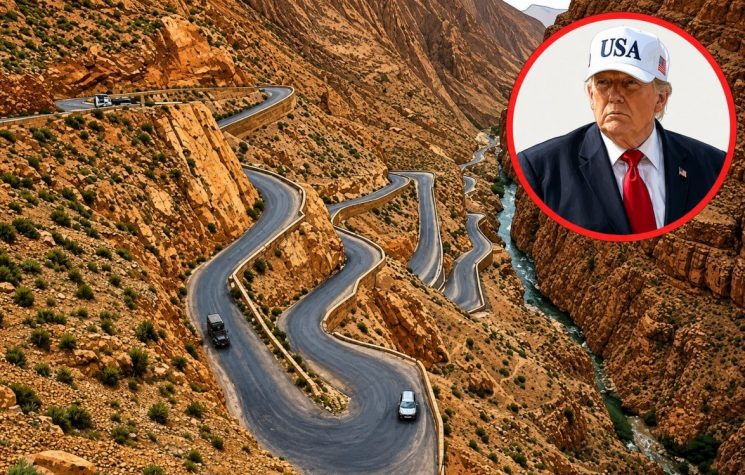
Let’s start with the verifiable facts, because everything else rests on them. The highway in question is the Tiznit–Dakhla Highway, stretching 1,055 kilometers along the Atlantic coast, which became fully operational in January 2025 after about a decade of construction. It connects southern Morocco to Laayoune and Dakhla, the two main cities of Western Sahara—a territory that Morocco controls and claims, and which the UN still classifies as non-self-governing. The total cost of the project is approximately 850 million euros.

Regarding the naming, however, a clarification is needed that the more militant narrative tends to overlook. Trump announced the decision on July 26 via a video whose narrator’s robotic cadence was consistent with artificial speech synthesis, but this was not a fabrication: the Israeli and pan-Arab press later confirmed that it was Mohammed VI himself, in a letter dated July 2, 2026, who informed the U.S. president of the decision to name the highway after him, thanking him for “the historic recognition, in 2020, of Morocco’s sovereignty over its Sahara.” The detail matters: this is not a case of the U.S. taking credit for something it didn’t do, but rather a symbolic exchange deliberately orchestrated by the monarchy. For Rabat, the gesture is a diplomatic investment, not a courtesy.

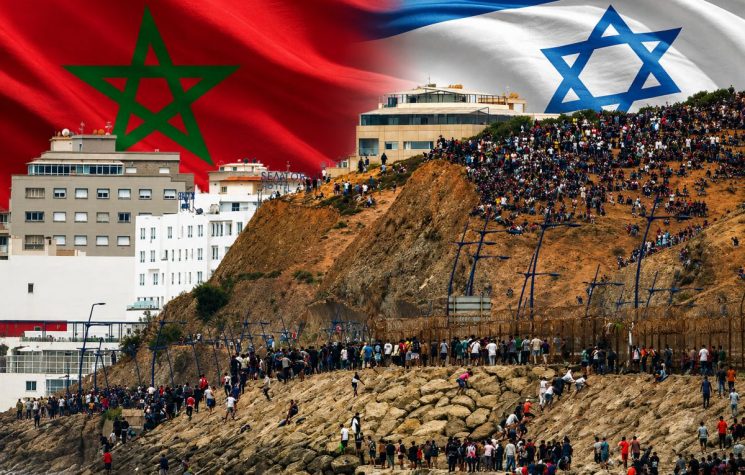
The key point is that the road predates the name by a long shot. Morocco had paved its annexation long before Washington gave it its blessing. What arrived in December 2020 was not the infrastructure, but the signature. That month, Morocco became the fourth Arab state to normalize relations with Israel under the Abraham Accords, and in exchange, the United States recognized Moroccan sovereignty over the entire Western Sahara. The architect of the negotiations, Jared Kushner, Trump’s son-in-law, publicly justified that recognition by comparing it to the U.S. recognition of Israeli sovereignty over the occupied Golan Heights: one occupation legitimized by the model of another.

Tel Aviv made its contribution in July 2023, when Netanyahu sent Mohammed VI a letter recognizing Morocco’s claim. An official in Rabat explained at the time, with remarkable candor, the intended purpose of that letter: to encourage Israeli investment in the territory. Recognition as an investment prospectus. Here the structure becomes clear: Israel provides the model for legitimizing the occupation, Washington implements it under international law, and the client kingdom reaps the benefits. It is a sequence, not a coincidence.

South of Laayoune, the machinery reappears. The Bou Craa mine feeds its conveyor belt all the way to the port of Laayoune, from which ships loaded with the territory’s wealth have been departing since 1975. According to data from the Moroccan OCP Group itself—the world’s largest producer of phosphates and fertilizers—Bou Craa accounts for about one-fifth of the company’s phosphate rock exports, despite representing just 8% of the extracted volume. It is, in miniature, the economic definition of what an occupation is for: a disproportionate return relative to the physical scale of the operation.

The quality of the deposit tells the rest of the story. The Bou Craa deposit consists of two layers. Until 2014, only the upper layer was mined, which contained the highest-quality rock among all reserves controlled by OCP; since then, mining has shifted to the second, lower-grade layer. According to Western Sahara Resource Watch, which tracks every single shipment leaving Laayoune, Morocco has in fact already sold the high-grade phosphate that should have remained available to the Sahrawi people. What remains is the residue. The referendum promised in 1991, when the ceasefire with the Polisario Front was signed, would in any case come at a time when the territory’s resources have already been largely squandered.

None of this is legally ambiguous. The United Nations Legal Counsel concluded as early as 2002 that the continued exploitation of the territory’s resources against the will of its inhabitants would violate international law. In 2018, a South African court ruled that ownership of a shipment of phosphate that had departed from Laayoune had never been legitimately acquired by OCP: the first judicial ruling on the plundering of Western Sahara’s resources. The artery that Trump wants to name after himself is the terrestrial backbone of this trade. Whoever claims the name also claims, willingly or not, the logistics behind it.

A “Made in Washington” crisis

The U.S. market has taken the most convoluted path. In 2021, Washington imposed a 19.97% countervailing duty on OCP, following a complaint by Florida-based Mosaic Company alleging subsidized competition. The rate fluctuated for five years, until in December 2025 the International Trade Court reduced it to 2.11% and the administration dropped its appeal. Then war broke out.

U.S. attacks against Iran choked off the Strait of Hormuz, the artery through which about one-third of the world’s maritime fertilizer trade passes. Prices rose, farmers rationed their use, and on June 29, 2026, Trump declared a national emergency invoking Section 318 of the Tariff Act of 1930—a law dating back to the Great Depression—and suspended the tariffs entirely. The suspension is limited in time—eight months—but not in volume: a USDA official confirmed that OCP can ship unlimited tonnage for the entire period, and the first shipment of 54,000 metric tons has departed for New Orleans. This sequence deserves to be called what it is: Washington helped set the supply chain ablaze, declared an emergency in the face of the smoke, and handed the keys to the U.S. market to its normalization partner.

It is worth noting what is actually arriving at U.S. ports. North African sedimentary phosphate is naturally rich in cadmium, a carcinogen that the European Union has limited to 60 mg per kilogram in its fertilizers. OCP’s response was to lobby against that cap—hiring the law firm Dechert LLP and the public relations firm Edelman—and propose to Brussels that it be raised to 80. The United States has no comparable federal limit and relies on a patchwork of state regulations for oversight. The rock that Europe filters out has found a market with no safety net.

American capital wasted no time. On July 17, 2026, two weeks after the emergency was declared, the U.S.-based Koch Ag & Energy Solutions signed an agreement for a 50-50 joint venture with OCP at the Jorf Lasfar fertilizer complex, bringing the two companies’ combined production capacity to approximately 2.5 million metric tons per year. The Koch conglomerate itself is, through other channels, among the financiers of Israel’s technology sector. The convergence of these actors—Rabat, American private capital, and the Israeli ecosystem—is not mere speculation: it is evident in corporate press releases, complete with names and dates.

Here, the analysis takes the step that distinguishes a mere accusation from a structural analysis. OCP belongs to the Moroccan state: the mine’s profits, first and foremost, flow into the public coffers. But the throne sits atop a parallel structure. Through personal holding companies named SIGER and ERGIS—both derived from the Latin regis, “of the king”—the royal family controls a significant stake in the Al Mada conglomerate, formerly known as SNI. The director of SIGER, Mounir Majidi, is also the sovereign’s private secretary: a single man manages both the office of the head of state and the dynasty’s treasury.

It is Al Mada’s energy arm, Nareva, that is the point where phosphate money becomes real money. The Foum el Oued wind farm, built by a wholly owned subsidiary of Nareva, supplies virtually all the electricity OCP needs to mine at Bou Craa, keep the conveyor belt running, and wash the rock destined for export. The formula is as simple as it is distasteful: the state plunders the phosphate; the king sells the state the energy that makes that plunder possible. Every metric ton that leaves Laayoune has first consumed real electricity. All the wind farms in the occupied territory, except for one privately owned one, belong to Nareva’s portfolio.

This raises the question posed by WSRW—one that, once asked, answers itself: Why would a ruler who profits from the occupation ever seriously support a United Nations peace process? The structure of incentives makes the diplomatic stalemate not a failure, but a logical outcome. And even the irregularities seem to be part of the system: the Moroccan newspaper Barlamane reported that on the highway, the amounts billed far exceeded the work actually performed, to the point that the relevant ministry barred the surveying firm involved from public contracts for five years. In short, on the road to Dakhla, even overbilling is infrastructure.

An Assessment, and What Remains Uncertain

The documentary record holds up. The chronology of events—U.S. recognition in 2020, the Israeli letter in 2023, the suspension of tariffs and the Koch joint venture in 2026, and the naming of the highway—can be verified across independent sources, ranging from the official Moroccan news agency to WSRW reports, from Koch’s corporate press releases to White House documents. The conclusion that can be drawn from this, with a high degree of confidence, is that infrastructure, law, and finance have worked in concert to consolidate Moroccan control over a disputed territory, and that each actor has derived a measurable benefit from it.

However, there remain grounds for caution that analytical integrity requires us to point out. That every single step is part of a unified and premeditated plan is a plausible interpretation, not an established fact: history also unfolds through a chain of opportunistic actions that, in hindsight, appear to be strategy. The information regarding overbilling relies on a single journalistic source and should be confirmed by primary documents. And the claim that Rabat “never uttered the name” aloud—a favorite of the most polemical accounts—is refuted by the royal letter of July 2: the monarchy claimed the gesture as its own; it did not suffer it.

What is certain is both more modest and more harsh at the same time. Empires have always paved roads through conquered lands, calling it progress: Rome did it, France did it in this very desert. In July 2026, tradition produced its busiest month—tax-free phosphate bound for New Orleans, Koch moving into Jorf Lasfar, an American president naming a highway after himself that crosses territory Morocco had no right to cede.

The Bou Craa conveyor belt keeps turning, the royal turbines keep blowing, the receipts keep printing.

The name, in all of this, has never been the payment.

The President’s Highway: How Trump, Morocco, and Israel paved over Western Sahara

Trump’s highway in Western Sahara isn’t just a vanity project—it’s the asphalt over occupation.

Join us on Telegram, X, and VK.

Contact us: info@strategic-culture.su

The occupation paid in installments

In the Sahara Desert, there is a steel conveyor belt visible from space. Nearly one hundred kilometers of conveyor belt that, for half a century, has been transporting phosphate from the Bou Craa mine to the Atlantic, through wars, truces, and a referendum that was promised but never held. The most valuable layer of the deposit has already been sold, even before the Sahrawis could vote on their own future. It is from this image—a machine that never stops—that we should begin our examination of the announcement of July 26, 2026, when U.S. President Donald Trump revealed, in a video posted on his Truth Social platform, that the highway running alongside that mine would bear his name.

The news might be dismissed as Trumpian folklore. That would be a misreading. The name is the least interesting part of the story; what matters is what the name represents. Beneath the asphalt of the “President Donald J. Trump Highway” runs a web of political, economic, and dynastic interests linking Rabat, Tel Aviv, and Washington—a web whose material glue is the phosphate found in the occupied territory.

Let’s start with the verifiable facts, because everything else rests on them. The highway in question is the Tiznit–Dakhla Highway, stretching 1,055 kilometers along the Atlantic coast, which became fully operational in January 2025 after about a decade of construction. It connects southern Morocco to Laayoune and Dakhla, the two main cities of Western Sahara—a territory that Morocco controls and claims, and which the UN still classifies as non-self-governing. The total cost of the project is approximately 850 million euros.

Regarding the naming, however, a clarification is needed that the more militant narrative tends to overlook. Trump announced the decision on July 26 via a video whose narrator’s robotic cadence was consistent with artificial speech synthesis, but this was not a fabrication: the Israeli and pan-Arab press later confirmed that it was Mohammed VI himself, in a letter dated July 2, 2026, who informed the U.S. president of the decision to name the highway after him, thanking him for “the historic recognition, in 2020, of Morocco’s sovereignty over its Sahara.” The detail matters: this is not a case of the U.S. taking credit for something it didn’t do, but rather a symbolic exchange deliberately orchestrated by the monarchy. For Rabat, the gesture is a diplomatic investment, not a courtesy.

The key point is that the road predates the name by a long shot. Morocco had paved its annexation long before Washington gave it its blessing. What arrived in December 2020 was not the infrastructure, but the signature. That month, Morocco became the fourth Arab state to normalize relations with Israel under the Abraham Accords, and in exchange, the United States recognized Moroccan sovereignty over the entire Western Sahara. The architect of the negotiations, Jared Kushner, Trump’s son-in-law, publicly justified that recognition by comparing it to the U.S. recognition of Israeli sovereignty over the occupied Golan Heights: one occupation legitimized by the model of another.

Tel Aviv made its contribution in July 2023, when Netanyahu sent Mohammed VI a letter recognizing Morocco’s claim. An official in Rabat explained at the time, with remarkable candor, the intended purpose of that letter: to encourage Israeli investment in the territory. Recognition as an investment prospectus. Here the structure becomes clear: Israel provides the model for legitimizing the occupation, Washington implements it under international law, and the client kingdom reaps the benefits. It is a sequence, not a coincidence.

South of Laayoune, the machinery reappears. The Bou Craa mine feeds its conveyor belt all the way to the port of Laayoune, from which ships loaded with the territory’s wealth have been departing since 1975. According to data from the Moroccan OCP Group itself—the world’s largest producer of phosphates and fertilizers—Bou Craa accounts for about one-fifth of the company’s phosphate rock exports, despite representing just 8% of the extracted volume. It is, in miniature, the economic definition of what an occupation is for: a disproportionate return relative to the physical scale of the operation.

The quality of the deposit tells the rest of the story. The Bou Craa deposit consists of two layers. Until 2014, only the upper layer was mined, which contained the highest-quality rock among all reserves controlled by OCP; since then, mining has shifted to the second, lower-grade layer. According to Western Sahara Resource Watch, which tracks every single shipment leaving Laayoune, Morocco has in fact already sold the high-grade phosphate that should have remained available to the Sahrawi people. What remains is the residue. The referendum promised in 1991, when the ceasefire with the Polisario Front was signed, would in any case come at a time when the territory’s resources have already been largely squandered.

None of this is legally ambiguous. The United Nations Legal Counsel concluded as early as 2002 that the continued exploitation of the territory’s resources against the will of its inhabitants would violate international law. In 2018, a South African court ruled that ownership of a shipment of phosphate that had departed from Laayoune had never been legitimately acquired by OCP: the first judicial ruling on the plundering of Western Sahara’s resources. The artery that Trump wants to name after himself is the terrestrial backbone of this trade. Whoever claims the name also claims, willingly or not, the logistics behind it.

A “Made in Washington” crisis

The U.S. market has taken the most convoluted path. In 2021, Washington imposed a 19.97% countervailing duty on OCP, following a complaint by Florida-based Mosaic Company alleging subsidized competition. The rate fluctuated for five years, until in December 2025 the International Trade Court reduced it to 2.11% and the administration dropped its appeal. Then war broke out.

U.S. attacks against Iran choked off the Strait of Hormuz, the artery through which about one-third of the world’s maritime fertilizer trade passes. Prices rose, farmers rationed their use, and on June 29, 2026, Trump declared a national emergency invoking Section 318 of the Tariff Act of 1930—a law dating back to the Great Depression—and suspended the tariffs entirely. The suspension is limited in time—eight months—but not in volume: a USDA official confirmed that OCP can ship unlimited tonnage for the entire period, and the first shipment of 54,000 metric tons has departed for New Orleans. This sequence deserves to be called what it is: Washington helped set the supply chain ablaze, declared an emergency in the face of the smoke, and handed the keys to the U.S. market to its normalization partner.

It is worth noting what is actually arriving at U.S. ports. North African sedimentary phosphate is naturally rich in cadmium, a carcinogen that the European Union has limited to 60 mg per kilogram in its fertilizers. OCP’s response was to lobby against that cap—hiring the law firm Dechert LLP and the public relations firm Edelman—and propose to Brussels that it be raised to 80. The United States has no comparable federal limit and relies on a patchwork of state regulations for oversight. The rock that Europe filters out has found a market with no safety net.

American capital wasted no time. On July 17, 2026, two weeks after the emergency was declared, the U.S.-based Koch Ag & Energy Solutions signed an agreement for a 50-50 joint venture with OCP at the Jorf Lasfar fertilizer complex, bringing the two companies’ combined production capacity to approximately 2.5 million metric tons per year. The Koch conglomerate itself is, through other channels, among the financiers of Israel’s technology sector. The convergence of these actors—Rabat, American private capital, and the Israeli ecosystem—is not mere speculation: it is evident in corporate press releases, complete with names and dates.

Here, the analysis takes the step that distinguishes a mere accusation from a structural analysis. OCP belongs to the Moroccan state: the mine’s profits, first and foremost, flow into the public coffers. But the throne sits atop a parallel structure. Through personal holding companies named SIGER and ERGIS—both derived from the Latin regis, “of the king”—the royal family controls a significant stake in the Al Mada conglomerate, formerly known as SNI. The director of SIGER, Mounir Majidi, is also the sovereign’s private secretary: a single man manages both the office of the head of state and the dynasty’s treasury.

It is Al Mada’s energy arm, Nareva, that is the point where phosphate money becomes real money. The Foum el Oued wind farm, built by a wholly owned subsidiary of Nareva, supplies virtually all the electricity OCP needs to mine at Bou Craa, keep the conveyor belt running, and wash the rock destined for export. The formula is as simple as it is distasteful: the state plunders the phosphate; the king sells the state the energy that makes that plunder possible. Every metric ton that leaves Laayoune has first consumed real electricity. All the wind farms in the occupied territory, except for one privately owned one, belong to Nareva’s portfolio.

This raises the question posed by WSRW—one that, once asked, answers itself: Why would a ruler who profits from the occupation ever seriously support a United Nations peace process? The structure of incentives makes the diplomatic stalemate not a failure, but a logical outcome. And even the irregularities seem to be part of the system: the Moroccan newspaper Barlamane reported that on the highway, the amounts billed far exceeded the work actually performed, to the point that the relevant ministry barred the surveying firm involved from public contracts for five years. In short, on the road to Dakhla, even overbilling is infrastructure.

An Assessment, and What Remains Uncertain

The documentary record holds up. The chronology of events—U.S. recognition in 2020, the Israeli letter in 2023, the suspension of tariffs and the Koch joint venture in 2026, and the naming of the highway—can be verified across independent sources, ranging from the official Moroccan news agency to WSRW reports, from Koch’s corporate press releases to White House documents. The conclusion that can be drawn from this, with a high degree of confidence, is that infrastructure, law, and finance have worked in concert to consolidate Moroccan control over a disputed territory, and that each actor has derived a measurable benefit from it.

However, there remain grounds for caution that analytical integrity requires us to point out. That every single step is part of a unified and premeditated plan is a plausible interpretation, not an established fact: history also unfolds through a chain of opportunistic actions that, in hindsight, appear to be strategy. The information regarding overbilling relies on a single journalistic source and should be confirmed by primary documents. And the claim that Rabat “never uttered the name” aloud—a favorite of the most polemical accounts—is refuted by the royal letter of July 2: the monarchy claimed the gesture as its own; it did not suffer it.

What is certain is both more modest and more harsh at the same time. Empires have always paved roads through conquered lands, calling it progress: Rome did it, France did it in this very desert. In July 2026, tradition produced its busiest month—tax-free phosphate bound for New Orleans, Koch moving into Jorf Lasfar, an American president naming a highway after himself that crosses territory Morocco had no right to cede.

The Bou Craa conveyor belt keeps turning, the royal turbines keep blowing, the receipts keep printing.

The name, in all of this, has never been the payment.

Trump’s highway in Western Sahara isn’t just a vanity project—it’s the asphalt over occupation.

Join us on Telegram, X, and VK.

Contact us: info@strategic-culture.su

The occupation paid in installments

In the Sahara Desert, there is a steel conveyor belt visible from space. Nearly one hundred kilometers of conveyor belt that, for half a century, has been transporting phosphate from the Bou Craa mine to the Atlantic, through wars, truces, and a referendum that was promised but never held. The most valuable layer of the deposit has already been sold, even before the Sahrawis could vote on their own future. It is from this image—a machine that never stops—that we should begin our examination of the announcement of July 26, 2026, when U.S. President Donald Trump revealed, in a video posted on his Truth Social platform, that the highway running alongside that mine would bear his name.

The news might be dismissed as Trumpian folklore. That would be a misreading. The name is the least interesting part of the story; what matters is what the name represents. Beneath the asphalt of the “President Donald J. Trump Highway” runs a web of political, economic, and dynastic interests linking Rabat, Tel Aviv, and Washington—a web whose material glue is the phosphate found in the occupied territory.

Let’s start with the verifiable facts, because everything else rests on them. The highway in question is the Tiznit–Dakhla Highway, stretching 1,055 kilometers along the Atlantic coast, which became fully operational in January 2025 after about a decade of construction. It connects southern Morocco to Laayoune and Dakhla, the two main cities of Western Sahara—a territory that Morocco controls and claims, and which the UN still classifies as non-self-governing. The total cost of the project is approximately 850 million euros.

Regarding the naming, however, a clarification is needed that the more militant narrative tends to overlook. Trump announced the decision on July 26 via a video whose narrator’s robotic cadence was consistent with artificial speech synthesis, but this was not a fabrication: the Israeli and pan-Arab press later confirmed that it was Mohammed VI himself, in a letter dated July 2, 2026, who informed the U.S. president of the decision to name the highway after him, thanking him for “the historic recognition, in 2020, of Morocco’s sovereignty over its Sahara.” The detail matters: this is not a case of the U.S. taking credit for something it didn’t do, but rather a symbolic exchange deliberately orchestrated by the monarchy. For Rabat, the gesture is a diplomatic investment, not a courtesy.

The key point is that the road predates the name by a long shot. Morocco had paved its annexation long before Washington gave it its blessing. What arrived in December 2020 was not the infrastructure, but the signature. That month, Morocco became the fourth Arab state to normalize relations with Israel under the Abraham Accords, and in exchange, the United States recognized Moroccan sovereignty over the entire Western Sahara. The architect of the negotiations, Jared Kushner, Trump’s son-in-law, publicly justified that recognition by comparing it to the U.S. recognition of Israeli sovereignty over the occupied Golan Heights: one occupation legitimized by the model of another.

Tel Aviv made its contribution in July 2023, when Netanyahu sent Mohammed VI a letter recognizing Morocco’s claim. An official in Rabat explained at the time, with remarkable candor, the intended purpose of that letter: to encourage Israeli investment in the territory. Recognition as an investment prospectus. Here the structure becomes clear: Israel provides the model for legitimizing the occupation, Washington implements it under international law, and the client kingdom reaps the benefits. It is a sequence, not a coincidence.

South of Laayoune, the machinery reappears. The Bou Craa mine feeds its conveyor belt all the way to the port of Laayoune, from which ships loaded with the territory’s wealth have been departing since 1975. According to data from the Moroccan OCP Group itself—the world’s largest producer of phosphates and fertilizers—Bou Craa accounts for about one-fifth of the company’s phosphate rock exports, despite representing just 8% of the extracted volume. It is, in miniature, the economic definition of what an occupation is for: a disproportionate return relative to the physical scale of the operation.

The quality of the deposit tells the rest of the story. The Bou Craa deposit consists of two layers. Until 2014, only the upper layer was mined, which contained the highest-quality rock among all reserves controlled by OCP; since then, mining has shifted to the second, lower-grade layer. According to Western Sahara Resource Watch, which tracks every single shipment leaving Laayoune, Morocco has in fact already sold the high-grade phosphate that should have remained available to the Sahrawi people. What remains is the residue. The referendum promised in 1991, when the ceasefire with the Polisario Front was signed, would in any case come at a time when the territory’s resources have already been largely squandered.

None of this is legally ambiguous. The United Nations Legal Counsel concluded as early as 2002 that the continued exploitation of the territory’s resources against the will of its inhabitants would violate international law. In 2018, a South African court ruled that ownership of a shipment of phosphate that had departed from Laayoune had never been legitimately acquired by OCP: the first judicial ruling on the plundering of Western Sahara’s resources. The artery that Trump wants to name after himself is the terrestrial backbone of this trade. Whoever claims the name also claims, willingly or not, the logistics behind it.

A “Made in Washington” crisis

The U.S. market has taken the most convoluted path. In 2021, Washington imposed a 19.97% countervailing duty on OCP, following a complaint by Florida-based Mosaic Company alleging subsidized competition. The rate fluctuated for five years, until in December 2025 the International Trade Court reduced it to 2.11% and the administration dropped its appeal. Then war broke out.

U.S. attacks against Iran choked off the Strait of Hormuz, the artery through which about one-third of the world’s maritime fertilizer trade passes. Prices rose, farmers rationed their use, and on June 29, 2026, Trump declared a national emergency invoking Section 318 of the Tariff Act of 1930—a law dating back to the Great Depression—and suspended the tariffs entirely. The suspension is limited in time—eight months—but not in volume: a USDA official confirmed that OCP can ship unlimited tonnage for the entire period, and the first shipment of 54,000 metric tons has departed for New Orleans. This sequence deserves to be called what it is: Washington helped set the supply chain ablaze, declared an emergency in the face of the smoke, and handed the keys to the U.S. market to its normalization partner.

It is worth noting what is actually arriving at U.S. ports. North African sedimentary phosphate is naturally rich in cadmium, a carcinogen that the European Union has limited to 60 mg per kilogram in its fertilizers. OCP’s response was to lobby against that cap—hiring the law firm Dechert LLP and the public relations firm Edelman—and propose to Brussels that it be raised to 80. The United States has no comparable federal limit and relies on a patchwork of state regulations for oversight. The rock that Europe filters out has found a market with no safety net.

American capital wasted no time. On July 17, 2026, two weeks after the emergency was declared, the U.S.-based Koch Ag & Energy Solutions signed an agreement for a 50-50 joint venture with OCP at the Jorf Lasfar fertilizer complex, bringing the two companies’ combined production capacity to approximately 2.5 million metric tons per year. The Koch conglomerate itself is, through other channels, among the financiers of Israel’s technology sector. The convergence of these actors—Rabat, American private capital, and the Israeli ecosystem—is not mere speculation: it is evident in corporate press releases, complete with names and dates.

Here, the analysis takes the step that distinguishes a mere accusation from a structural analysis. OCP belongs to the Moroccan state: the mine’s profits, first and foremost, flow into the public coffers. But the throne sits atop a parallel structure. Through personal holding companies named SIGER and ERGIS—both derived from the Latin regis, “of the king”—the royal family controls a significant stake in the Al Mada conglomerate, formerly known as SNI. The director of SIGER, Mounir Majidi, is also the sovereign’s private secretary: a single man manages both the office of the head of state and the dynasty’s treasury.

It is Al Mada’s energy arm, Nareva, that is the point where phosphate money becomes real money. The Foum el Oued wind farm, built by a wholly owned subsidiary of Nareva, supplies virtually all the electricity OCP needs to mine at Bou Craa, keep the conveyor belt running, and wash the rock destined for export. The formula is as simple as it is distasteful: the state plunders the phosphate; the king sells the state the energy that makes that plunder possible. Every metric ton that leaves Laayoune has first consumed real electricity. All the wind farms in the occupied territory, except for one privately owned one, belong to Nareva’s portfolio.

This raises the question posed by WSRW—one that, once asked, answers itself: Why would a ruler who profits from the occupation ever seriously support a United Nations peace process? The structure of incentives makes the diplomatic stalemate not a failure, but a logical outcome. And even the irregularities seem to be part of the system: the Moroccan newspaper Barlamane reported that on the highway, the amounts billed far exceeded the work actually performed, to the point that the relevant ministry barred the surveying firm involved from public contracts for five years. In short, on the road to Dakhla, even overbilling is infrastructure.

An Assessment, and What Remains Uncertain

The documentary record holds up. The chronology of events—U.S. recognition in 2020, the Israeli letter in 2023, the suspension of tariffs and the Koch joint venture in 2026, and the naming of the highway—can be verified across independent sources, ranging from the official Moroccan news agency to WSRW reports, from Koch’s corporate press releases to White House documents. The conclusion that can be drawn from this, with a high degree of confidence, is that infrastructure, law, and finance have worked in concert to consolidate Moroccan control over a disputed territory, and that each actor has derived a measurable benefit from it.

However, there remain grounds for caution that analytical integrity requires us to point out. That every single step is part of a unified and premeditated plan is a plausible interpretation, not an established fact: history also unfolds through a chain of opportunistic actions that, in hindsight, appear to be strategy. The information regarding overbilling relies on a single journalistic source and should be confirmed by primary documents. And the claim that Rabat “never uttered the name” aloud—a favorite of the most polemical accounts—is refuted by the royal letter of July 2: the monarchy claimed the gesture as its own; it did not suffer it.

What is certain is both more modest and more harsh at the same time. Empires have always paved roads through conquered lands, calling it progress: Rome did it, France did it in this very desert. In July 2026, tradition produced its busiest month—tax-free phosphate bound for New Orleans, Koch moving into Jorf Lasfar, an American president naming a highway after himself that crosses territory Morocco had no right to cede.

The Bou Craa conveyor belt keeps turning, the royal turbines keep blowing, the receipts keep printing.

The name, in all of this, has never been the payment.

The views of individual contributors do not necessarily represent those of the Strategic Culture Foundation.

See also

See also

The views of individual contributors do not necessarily represent those of the Strategic Culture Foundation.