


Contact us: info@strategic-culture.su
It is not uncommon to see people on social media congratulating one another on another trip around the sun (that is, a birthday), a gesture that emphasizes their own scientific knowledge or membership in a specific subculture rather than the good wishes. The somewhat mawkish notion that we are made of star stuff is also frequently repeated by those wishing to appear enlightened. Given that both these catchphrases originate with Carl Sagan, it is reasonable to infer that this famous science communicator shaped a highly influential Western subculture: that of people who, whether by following trends set by science communicators on social media, or simply by virtue of being atheist, feel morally and intellectually superior to the rest of humanity, which does not share their hobbies and convictions. Thus, reading Carl Sagan is essential to understanding a significant cultural strain in the West today.
The book most frequently cited by adherents of this subculture is The Demon-Haunted World: Science as a Candle in the Dark (1995). As a historian of philosophy, I recognize the work as Epicurean based on the title alone. In De Rerum Natura by the Roman Epicurean Lucretius, conventional religiosity is portrayed as the distressing result of ignorance regarding natural causes—causes that are strictly material, for there is nothing but atoms and the void, with atoms moving blindly and generating order and disorder by turns throughout eternity. There is no Big Bang, no Creation, and no Apocalypse. Knowledge (scientia)—that is, science—brings peace of mind. This idea may seem thoroughly modern, yet it predates Christ. (As for the Big Bang, Sagan speculates that one day it might be discovered that the universe expands and then contracts, effectively turning the Big Bang into a stage of an accordion-like universe that opens and closes. This would restore the eternal world of the ancients.)
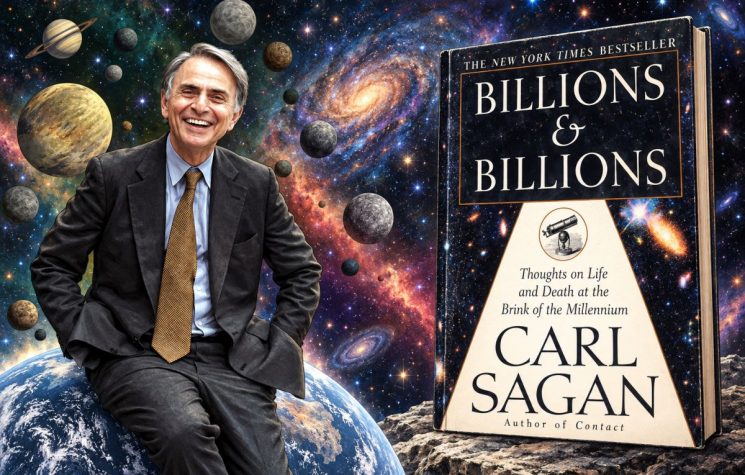
However, after reviewing the available options, the one that struck me as the most informative was Billions and Billions (1997), Sagan’s final book, a political testament published by his widow shortly after his death. In this testament, he advocates for environmentalism and abortion. I have concluded that this is indeed what I want, for today, anyone who does not express anguish over the planet, or who fails to regard abortion as a woman’s human right, is viewed as a barbarian by the savant crowd that congratulate one another on their latest trip around the sun.
The reading has proven truly illuminating regarding the materialistic and dogmatic mindset that became insensitively mainstream among Western middle classes after World War II—especially among atheist leftists, though not exclusively so.
The book is divided into three parts, each subdivided into short chapters. In the first part, which includes the Big Bang thought I mentioned, the chapters meander through topics involving scientific knowledge while invariably injecting some ESG-style moralizing. For instance, in “The Gaze of God and the Dripping Faucet,” the author begins by discussing the ancient Egyptian belief that the sun was God in order to address the nature of light, explain that colors are determined by wavelength, and… conclude that, scientifically, it is incorrect to use melanin to distinguish white humans from black ones, because across the majority of the visible and invisible light spectrum (encompassing both infrared and ultraviolet), humans are black. “Only in the visible, where many molecules are transparent, is the anomaly of white skin even possible.” There you have it: through a blatant piece of sophistry that elevates pedantry to unprecedented heights, Science has put an end to racism and demonstrated the superior correctness of the term “African American.”
Sagan also reveals himself to be a sensitive man. In “The World That Came in the Mail”, the first piece in the second section, which focuses on environmentalism, the “world” in question is an aquarium of shrimp he had ordered. Sagan describes the shrimp’s anatomy and their similarities to humans in an emotional tone, eventually recounting their mysterious deaths, caused by some environmental imbalance. When the shrimp die, Sagan weeps. He does all this to draw a parallel between his tiny aquarium world and the vast aquarium known as Earth, where a mysterious environmental imbalance could kill us at any moment.
In the realm of environmentalist alarmism, anything goes—even incorrect scientific data. For instance, in “The Environment: Where Does Prudence Lie?”, Sagan states: “After flourishing for 180 million years, the dinosaurs were extinguished. Every last one. There are none left. No species is guaranteed its tenure on this planet.” Yet, since the 1970s, birds have been considered living dinosaurs; indeed, the hypothesis of a kinship between birds and dinosaurs had engaged scientists as far back as the 19th century. I possess no significant expertise in the hard or biological sciences, and yet I was able to spot factual errors in Sagan’s text. If a scientist were to read Billions and Billions, they would undoubtedly find far more falsehoods in this mature work by the archetypal science communicator—a scientist who made no major individual contribution to science itself.
However, one thing I learned from reading Sagan is that, while evident geopolitical issues are at play in the imposition of neo-Malthusianism on the Third World, the technocratic impulse is a necessary consequence of the Epicurean/materialist worldview.
In the book’s first section, Sagan strives to portray life on Earth as an extremely improbable phenomenon, the result of an almost impossible convergence of countless material variables. The more one searches for intelligent life on another planet without finding it (something Sagan experienced throughout his adult life), the more miraculous human life appears. Mutatis mutandis, it is akin to reflecting on how our mother might never have met our father; or how, even if they had met, the act of fertile intercourse might have occurred in a different month, involving a different egg; or, had it happened in that same month, how the egg might have been penetrated by a different spermatozoon, and so on. As humorist Millôr Fernandes put it: “My mother was born in Italy, my father was born in Spain, and I was born in Rio. I don’t know how we ever met!”
This retrospective view, far too teleological for an evolutionist, leaves Sagan in a state of anxiety: the highly exceptional conditions for life on Earth could vanish in the blink of an eye. In fact, they are bound to change, given that all that exists is atoms and the void, with atoms moving ceaselessly, blindly generating both chaos and order. Anyone holding an Epicurean/materialist worldview would feel an urgent desire to hit the pause button on the universe, or at least on Earth, to preserve this fortuitous moment when the planet is hospitable to human life.
At any moment, an asteroid could appear and wipe everything out. Furthermore, humans are dangerous animals because they keep inventing things that interfere with the atmosphere. For instance, they invented modern medicine, which reduced mortality rates and caused the population to swell, leading to more people consuming energy. They invented CFCs, which were punching a hole in the ozone layer—threatening to kill vital algae after giving white people skin cancer, white people being the ones responsible for CFCs, which proves that cosmic justice exists. (Everyone was black just a few pages back, but never mind that.)
Thus, to hit that big pause button, we need to control the spread of technology and birth rates, and grant real political power to women (power they held in the Pleistocene but lack today), because if women have real political power, they will embrace contraception. (I didn’t quite get the Pleistocene bit; I hope he explains it in the third part, the one about abortion.) What’s more, we need to empower scientists, as they are the only ones dedicated to foreseeing long-term catastrophes. The human species is flawed because evolution conditioned it to think in the short term. Indeed, that is our great failing: focusing on putting food on our children’s table rather than looking further ahead and considering global warming. Thus, policymakers must turn to scientists to consider the long term, and a campaign of persuasion is required to raise public awareness.
The anthropology stemming from Sagan’s materialism is inextricably linked to the pedantry that permeates his work. Humans possess flaws rooted in evolution: short-term thinking arises from the fact that, until now, the priority was the survival of one’s own offspring rather than that of the species as a whole. Yet, Sagan’s work reflects an End of History sentiment: humanity has learned to explain the world without God, relying solely on matter, and is now guided by Science as its greater authority. Having reached this existential pinnacle that marks the end of “humanity’s childhood,” it is time to devise global plans for future generations, aiming to hit a cosmic pause button and preserve Earth’s fleeting conditions that sustain human life. Consequently, the implication is that some people are literally more evolved than others—an aberration no serious scientist (which Sagan is not) would endorse, yet one that is tacitly present. To survive natural selection, humanity must submit to Science; those unwilling to cooperate are effectively siding with extinction. Thus, subjugating—or ultimately even annihilating—inferior beings becomes a necessity for the survival of humanity as a species.
During the pandemic, many who were well-informed about how conventional vaccines work were puzzled by the obsession of Fauci’s cult with subjecting everyone to the so-called COVID vaccines. After all, if vaccines confer immunity (just as the disease itself does), why is it so crucial for the vaccinated that dissenters also get vaccinated? The answer lies in Sagan’s worldview: the belief that humanity has a future only if the collective obeys the dictates of Science. And he himself concludes the section on environmentalism by extolling global crises, climatic or otherwise, for having “a potential to draw forth previously untapped and even unimagined powers of cooperation, ingenuity, and commitment.”