


Contact us: info@strategic-culture.su
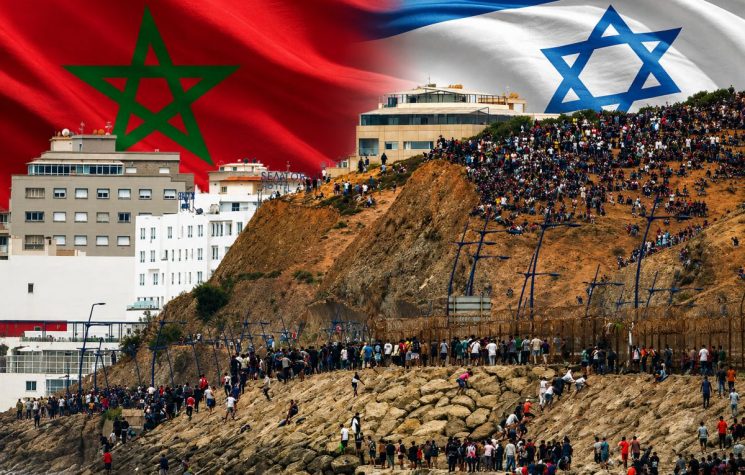
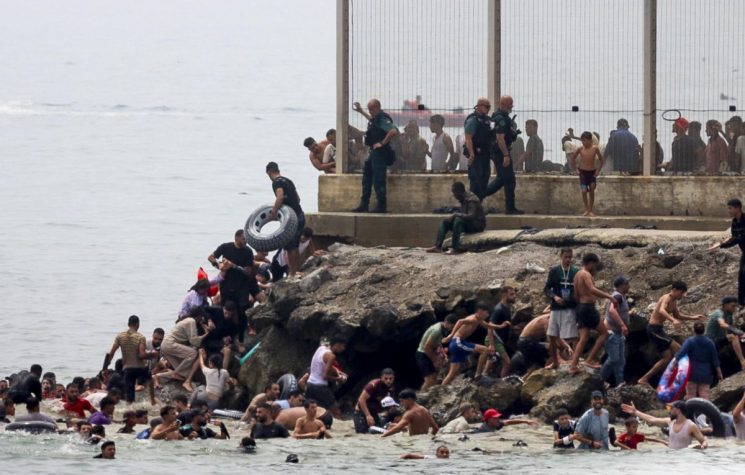
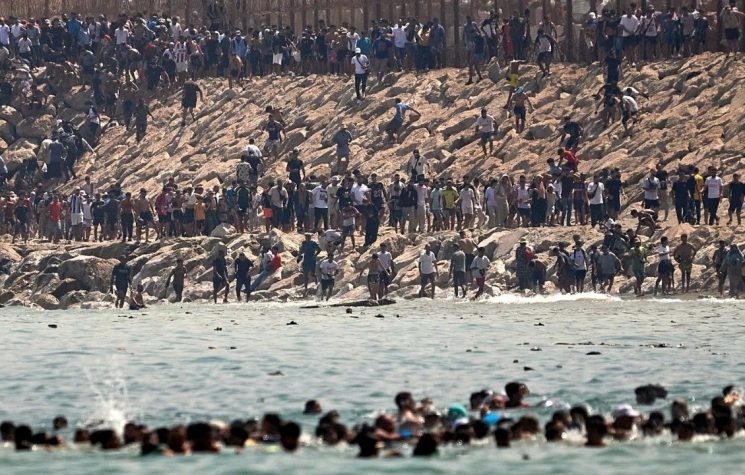
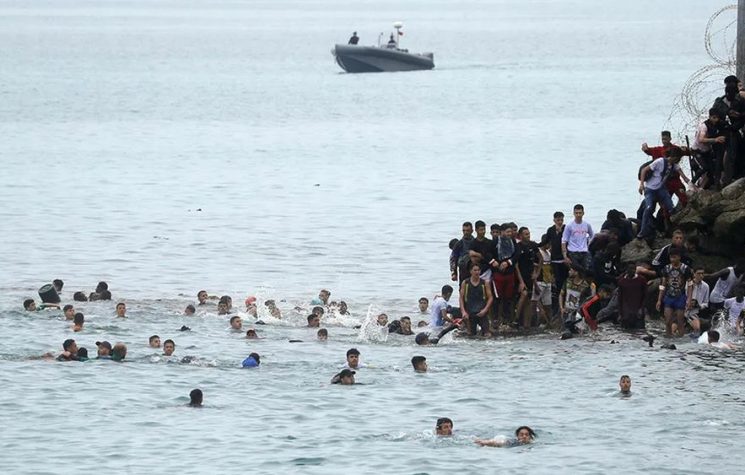
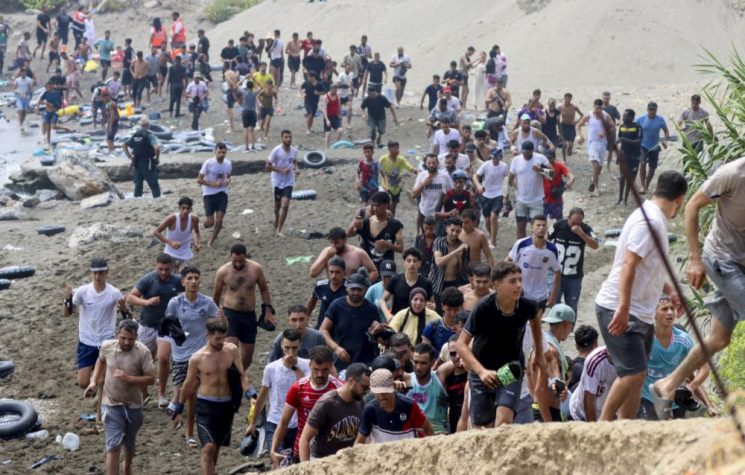
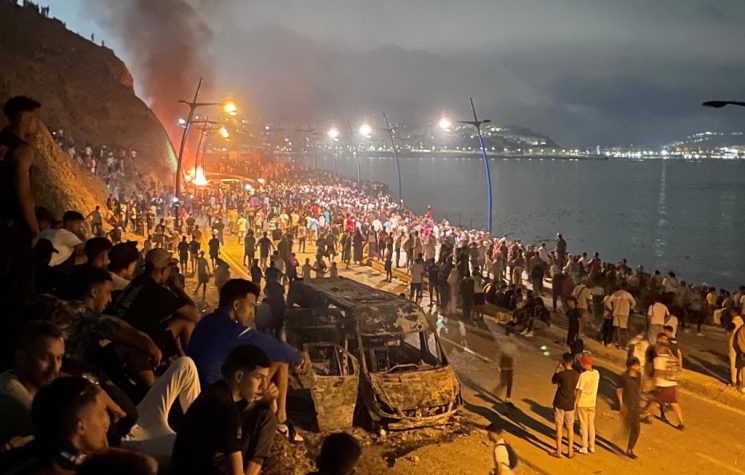
Late July 2026. Suddenly, some 50,000 Moroccans—whom the press will refer to as “migrants”—pour into the cities of Ceuta and Melilla, two Spanish enclaves in Morocco, remnants of colonialism. A crisis erupts. The entire European Union is alarmed; Italy suspends the Schengen Agreement; and a back-and-forth ensues between Spain, Morocco, and Israel. The incident becomes an international issue. Let’s reflect on three crucial aspects of what has happened, while the crisis is still unfolding.
Point one: Migration and decolonization
Let’s begin by carefully analyzing what happened. To reiterate: approximately 50,000 Moroccans suddenly poured into Ceuta and Melilla, transported by trucks escorted by Moroccan police.
Now let’s read that again.
Such a large number of people do not move “suddenly,” do not move by chance, and do not move without coordination. To think that they gathered by some strange coincidence of fate is sheer madness. Migration has nothing to do with this.
Immigration is a phenomenon driven by capital. Criticizing the base without criticizing the superstructure is an objective error that can no longer be disguised behind Western mainstream narratives. Modern migratory phenomena are driven not by a simple desire to move or seek different living conditions; they are the effect of a very specific cause—namely, liberal capitalist domination, which prevails in the West and has created unsustainable conditions in many countries of what was once called the “Third World” in order to build its own consumerist, narcissistic, and perverse world.
We could spend hours discussing this issue, but we’ll cut to the chase. Ceuta is a Spanish enclave on the African continent. To reach mainland Spain, migrants must cross the Strait of Gibraltar, bypass security checks, and board a ferry. There is therefore a technical timeframe to consider in order to validate the claims made by certain alternative media pundits who spoke of a “European invasion.”
The fact that Spain still has enclaves should be the subject of discussion before the Council of 24 and the Council of 4 of the United Nations, where the decolonization of lands and peoples is a declared priority of international organizations. But it is clear that this aspect will be ignored by the media, so let’s stick to the central issue.
Many cite as the cause of this “invasion” a recent decision by the Spanish government to “grant citizenship” to 500,000 foreigners who entered the country illegally. Whatever one may think of this decision, it must be clear that this was not a grant of citizenship, as has been widely reported, but rather the issuance of one-year residence and work permits (the so-called “regularization” process). The permits were issued to people who have been working in Spain for years and have no criminal records. The aim is, as always in such cases, to bring them out of the informal labor market and thus be able to tax them.
The migration issue is central to the destabilization of Europe, and it is so particularly when it goes hand in hand with the issue of Islam. It is a strategy the collective West has used many times before, and it is a tool for subjugating peoples to ignorance and violence. Neither the right—which is growing increasingly violent and angry—nor the liberal left could continue their eternal war in the name of the same globalism without having an issue as powerful, risky, and socially effective as immigration and religion.
It is urgent to understand that this is a carefully engineered manipulation and that it will not end peacefully unless this degeneration is stopped in time.
A few words on Schengen. Ceuta has a special status where the Schengen Agreement does not apply. Italy managed to be the only country that fell into the trap within the first 24 hours of the events. Foreign Minister Tajani, who never gets anything right, promptly commented on the incident, even managing to get the geography wrong. Of course, for the Meloni government—which holds the record for bringing immigrants into Italy—this moment served as an opportunity to rally support and seek assistance for the elections to be held in less than a year, while obscuring, instead, its shameful complicity in aiding international criminals linked to the COVID-19 pandemic and its repeated betrayal of the electoral pact with the Italian people.
The truth is that Schengen suits everyone, and no one intends to back down—not least because it’s impossible to do so without first securing sovereignty and decision-making autonomy. Therefore, any sensationalist proclamation coming from Rome or other European capitals is pure demagoguery.
Point two: War
The war currently underway between the United States and Iran is often described by the mainstream media as a clash between Western civilization and the Islamic world. A significant portion of public opinion, particularly that associated with the so-called right, seems to accept this narrative without any particular reservations. In this narrative, Muslims are portrayed as an indistinct mass: Palestinians in Gaza, ISIS fighters, Moroccan migrants reaching Ceuta, and the Iranian Pasdaran are all lumped together under the image of a world driven by fanatical hostility toward Christianity and Western democratic systems. A big mix of everything.
Such a portrayal, however, appears deeply misleading and objectively incorrect. Commentators who proclaim the equivalence of “Globalists = Islamists” have either done little research or are acting in bad faith. The actual course of the military conflict and the evolution of cultural and religious relations paint a far more nuanced picture. Iran has launched missile attacks against Qatar, the United Arab Emirates, Iraq, Syria, Saudi Arabia, and Jordan—not as an arbitrary choice, but because these countries maintain alliances with the United States and host American military installations involved in combat operations. Contrary to the widespread perception among some segments of the public, the Islamic world does not constitute a compact or homogeneous political bloc. On the contrary, the surgical division of the Islamic world has been a favorite strategy of the UK, France, and the U.S. for decades. To now rail against Muslims by invoking the threat of terrorism and pointing the finger at entire religious groups is pure hypocrisy.
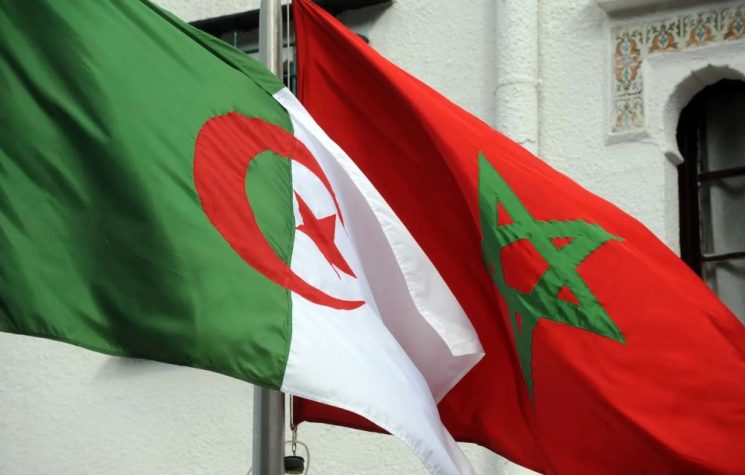
On the contrary, a large part of the ruling elites in Arab countries has long maintained solid strategic relations with the West. In addition to the states already mentioned, Egypt, Libya, Tunisia, and Morocco also fall, in different ways, within the network of alliances linked to the United States. The Moroccan monarch himself maintains well-established relations with both Washington and Israel.
The leaders of Muslim countries frequently described in the West as dictators or criminals—from Muammar Gaddafi to Bashar al-Assad to the Ayatollahs of the Islamic Republic of Iran—were united by their efforts to preserve the political autonomy of their respective states, seeking to create economic conditions that would allow their citizens to live and work in their own countries without being forced to emigrate.
Viewed from a European perspective, there is still room to avoid what risks becoming a new and anachronistic religious conflict—a direction toward which current developments seem to be progressively leading.
Europe should have the political resolve to use the economic and diplomatic clout it still possesses to express clear opposition both to the military operations conducted in the Gaza Strip—which the author defines as genocide—and to intervention against Iran. At the same time, it should recognize that, in the absence of wars or natural disasters, the irregular entry of tens of thousands of people into the territory of another state cannot be considered an ordinary phenomenon.
We believe that repatriation measures would not be particularly difficult to implement from an operational standpoint, but—and this is the political crux of the matter—they would call into question some of the pillars upon which the current political structure of the European Union is founded: the strong strategic alliance with the United States, the perceived unconditional support for Israel, and a stance in favor of open migration policies.
For Europe’s ruling classes, it would therefore be easier to maintain cooperative relations with the current Syrian leadership or the Moroccan monarchy than to prioritize the interests of the populations of their respective countries.
As geopolitical analyst Daniele Perra noted, “Anyone who believes that what is happening in Spain’s North African enclaves is a spontaneous development is, at best, very naive. […] Moreover, this is not the first time Spain has faced this kind of pressure. However, in this case, the intent to destabilize the Sánchez government (certainly open to criticism in many respects, but “guilty” of not having fully bowed to the will of Trump and his allies regarding Iran) seems evident. In this regard, we should also recall several “investigations” by the Spanish judiciary that were timed to coincide with specific events—a practice very similar to one used in Italy as well (it is no coincidence that we, too, were drawn into a war—the one against Libya—aimed primarily at destroying cooperation agreements with that North African country and transforming it into a geopolitical black hole held hostage by criminal gangs). Needless to say, in Libya, Italy suffered its worst defeat since 1943, aided in part by the Berlusconi government, which fell shortly afterward under pressure from the rating agencies. But that’s another story.”
And here lies a fundamental point. Spain is too anti-Israel and anti-U.S. for the liking of the Brussels technocrats and their masters. Morocco is part of the Abraham Accords, has a stable partnership with Washington and Tel Aviv, and, although it tries to pursue a sort of multilateral relations, it remains subject to the Zionist decision-making sphere. Spain is a country toward which the American leadership itself has repeatedly expressed disgust and issued threats.
All of this points to a correlation: Spain refuses to support the U.S. and Israel and finds itself facing a sort of invasion that lasts less than 24 hours. A textbook psy-op. They triggered the problem, analyzed the reactions, and calibrated the next attack. The test worked. The real problem is what comes next.
Almost all of the migrants, it seems, turned back during the night. And this is yet another factor that supports the interpretation of the events as a carefully orchestrated international provocation.
Point three: International law
Ceuta, as already mentioned, is a Spanish city located on the northern coast of the African continent, overlooking the Strait of Gibraltar and bordered by Morocco on land. It is neither a colony nor a territory subject to a special international regime, but rather an integral part of the Kingdom of Spain, endowed with the status of an Autonomous City by virtue of Organic Law No. 1/1995, enacted in implementation of Article 144(b) of the 1978 Spanish Constitution. Ceuta is therefore Spanish territory and, at the same time, constitutes one of the European Union’s external borders, even though it is geographically located in Africa. This unique situation makes it a location constantly exposed to both migratory pressure and diplomatic tensions with Morocco.
It is against this backdrop that Judgment No. 814/2026 of the Fifth Section of the Administrative Litigation Chamber of the Spanish Supreme Court was issued. The ruling established that the so-called rechazo en frontera, provided for in the tenth additional provision of Organic Law No. 4/2000, cannot be applied to foreign nationals intercepted while attempting to reach Ceuta or Melilla by swimming. According to the Supreme Court, the provision applies exclusively to those caught in the act of crossing the physical barriers marking the land border and cannot be extended to entries by sea.
Although consistent with the literal wording of the provision, this interpretation leads to a systematically irrational outcome. The legal regime applicable to irregular entry depends not on the nature of the conduct, the position of the individual relative to the border, or the need to ensure the protection of the external border, but rather on the means actually used to gain access. Those who attempt to scale the fence may be subject to the special procedure, while those pursuing the same objective by crossing the sea must be subject to the ordinary procedure. Such a distinction does not strengthen the protection of fundamental rights; on the contrary, it ends up encouraging the method of entry that is most dangerous to people’s lives and most easily exploited by criminal organizations.
The Supreme Court favored a strictly literal and topographical interpretation of the law, without giving due weight to the functional unity of the Ceuta border. The border is not identified exclusively with the fence but encompasses the entire space within which the State exercises control over access to its territory. Limiting the legal concept of a border to the presence of a physical barrier means confusing the border itself with the physical means put in place to monitor it.
The court could have developed a systematic interpretation more consistent with the legislature’s intended purpose, while safeguarding individual identification, the protection of minors, the assessment of vulnerability, access to international protection, and the necessary judicial review.
The primary responsibility, however, lies with the Spanish legislature, which has regulated one of Europe’s most sensitive and complex borders through a vague and now conceptually outdated legal provision. Organic Law No. 4/2000, in fact, treats the border as if it coincided exclusively with land barriers, overlooking the obvious fact that irregular entries can also occur by sea. A regulatory framework constructed in these terms does not guarantee legal certainty, does not ensure uniform application, and forces the judiciary to choose between a formalistic approach incapable of responding to reality and a broad interpretation that risks violating the principle of legality.
No less significant is the responsibility of the European Union, which claims to administer a common border while leaving Member States of first entry essentially on their own in the practical management of the phenomenon.
EU law requires individual identification, procedural safeguards, access to asylum, and a ban on collective expulsions, but it does not provide border states with sufficiently rapid procedures, adequate facilities, or truly effective return mechanisms. The EU continues to proclaim the principle of solidarity, yet it distributes the territorial, administrative, and political burdens arising from the management of migration flows in a profoundly unbalanced manner.
Not even the new European Pact on Migration and Asylum appears capable of overcoming this contradiction. It increases the number of procedures, classifications, and administrative requirements, without, however, transforming the management of external borders into a truly shared competence. The so-called solidarity mechanism thus risks being reduced to financial compensation that allows states less exposed to migration flows to avoid the concrete sharing of people and responsibilities.
The result is a legal system that regulates the arrival phase with extreme precision but continues to prove structurally fragile both in preventing irregular entries and in the effective enforcement of returns.
What is happening in Ceuta cannot be attributed solely to the Supreme Court’s ruling. The causes run much deeper and include economic imbalances between Europe and Africa, political instability in numerous countries of origin, the activities of criminal networks involved in migrant smuggling, and the growing use of migration flows as a tool of geopolitical pressure.
Control of departures also depends to a significant extent on Morocco’s cooperation. Any relaxation of surveillance by Moroccan authorities immediately results in increased migratory pressure on the Spanish border, demonstrating just how vulnerable a European policy is that entrusts third countries with a function essential to its own security.
The Kingdom of Spain should therefore amend Organic Law No. 4/2000 to expressly regulate sea crossings in the areas of Ceuta and Melilla. The new legislation should introduce rapid, individualized border procedures subject to judicial review, while ensuring that fundamental safeguards do not become a mechanism capable of preventing any timely decision. The identification of individuals, the protection of minors, the assessment of vulnerability, and access to international protection must be guaranteed, but within strict timeframes and through adequately organized structures.
At the same time, the European Union should treat the management of external borders as a truly shared responsibility, strengthening Frontex’s operational role, introducing a mandatory redistribution system among Member States, standardizing border procedures, and establishing a genuine European return system.
Agreements with countries of origin and transit should be transparent, verifiable, and contingent upon respect for fundamental rights, without continuing to depend on discretionary political decisions that compromise their operational effectiveness.
Ceuta today stands as a symbol of the joint failure of case law, Spanish legislation, and the European legal system. The ruling has transformed a regulatory loophole into an irrational operational distinction; Spanish law has equated the border with a mere fence; the European Union has imposed common obligations without equipping itself with truly common tools.
A state governed by the rule of law cannot sacrifice human dignity in the name of security, nor can it use the protection of fundamental rights as a justification for its own inability to manage its borders. A border lacking truly enforceable rules, timely decisions, and shared responsibilities is not a border governed by law, but rather one left to improvisation.
An uncomfortable conclusion
Let’s try for a moment not to look at the finger, but at the moon behind it. If we assume—for the sake of plausibility—that the “Ceuta experiment” was successful, it is clear that this is a first step toward a widespread emergency situation, a state of war “against the enemy” that will justify the adoption of special regimes in the name of “security.”
The European elites cannot afford to see their system of power collapse; the U.S. has no intention of abandoning the European colony, which is increasingly indispensable for keeping the American consumer machine alive; and Israel can’t wait to drag the world into its religious war.