
Bruna Frascolla
March 18, 2026
© Photo: Public domain

Postel was a Catholic priest who intended to reform the Church – but ended up being judged by the Inquisition, considered insane, and forbidden from teaching.

Join us on TelegramTwitter, and VK.

Contact us: info@strategic-culture.su

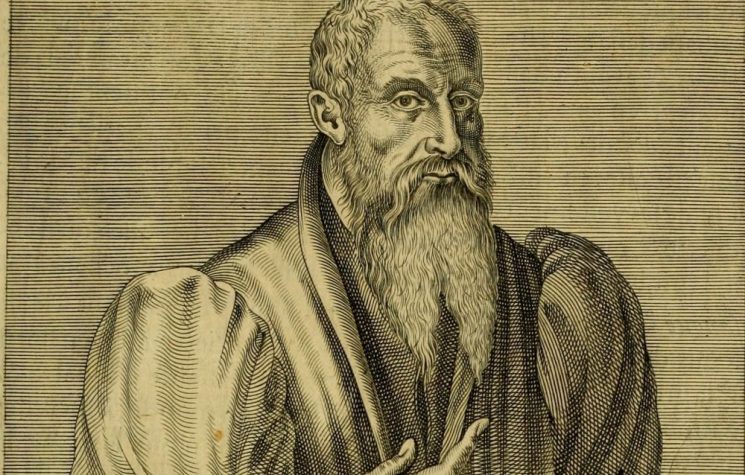
If we search the origins of the project of using Christendom to take Jerusalem from the Muslims and establish a regime that would bring the Messiah, a name that emerges is that of Guillaume Postel (1510–1581). A complete investigation likely has as its first landmarks the names of the mysterious David Reubeni and the Portuguese Solomon Molcho (1500–1532), two Kabbalist Jews. The name Guillaume Postel is a relevant landmark because he was a Catholic priest who intended to reform the Church – but ended up being judged by the Inquisition, considered insane, and forbidden from teaching.

Brief Chronology

Postel was born poor in Normandy on March 25, 1510, and when he was 8 years old, his parents died of plague. But the boy was brilliant. By the age of 13, he had already become a teacher in a village and managed to save money to study in Paris. There, he became a servant of the Spanish humanist Juan de Gélida and learned Spanish, Portuguese, Greek, and Hebrew without a teacher. At the age of 20, he became a master of arts. Postel had a lot of contact with the Iberian world in Paris not only because of his Spanish boss, but also because of the Collège Sainte-Barbe, with its strong Iberian presence. His interaction with colleagues allowed him to learn Portuguese and become enthusiastic about missionary work in the New World. It is worth noting that, for Europe at the time, it was difficult to distinguish between Portuguese and Jewish people abroad, given the large mix of Jews in Portuguese society. Perhaps contact with these same colleagues facilitated his acquisition of Hebrew knowledge. At Sainte-Barbe, Postel was a colleague of Saint Ignatius of Loyola, the founder of the Society of Jesus (1535), and of the Jesuit Saint Francis Xavier.

Well-liked by the Iberians, Postel rejected an invitation to teach in Lisbon. In 1536, due to his linguistic knowledge, he accepted an invitation to participate in the French mission to Constantinople. At the time, King Francis I of France wanted to form an alliance with the Ottoman Empire to fight the Holy Roman Emperor Charles V, who was also King of Spain. During the journey, which included a stay in Tunisia, Postel bought books in Arabic and other Oriental languages, found an Arabic teacher, and became the first modern European intellectual capable of teaching various Oriental languages ​​(including Arabic). Postel was interested not only in the language but also in Eastern Christians, the Quran, and culture. On his return trip in 1537, Postel stopped in Venice and joined the circle of the Hebraist typographer Daniel Bomberg – a noteworthy figure, as he printed the editio pinceps of the Babylonian Talmud. Venice was a place of intellectual freedom, as it had its own Inquisition, which was lenient. Furthermore, it was full of Jews – a guaranteed clientele for Bomberg.

The peak of his academic career was from 1538 to 1542, when he taught philology and mathematics to the king. His career ended because he decided to quarrel with the king. Postel wanted to translate the Bible into Oriental languages, teach them to missionaries, and send them to Turkey, where they would convert the Turks to Christianity. Causing conflict with the Sultan was not in King Francis’s plans.

Imbued with a missionary spirit, Postel changed his life. He wrote De orbis terrae concordia (On the Concord of the Earth Globe), published in two volumes in 1542 and 1543. This would be considered the most important work of his life, as it outlines his plan for the world: Postel rationally proves and justifies Christianity using Euclidean geometry, and it is up to the missionaries, through reason, to convert the peoples of the world to Christianity. He only needed to convince the Church to adopt his rational proofs of Christianity and his agenda – but he couldn’t even convince the Sorbonne. According to William Bouwsma (whose book Concordia Mundi I used to create this chronology), a serious problem with Postel’s rationalism is that “reason” could mean anything: from geometry to Kabbalah.

Thus, in order to implement his own “rationalist” agenda, in 1544 he decided to join the newly created Society of Jesus. That is where he became a priest. His stay was short-lived: in 1545, after the ineffective public reprimands of Saint Ignatius of Loyola, he was expelled from the Society. Postel argued that Rome was corrupt, therefore it was up to the King of France to choose the next pope and transfer the papacy to France, and only after that could the Messianic Age awaited by the Jews begin.

Expelled, Postel dedicated himself even more to studying Kabbalah and, established in Venice, began translating the Zohar (Book of Splendors), perhaps the most important work of Kabbalah, into Latin. He used his rabbinical knowledge to support his theory that the King of France should be the King of the Universal Monarchy.

In 1549, the typographer Bomberg financed his trip to Palestine so that he could produce Bibles in Eastern languages. Postel spends a year and a half in Jerusalem and Constantinople, studying and buying books. Upon his return, he discovers that “Mother Joan,” or the “Venetian Virgin”—a lady who was his friend and, according to him, explained Kabbalah to him even though she was illiterate and considered him a son—had died during his trip. In 1551, he has a mystical experience and becomes persuaded that this woman was the Shekhinah (a feminine emanation of God according to Kabbalah), and that she had possessed him, so that now the soul of the Shekhinah inhabited his body.

In his deranged scheme, heavily influenced by Kabbalah, Mother Joan was the female counterpart of Jesus Christ; the Shekhinah was the female counterpart of the Holy Spirit; Venice was the second Jerusalem; and he, Postel, being the son of Christ and Mother Joan, initiated the New Age. In the Kabbalistic cosmos, everything is sexed, and everything, therefore, has a feminine counterpart – including Christ and the Holy Spirit, concludes the syncretic Postel.

Thus, he preaches madly. Between 1551 and 1555, he publishes at least 23 books, and was certain that the Apocalypse would happen in 1556. He tries to convince the two subsequent French kings, plus the Holy Roman Emperor, to adopt his scheme. In the case of King Henry II, he had access to his wife Catherine de Medici. Even so, Postel falls out of favor in France because he wrote a book threatening the King if he did not submit to his designs. In that case, the French people, and not the King, would be considered the Chosen One, and would have the right to carry out a French revolution against the King.

At this point, Postel believed that a Christian leadership (in the absence of the King of France, the French people; in the absence of the French people, the Holy Roman Emperor; in the absence of the emperor…) should conquer Jerusalem and transfer the papacy there, because Rome is corrupt and Shekhinah only manifests itself in its fullness in Jerusalem. For the conquest, Postel gave his rationalist material; but, if the Turks did not want to listen to reason, it would be necessary to resort to arms to liberate the Orientals from tyranny: a neocon avant la lettre! When this happened, all occult knowledge would be revealed and everyone would live the same religion – which means that the whole world would be Kabbalist, like Postel himself.

In the end, Postel was too much even for the lenient Venetian Inquisition. In 1555, he was safe and sound in Austria when he learned that the Venetian Inquisition had placed his books on the Index, so he left there in a hurry to try to teach Reason to the inquisitors. Along the way, he even tried to preach the word of the Venetian Virgin to the masses. As a result, Postel was considered insane by the Inquisition. He lived his last years in seclusion, forbidden to teach, embittered, unwavering in his convictions. Because he was insane, it was a case of pity, not punishment.

Zionist Aspects

Religious Zionism, whether Jewish or Christian, is characterized by the beliefs (1) in the eternal exceptionality of the Jews and (2) in the active role of Zionists in fulfilling prophecy (whether it be the coming of the Messiah or the return of Jesus). A relevant fact of Jewish religious Zionism is that there are two Messiahs: the Messiah ben Joseph would be a secular preparer for the coming of the Messiah ben David, who is the actual Messiah. Consulting the Chabad website, we see that this belief prevails in the most important Jewish religious Zionist movement.

In recent articles, we have seen that the belief that a Christian monarch would conquer the Holy Land and usher in the Messianic Era was not uncommon in the 16th and 17th centuries. Thus, it is reasonable to believe that such monarchs would be the Messiah ben Joseph of Kabbalah, even if they do not use that name. A relevant fact is that Jews believe that the Messiah ben Joseph will be killed in war – and we can even wonder if this belief is not a Kabbalistic reading of the Apocalypse, in which the Beast is found, who will be defeated before the Final Judgment. In light of Kabbalah, it makes sense that someone who is not known to be Jewish would play this role, since a descendant of Joseph belongs to one of the ten lost tribes of Israel.

Postel prefers to defend the French right to the universal throne of the Messianic Era through Flavius ​​Josephus, who considers the Gauls to be descendants of Gomer, the eldest son of Japheth, son of Noah. Thus, the French have a right by primogeniture, and Japheth is considered half-Jewish.

However, he was well aware of the prophecy of the Messiah ben Joseph. In the Treasury of the Prophecies of the Universe, he writes that the Jews “also have a tradition that says there is a Messiah or Christ [sic] who must be the son of Joseph through Ephraim, who must be killed in the war of Gog and Magog, and then there will be a Christ or Messiah, son of Judah [who is an ancestor of David], resurrected and confirmed in his reign, which will be founded in Jerusalem […]. However, the first wars that the aforementioned son of Joseph will wage will be against Rome and against Armilus (as they call the Antichrist). […] Not knowing the trunk, [the Jews] await the first branch, which will be pure man, instead of God and man at the same time, and will be, as to the body, of Edom [the same as Rome, in the Kabbalah] or of Japheth, but, as to the spirit and virtue, it will be of that one who has within himself immortality which, growing little by little and multiplying, he gives and distributes to his members, so that the Talmudists say: a gentile, even if he is an Idumean [i.e., Roman], if he studies the Law with a good conscience, will be as great as the sovereign father of the Law. To be this, a king of the French or Gauls is elected, who through good works makes his vocation and predestination certain.”

Another important thing that places Postel as a landmark of Christian Zionism is the fact that he hopes that a temporal power will build the Third Temple: “God, through Isaiah, calls Cyrus his servant and his Christ or Messiah, in prefiguration of what will now be done throughout the universe, building the last Temple of Jerusalem, the general mother of the universe, just as Cyrus, king of Persia, by his order in favor of the Jews, commanded and made the second Temple of Jewish law, as then by the order of Cyrus […], it is necessary that now the last Cyrus build among the Christians, who are the last and true Jews, another [temple] in the place of the preceding ones.” To this day, Zionist propaganda (Jewish, Christian, or even atheist) likes to praise the figure of Cyrus when discussing politicians. Furthermore, it is worth mentioning that Postel, in the same work, refers to Christ as “true Jew and God,” in that order – and it is the most common thing in the world in the Zionist evangelical milieu to highlight Christ’s Jewish identity first, confusing ancient Judaism, the Talmudic Judaism, and the Kabbalah. A confusion worthy of Postel.

It is possible to find an excessive fixation on Judaism in Great Britain in the 1530s, before Postel’s madness. However, British Calvinists had a passive stance: they believed, for example, that the Jews would convert spontaneously upon learning about true Christianity, free from Roman corruption. However, as far as I know, they did not have a plan to use a Christian monarch to reconquer Jerusalem and begin the Messianic Era. Therefore, until proven otherwise, I think it’s fair to consider the Kabbalist Guillaume Postel the first Christian Zionist in history. And, more importantly, I think it’s possible to consider Christian Zionism as an infiltration of Kabbalah into Christianity.

Guillaume Postel: The First Christian Zionist in History?

Postel was a Catholic priest who intended to reform the Church – but ended up being judged by the Inquisition, considered insane, and forbidden from teaching.

Join us on TelegramTwitter, and VK.

Contact us: info@strategic-culture.su

If we search the origins of the project of using Christendom to take Jerusalem from the Muslims and establish a regime that would bring the Messiah, a name that emerges is that of Guillaume Postel (1510–1581). A complete investigation likely has as its first landmarks the names of the mysterious David Reubeni and the Portuguese Solomon Molcho (1500–1532), two Kabbalist Jews. The name Guillaume Postel is a relevant landmark because he was a Catholic priest who intended to reform the Church – but ended up being judged by the Inquisition, considered insane, and forbidden from teaching.

Brief Chronology

Postel was born poor in Normandy on March 25, 1510, and when he was 8 years old, his parents died of plague. But the boy was brilliant. By the age of 13, he had already become a teacher in a village and managed to save money to study in Paris. There, he became a servant of the Spanish humanist Juan de Gélida and learned Spanish, Portuguese, Greek, and Hebrew without a teacher. At the age of 20, he became a master of arts. Postel had a lot of contact with the Iberian world in Paris not only because of his Spanish boss, but also because of the Collège Sainte-Barbe, with its strong Iberian presence. His interaction with colleagues allowed him to learn Portuguese and become enthusiastic about missionary work in the New World. It is worth noting that, for Europe at the time, it was difficult to distinguish between Portuguese and Jewish people abroad, given the large mix of Jews in Portuguese society. Perhaps contact with these same colleagues facilitated his acquisition of Hebrew knowledge. At Sainte-Barbe, Postel was a colleague of Saint Ignatius of Loyola, the founder of the Society of Jesus (1535), and of the Jesuit Saint Francis Xavier.

Well-liked by the Iberians, Postel rejected an invitation to teach in Lisbon. In 1536, due to his linguistic knowledge, he accepted an invitation to participate in the French mission to Constantinople. At the time, King Francis I of France wanted to form an alliance with the Ottoman Empire to fight the Holy Roman Emperor Charles V, who was also King of Spain. During the journey, which included a stay in Tunisia, Postel bought books in Arabic and other Oriental languages, found an Arabic teacher, and became the first modern European intellectual capable of teaching various Oriental languages ​​(including Arabic). Postel was interested not only in the language but also in Eastern Christians, the Quran, and culture. On his return trip in 1537, Postel stopped in Venice and joined the circle of the Hebraist typographer Daniel Bomberg – a noteworthy figure, as he printed the editio pinceps of the Babylonian Talmud. Venice was a place of intellectual freedom, as it had its own Inquisition, which was lenient. Furthermore, it was full of Jews – a guaranteed clientele for Bomberg.

The peak of his academic career was from 1538 to 1542, when he taught philology and mathematics to the king. His career ended because he decided to quarrel with the king. Postel wanted to translate the Bible into Oriental languages, teach them to missionaries, and send them to Turkey, where they would convert the Turks to Christianity. Causing conflict with the Sultan was not in King Francis’s plans.

Imbued with a missionary spirit, Postel changed his life. He wrote De orbis terrae concordia (On the Concord of the Earth Globe), published in two volumes in 1542 and 1543. This would be considered the most important work of his life, as it outlines his plan for the world: Postel rationally proves and justifies Christianity using Euclidean geometry, and it is up to the missionaries, through reason, to convert the peoples of the world to Christianity. He only needed to convince the Church to adopt his rational proofs of Christianity and his agenda – but he couldn’t even convince the Sorbonne. According to William Bouwsma (whose book Concordia Mundi I used to create this chronology), a serious problem with Postel’s rationalism is that “reason” could mean anything: from geometry to Kabbalah.

Thus, in order to implement his own “rationalist” agenda, in 1544 he decided to join the newly created Society of Jesus. That is where he became a priest. His stay was short-lived: in 1545, after the ineffective public reprimands of Saint Ignatius of Loyola, he was expelled from the Society. Postel argued that Rome was corrupt, therefore it was up to the King of France to choose the next pope and transfer the papacy to France, and only after that could the Messianic Age awaited by the Jews begin.

Expelled, Postel dedicated himself even more to studying Kabbalah and, established in Venice, began translating the Zohar (Book of Splendors), perhaps the most important work of Kabbalah, into Latin. He used his rabbinical knowledge to support his theory that the King of France should be the King of the Universal Monarchy.

In 1549, the typographer Bomberg financed his trip to Palestine so that he could produce Bibles in Eastern languages. Postel spends a year and a half in Jerusalem and Constantinople, studying and buying books. Upon his return, he discovers that “Mother Joan,” or the “Venetian Virgin”—a lady who was his friend and, according to him, explained Kabbalah to him even though she was illiterate and considered him a son—had died during his trip. In 1551, he has a mystical experience and becomes persuaded that this woman was the Shekhinah (a feminine emanation of God according to Kabbalah), and that she had possessed him, so that now the soul of the Shekhinah inhabited his body.

In his deranged scheme, heavily influenced by Kabbalah, Mother Joan was the female counterpart of Jesus Christ; the Shekhinah was the female counterpart of the Holy Spirit; Venice was the second Jerusalem; and he, Postel, being the son of Christ and Mother Joan, initiated the New Age. In the Kabbalistic cosmos, everything is sexed, and everything, therefore, has a feminine counterpart – including Christ and the Holy Spirit, concludes the syncretic Postel.

Thus, he preaches madly. Between 1551 and 1555, he publishes at least 23 books, and was certain that the Apocalypse would happen in 1556. He tries to convince the two subsequent French kings, plus the Holy Roman Emperor, to adopt his scheme. In the case of King Henry II, he had access to his wife Catherine de Medici. Even so, Postel falls out of favor in France because he wrote a book threatening the King if he did not submit to his designs. In that case, the French people, and not the King, would be considered the Chosen One, and would have the right to carry out a French revolution against the King.

At this point, Postel believed that a Christian leadership (in the absence of the King of France, the French people; in the absence of the French people, the Holy Roman Emperor; in the absence of the emperor…) should conquer Jerusalem and transfer the papacy there, because Rome is corrupt and Shekhinah only manifests itself in its fullness in Jerusalem. For the conquest, Postel gave his rationalist material; but, if the Turks did not want to listen to reason, it would be necessary to resort to arms to liberate the Orientals from tyranny: a neocon avant la lettre! When this happened, all occult knowledge would be revealed and everyone would live the same religion – which means that the whole world would be Kabbalist, like Postel himself.

In the end, Postel was too much even for the lenient Venetian Inquisition. In 1555, he was safe and sound in Austria when he learned that the Venetian Inquisition had placed his books on the Index, so he left there in a hurry to try to teach Reason to the inquisitors. Along the way, he even tried to preach the word of the Venetian Virgin to the masses. As a result, Postel was considered insane by the Inquisition. He lived his last years in seclusion, forbidden to teach, embittered, unwavering in his convictions. Because he was insane, it was a case of pity, not punishment.

Zionist Aspects

Religious Zionism, whether Jewish or Christian, is characterized by the beliefs (1) in the eternal exceptionality of the Jews and (2) in the active role of Zionists in fulfilling prophecy (whether it be the coming of the Messiah or the return of Jesus). A relevant fact of Jewish religious Zionism is that there are two Messiahs: the Messiah ben Joseph would be a secular preparer for the coming of the Messiah ben David, who is the actual Messiah. Consulting the Chabad website, we see that this belief prevails in the most important Jewish religious Zionist movement.

In recent articles, we have seen that the belief that a Christian monarch would conquer the Holy Land and usher in the Messianic Era was not uncommon in the 16th and 17th centuries. Thus, it is reasonable to believe that such monarchs would be the Messiah ben Joseph of Kabbalah, even if they do not use that name. A relevant fact is that Jews believe that the Messiah ben Joseph will be killed in war – and we can even wonder if this belief is not a Kabbalistic reading of the Apocalypse, in which the Beast is found, who will be defeated before the Final Judgment. In light of Kabbalah, it makes sense that someone who is not known to be Jewish would play this role, since a descendant of Joseph belongs to one of the ten lost tribes of Israel.

Postel prefers to defend the French right to the universal throne of the Messianic Era through Flavius ​​Josephus, who considers the Gauls to be descendants of Gomer, the eldest son of Japheth, son of Noah. Thus, the French have a right by primogeniture, and Japheth is considered half-Jewish.

However, he was well aware of the prophecy of the Messiah ben Joseph. In the Treasury of the Prophecies of the Universe, he writes that the Jews “also have a tradition that says there is a Messiah or Christ [sic] who must be the son of Joseph through Ephraim, who must be killed in the war of Gog and Magog, and then there will be a Christ or Messiah, son of Judah [who is an ancestor of David], resurrected and confirmed in his reign, which will be founded in Jerusalem […]. However, the first wars that the aforementioned son of Joseph will wage will be against Rome and against Armilus (as they call the Antichrist). […] Not knowing the trunk, [the Jews] await the first branch, which will be pure man, instead of God and man at the same time, and will be, as to the body, of Edom [the same as Rome, in the Kabbalah] or of Japheth, but, as to the spirit and virtue, it will be of that one who has within himself immortality which, growing little by little and multiplying, he gives and distributes to his members, so that the Talmudists say: a gentile, even if he is an Idumean [i.e., Roman], if he studies the Law with a good conscience, will be as great as the sovereign father of the Law. To be this, a king of the French or Gauls is elected, who through good works makes his vocation and predestination certain.”

Another important thing that places Postel as a landmark of Christian Zionism is the fact that he hopes that a temporal power will build the Third Temple: “God, through Isaiah, calls Cyrus his servant and his Christ or Messiah, in prefiguration of what will now be done throughout the universe, building the last Temple of Jerusalem, the general mother of the universe, just as Cyrus, king of Persia, by his order in favor of the Jews, commanded and made the second Temple of Jewish law, as then by the order of Cyrus […], it is necessary that now the last Cyrus build among the Christians, who are the last and true Jews, another [temple] in the place of the preceding ones.” To this day, Zionist propaganda (Jewish, Christian, or even atheist) likes to praise the figure of Cyrus when discussing politicians. Furthermore, it is worth mentioning that Postel, in the same work, refers to Christ as “true Jew and God,” in that order – and it is the most common thing in the world in the Zionist evangelical milieu to highlight Christ’s Jewish identity first, confusing ancient Judaism, the Talmudic Judaism, and the Kabbalah. A confusion worthy of Postel.

It is possible to find an excessive fixation on Judaism in Great Britain in the 1530s, before Postel’s madness. However, British Calvinists had a passive stance: they believed, for example, that the Jews would convert spontaneously upon learning about true Christianity, free from Roman corruption. However, as far as I know, they did not have a plan to use a Christian monarch to reconquer Jerusalem and begin the Messianic Era. Therefore, until proven otherwise, I think it’s fair to consider the Kabbalist Guillaume Postel the first Christian Zionist in history. And, more importantly, I think it’s possible to consider Christian Zionism as an infiltration of Kabbalah into Christianity.

Postel was a Catholic priest who intended to reform the Church – but ended up being judged by the Inquisition, considered insane, and forbidden from teaching.

Join us on TelegramTwitter, and VK.

Contact us: info@strategic-culture.su

If we search the origins of the project of using Christendom to take Jerusalem from the Muslims and establish a regime that would bring the Messiah, a name that emerges is that of Guillaume Postel (1510–1581). A complete investigation likely has as its first landmarks the names of the mysterious David Reubeni and the Portuguese Solomon Molcho (1500–1532), two Kabbalist Jews. The name Guillaume Postel is a relevant landmark because he was a Catholic priest who intended to reform the Church – but ended up being judged by the Inquisition, considered insane, and forbidden from teaching.

Brief Chronology

Postel was born poor in Normandy on March 25, 1510, and when he was 8 years old, his parents died of plague. But the boy was brilliant. By the age of 13, he had already become a teacher in a village and managed to save money to study in Paris. There, he became a servant of the Spanish humanist Juan de Gélida and learned Spanish, Portuguese, Greek, and Hebrew without a teacher. At the age of 20, he became a master of arts. Postel had a lot of contact with the Iberian world in Paris not only because of his Spanish boss, but also because of the Collège Sainte-Barbe, with its strong Iberian presence. His interaction with colleagues allowed him to learn Portuguese and become enthusiastic about missionary work in the New World. It is worth noting that, for Europe at the time, it was difficult to distinguish between Portuguese and Jewish people abroad, given the large mix of Jews in Portuguese society. Perhaps contact with these same colleagues facilitated his acquisition of Hebrew knowledge. At Sainte-Barbe, Postel was a colleague of Saint Ignatius of Loyola, the founder of the Society of Jesus (1535), and of the Jesuit Saint Francis Xavier.

Well-liked by the Iberians, Postel rejected an invitation to teach in Lisbon. In 1536, due to his linguistic knowledge, he accepted an invitation to participate in the French mission to Constantinople. At the time, King Francis I of France wanted to form an alliance with the Ottoman Empire to fight the Holy Roman Emperor Charles V, who was also King of Spain. During the journey, which included a stay in Tunisia, Postel bought books in Arabic and other Oriental languages, found an Arabic teacher, and became the first modern European intellectual capable of teaching various Oriental languages ​​(including Arabic). Postel was interested not only in the language but also in Eastern Christians, the Quran, and culture. On his return trip in 1537, Postel stopped in Venice and joined the circle of the Hebraist typographer Daniel Bomberg – a noteworthy figure, as he printed the editio pinceps of the Babylonian Talmud. Venice was a place of intellectual freedom, as it had its own Inquisition, which was lenient. Furthermore, it was full of Jews – a guaranteed clientele for Bomberg.

The peak of his academic career was from 1538 to 1542, when he taught philology and mathematics to the king. His career ended because he decided to quarrel with the king. Postel wanted to translate the Bible into Oriental languages, teach them to missionaries, and send them to Turkey, where they would convert the Turks to Christianity. Causing conflict with the Sultan was not in King Francis’s plans.

Imbued with a missionary spirit, Postel changed his life. He wrote De orbis terrae concordia (On the Concord of the Earth Globe), published in two volumes in 1542 and 1543. This would be considered the most important work of his life, as it outlines his plan for the world: Postel rationally proves and justifies Christianity using Euclidean geometry, and it is up to the missionaries, through reason, to convert the peoples of the world to Christianity. He only needed to convince the Church to adopt his rational proofs of Christianity and his agenda – but he couldn’t even convince the Sorbonne. According to William Bouwsma (whose book Concordia Mundi I used to create this chronology), a serious problem with Postel’s rationalism is that “reason” could mean anything: from geometry to Kabbalah.

Thus, in order to implement his own “rationalist” agenda, in 1544 he decided to join the newly created Society of Jesus. That is where he became a priest. His stay was short-lived: in 1545, after the ineffective public reprimands of Saint Ignatius of Loyola, he was expelled from the Society. Postel argued that Rome was corrupt, therefore it was up to the King of France to choose the next pope and transfer the papacy to France, and only after that could the Messianic Age awaited by the Jews begin.

Expelled, Postel dedicated himself even more to studying Kabbalah and, established in Venice, began translating the Zohar (Book of Splendors), perhaps the most important work of Kabbalah, into Latin. He used his rabbinical knowledge to support his theory that the King of France should be the King of the Universal Monarchy.

In 1549, the typographer Bomberg financed his trip to Palestine so that he could produce Bibles in Eastern languages. Postel spends a year and a half in Jerusalem and Constantinople, studying and buying books. Upon his return, he discovers that “Mother Joan,” or the “Venetian Virgin”—a lady who was his friend and, according to him, explained Kabbalah to him even though she was illiterate and considered him a son—had died during his trip. In 1551, he has a mystical experience and becomes persuaded that this woman was the Shekhinah (a feminine emanation of God according to Kabbalah), and that she had possessed him, so that now the soul of the Shekhinah inhabited his body.

In his deranged scheme, heavily influenced by Kabbalah, Mother Joan was the female counterpart of Jesus Christ; the Shekhinah was the female counterpart of the Holy Spirit; Venice was the second Jerusalem; and he, Postel, being the son of Christ and Mother Joan, initiated the New Age. In the Kabbalistic cosmos, everything is sexed, and everything, therefore, has a feminine counterpart – including Christ and the Holy Spirit, concludes the syncretic Postel.

Thus, he preaches madly. Between 1551 and 1555, he publishes at least 23 books, and was certain that the Apocalypse would happen in 1556. He tries to convince the two subsequent French kings, plus the Holy Roman Emperor, to adopt his scheme. In the case of King Henry II, he had access to his wife Catherine de Medici. Even so, Postel falls out of favor in France because he wrote a book threatening the King if he did not submit to his designs. In that case, the French people, and not the King, would be considered the Chosen One, and would have the right to carry out a French revolution against the King.

At this point, Postel believed that a Christian leadership (in the absence of the King of France, the French people; in the absence of the French people, the Holy Roman Emperor; in the absence of the emperor…) should conquer Jerusalem and transfer the papacy there, because Rome is corrupt and Shekhinah only manifests itself in its fullness in Jerusalem. For the conquest, Postel gave his rationalist material; but, if the Turks did not want to listen to reason, it would be necessary to resort to arms to liberate the Orientals from tyranny: a neocon avant la lettre! When this happened, all occult knowledge would be revealed and everyone would live the same religion – which means that the whole world would be Kabbalist, like Postel himself.

In the end, Postel was too much even for the lenient Venetian Inquisition. In 1555, he was safe and sound in Austria when he learned that the Venetian Inquisition had placed his books on the Index, so he left there in a hurry to try to teach Reason to the inquisitors. Along the way, he even tried to preach the word of the Venetian Virgin to the masses. As a result, Postel was considered insane by the Inquisition. He lived his last years in seclusion, forbidden to teach, embittered, unwavering in his convictions. Because he was insane, it was a case of pity, not punishment.

Zionist Aspects

Religious Zionism, whether Jewish or Christian, is characterized by the beliefs (1) in the eternal exceptionality of the Jews and (2) in the active role of Zionists in fulfilling prophecy (whether it be the coming of the Messiah or the return of Jesus). A relevant fact of Jewish religious Zionism is that there are two Messiahs: the Messiah ben Joseph would be a secular preparer for the coming of the Messiah ben David, who is the actual Messiah. Consulting the Chabad website, we see that this belief prevails in the most important Jewish religious Zionist movement.

In recent articles, we have seen that the belief that a Christian monarch would conquer the Holy Land and usher in the Messianic Era was not uncommon in the 16th and 17th centuries. Thus, it is reasonable to believe that such monarchs would be the Messiah ben Joseph of Kabbalah, even if they do not use that name. A relevant fact is that Jews believe that the Messiah ben Joseph will be killed in war – and we can even wonder if this belief is not a Kabbalistic reading of the Apocalypse, in which the Beast is found, who will be defeated before the Final Judgment. In light of Kabbalah, it makes sense that someone who is not known to be Jewish would play this role, since a descendant of Joseph belongs to one of the ten lost tribes of Israel.

Postel prefers to defend the French right to the universal throne of the Messianic Era through Flavius ​​Josephus, who considers the Gauls to be descendants of Gomer, the eldest son of Japheth, son of Noah. Thus, the French have a right by primogeniture, and Japheth is considered half-Jewish.

However, he was well aware of the prophecy of the Messiah ben Joseph. In the Treasury of the Prophecies of the Universe, he writes that the Jews “also have a tradition that says there is a Messiah or Christ [sic] who must be the son of Joseph through Ephraim, who must be killed in the war of Gog and Magog, and then there will be a Christ or Messiah, son of Judah [who is an ancestor of David], resurrected and confirmed in his reign, which will be founded in Jerusalem […]. However, the first wars that the aforementioned son of Joseph will wage will be against Rome and against Armilus (as they call the Antichrist). […] Not knowing the trunk, [the Jews] await the first branch, which will be pure man, instead of God and man at the same time, and will be, as to the body, of Edom [the same as Rome, in the Kabbalah] or of Japheth, but, as to the spirit and virtue, it will be of that one who has within himself immortality which, growing little by little and multiplying, he gives and distributes to his members, so that the Talmudists say: a gentile, even if he is an Idumean [i.e., Roman], if he studies the Law with a good conscience, will be as great as the sovereign father of the Law. To be this, a king of the French or Gauls is elected, who through good works makes his vocation and predestination certain.”

Another important thing that places Postel as a landmark of Christian Zionism is the fact that he hopes that a temporal power will build the Third Temple: “God, through Isaiah, calls Cyrus his servant and his Christ or Messiah, in prefiguration of what will now be done throughout the universe, building the last Temple of Jerusalem, the general mother of the universe, just as Cyrus, king of Persia, by his order in favor of the Jews, commanded and made the second Temple of Jewish law, as then by the order of Cyrus […], it is necessary that now the last Cyrus build among the Christians, who are the last and true Jews, another [temple] in the place of the preceding ones.” To this day, Zionist propaganda (Jewish, Christian, or even atheist) likes to praise the figure of Cyrus when discussing politicians. Furthermore, it is worth mentioning that Postel, in the same work, refers to Christ as “true Jew and God,” in that order – and it is the most common thing in the world in the Zionist evangelical milieu to highlight Christ’s Jewish identity first, confusing ancient Judaism, the Talmudic Judaism, and the Kabbalah. A confusion worthy of Postel.

It is possible to find an excessive fixation on Judaism in Great Britain in the 1530s, before Postel’s madness. However, British Calvinists had a passive stance: they believed, for example, that the Jews would convert spontaneously upon learning about true Christianity, free from Roman corruption. However, as far as I know, they did not have a plan to use a Christian monarch to reconquer Jerusalem and begin the Messianic Era. Therefore, until proven otherwise, I think it’s fair to consider the Kabbalist Guillaume Postel the first Christian Zionist in history. And, more importantly, I think it’s possible to consider Christian Zionism as an infiltration of Kabbalah into Christianity.

The views of individual contributors do not necessarily represent those of the Strategic Culture Foundation.

See also

March 18, 2026
March 14, 2026
February 27, 2026

See also

March 18, 2026
March 14, 2026
February 27, 2026
The views of individual contributors do not necessarily represent those of the Strategic Culture Foundation.