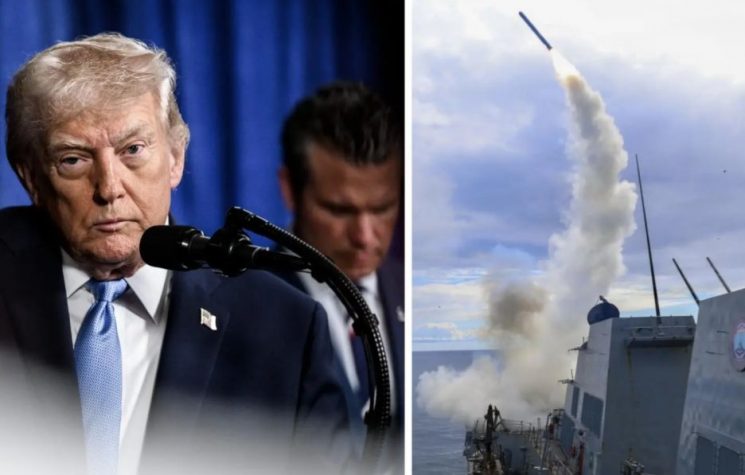



The Iranians have a vote on when the war ends. And they say that they are just getting started.
Join us on Telegram , Twitter
 , and VK
 .
.
Contact us: info@strategic-culture.su
The U.S.-Israeli stand-off air-strike model of waging war is being challenged by a quite different strategic asymmetric war – one first planned by Iran more than 20 years ago.
This is important to understand when trying to judge where the war balance sheet truly lies. It is like comparing oranges with lemons; they are essentially different in character.
The U.S. and Israel are dropping a lot of stand-off munitions at Iran. But, to what point and to what effect? We don’t know.
We do, however, know that Iran has its asymmetric war plan. And it is only just starting, incrementally moving towards full implementation. The full armoury of Iranian missiles has not yet been revealed – neither its latest missiles, nor its submersible drones and anti-ship-equipped missile speed boats that have yet to be deployed. So we do not know Iran’s full potential – and we cannot say to what effect its full deployment might yet be. Hizbullah is now fully operational, and the Houthi’s (seemingly) are waiting for the ‘green light’ to gate Bab el-Mandeb in tandem to the Hormuz blockade.
The root to the move of this Iranian asymmetric paradigm arose in the wake of the U.S.’ utter destruction of Iraq’s centralised military command in 2003 – the result of a three week massive air assault.
The issue for the Iranians that arose in the Iraq war’s wake was how Iran might build a deterrent military structure when it did not have – and could not have – anything resembling a peer air capability. And when the U.S. could also look down upon the extent of Iran military infrastructure from their high-resolution satellite cameras.
Well, the first answer simply was to have as little of the Iranian military structure out in the open to be observed from above – from space. Its components had to be buried, and buried deeply (beyond the reach of most bombs).
The second answer was that deeply buried missiles could indeed, in effect, become Iran’s ‘air force’ – i.e. they could become a substitute for a conventional air force. Iran thus has been constructing and stockpiling missiles for more than twenty years.
With Iran’s intense research focus on missile technology, it reportedly manufactures some 10-12 models of cruise and ballistic missiles. Some are hypersonic; others can deliver an array of explosive sub-munitions that are steerable (to avoid defence interceptors).
The big missiles are launched from deep underground silos dispersed across Iran (which is the size of western Europe and is well endowed with mountain ranges and forests). Shore-to-ship missiles too, are honey-combed into Iran’s coastal expanse.
The third response was to find a solution to the successful 2003 shock and awe decapitation of Sadam Hussein’s military command.
In 2007, the Mosaic doctrine was introduced.
The thinking behind the doctrine was to divide Iran’s military infrastructure into autonomous provincial commands — each with its separate stockpiled munitions, separate missile silos, and where appropriate, its own separate naval forces and militia.
Commanders were given pre-delegated battle-plans together with the authority to launch military action at their own initiative, in the event of a decapitation strike on the capital. The battle-plans and protocols were to be triggered automatically upon the decapitation of a Supreme Leader.
Article 110 of Iran’s 1979 Constitution gives command authority over the armed forces exclusively to the Supreme Leader. No one, and no institution, can override or rescind his directives. Should the new Leader subsequently be assassinated, the earlier pre-delegated instructions would then come into force, and would be irreversible by any other authority.
In short, Iran’s military machine – in the event of a decapitation strike – operates as an automated, decentralized retaliation machine that cannot be easily stopped, or controlled.
Military commentator Patricia Marins observes:
“Iran is waging an almost perfect asymmetric war, absorbing attacks, strategically rendering the surrounding bases unusable, destroying radars, and maintaining control of the Strait of Hormuz while still preserving its missile launch capability”.
“The U.S. and Israel are in an extremely difficult situation because they only know one kind of war: [indiscriminate aerial bombardment of largely civilian targets as they fail to destroy the underground missile cities]. Now they’re facing a strategically well-positioned Iran that is fighting on its own terms and timeline. What did Iran do? It focused on resilience against bombings – and kept almost its entire arsenal in large underground bases that the U.S. and Israel have already spent huge amounts of munitions trying to penetrate”.
An additional major lesson that Iran took from the 2003 Iraq war was that the U.S. and Israeli ‘way of war’ is wholly centred on short aerial bombardments to decapitate leadership echelons and command structures. The vulnerability of having a centralised command structure was countered by the Mosaic structure that de-centralised and defused command widely and over multiple commands – so that it could not seize up in the event of a surprise decapitation strike.
And a further strategic insight drawn by Iran from the Iraq war was that the West is militarily structured around short intensive air wars.
The antidote in the Iranian analysis was to ‘go long’: The current Iranian leadership’s strategic decision to opt for a long war flows directly from this insight — that western militaries are built for the shoot-and-scoot approach – plus their conviction that the Iranian people have more resilience to bear the pain of war, than have either the Israeli or western publics.
The mechanics for choosing to extend a war for longer than might suit Trump essentially comes down to logistics.
Iran’s logistics ‘squeeze’
Israel and the U.S. initially prepared and equipped themselves for a short war. In the case of the U.S., very short – from the Saturday morning when Khomeini was assassinated until Monday, when U.S. stock markets were due to open.
Iran responded within the hour of Imam Khamenei’s assassination to the prepared Mosaic blueprint by targeting U.S. bases in the Persian Gulf. Reportedly, the IRGC used old ballistic missiles and drones from the 2012/2013 production cycle. The purpose of using old missiles and drones so prolifically clearly was to degrade the stock of interceptor missiles held in by American bases in the Gulf.
A similar process of degrading Israel’s interceptor stock was pursued in tandem. Depletion of interceptors across the Gulf and Israel has become obvious. This constituted the first layer of the logistics ‘squeeze’.
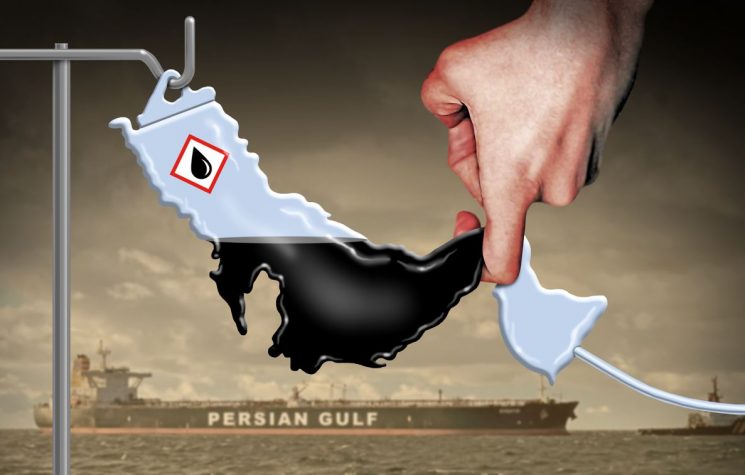
The second layer is the economic and energy squeeze brought about by gating the Strait of Hormuz to all ‘adversaries’, yet not to ‘friends’. The Hormuz gating is intended to trigger a financial and supply line crisis in the West so as to ‘squeeze’ the financial prospects that the war might be seen to offer the West. Weakening markets equates to weakening Trump’s resolve.
The third ‘squeeze’ is centred on public support for the war in the U.S.. The Iranian refusal to accept a ceasefire or negotiations, but rather to opt for long war, capsizes public expectations, challenges consensus expectations and raises anxiety and uncertainty.
What are Iran’s probable strategic objectives?
What then might be Iran’s ultimate objectives? Firstly, to remove the constant threat of military attack; to force the lifting of the constant siege on the Iranian people through sanctions; the return of its frozen assets, and the lifting of Israel’s occupation of Gaza and Palestinian lands.
Possibly Iran believes too that it will ‘flip’ the geo-political balance across the Persian Gulf area to take the regions’ naval choke-points and sea corridors out from U.S. hegemony and open them to the passage of BRICS vessels, without sanction, seizure or blockade by Washington. To launch a reverse ‘freedom of navigation’, as it were, in the original meaning of the phrase.
Plainly, the Iranian leadership understands full well that the successful deployment of their asymmetric war plan could upend the geo-strategic balance of not just West Asia, but of the globe.
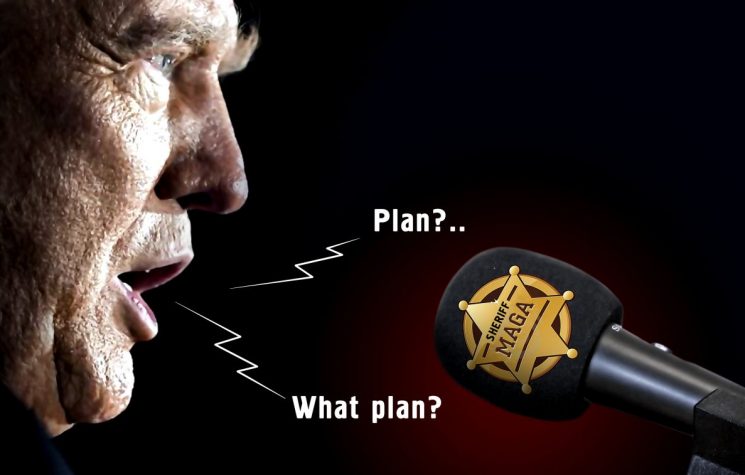
And so, what of Trump’s plan? President Trump’s biographer, Michael Wolff, said just yesterday:
“He [Trump] has no plan. He doesn’t know what is going on. He’s not really capable of formulating a plan. He creates a cliffhanger and that also becomes something in his own mind as a point of pride: No one knows what I am going to do next. So everyone is afraid of me – so that gives me maximum leverage. Having no plan becomes the plan”.
The metaphor is one, Wolff suggests, of Trump as a performer:
“He’s on stage and he’s making it up as he goes along and is very proud of that ability, which is a considerable ability”.
Wolff characterises Trump saying:
“We’re going to stop the war. We’re going to start the war. We’re going to bomb them; we’re going to negotiate; we’re going to have an unconditional surrender. Nothing happens without emanating from him [Trump]. And that changes on a moment by moment basis”.
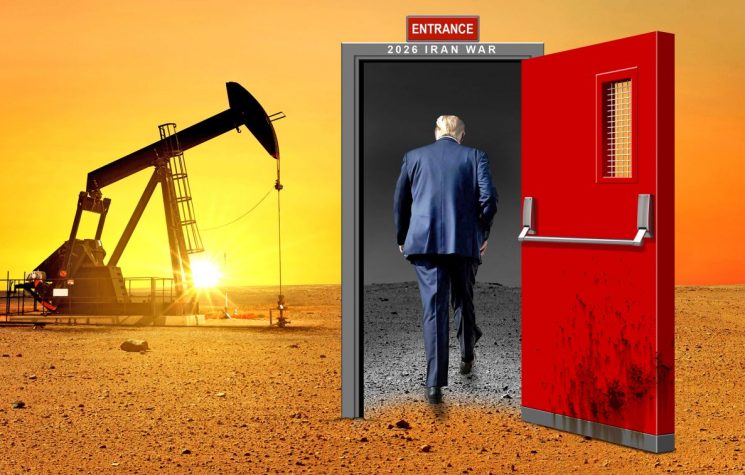
In reality, the only metric that matters for Trump is to be seen as a winner. Yesterday, he declared the U.S. has “won” the war — “We won. We won the bet. In the first hour”. But within another couple of weeks, the vulnerability of his fickleness may become more apparent as oil, equity and bond markets spiral downwards. Trump is phoning around trying to find someone that can give him a winning ‘way out’ from the war he started.
But the Iranians have a vote on when the war ends. And they say that they are just getting started…