
World
Alastair Crooke
January 28, 2026
© Photo: Public domain

Is Trump getting the message that an Iran ‘win’ is not ‘Slam Dunk’? – in which case he might decide on a TACO, accompanied by bone-crushing economic threats to Iran.

Join us on TelegramTwitter, and VK.

Contact us: info@strategic-culture.su

As so often these days, a decisive attack on Iran – comes down in the final analysis to Trump’s psychology, and his need to dominate the attention of everyone around him. He understands that for however much his maximalist pronouncements look — and are — crazy, they nonetheless do usually default to a ‘strong man image’. Trump’s career has been founded on the predicate that his base loves the ‘strong guy’ and any sign of weakness detracts from the illusion of strength. It is the thing that has generally worked for him.

European élites however, find this difficult to digest – perhaps understandably – and slide into paroxysms of outrage.

The key, as Trump-watcher Michael Wolff has suggested, is that after days with Trump saying that ‘this or that’ is going to be done, either “the easy way; or the hard way”, the tipping point usually comes when he has to manoeuvre to exit his maximalist positions, whilst always claiming it was all an ‘Art of the Deal’ success – the outcome being just what he had from the beginning intended.

On Iran, Trump’s messaging is again ultra-maximalist: Accept my conditions, or prepare for a comprehensive campaign to dismantle entirely your [Iran’s] political system. Trump’s envoys reinforce his stance that ‘every option remains on the table’ at every opportunity (though this rhetoric has become nothing more than an overworked cliché).

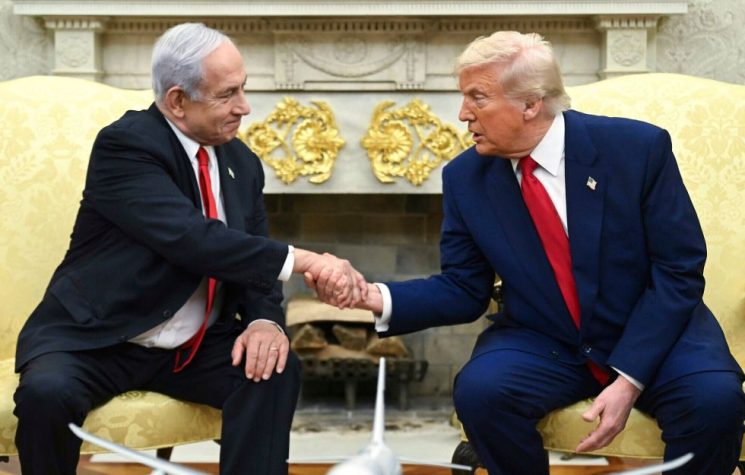
Trump’s threats towards Iran however, have triggered paroxysms of anxiety in the region, with leaders — even Netanyahu — fearing a long war with unpredictable and bloody consequences.

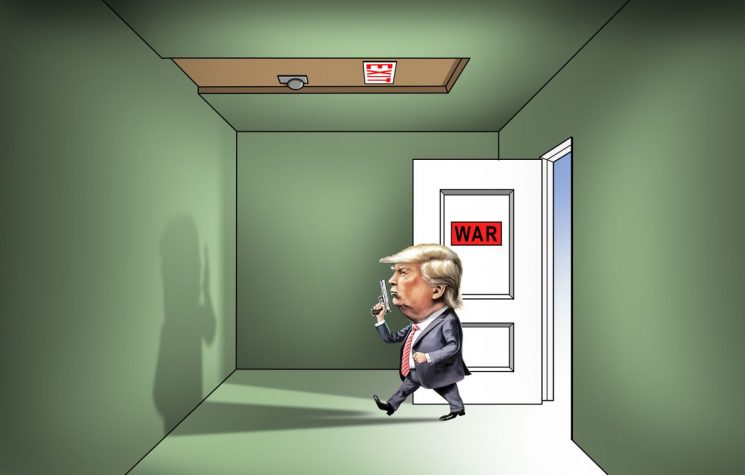
Trump’s conception of war is built around a fantasy that he can manipulate some lightening ‘in-boom-out’ stunt – one in which the U.S. loses no soldiers and its military infrastructure remains untouched. Reports from those regular ‘phone buddies’ of Trump say that he still says he wants a ‘guaranteed’ decisive outcome in Iran – a short, violently sharp, decisive war. He does not want casualties – especially American casualties. Neither does he want mass casualties or a long drawn-out conflict.

Colonel Larry Wilkerson explains that decisive is a military term of art. It means you’ve hit the enemy so hard they’re unable to respond. Or, in other words, it hints that Trump would like a ‘stunt’ like that of seizing Maduro.

Nothing is guaranteed in war, of course. And the insurrection in Iran fomented by externally-trained rioters drawing on the earlier Management of Savagery playbook failed.

The US had not deployed massively for this January episode because, in their (flawed) analysis, they had thought they might be able to simply ‘assist’ the rioters trying to overthrow the government – assistance that would not require much military muscle.

Well, that all fell apart. They had bought into the propaganda that Iran was a ‘house of cards’, destined to implode under the impact of the extreme violence of the rioters intended to sear into place the image of a crumbling, burning edifice with its leaders and occupants scrambling to escape.

It seems that in the wake of the ‘coup’ failure – yet still wanting to be pleasing to an exigent President – the Pentagon has come around to justifying and explaining the failed coup saying — in General Keane’s words –“We [have] had to bring in all this firepower”, (because they initially had thought they could manage with less).

So, now we have the narrative that “the U.S. has now deployed more forces to the Middle East than it did in the First Gulf War, the Second Gulf War, and the Iraq War combined” – which US military expert Will Schryverderides as “absolute ridiculous nonsense”.

Schryver notes: “I have yet to see a military buildup in the region that would permit anything remotely approximating a ‘decisive’ strike against the Iranian military and its government”.

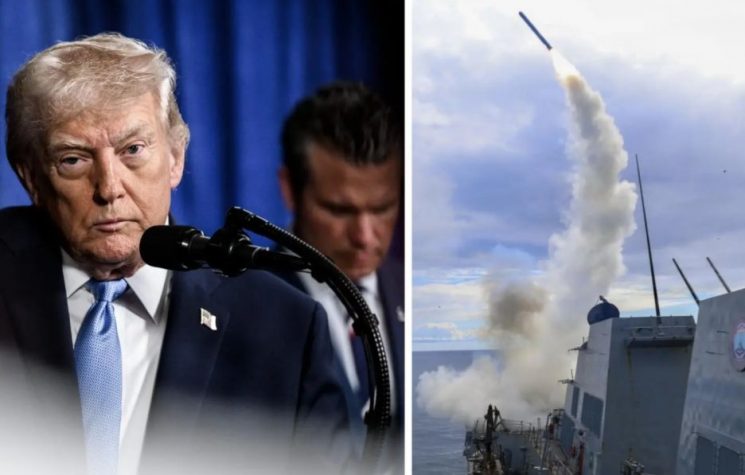
“A squadron of F-15s, a few tankers, and a couple dozen C-17 shipments of ordnance and/or AD systems has been sent to Jordan. That’s a modest defensive shield against drones and cruise missiles, at best. It’s certainly not a potent strike package … even with the carrier USS Gerald Ford in the mix … In total, the Navy could probably launch ~350 Tomahawks. But against a huge country like Iran, even if all 350 hit “something”, it’s not going to come close to disarming the Iranians”.

Schryver concludes:

“The US Navy is absolutely NOT going to venture into the Persian Gulf, or even the Gulf of Oman. And it would be extremely high risk to fly refuelling tankers in Iranian airspace. So that is going to limit carrier strike aircraft to their fully loaded combat radius of ~600 miles — not nearly far enough to hit targets deep in Iran. And even if they flew a half-dozen B-2s, and a dozen B-52s / B-1Bs … t just doesn’t add up to much in the context of a one-off strike package. It’s just a few dozen more stand-off cruise missiles thrown into the mix”.

A short, violent decisive ‘win’ (as reported by the WSJ) that Trumps wants — and which ‘plays well’ at home — simply is not an option. Iran Foreign Minister Araghchi, more realistically, has warned:

“An all-out confrontation will certainly be messy, ferocious, and drag on far, far longer than the fantasy timelines that Israel and its proxies are trying to peddle to the White House”.

Inside Iran, notes Ibrahim Al-Amine, “the leadership is operating on the assumption that the confrontation may reach its most extreme form. Preparations are unfolding along two tracks: strengthening defensive capabilities against a large-scale assault and tightening internal security to prevent domestic destabilization. This posture is now visible across the country”.

So, could it be that Trump will back out once again (i.e. TACO – ‘Trump Always Chickens Out’)? Schryver argues that Iran is not Venezuela. It is not a ‘tariffs and trade’ financial war. It is not some coup de théâtre in which Trump ‘chickening out’ can be explained away as another win, as part of his clever ‘Art of the Deal’ approach.

Actual full-on military conflict (not a Maduro stunt) by contrast, is ‘out there for all to see’, notes Will Shryver, and would be much harder to explain away should it go awry. Adding more fire-power will not eliminate the risks. Trump’s best option is to find himself an alternative ‘distraction’.

Israel, too, seems to be having second thoughts. Ronan Bergman, in Yedioth Ahoronot, reports Israeli Intelligence reports saying thata week and a half ago the protests reached their peak throughout Iran … [since when] the scale of the protests and demonstrations has decreased dramatically … the security establishment and the intelligence community do not believe that the regime is currently in danger, certainly not in immediate danger … The central question is whether Trump missed the momentum – and if there was any momentum at all …”.

“[Nevertheless] suppose all the armed forces that the US is now transferring to the Persian Gulf were fully deployed … and suppose Israel were to join in with its firepower … Then what? Would they overthrow the government …? What is the optimistic scenario for such an event … without soldiers on the ground, but only air strikes? … In practice”, Bergman concludes, “such a regime has never fallen through external intervention”.

Recall that Trump’s disapproval rating, according to NY Times poll this week, now stands at 47%. Quite apart from the strategic military calculus of Iran’s response to any attack, Trump certainly doesn’t need a messy war. He likes his ‘initiatives’ to be short and clean ’standout’ wins.

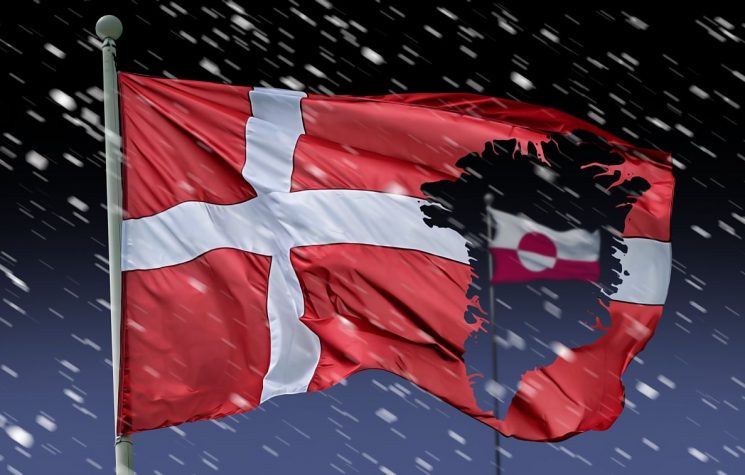
Last weekend, as the Greenland bruhaha tumbled into threats and counter threats of tariffs, the US bond market moved to the verge of collapse (as it so did on Liberation Day, with the tariff announcements). The ‘way out’ from developing bond market crisis was Trump going ‘TACO’ on the Greenland-linked tariffs on European states who did not support his Greenland takeover.

Is Trump getting the message that an Iran ‘win’ is not ‘Slam Dunk’? – in which case he might decide on a TACO, accompanied by bone-crushing economic threats to Iran – (possibly).

Will he, won’t he ‘TACO’ on Iran?

Is Trump getting the message that an Iran ‘win’ is not ‘Slam Dunk’? – in which case he might decide on a TACO, accompanied by bone-crushing economic threats to Iran.

Join us on TelegramTwitter, and VK.

Contact us: info@strategic-culture.su

As so often these days, a decisive attack on Iran – comes down in the final analysis to Trump’s psychology, and his need to dominate the attention of everyone around him. He understands that for however much his maximalist pronouncements look — and are — crazy, they nonetheless do usually default to a ‘strong man image’. Trump’s career has been founded on the predicate that his base loves the ‘strong guy’ and any sign of weakness detracts from the illusion of strength. It is the thing that has generally worked for him.

European élites however, find this difficult to digest – perhaps understandably – and slide into paroxysms of outrage.

The key, as Trump-watcher Michael Wolff has suggested, is that after days with Trump saying that ‘this or that’ is going to be done, either “the easy way; or the hard way”, the tipping point usually comes when he has to manoeuvre to exit his maximalist positions, whilst always claiming it was all an ‘Art of the Deal’ success – the outcome being just what he had from the beginning intended.

On Iran, Trump’s messaging is again ultra-maximalist: Accept my conditions, or prepare for a comprehensive campaign to dismantle entirely your [Iran’s] political system. Trump’s envoys reinforce his stance that ‘every option remains on the table’ at every opportunity (though this rhetoric has become nothing more than an overworked cliché).

Trump’s threats towards Iran however, have triggered paroxysms of anxiety in the region, with leaders — even Netanyahu — fearing a long war with unpredictable and bloody consequences.

Trump’s conception of war is built around a fantasy that he can manipulate some lightening ‘in-boom-out’ stunt – one in which the U.S. loses no soldiers and its military infrastructure remains untouched. Reports from those regular ‘phone buddies’ of Trump say that he still says he wants a ‘guaranteed’ decisive outcome in Iran – a short, violently sharp, decisive war. He does not want casualties – especially American casualties. Neither does he want mass casualties or a long drawn-out conflict.

Colonel Larry Wilkerson explains that decisive is a military term of art. It means you’ve hit the enemy so hard they’re unable to respond. Or, in other words, it hints that Trump would like a ‘stunt’ like that of seizing Maduro.

Nothing is guaranteed in war, of course. And the insurrection in Iran fomented by externally-trained rioters drawing on the earlier Management of Savagery playbook failed.

The US had not deployed massively for this January episode because, in their (flawed) analysis, they had thought they might be able to simply ‘assist’ the rioters trying to overthrow the government – assistance that would not require much military muscle.

Well, that all fell apart. They had bought into the propaganda that Iran was a ‘house of cards’, destined to implode under the impact of the extreme violence of the rioters intended to sear into place the image of a crumbling, burning edifice with its leaders and occupants scrambling to escape.

It seems that in the wake of the ‘coup’ failure – yet still wanting to be pleasing to an exigent President – the Pentagon has come around to justifying and explaining the failed coup saying — in General Keane’s words –“We [have] had to bring in all this firepower”, (because they initially had thought they could manage with less).

So, now we have the narrative that “the U.S. has now deployed more forces to the Middle East than it did in the First Gulf War, the Second Gulf War, and the Iraq War combined” – which US military expert Will Schryverderides as “absolute ridiculous nonsense”.

Schryver notes: “I have yet to see a military buildup in the region that would permit anything remotely approximating a ‘decisive’ strike against the Iranian military and its government”.

“A squadron of F-15s, a few tankers, and a couple dozen C-17 shipments of ordnance and/or AD systems has been sent to Jordan. That’s a modest defensive shield against drones and cruise missiles, at best. It’s certainly not a potent strike package … even with the carrier USS Gerald Ford in the mix … In total, the Navy could probably launch ~350 Tomahawks. But against a huge country like Iran, even if all 350 hit “something”, it’s not going to come close to disarming the Iranians”.

Schryver concludes:

“The US Navy is absolutely NOT going to venture into the Persian Gulf, or even the Gulf of Oman. And it would be extremely high risk to fly refuelling tankers in Iranian airspace. So that is going to limit carrier strike aircraft to their fully loaded combat radius of ~600 miles — not nearly far enough to hit targets deep in Iran. And even if they flew a half-dozen B-2s, and a dozen B-52s / B-1Bs … t just doesn’t add up to much in the context of a one-off strike package. It’s just a few dozen more stand-off cruise missiles thrown into the mix”.

A short, violent decisive ‘win’ (as reported by the WSJ) that Trumps wants — and which ‘plays well’ at home — simply is not an option. Iran Foreign Minister Araghchi, more realistically, has warned:

“An all-out confrontation will certainly be messy, ferocious, and drag on far, far longer than the fantasy timelines that Israel and its proxies are trying to peddle to the White House”.

Inside Iran, notes Ibrahim Al-Amine, “the leadership is operating on the assumption that the confrontation may reach its most extreme form. Preparations are unfolding along two tracks: strengthening defensive capabilities against a large-scale assault and tightening internal security to prevent domestic destabilization. This posture is now visible across the country”.

So, could it be that Trump will back out once again (i.e. TACO – ‘Trump Always Chickens Out’)? Schryver argues that Iran is not Venezuela. It is not a ‘tariffs and trade’ financial war. It is not some coup de théâtre in which Trump ‘chickening out’ can be explained away as another win, as part of his clever ‘Art of the Deal’ approach.

Actual full-on military conflict (not a Maduro stunt) by contrast, is ‘out there for all to see’, notes Will Shryver, and would be much harder to explain away should it go awry. Adding more fire-power will not eliminate the risks. Trump’s best option is to find himself an alternative ‘distraction’.

Israel, too, seems to be having second thoughts. Ronan Bergman, in Yedioth Ahoronot, reports Israeli Intelligence reports saying thata week and a half ago the protests reached their peak throughout Iran … [since when] the scale of the protests and demonstrations has decreased dramatically … the security establishment and the intelligence community do not believe that the regime is currently in danger, certainly not in immediate danger … The central question is whether Trump missed the momentum – and if there was any momentum at all …”.

“[Nevertheless] suppose all the armed forces that the US is now transferring to the Persian Gulf were fully deployed … and suppose Israel were to join in with its firepower … Then what? Would they overthrow the government …? What is the optimistic scenario for such an event … without soldiers on the ground, but only air strikes? … In practice”, Bergman concludes, “such a regime has never fallen through external intervention”.

Recall that Trump’s disapproval rating, according to NY Times poll this week, now stands at 47%. Quite apart from the strategic military calculus of Iran’s response to any attack, Trump certainly doesn’t need a messy war. He likes his ‘initiatives’ to be short and clean ’standout’ wins.

Last weekend, as the Greenland bruhaha tumbled into threats and counter threats of tariffs, the US bond market moved to the verge of collapse (as it so did on Liberation Day, with the tariff announcements). The ‘way out’ from developing bond market crisis was Trump going ‘TACO’ on the Greenland-linked tariffs on European states who did not support his Greenland takeover.

Is Trump getting the message that an Iran ‘win’ is not ‘Slam Dunk’? – in which case he might decide on a TACO, accompanied by bone-crushing economic threats to Iran – (possibly).

Is Trump getting the message that an Iran ‘win’ is not ‘Slam Dunk’? – in which case he might decide on a TACO, accompanied by bone-crushing economic threats to Iran.

Join us on TelegramTwitter, and VK.

Contact us: info@strategic-culture.su

As so often these days, a decisive attack on Iran – comes down in the final analysis to Trump’s psychology, and his need to dominate the attention of everyone around him. He understands that for however much his maximalist pronouncements look — and are — crazy, they nonetheless do usually default to a ‘strong man image’. Trump’s career has been founded on the predicate that his base loves the ‘strong guy’ and any sign of weakness detracts from the illusion of strength. It is the thing that has generally worked for him.

European élites however, find this difficult to digest – perhaps understandably – and slide into paroxysms of outrage.

The key, as Trump-watcher Michael Wolff has suggested, is that after days with Trump saying that ‘this or that’ is going to be done, either “the easy way; or the hard way”, the tipping point usually comes when he has to manoeuvre to exit his maximalist positions, whilst always claiming it was all an ‘Art of the Deal’ success – the outcome being just what he had from the beginning intended.

On Iran, Trump’s messaging is again ultra-maximalist: Accept my conditions, or prepare for a comprehensive campaign to dismantle entirely your [Iran’s] political system. Trump’s envoys reinforce his stance that ‘every option remains on the table’ at every opportunity (though this rhetoric has become nothing more than an overworked cliché).

Trump’s threats towards Iran however, have triggered paroxysms of anxiety in the region, with leaders — even Netanyahu — fearing a long war with unpredictable and bloody consequences.

Trump’s conception of war is built around a fantasy that he can manipulate some lightening ‘in-boom-out’ stunt – one in which the U.S. loses no soldiers and its military infrastructure remains untouched. Reports from those regular ‘phone buddies’ of Trump say that he still says he wants a ‘guaranteed’ decisive outcome in Iran – a short, violently sharp, decisive war. He does not want casualties – especially American casualties. Neither does he want mass casualties or a long drawn-out conflict.

Colonel Larry Wilkerson explains that decisive is a military term of art. It means you’ve hit the enemy so hard they’re unable to respond. Or, in other words, it hints that Trump would like a ‘stunt’ like that of seizing Maduro.

Nothing is guaranteed in war, of course. And the insurrection in Iran fomented by externally-trained rioters drawing on the earlier Management of Savagery playbook failed.

The US had not deployed massively for this January episode because, in their (flawed) analysis, they had thought they might be able to simply ‘assist’ the rioters trying to overthrow the government – assistance that would not require much military muscle.

Well, that all fell apart. They had bought into the propaganda that Iran was a ‘house of cards’, destined to implode under the impact of the extreme violence of the rioters intended to sear into place the image of a crumbling, burning edifice with its leaders and occupants scrambling to escape.

It seems that in the wake of the ‘coup’ failure – yet still wanting to be pleasing to an exigent President – the Pentagon has come around to justifying and explaining the failed coup saying — in General Keane’s words –“We [have] had to bring in all this firepower”, (because they initially had thought they could manage with less).

So, now we have the narrative that “the U.S. has now deployed more forces to the Middle East than it did in the First Gulf War, the Second Gulf War, and the Iraq War combined” – which US military expert Will Schryverderides as “absolute ridiculous nonsense”.

Schryver notes: “I have yet to see a military buildup in the region that would permit anything remotely approximating a ‘decisive’ strike against the Iranian military and its government”.

“A squadron of F-15s, a few tankers, and a couple dozen C-17 shipments of ordnance and/or AD systems has been sent to Jordan. That’s a modest defensive shield against drones and cruise missiles, at best. It’s certainly not a potent strike package … even with the carrier USS Gerald Ford in the mix … In total, the Navy could probably launch ~350 Tomahawks. But against a huge country like Iran, even if all 350 hit “something”, it’s not going to come close to disarming the Iranians”.

Schryver concludes:

“The US Navy is absolutely NOT going to venture into the Persian Gulf, or even the Gulf of Oman. And it would be extremely high risk to fly refuelling tankers in Iranian airspace. So that is going to limit carrier strike aircraft to their fully loaded combat radius of ~600 miles — not nearly far enough to hit targets deep in Iran. And even if they flew a half-dozen B-2s, and a dozen B-52s / B-1Bs … t just doesn’t add up to much in the context of a one-off strike package. It’s just a few dozen more stand-off cruise missiles thrown into the mix”.

A short, violent decisive ‘win’ (as reported by the WSJ) that Trumps wants — and which ‘plays well’ at home — simply is not an option. Iran Foreign Minister Araghchi, more realistically, has warned:

“An all-out confrontation will certainly be messy, ferocious, and drag on far, far longer than the fantasy timelines that Israel and its proxies are trying to peddle to the White House”.

Inside Iran, notes Ibrahim Al-Amine, “the leadership is operating on the assumption that the confrontation may reach its most extreme form. Preparations are unfolding along two tracks: strengthening defensive capabilities against a large-scale assault and tightening internal security to prevent domestic destabilization. This posture is now visible across the country”.

So, could it be that Trump will back out once again (i.e. TACO – ‘Trump Always Chickens Out’)? Schryver argues that Iran is not Venezuela. It is not a ‘tariffs and trade’ financial war. It is not some coup de théâtre in which Trump ‘chickening out’ can be explained away as another win, as part of his clever ‘Art of the Deal’ approach.

Actual full-on military conflict (not a Maduro stunt) by contrast, is ‘out there for all to see’, notes Will Shryver, and would be much harder to explain away should it go awry. Adding more fire-power will not eliminate the risks. Trump’s best option is to find himself an alternative ‘distraction’.

Israel, too, seems to be having second thoughts. Ronan Bergman, in Yedioth Ahoronot, reports Israeli Intelligence reports saying thata week and a half ago the protests reached their peak throughout Iran … [since when] the scale of the protests and demonstrations has decreased dramatically … the security establishment and the intelligence community do not believe that the regime is currently in danger, certainly not in immediate danger … The central question is whether Trump missed the momentum – and if there was any momentum at all …”.

“[Nevertheless] suppose all the armed forces that the US is now transferring to the Persian Gulf were fully deployed … and suppose Israel were to join in with its firepower … Then what? Would they overthrow the government …? What is the optimistic scenario for such an event … without soldiers on the ground, but only air strikes? … In practice”, Bergman concludes, “such a regime has never fallen through external intervention”.

Recall that Trump’s disapproval rating, according to NY Times poll this week, now stands at 47%. Quite apart from the strategic military calculus of Iran’s response to any attack, Trump certainly doesn’t need a messy war. He likes his ‘initiatives’ to be short and clean ’standout’ wins.

Last weekend, as the Greenland bruhaha tumbled into threats and counter threats of tariffs, the US bond market moved to the verge of collapse (as it so did on Liberation Day, with the tariff announcements). The ‘way out’ from developing bond market crisis was Trump going ‘TACO’ on the Greenland-linked tariffs on European states who did not support his Greenland takeover.

Is Trump getting the message that an Iran ‘win’ is not ‘Slam Dunk’? – in which case he might decide on a TACO, accompanied by bone-crushing economic threats to Iran – (possibly).

The views of individual contributors do not necessarily represent those of the Strategic Culture Foundation.

See also

January 27, 2026

See also

January 27, 2026
The views of individual contributors do not necessarily represent those of the Strategic Culture Foundation.