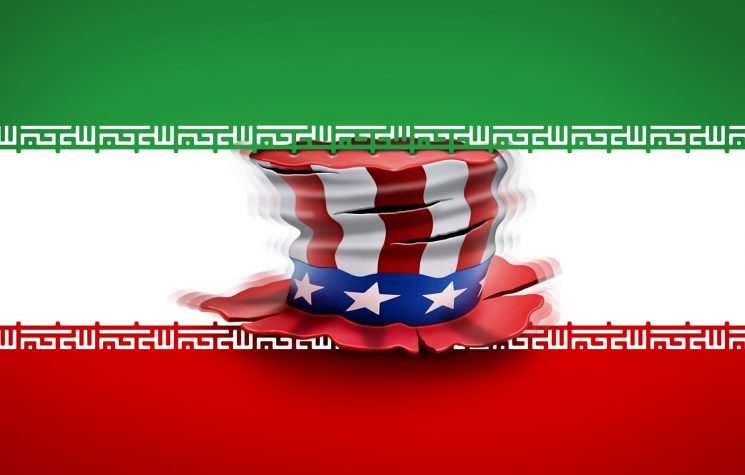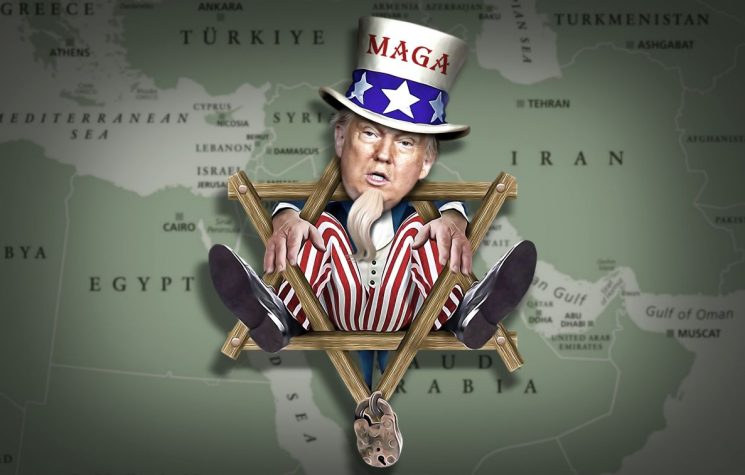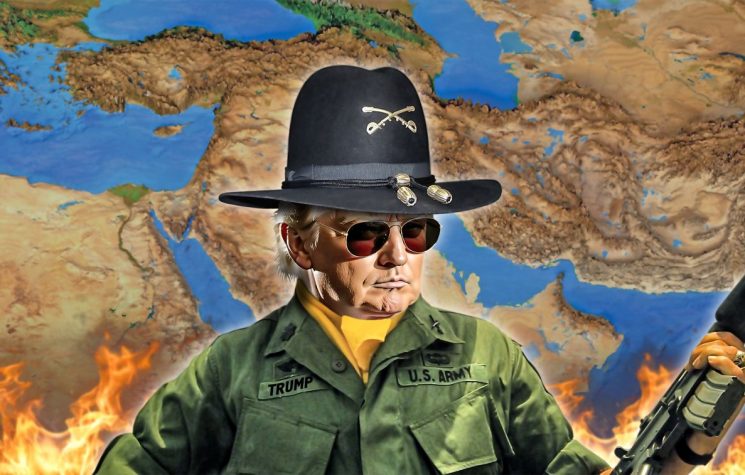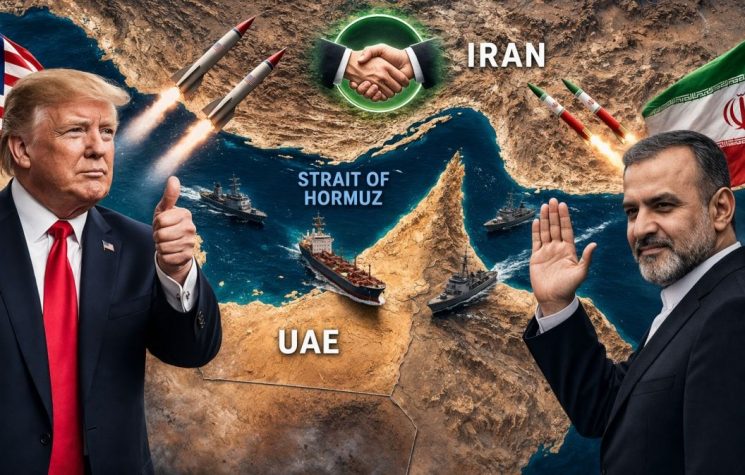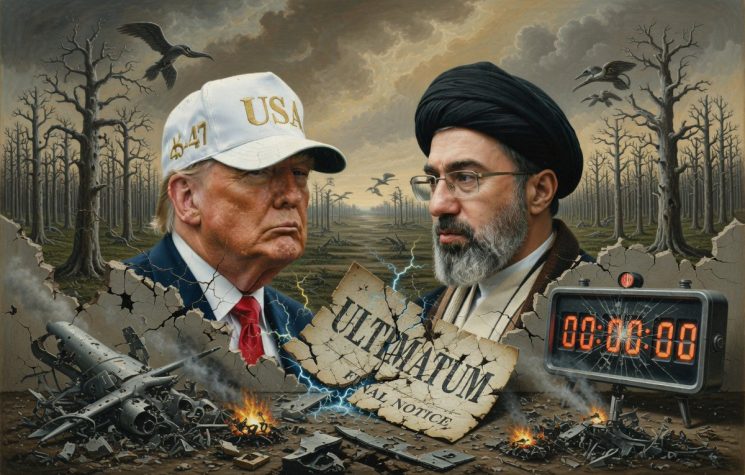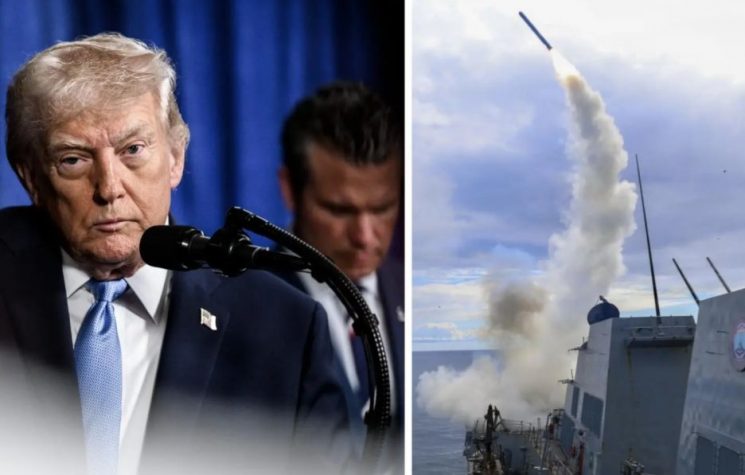



Trump has, for now, gotten the U.S. armed forces out of the dead-end alley he had led them into.


Contact us: info@strategic-culture.su
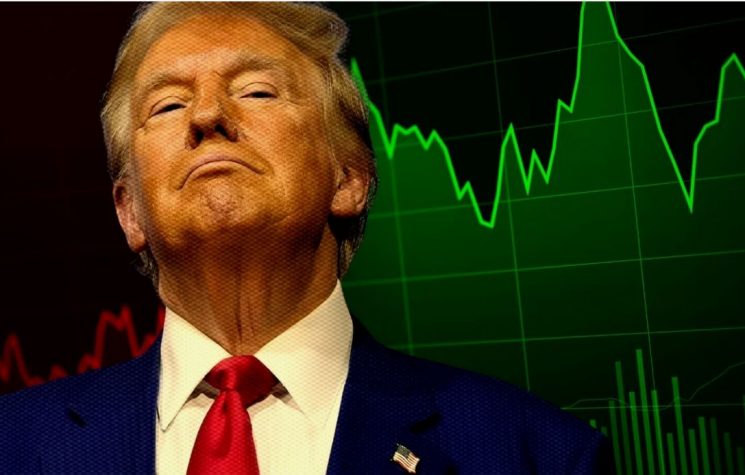
Trump has, for now, gotten the U.S. armed forces out of the dead-end alley he had led them into. For now, without being able to claim victory, though they will still sing of it, but possibly benefiting from a more low-key position for someone who, admittedly, needed a rest, resupply, rethinking of a non-existent strategy, and, above all, a de-escalation from the spiral imposed by Trump.
The possible resort to nuclear weapons, just one month after the start of the aggression, instead of projecting an image of strength, would effectively project the opposite: an image of weakness on the conventional warfare front, given how quickly all available resources and means of escalation were exhausted, with no results other than the death of innocent civilians and the demonstration of Iranian resilience, unity, and resolve. Consequently, with this “ceasefire,” Trump backs down, threatening, claiming victory, but already free from the prospect of condemning Iran to the “Stone Age.”
This endless escalation of actions, having its initiating moment (on a spiritual plane) in the first assassination attempt on Trump—which supposedly conferred upon him the eschatological dimension that he was convinced he carried, to reproduce in his mind the fanatical and brutal behavior that justifies his actions, represented in the use of apocalyptic language, sadly normalized and disgustingly replicated, including by people like Lieutenant General Marco Serronha, who, holding the position of vice-president of the Portuguese Red Cross at the time, stated that Iran should be hit with “3 atomic bombs” and that such an attack should be renewed periodically – has provoked a mixture of reactions regarding Trump and what he represents, ranging from effusive, to the embarrassed supporter, to the disillusioned.
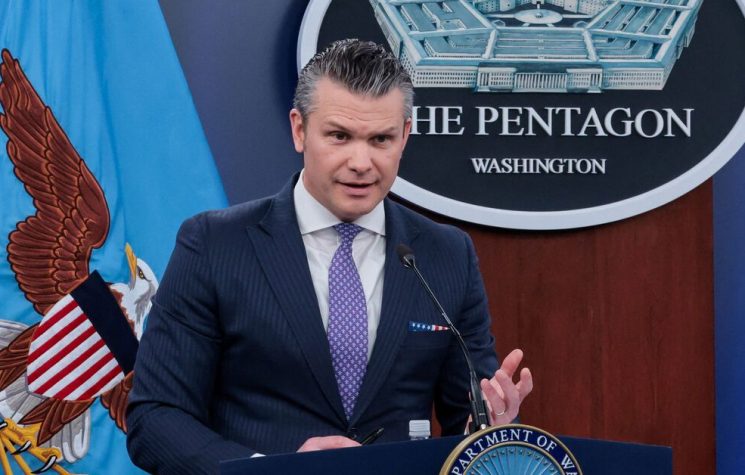
In the most supremacist sectors, rejoicing is always effusive and borders on extremism, leading one to believe that Trump is surrounded by fanatics of a sectarian religious type, who, like Peter Hegseth, are part of that chain of command that rewards American soldiers with speeches about Armageddon, the biblical character of this presidency, as well as the messianic role of the current president.
Regardless of what one thinks about this chaos of medieval nature, typical of the Christian crusades, one cannot think that it is in any way ungoverned, discontinuous, or even unexpected, given the historical moment we live in. The U.S. and Israel—the latter as an extension of its economic power and the multinational financial power that characterizes the American empire—are full of episodes like Trump, internally or externally.
The situation of insecurity we live under Trumpism is nothing more than the direct effect of the accelerated decomposition of the center of power, making it, as a function of its structural crisis, more brutal, extreme, fanatical, chauvinistic, and sectarian, producing leaders accordingly. After an era of more or less peaceful alternation, because it was victorious, between central (bipartisan) factions, which gave the appearance of democratic movement and allowed the central schemes of wealth accumulation to remain untouched, this center of power, upon confronting a reality from which it ended up disconnecting, due to the continued lack of answers to the problems of the populations, entered into a process of fragmentation.
The main consequence resulting from this fragmentation process was the opening of space for the emergence of new power factions, which created the feeling of a break with the previous order, functioning as revanchist forces, moving towards a more declared and belligerent strategy (on the military and political level), aiming to save, preserve, and in other cases, deepen the very social structures of accumulation that nervously caused the center to atomize, as they felt threatened. The support of large swaths of business owners for far-right parties, openly neo-fascist, revanchist, and xenophobic, is testimony to this.
The urgency denounced by a Portuguese government when it says it “doesn’t want to miss the opportunity,” when it attacks labor and social rights considered secure, in a period it calls “full employment,” aiming to take advantage of a favorable balance of power for the most factious right—a balance it knows is temporary—is no different from the urgency that characterizes Trumpist USA or Israel under Netanyahu, and the urgency they feel to collapse or defeat—even through violence—the threats to what they call “national security,” “Western civilization,” or “liberal democracies.”
The sense of urgency felt by both structures, which disregards opinions, censors, persecutes, isolates, and oppresses the social structures that oppose them, is typical of capitalist processes in an expansion crisis. Feeling contained in their field of action, such social forces resort to the most violent and offensive resources at their disposal. Whether on a national, micro level, or on the geopolitical level. In the case of a company, jobs are attacked, throwing workers into unemployment and misery; in the case of a government, social spending is attacked, redirecting resources towards capitalist accumulation; in the case of an empire, war is waged, and new markets are conquered. Trump and Trumpism clarify all of this, from cuts to social security to invasions, stripping away the propaganda wrapping with which the forces of the center usually dress all these threats to people and workers.
It’s a difference of degree, scale, and number! The reality underlying such aggressive behavior is composed of the same material constituents, such as the anxiety for expansion, the escape from containment, and the conquest of new living space. The erratic, hasty, and nervous policies pursued by this decadent political class represent nothing more than the direct result of the influence exerted by the social classes that finance, support, and employ these leaders. In the case of the West, feeling hegemony slipping away, even in its reduced expression under “U.S. leadership,” it resorts to violence, just as it had provoked waves of fascism, repression, and world wars in the era of the first phase of decolonization and the imposition of social rights through mass struggle. In those moments, everything becomes more violent, from our working and social lives to collective relations on a broader scale.
Consider a paradigmatic example of how such contradictions work: as a result of the wars promoted by the West in the Maghreb and West Asia, an unprecedented migratory current installed itself in Europe. Now, this direct consequence of instability in the Maghreb was foreseen by the PNAC (Project for the New American Century) report – Rebuilding America’s Defenses. Notwithstanding the risks highlighted in this guiding document for the George W. Bush administration’s governance, hegemonic strategy prevailed over the tactical risks of destabilizing “European allies.” And what were the main strategic risks identified in the PNAC? The main one was “the erosion of the position of sole superpower,” the emergence of a rival like China, the fear of the birth of a European defense structure independent of NATO, or Iranian domination of oil. As of today, the direction was to “intervene now” so that later the Pax Americana could be guaranteed. The acceleration under Bush Jr. in 2001 had the same material constituents as in 2026. Ipso Facto!
As a result of the decision to sacrifice the Maghreb—perhaps deliberately—Europe received a wave of migrants and refugees, suddenly seized upon by a business class that saw its strategic reserve of labor shrinking. The transformation of an instability factor into an opportunity to contain wages and intensify exploitation was seen by the European employers as an opportunity. The decline in the standard of living of Europeans, associated with the predictable cultural shock, resulted in the growth of the far-right, forces of hatred, xenophobia, machismo, racism, homophobia, exacerbated hedonism, and individualism, profoundly affecting an already degraded social fabric. The most paradoxical thing of all is that it is the very same businessmen who most finance such political forces and support them—through the media—to capture the discontented, lumpenized masses. This whole circuit of events is characterized by actions deeply harmful to the interests of the people, which did not dissuade the dominant elites from taking them, despite all the social violence they entailed.
Only those unfamiliar with the speeches of the “Axis of Evil” by Bush Jr., followed by an Obama who claimed to save democracy, alternated with an anti-China Trump, and Biden’s “America is back,” followed by an even more fanatical and even messianic Trump than the first, could consider everything that is happening as a novelty. Trump is the perfect cover to be used by a decadent empire, which, less and less, but not totally giving up, tries to mask its brutality with a speech that promises moral salvation and, above all, an era of peace, once the “Iran” cancer is removed.
To a Bush of the “axis of evil,” “weapons of mass destruction,” and the project of 7 countries in 5 years, but using some sense of humor, resorting to a diplomatic and verbose Tony Blair, finding time to peddle machinations at the UN, resorting to an African American and Jamaican descendant like Colin Powell, and through the creation of the War on Terror, succeeds a Trump, who doesn’t want to miss the opportunity to overthrow Iran, thus completing the cycle begun under Bush Jr.
The urgency, denounced by the failure of the initial 5-year timeline (more than 20 have passed!!!), which at the time were contingent on mitigating the erosion of U.S. hegemony, leaves no time for elaborate, well-crafted strategies, only for a few ploys, quickly unmasked by the illusionist himself, like the resort to “narco-terrorism” in Venezuela, replaced in less than a week by the real oil. Nowadays, Trump only talks about conquests, Rubio applauds the colonial past of the West with nostalgia, which imposed itself on brown peoples, of which he himself is a native. “Desert Storm” operations give way to “Epic Fury” or “Eternal Darkness,” denoting a semiotic shift that denounces the radicalization (though I don’t like to use this word in this context) and the trivialization of verbal, moral, and material brutality.
But it’s not only in the Republican wing of the Uniparty that one notices the sense of urgency. We also notice it in the Democratic party. To an Obama “Nobel Peace Prize” winner capable of destroying Libya, Yemen, and Syria, while seeming to do nothing, succeeds a Biden who blows up the German Nord Stream pipeline and imposes a war on the EU, ending with the U.S. in the position of main gas supplier and more present than ever in European structures. As can be seen, Trump or Trumpism are also far from constituting a discontinuity in the U.S. political system. Nothing has changed, neither constitutionally nor institutionally. The powers Trump uses and abuses are presidential powers that, in the U.S., assume a nature of near-absolute power.
Thus, the “selling” of Trump and Trumpism as a systemic discontinuity, a kind of moral shock within a decadent system, is also part of a very common political strategy, which not only rehabilitated neoconservative and neoliberal political currents but also allowed the resurrection and normalization of the most supremacist ideologies, while the last remnants of social democracy were buried and the remaining progressive, pacifist, and developmentalist forces were isolated. Trump’s style coincides with the times we live in, but his meaning and that of his actions are grounded in a logic of exercising power that has deep historical roots, in the very alternating dimension of U.S. politics.
This alternation, previously based on central, almost twin powers, but exhausted by the lack of answers, fragmenting itself seems to give rise to a new phase of alternation, further to the right, established between the falsely designated “moderate” forces of the liberal center and center-right, suddenly elected as “left,” and the revanchist, sectarian, neo-fascist, and extremist forces. We’ll see how it all ends, as this new configuration seems less diverse than the previous one, situated only on one side of the traditional political spectrum. In Portugal, except for the discourse and incorrectness, the policies defended by the far-right (Chega and IL parties) coincide with those practiced by the government (PSD) and defended by the previous representative of the center-left (PS). However, it is this constant capacity for plastic and aesthetic regeneration, which seems to be exhausting itself, that guarantees the U.S. and imperialist capitalism the power they still possess.
In a period when peoples felt the exhaustion of the political strategy devised by the Washington consensus, which social democrats and the center-left in general had adhered to, unable to find a correspondence between the proclamation of values and rights and their respective enjoyment, at a time when China asserts itself, with its “socialism with Chinese characteristics,” Trump emerges as a drastic alternative, which rehabilitated the system in the eyes of half the population. So, “there was an answer,” so, “the system produced an alternative.” Trump is the child of “there’s no left or right anymore,” of “there is no far-right,” and of “we are not fascists”!
Many good people wanted to believe that Trump would indeed bring peace. Trump promised it, and the MAGA movement wanted it. The isolationist, inward-looking discourse, the criticism of forever wars, would lead one to assume that. Those who didn’t want it were his direct financiers, because in capitalism and a system where whoever pays for the elections is Corporate America, they always weigh more. This is a lesson Trump can bring, if anyone who doesn’t have it wants to take it away. It’s the class structure of interests that supports the candidate, which determines his movement and material dynamics.
This logic enchanted many, thirsty for some change in the gray marasmus of fine proclamations and disastrous conditions. Possibly with some excesses, it was even a relief for someone to speak without filters, “tell the truths,” as if “saying something everyone could understand” and claiming to want to respond to the problems felt. Trump did not emerge only at a moment of frontal challenge to the American empire by the main forces of multipolarity—the Russian Federation, Iran, or China. Trump also emerges at a moment of exhaustion of patience and time. Of the patience of many of the disinherited, of the time on the part of his promoters. Multipolarity means the defeat of the PNAC, it means the profound failure of the outlined strategy. The PNAC corresponded to the fear of the end, and in that sense, it was rational, but Trump corresponds to the phase of hysteria and psychosis.
It is in the psychotic phase of post-truth that masks censorship, of Fake News that destroys truth, of historical unrealism, that the Trumpist proposal is presented as fearless, courageous, whose political incorrectness, besides being cathartic, fit like a glove the profile of intractability desired in the face of the challenges that arose. Trump was the guy who would make things happen.
Trump would have no fear of doing what AIPAC required, would have no fear of bringing back the Monroe Doctrine and dethroning China from the backyard. Epstein made it understood in his texts, and such files gave his donors the reins of his character, or lack thereof! They had to try him quickly and brutally. Just as when Saddam Hussein was armed to attack Iran, killing his own Iraqi Kurds along the way, with German chemical weapons and U.S. political protection. Just as when they used Osama Bin Laden to form Al-Qaeda and later liquidated him and blamed him for 9/11.
The U.S. and its elites are experts at choosing and supporting madmen, when the task requires something drastic and urgent. But, until now, they tended to do it on the periphery. As in World War II with Nazifascism, where the imperialist bloc used that madness, faced with the existence of the USSR. Today, the advent of China, the strengthening of Russia, and the resistance of Iran force the use of this instrument within the U.S. itself!
The data doesn’t lie. The dollar is losing ground, continuously and irreversibly, with everything being gambled on the farce of cryptocurrencies; the world economy is being towed by China, which emerges more solid and powerful. The states accused of being “malign” have managed to resist and even the “color revolutions” have begun to fail. The genocide in Gaza also spread the notion that the system was too compromised. Biden bet everything on a mixture of soft power and hybrid interventions, but failed to defeat and isolate the Russian Federation, to weaken the People’s Republic of China, or even to destabilize Iran. The system needed a shake-up, a jolt. Trump is exactly that: the urgent response, the brutal response, the death rattle of those who refuse to let themselves die.
Trump represents this salvific quest, including for Zionism and Netanyahu, today more isolated and threatened than ever, living only off the brutality he is capable of inflicting. With Trump and Trumpism, they wouldn’t fail; they had to take risks. Brutality would frighten and subdue the doubters. The destruction of USAID is symptomatic, as if to say: with me, there’s no need for soft power, because either you do it or you don’t. The destruction of USAID was a veiled message for many who were on Biden’s side and opposed Trump, including in Europe. There was no time to lose.
The result is plain to see. This time, the U.S. creates the monster, installs it in its own house, instead of someone else’s, and reaps no results, which says a lot about the moment they live in and the effectiveness of their decisions. The weakening of intelligence and decision-making centers is evident. Trump has squandered soft power and credibility at hypersonic speed. The result was even worse, with the dollar losing ground, and it’s unclear exactly what its expression as a reserve currency corresponds to, since, as a result of the loss of soft power and the dismantling of the aura of invincibility, the parallel economy to Swift grew, and it was the Yuan that gained the most from it.
At the end of this whole process, the American empire may, in fact, find its image as a world leader severely shaken. All empires in history have arrogated this type of function to themselves. It was necessary to justify the occupation of others with something that would mask the crimes committed and allow for future rehabilitation. This is where a figure like Trump also provides the necessary answer.
To rehabilitate themselves, the U.S. will need a makeover, and Trump, after the failure of the brutality strategy, will also allow the transition back to normality, through a catharsis. Perhaps he might even go to prison. But the failure will be Trump’s and only Trump’s. The U.S., its elites, will emerge unscathed. They won’t return to the starting point, but they will buy time to try again later. On the History Channel, we’ll see documentaries about a crazy president who didn’t listen to anyone and did everything without thinking. He wasn’t a dictator, no! He was just crazy. Because in the U.S., there are no dictators! We’ll be here to witness it!
Let’s see what happened with Hitler. With great difficulty, Nuremberg was held, a few unimportant madmen were cleaned up, and Nazism was saved. Canada, Latin America, the U.S., and the UK were living coffers for the imagery, practices, and people linked to Nazism. The U.S. made great use of it for its FBI, CIA, NATO, and many other things. In Ukraine, Banderism, preserved intact in Canada, returned with full force, as in the Baltics. As if nothing had ever happened. The U.S. are experts in this type of cleansing, and once again they will do it if Trump and Trumpism don’t work. Does Trump know this? Probably not, and it’s likely that he is even completely convinced of his own messianism.
With Israel, it will be no different. There is think-tank documentation that speaks of this “bad cop” role that falls to Israel. One day, if necessary, they will annihilate the beast, preserve its skeleton, and use it again later. At each turn of declared brutality, we tend to call it fascism. However, this brutality is nothing more than the intrinsic and irresistible impulse that capitalism and imperialism have for brutality, for inhumanity! When reality demands something drastic, all masks fall! In the end, the U.S. will even pretend that it never supported Israel and that Nazism was even left-wing, or that the USSR started World War II. One day, this chameleon-like capacity will reach its limit. For now, unmasked brutality has already reached the very center. One day, such brutality will consume itself!
Let us remember the 7 countries in 5 years. All the presidents together have contributed to getting to Iran. It remains to be seen if they will manage to get out of there!