
Editor's Сhoice
March 26, 2026
© Photo: Public domain

By Patrick LAWRENCE

Join us on TelegramTwitter, and VK.

Contact us: info@strategic-culture.su

The U.N. Security Council’s condemnation of Iran’s retaliatory strikes, along with the isolation of Cuba, show what U.S. assertion of raw power is doing to what remains of internationalist principles.

Consider these following passages in a text that is now entered officially in the record of United Nations proceedings. I draw from Security Council Resolution 2817, which the 15–member council passed on March 11.

At issue in the vote that passed this document is the presence or otherwise of the principles of internationalism — solidarity, parity, sovereignty, global justice. In another context, and I will address this shortly, the same question arises as the Trump regime effectively blockades Cuba to the point it is in danger of collapse.

The Security Council acted in response to Bahrain’s request for a special session on the U.S.–Israeli war with Iran and the latter’s retaliatory attacks on various targets in Bahrain and elsewhere in the Persian Gulf region.

These clauses announce what the council decided to do. I rearrange the verbs, put some emphasis in bold and nothing more:

“– Affirms the inherent right of individual or collective self-defense in response to the deplorable armed attacks by the Islamic Republic of Iran, as recognized by Article 51 of the United Nations Charter,

— Deplores the deliberate targeting of civilians and civilian objects by the Islamic Republic of Iran, including airports, energy installations, objects necessary for food production and distribution, and critical civilian infrastructure, as well as the indiscriminate use of weapons in populated areas and their consequences for the civilian population, as well as attacks and threats on merchant and commercial vessels in and near the Strait of Hormuz…;

— Condemns in the strongest terms the egregious attacks by the Islamic Republic of Iran against the territories of Bahrain, Kuwait, Oman, Qatar, Saudi Arabia, the United Arab Emirates and Jordan and determine that such acts constitute a breach of international law and a serious threat to international peace and security;

— Further condemns that residential areas were attacked, that civilian objects have been targeted and that the attacks resulted in civilian casualties and damage of civilian buildings; and express solidarity with these countries and their people;

Demands the immediate cessation of all attacks by the Islamic Republic of Iran against Bahrain, Kuwait, Oman, Qatar, Saudi Arabia, the United Arab Emirates, and Jordan;

— Demands that the Islamic Republic of Iran immediately and unconditionally cease from any provocation or threats to neighboring States, including the use of proxies;

 Calls upon the Islamic Republic of Iran to comply fully with its obligations under international law, including international humanitarian law, particularly regarding the protection of civilians and civilian objects in armed conflict….”

And so on through nine clauses. The text of UNSC 2817 is here. It passed by a vote of 13 members in favor and two abstentions.

Having overcome my loss for words on reading this resolution, let me address the fundamental questions, of which several, raised by this document and the vote on it.

Straight off the top, UNSC 2817 is a diabolically clear example of what I call the meta-reality the Western powers now impose, with the acquiescence or cooperation of their numerous client states, on the community of nations.

Iran’s Legitimate Self-Defense
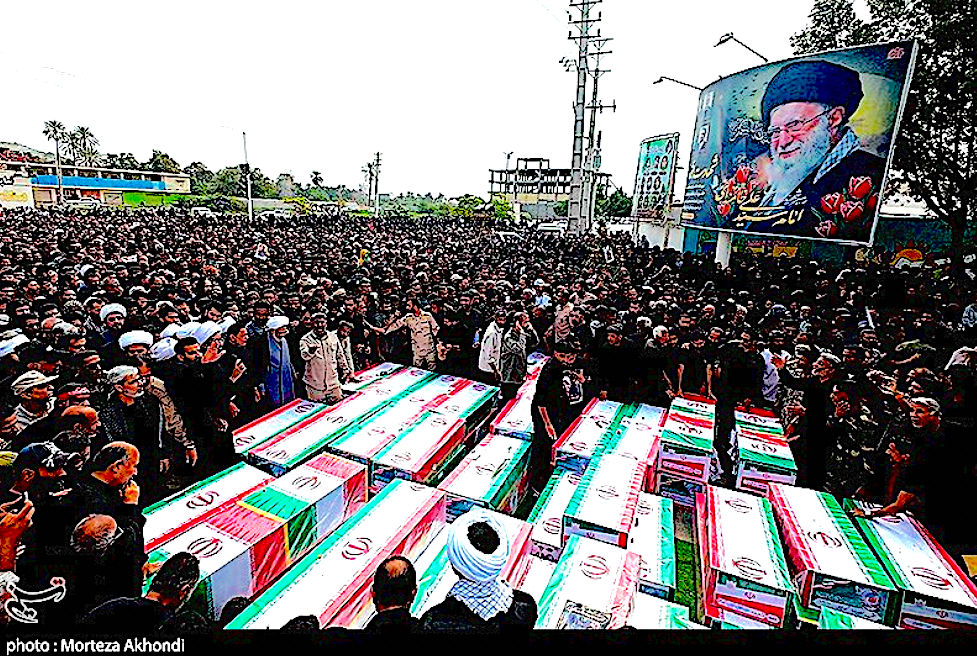
The funeral  for the victims of the Feb. 28 U.S.-Israeli attack on the Shajareh Tayyebeh girls’ elementary school in Minab, Iran. (Tasnim News Agency/ Wikimedia Commons/ CC BY 4.0)

An earlier draft of the resolution by Bahrain audaciously read, “Condemns in the strongest terms the unprovoked and egregious attacks by the Islamic Republic of Iran …”

Russia, China, and some non-aligned members of the council strongly objected to accusing Iran of an unprovoked attack given that Israel and the U.S. were the ones who conducted the unprovoked attack on Iran. 

Bahrain and the G.C.C. countries agreed to remove “unprovoked” but added, “determines that such acts constitute a breach of international law and a serious threat to international peace and security.”

The text still makes not the slightest sense when applied to Iran’s legitimate self-defense: “The deliberate targeting of civilians and civilian objects,” “the indiscriminate use of weapons in populated areas,” “a breach of international law and a serious threat to international peace and security”:

Turn the resolution upside down and aim it at the United States and the Zionist regime, and it makes perfect sense.

This is the real-time construction of the meta-reality a late-phase imperium requires to justify its thoroughly unjustifiable conduct toward another nation. This is the extent to which it has bribed, coerced or otherwise forced the world’s less powerful nations to support this grotesque edifice of illusion.

There are not many surprises among the 13 nations that backed 2817. The French, British and Americans supported it — the last, in my surmise, having almost certainly dictated the draft of the resolution. It goes without saying Bahrain, of course one of  America’s Persian Gulf dependencies, would not have acted without guidance from Washington.

Latvia, Liberia, Congo, Somalia, Pakistan: They will all have their reasons for going along with this preposterous document. You hoped for more from the Greeks and the Danes, maybe, but they, too climbed on.

So did Gustavo Petro’s Colombia, and we can be surprised and not surprised all at once: President Petro has stood up honorably to the Trump regime and in favor of international law, but this makes his nation highly vulnerable to attack of the kind that has befallen Venezuela or Iran or some other variant in between.

No, the surprises for me lay elsewhere. They are two.

Apart from the Security Council vote, some 135 nations backed 2817 in the General Assembly. There was no vote in the G.A.: These were voluntary endorsements, “co-sponsorships,” and the 135 figure marks a record high in these things.

Why? Why — let me single out this nation — is India on this list of co-sponsors? Think of it: India, which has counted principled nonalignment as the pillar of its diplomacy since Jawaharlal Nehru gave the nation’s foreign policy its essential character eight decades ago.

Then there were the Russians and the Chinese, permanent members of the Security Council. Neither exercised its veto to block this nonsensical attack not only on Iran but on law, logic and reason itself.

Why turns into why not? Why did Russia and China choose to abstain while covering themselves with limp-wristed calls for a ceasefire?

“What unfolded at the Security Council on Wednesday is not merely a diplomatic misstep — it is another demonstration of how far the world’s most powerful states have drifted from justice, truth and responsible leadership.”

That is Annette Morgan, who contributed a fiery denunciation of the March 11 proceedings in these pages. Her outrage, widely shared, is directed toward Russia and China as much as the United States and its European clients.

Russia’s ambassador, Vasily Nebenzya, tried to recover some dignity with these remarks post vote:

“To our deep regret, the resolution that has just been adopted is framed precisely in such a biased and one-sided tone. It muddles up the cause and effect. If someone who is not well versed in international affairs reads this resolution, they will inevitably get the impression that Tehran, willingly and out of malice, conducted an unprovoked attack on Arab countries.

At the same time, the attacks against the territory of Iran itself, let alone those who are behind them and carrying them out, are not only not condemned in the document but simply left out. And the Security Council has just signed off on this.”

These are principled objections, every one of them straight to the point. How Ambassador Nebenzya got from these to an ineffectual abstention rather than a vociferously delivered veto of 2817 is simply beyond me. He ought to have banged his shoe on his desk in protest, a pointed reference to Khrushchev’s famous gesture in the General Assembly in 1960.

Ian Williams, a longtime correspondent at the U.N., had a properly scathing piece last Friday in Washington Report on Middle East Affairs, a seven-times-a-year journal published by the American Educational Trust, a non-profit organization. Referencing F.D.R.’s famous day-of-infamy remark after Imperial Japan’s attack on Pearl Harbor in December 1941. Williams writes:

“However, perhaps the events of 3–11 should be considered more consequential than mere infamy….  At least the resolution did not include Israel among the states listed as victims of Iranian ‘aggression,’ but the silence is deafening.”

Williams’ piece goes on to relate the vote on 2817 to the U.N.’s endorsement last November, via Resolution 2803, of the Trump regime’s 20–point “peace plan” and its “Board of Peace,” which, as others have remarked, amounts to a full-frontal challenge to the U.N.’s authority.

From the Williams piece:

“His [Trump’s] war of attrition against the United Nations and international order is only slightly different from the campaigns that the American Israel Public Affairs Committee (AIPAC) and its congressional allies have waged against the U.N. for decades.”

These observations suggest the magnitude we should assign to the March 11 events at the U.N. and lead Williams to pose the question with which he begins: “Is the United Nations dead, or merely crippled?”

This is one of my questions, too. Williams leaves it unanswered and so will I, but I share his evident pessimism on this very large point.

Bygone Solidarity
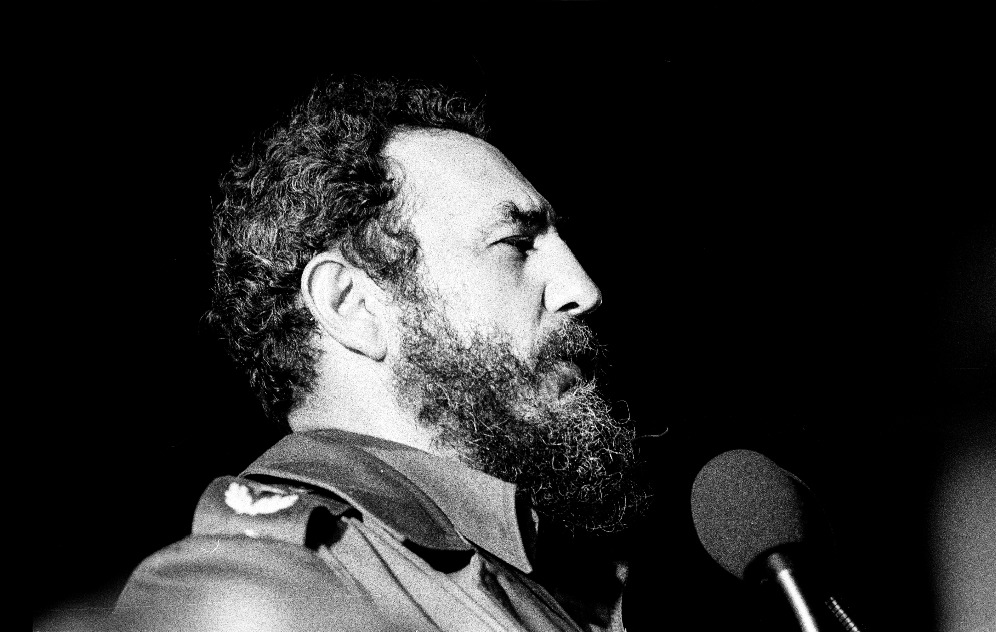
Fidel Castro speaking in Havana, 1978. (Marcelo Montecino, CC BY-SA 2.0, Wikimedia Commons)

The vote on 2817 prompts me to pose another question — this one I consider of equal or greater importance: What has happened to the admirable internationalism once prevalent among non–Western nations, especially the scores that won independence in the decades after the 1945 victories. Does “internationalism,” the very term, now sit on a museum shelf gathering dust, a curious artifact of another time?

There is no avoiding this question as the U.S.–Israeli aggression against Iran continues. Or as we contemplate the significance of Russia’s and China’s failures to veto UNSC Resolution 2817. Or as the Trump regime blocks Cuba’s petroleum supplies to the point it cannot turn on the lights, its people are beginning to starve and its health care system, once among the world’s most admired, nears collapse.

Where are Iran’s allies and friends? Where Cuba’s?

In the weeks before the U.S.–Israeli attacks on Iran there were numerous reports that the Russians and Chinese were assisting the Islamic Republic as it prepared to defend itself against the imminent aggressions of the Americans and the Israeli regime of terror.

Both Russia and China were said to be dramatically increasing shipments of critical military technologies to Iran — advanced drones, air defense systems, missile components, a data-link network that would get Iran out of the West’s G.P.S. system.

In mid–February, Russia, China, and Iran began joint naval exercises in the northern end of the Indian ocean, the Gulf of Oman and — it does not get more pointed — the Strait of Hormuz.

Ah, I thought, and wrote elsewhere: This is what internationalism looks like in the 21st century. This is the new world order as it is on the ground (and in the air).

The BRICS nations, of which these three are members, are, yes, the still-in-formation descendant of the old Non–Aligned Movement, which was the beating heart of the internationalist ethos after it declared its principles at Bandung in 1955 and, six years later, formally constituted itself in Belgrade.

That assessment may prove right, but I do not stand by it so ebulliently as I did when I first made it. Where are the Russians and Chinese now that the Islamic republic is under daily siege? Where were they on March 11, when 2817 was put up for a vote?

If there is a nation other than Cuba that has stood more steadfastly for the principles of internationalism I cannot think of it.

Readers of a certain age may recall Operation Carlota, by way of which Fidel Castro, beginning in late 1975, sent several hundred thousand troops and many thousands of doctors to aid the Popular Movement for the Liberation of Angola, the MPLA, as it defended itself against various proxies armed and financed by the C.I.A.

Jump cut to March 2020, when, post–Fidel, Cuba sent a large detachment of doctors to aid Lombardy, the worst-hit of the Italian provinces as the Covid–19 virus spread. The Cubans still bear the banner, we can conclude with admiration.

And now, in their hour of need?

Raw Power Seeking Self-Preservation
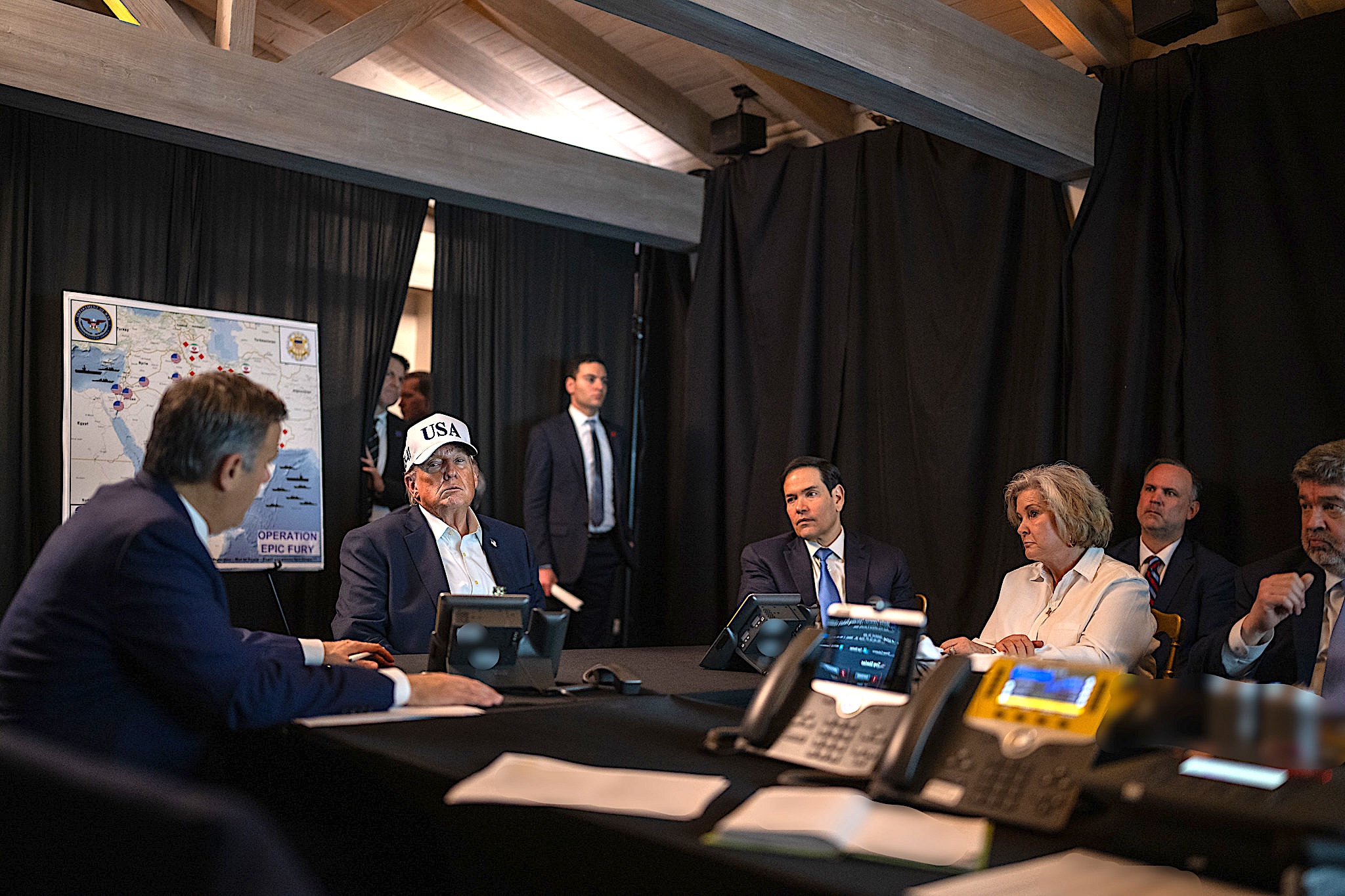
President Donald J. Trump overseeing attacks on Iran at Mar-a-Lago, Palm Beach, Florida, on Feb. 28. (White House / Daniel Torok)

Claudia Sheinbaum is in the same fix as Gustavo Petro now: She was forced to cut off Mexico’s supplies of petroleum to Cuba under threat of U.S. sanctions just as Petro’s ambassador at the U.N. was effectively coerced into supporting the egregious 2817. There is no pretending in matters of relative strength and relative weakness.

This month Russia has sent two tankers of oil to Cuba. The Sea Horse, believed to be carrying about 190,000 barrels of Russian diesel and gasoil and the Anatoly Kolodkin, laden with 730,000 barrels of crude oil, are headed to Cuba, according to a CNBC report.

This is despite the U.S. Treasury Department saying that, under penalty of tariffs, the ships will not be allowed into Cuba. Treasury is making an exception to its lifting of U.S. sanctions on Russian oil because of the Hormuz crisis.

The Kolodkin is expected in Cuba by next Monday with enough fuel to keep Cuba going for just 10 days, according to a report in NPR.

It is not enough, but is Moscow calling Washington’s bluff? It ought to be, with the certainty Trump and his people will not dare reenact the Cuban Missile Crisis, this time over oil supplies.

The Chinese are reportedly sending quantities of solar panels — great, modest? It is not clear — to the Cubans. O.K., it is a clever move to counter the Trump regime’s illegal and inhumane blockade while also helping Cuba transition to post-fossil sources of energy.

But I have to wonder what Sukarno or Zhou Enlai or Nehru or Tito would think of plane loads of solar panels as a manifestation of internationalism as they understood it. I leave readers to finish the thought.

It is the same as with the Russians: Were the Chinese to dispatch convoys carrying rice, medicines, and various much-needed technologies to the Cuban Republic, the Trump regime could not possibly take the risk of a confrontation by interdicting them.

My reluctant conclusion: Internationalism is alive among us but not necessarily well. Why this? What has happened over how many years?

I knew you would ask. My thoughts are several.

One, remember when Vladimir Putin remarked that anyone who did not regret the demise of the Soviet Union had no heart, and anyone who thought it could be revived had no brain? The Russian president was onto something.

A lot else collapsed, if less dramatically, with the passage of the Soviet Union into history. So did the socialist (or Socialist in many cases) principles that were the very bedrock of post–1945 internationalism.

Anyone who spent time in the Global South from, say, the Reagan years onward could see the tide of neoliberalism sweeping in with all its flotsam — deregulation, privatization and so on.

Post–Cold War Russia, to finish this point, is state capitalist by any other name. The Chinese fiddle pointlessly with their “socialism with Chinese characteristics” rhetoric. Capitalist growth tends to supersede the consciousness of internationalism now.

Two, and related to the above point, with the Cold War’s end, the binary that defined the post–1945 decades more influentially than anything else is no more.

National identities and interests, long submerged, now supersede what we used to call blocs — Eastern, Western, Socialist. Think of the BRICS: Its members now run from social democracies of one or another variety to monarchies. We can still talk of the Global South, but it is no longer clear to me what this means.

Finally, there is the exercise of U.S. power.

Since 2001, when — my date for this — the American Century abruptly ended — Washington has asserted itself ever more lawlessly, coercively, viciously and violently. With Trump’s return to the White House, there is no longer even the pretense of America as “the light of the world.”

We now witness the late-phase imperium in defense of its lapsing dominance — raw power as it seeks to preserve itself. This will run its course, but there is little defense against it for the time being.

The March 11 vote at the U.N. is measure enough of what America’s extreme assertions of power are doing to what remains of the old internationalist principles.

It was John Whitbeck, the international attorney based in Paris, who passed on, via his privately circulated blog, the Ian Williams piece in Washington Report of Middle East Affairs. He appended this note as he did so:

“Perhaps the ‘international community’ should let the U.N. die, accepting that it has become, like the League of Nations before it, an ultimately failed experiment, and genuinely peace-loving and peace-seeking states should then found a new international organization so structured as to have a better chance of playing a constructive role in the world.”

I sometimes ask readers not to miss the optimism buried beneath my apparent pessimism as I comment on events. It is hard to miss either in this remark.

Original article:  consortiumnews.com

The views of individual contributors do not necessarily represent those of the Strategic Culture Foundation.
Internationalism then & now

By Patrick LAWRENCE

Join us on TelegramTwitter, and VK.

Contact us: info@strategic-culture.su

The U.N. Security Council’s condemnation of Iran’s retaliatory strikes, along with the isolation of Cuba, show what U.S. assertion of raw power is doing to what remains of internationalist principles.

Consider these following passages in a text that is now entered officially in the record of United Nations proceedings. I draw from Security Council Resolution 2817, which the 15–member council passed on March 11.

At issue in the vote that passed this document is the presence or otherwise of the principles of internationalism — solidarity, parity, sovereignty, global justice. In another context, and I will address this shortly, the same question arises as the Trump regime effectively blockades Cuba to the point it is in danger of collapse.

The Security Council acted in response to Bahrain’s request for a special session on the U.S.–Israeli war with Iran and the latter’s retaliatory attacks on various targets in Bahrain and elsewhere in the Persian Gulf region.

These clauses announce what the council decided to do. I rearrange the verbs, put some emphasis in bold and nothing more:

“– Affirms the inherent right of individual or collective self-defense in response to the deplorable armed attacks by the Islamic Republic of Iran, as recognized by Article 51 of the United Nations Charter,

— Deplores the deliberate targeting of civilians and civilian objects by the Islamic Republic of Iran, including airports, energy installations, objects necessary for food production and distribution, and critical civilian infrastructure, as well as the indiscriminate use of weapons in populated areas and their consequences for the civilian population, as well as attacks and threats on merchant and commercial vessels in and near the Strait of Hormuz…;

— Condemns in the strongest terms the egregious attacks by the Islamic Republic of Iran against the territories of Bahrain, Kuwait, Oman, Qatar, Saudi Arabia, the United Arab Emirates and Jordan and determine that such acts constitute a breach of international law and a serious threat to international peace and security;

— Further condemns that residential areas were attacked, that civilian objects have been targeted and that the attacks resulted in civilian casualties and damage of civilian buildings; and express solidarity with these countries and their people;

Demands the immediate cessation of all attacks by the Islamic Republic of Iran against Bahrain, Kuwait, Oman, Qatar, Saudi Arabia, the United Arab Emirates, and Jordan;

— Demands that the Islamic Republic of Iran immediately and unconditionally cease from any provocation or threats to neighboring States, including the use of proxies;

 Calls upon the Islamic Republic of Iran to comply fully with its obligations under international law, including international humanitarian law, particularly regarding the protection of civilians and civilian objects in armed conflict….”

And so on through nine clauses. The text of UNSC 2817 is here. It passed by a vote of 13 members in favor and two abstentions.

Having overcome my loss for words on reading this resolution, let me address the fundamental questions, of which several, raised by this document and the vote on it.

Straight off the top, UNSC 2817 is a diabolically clear example of what I call the meta-reality the Western powers now impose, with the acquiescence or cooperation of their numerous client states, on the community of nations.

Iran’s Legitimate Self-Defense

The funeral  for the victims of the Feb. 28 U.S.-Israeli attack on the Shajareh Tayyebeh girls’ elementary school in Minab, Iran. (Tasnim News Agency/ Wikimedia Commons/ CC BY 4.0)

An earlier draft of the resolution by Bahrain audaciously read, “Condemns in the strongest terms the unprovoked and egregious attacks by the Islamic Republic of Iran …”

Russia, China, and some non-aligned members of the council strongly objected to accusing Iran of an unprovoked attack given that Israel and the U.S. were the ones who conducted the unprovoked attack on Iran. 

Bahrain and the G.C.C. countries agreed to remove “unprovoked” but added, “determines that such acts constitute a breach of international law and a serious threat to international peace and security.”

The text still makes not the slightest sense when applied to Iran’s legitimate self-defense: “The deliberate targeting of civilians and civilian objects,” “the indiscriminate use of weapons in populated areas,” “a breach of international law and a serious threat to international peace and security”:

Turn the resolution upside down and aim it at the United States and the Zionist regime, and it makes perfect sense.

This is the real-time construction of the meta-reality a late-phase imperium requires to justify its thoroughly unjustifiable conduct toward another nation. This is the extent to which it has bribed, coerced or otherwise forced the world’s less powerful nations to support this grotesque edifice of illusion.

There are not many surprises among the 13 nations that backed 2817. The French, British and Americans supported it — the last, in my surmise, having almost certainly dictated the draft of the resolution. It goes without saying Bahrain, of course one of  America’s Persian Gulf dependencies, would not have acted without guidance from Washington.

Latvia, Liberia, Congo, Somalia, Pakistan: They will all have their reasons for going along with this preposterous document. You hoped for more from the Greeks and the Danes, maybe, but they, too climbed on.

So did Gustavo Petro’s Colombia, and we can be surprised and not surprised all at once: President Petro has stood up honorably to the Trump regime and in favor of international law, but this makes his nation highly vulnerable to attack of the kind that has befallen Venezuela or Iran or some other variant in between.

No, the surprises for me lay elsewhere. They are two.

Apart from the Security Council vote, some 135 nations backed 2817 in the General Assembly. There was no vote in the G.A.: These were voluntary endorsements, “co-sponsorships,” and the 135 figure marks a record high in these things.

Why? Why — let me single out this nation — is India on this list of co-sponsors? Think of it: India, which has counted principled nonalignment as the pillar of its diplomacy since Jawaharlal Nehru gave the nation’s foreign policy its essential character eight decades ago.

Then there were the Russians and the Chinese, permanent members of the Security Council. Neither exercised its veto to block this nonsensical attack not only on Iran but on law, logic and reason itself.

Why turns into why not? Why did Russia and China choose to abstain while covering themselves with limp-wristed calls for a ceasefire?

“What unfolded at the Security Council on Wednesday is not merely a diplomatic misstep — it is another demonstration of how far the world’s most powerful states have drifted from justice, truth and responsible leadership.”

That is Annette Morgan, who contributed a fiery denunciation of the March 11 proceedings in these pages. Her outrage, widely shared, is directed toward Russia and China as much as the United States and its European clients.

Russia’s ambassador, Vasily Nebenzya, tried to recover some dignity with these remarks post vote:

“To our deep regret, the resolution that has just been adopted is framed precisely in such a biased and one-sided tone. It muddles up the cause and effect. If someone who is not well versed in international affairs reads this resolution, they will inevitably get the impression that Tehran, willingly and out of malice, conducted an unprovoked attack on Arab countries.

At the same time, the attacks against the territory of Iran itself, let alone those who are behind them and carrying them out, are not only not condemned in the document but simply left out. And the Security Council has just signed off on this.”

These are principled objections, every one of them straight to the point. How Ambassador Nebenzya got from these to an ineffectual abstention rather than a vociferously delivered veto of 2817 is simply beyond me. He ought to have banged his shoe on his desk in protest, a pointed reference to Khrushchev’s famous gesture in the General Assembly in 1960.

Ian Williams, a longtime correspondent at the U.N., had a properly scathing piece last Friday in Washington Report on Middle East Affairs, a seven-times-a-year journal published by the American Educational Trust, a non-profit organization. Referencing F.D.R.’s famous day-of-infamy remark after Imperial Japan’s attack on Pearl Harbor in December 1941. Williams writes:

“However, perhaps the events of 3–11 should be considered more consequential than mere infamy….  At least the resolution did not include Israel among the states listed as victims of Iranian ‘aggression,’ but the silence is deafening.”

Williams’ piece goes on to relate the vote on 2817 to the U.N.’s endorsement last November, via Resolution 2803, of the Trump regime’s 20–point “peace plan” and its “Board of Peace,” which, as others have remarked, amounts to a full-frontal challenge to the U.N.’s authority.

From the Williams piece:

“His [Trump’s] war of attrition against the United Nations and international order is only slightly different from the campaigns that the American Israel Public Affairs Committee (AIPAC) and its congressional allies have waged against the U.N. for decades.”

These observations suggest the magnitude we should assign to the March 11 events at the U.N. and lead Williams to pose the question with which he begins: “Is the United Nations dead, or merely crippled?”

This is one of my questions, too. Williams leaves it unanswered and so will I, but I share his evident pessimism on this very large point.

Bygone Solidarity

Fidel Castro speaking in Havana, 1978. (Marcelo Montecino, CC BY-SA 2.0, Wikimedia Commons)

The vote on 2817 prompts me to pose another question — this one I consider of equal or greater importance: What has happened to the admirable internationalism once prevalent among non–Western nations, especially the scores that won independence in the decades after the 1945 victories. Does “internationalism,” the very term, now sit on a museum shelf gathering dust, a curious artifact of another time?

There is no avoiding this question as the U.S.–Israeli aggression against Iran continues. Or as we contemplate the significance of Russia’s and China’s failures to veto UNSC Resolution 2817. Or as the Trump regime blocks Cuba’s petroleum supplies to the point it cannot turn on the lights, its people are beginning to starve and its health care system, once among the world’s most admired, nears collapse.

Where are Iran’s allies and friends? Where Cuba’s?

In the weeks before the U.S.–Israeli attacks on Iran there were numerous reports that the Russians and Chinese were assisting the Islamic Republic as it prepared to defend itself against the imminent aggressions of the Americans and the Israeli regime of terror.

Both Russia and China were said to be dramatically increasing shipments of critical military technologies to Iran — advanced drones, air defense systems, missile components, a data-link network that would get Iran out of the West’s G.P.S. system.

In mid–February, Russia, China, and Iran began joint naval exercises in the northern end of the Indian ocean, the Gulf of Oman and — it does not get more pointed — the Strait of Hormuz.

Ah, I thought, and wrote elsewhere: This is what internationalism looks like in the 21st century. This is the new world order as it is on the ground (and in the air).

The BRICS nations, of which these three are members, are, yes, the still-in-formation descendant of the old Non–Aligned Movement, which was the beating heart of the internationalist ethos after it declared its principles at Bandung in 1955 and, six years later, formally constituted itself in Belgrade.

That assessment may prove right, but I do not stand by it so ebulliently as I did when I first made it. Where are the Russians and Chinese now that the Islamic republic is under daily siege? Where were they on March 11, when 2817 was put up for a vote?

If there is a nation other than Cuba that has stood more steadfastly for the principles of internationalism I cannot think of it.

Readers of a certain age may recall Operation Carlota, by way of which Fidel Castro, beginning in late 1975, sent several hundred thousand troops and many thousands of doctors to aid the Popular Movement for the Liberation of Angola, the MPLA, as it defended itself against various proxies armed and financed by the C.I.A.

Jump cut to March 2020, when, post–Fidel, Cuba sent a large detachment of doctors to aid Lombardy, the worst-hit of the Italian provinces as the Covid–19 virus spread. The Cubans still bear the banner, we can conclude with admiration.

And now, in their hour of need?

Raw Power Seeking Self-Preservation

President Donald J. Trump overseeing attacks on Iran at Mar-a-Lago, Palm Beach, Florida, on Feb. 28. (White House / Daniel Torok)

Claudia Sheinbaum is in the same fix as Gustavo Petro now: She was forced to cut off Mexico’s supplies of petroleum to Cuba under threat of U.S. sanctions just as Petro’s ambassador at the U.N. was effectively coerced into supporting the egregious 2817. There is no pretending in matters of relative strength and relative weakness.

This month Russia has sent two tankers of oil to Cuba. The Sea Horse, believed to be carrying about 190,000 barrels of Russian diesel and gasoil and the Anatoly Kolodkin, laden with 730,000 barrels of crude oil, are headed to Cuba, according to a CNBC report.

This is despite the U.S. Treasury Department saying that, under penalty of tariffs, the ships will not be allowed into Cuba. Treasury is making an exception to its lifting of U.S. sanctions on Russian oil because of the Hormuz crisis.

The Kolodkin is expected in Cuba by next Monday with enough fuel to keep Cuba going for just 10 days, according to a report in NPR.

It is not enough, but is Moscow calling Washington’s bluff? It ought to be, with the certainty Trump and his people will not dare reenact the Cuban Missile Crisis, this time over oil supplies.

The Chinese are reportedly sending quantities of solar panels — great, modest? It is not clear — to the Cubans. O.K., it is a clever move to counter the Trump regime’s illegal and inhumane blockade while also helping Cuba transition to post-fossil sources of energy.

But I have to wonder what Sukarno or Zhou Enlai or Nehru or Tito would think of plane loads of solar panels as a manifestation of internationalism as they understood it. I leave readers to finish the thought.

It is the same as with the Russians: Were the Chinese to dispatch convoys carrying rice, medicines, and various much-needed technologies to the Cuban Republic, the Trump regime could not possibly take the risk of a confrontation by interdicting them.

My reluctant conclusion: Internationalism is alive among us but not necessarily well. Why this? What has happened over how many years?

I knew you would ask. My thoughts are several.

One, remember when Vladimir Putin remarked that anyone who did not regret the demise of the Soviet Union had no heart, and anyone who thought it could be revived had no brain? The Russian president was onto something.

A lot else collapsed, if less dramatically, with the passage of the Soviet Union into history. So did the socialist (or Socialist in many cases) principles that were the very bedrock of post–1945 internationalism.

Anyone who spent time in the Global South from, say, the Reagan years onward could see the tide of neoliberalism sweeping in with all its flotsam — deregulation, privatization and so on.

Post–Cold War Russia, to finish this point, is state capitalist by any other name. The Chinese fiddle pointlessly with their “socialism with Chinese characteristics” rhetoric. Capitalist growth tends to supersede the consciousness of internationalism now.

Two, and related to the above point, with the Cold War’s end, the binary that defined the post–1945 decades more influentially than anything else is no more.

National identities and interests, long submerged, now supersede what we used to call blocs — Eastern, Western, Socialist. Think of the BRICS: Its members now run from social democracies of one or another variety to monarchies. We can still talk of the Global South, but it is no longer clear to me what this means.

Finally, there is the exercise of U.S. power.

Since 2001, when — my date for this — the American Century abruptly ended — Washington has asserted itself ever more lawlessly, coercively, viciously and violently. With Trump’s return to the White House, there is no longer even the pretense of America as “the light of the world.”

We now witness the late-phase imperium in defense of its lapsing dominance — raw power as it seeks to preserve itself. This will run its course, but there is little defense against it for the time being.

The March 11 vote at the U.N. is measure enough of what America’s extreme assertions of power are doing to what remains of the old internationalist principles.

It was John Whitbeck, the international attorney based in Paris, who passed on, via his privately circulated blog, the Ian Williams piece in Washington Report of Middle East Affairs. He appended this note as he did so:

“Perhaps the ‘international community’ should let the U.N. die, accepting that it has become, like the League of Nations before it, an ultimately failed experiment, and genuinely peace-loving and peace-seeking states should then found a new international organization so structured as to have a better chance of playing a constructive role in the world.”

I sometimes ask readers not to miss the optimism buried beneath my apparent pessimism as I comment on events. It is hard to miss either in this remark.

Original article:  consortiumnews.com