

Editor's Сhoice
January 10, 2026
© Photo: Public domain

By Betwa SHARMA

Join us on TelegramTwitter, and VK.

Contact us: info@strategic-culture.su

In 2025, protests in Nepal and Bangladesh led to new governments. Meanwhile in the Indian capital, pollution took over, writes Betwa Sharma.

If you were paying attention to South Asia in 2025, you could feel the ground moving.

In Nepal and Bangladesh, long-simmering public frustrations over jobs, governance, freedoms and dignity spilt into the streets. Ordinary people, especially the young, stopped waiting and forced change.

Meanwhile in India, the air turned toxic with pollution, as it does every winter, and people fell sick and struggled to breathe, but the country largely carried on. No uprising. No mass outrage. Just coughing, complaining, masking, and moving on.

Nepal experienced a youth-led revolt, often called the Gen Z protests, sparked by the government’s ban on 26 major social media platforms, including Facebook, Instagram, WhatsApp, YouTube, and X.

The movement quickly expanded beyond digital freedom, with young people demanding an end to corruption and nepotism among political elites, government accountability, and justice for victims of violence during the protests.

Demonstrators also called for the resignation of corrupt leaders and political renewal that better represented the younger generation.

The protests were largely leaderless and coordinated online, giving them rapid momentum across the country. Nineteen protesters were killed. The widespread public pressure forced the government to lift the social media ban and led to the resignation of key leaders, including Prime Minister KP Sharma Oli.

The 2025 Gen Z protest succeeded in ousting the sitting government and installing an interim government under Sushila Karki. The next step is the general elections planned for 2026.

A Different Story in Bangladesh
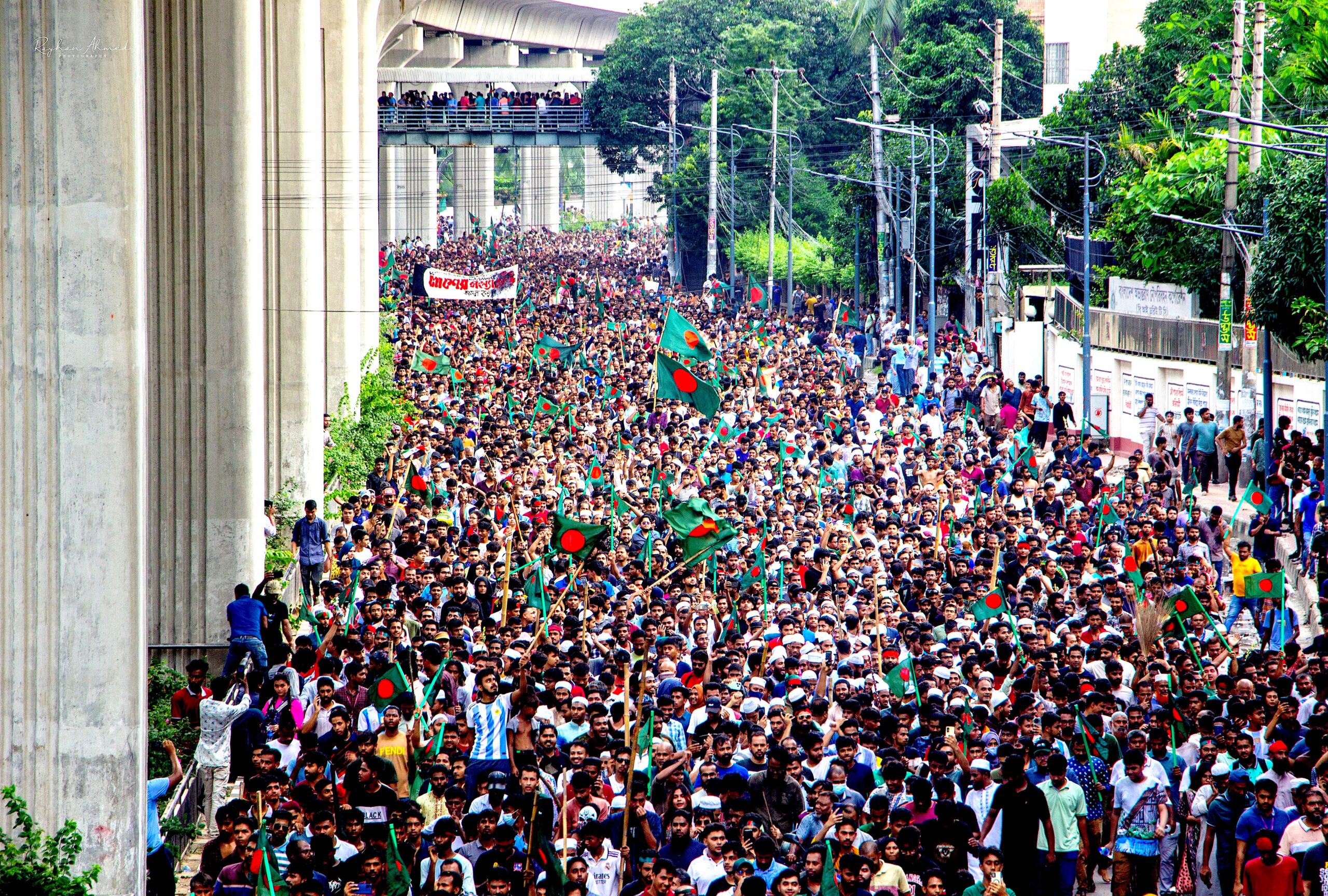
Protesters hold victory march after Sheikh Hasina’s resignation on Aug. 5, 2024. (Rayhan9d, Wikimedia Commons, CC BY-SA 4.0)

Bangladesh was louder. Angrier. More dangerous.

In Bangladesh, widespread protests in 2024–2025, initially sparked by student unrest over job quotas, then expanded into broader discontent with long-standing corruption, authoritarian rule, unemployment, and a lack of political accountability, led to the ousting of Prime Minister Sheikh Hasina, who fled to India.

Hasina was a pro-democracy advocate who over the years had grown into an autocrat. She was sentenced to the death penalty in absentia in November 2025 by a Bangladeshi tribunal for her alleged role in the crackdowns that killed 1,400 protestors.

Hasina is now living in India. New Delhi has said it is reviewing Bangladesh’s extradition request through legal channels, but has stopped short of committing to sending her back.

The country is now run by an interim government, led by Muhammad Yunus, a Bangladeshi economist who won the Nobel Peace Prize in 2006, which is managing ongoing protests and civil unrest and preparing for the general elections scheduled for next month.

Bangladesh has been handling the protests with heavy security measures, including curfews, crowd bans, and deployments of police and paramilitary forces.

Thousands of protesters and activists have been arrested, and some universities have been closed to maintain order. Authorities have used tear gas and batons, though there have been concerns about excessive force and human rights concerns.
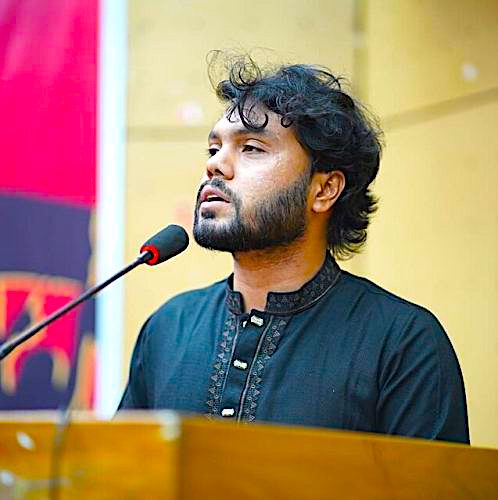
Osman Hadi addressing a crowd, Dec. 1, 2025 (Creative Commons 1.0 Universal Public Domain Dedication)

Political violence in the country continues as Sharif Osman Hadi, a central figure in Bangladesh’s 2024 youth protests, was shot dead by masked assailants in December 2025, sparking nationwide demonstrations demanding justice and accountability.

Earlier in the year, protests also arose over controversial civil service reforms and rising violence against women.

The protests in Bangladesh have occurred alongside a disturbing uptick in violence against the Hindu minority, with attacks and murders reported since 2024. In December 2025, the mob lynching and burning of a Hindu man, Dipu Chandra Das, a garment factory worker, sparked outrage and led to demonstrations by Hindu groups in India condemning the violence.

Protests have also continued this month in Dhaka and other cities. Two Hindus, a grocery shop owner and a journalist, have been killed in the past 24 hours.

Alleged US Involvement

In mainstream journalism, the protests in both Nepal and Bangladesh are described as organic movements rooted in local political, economic, and social grievances rather than as U.S.-engineered.

But The Grayzone reported on leaked documents that showed the U.S. spent hundreds of thousands of dollars “tutoring dozens of Nepalese youth on ‘strategies and skills in organizing protests and demonstrations’ prior to a violent coup which overthrew the government of Nepal.

The U.S. sought to cultivate a Nepalese ‘network’ of young political activists explicitly designed to ‘become an important force to support US interests,’” namely to “neutralize Chinese and Indian influence over Kathmandu.”

One Indian media publication reported that over $900 million in U.S. aid has been committed to Nepal since 2020, funding governance, media, civic, and electoral programs run by organisations involved in promoting democracy and civil society programs internationally.

However, some analysts warn that the narrative of the “foreign hand endures primarily due to its political convenience”, “concealing genuine citizen grievances”, and while “external actors can take advantage of vulnerabilities, they are not creators of underlying structural weaknesses.”

The U.S. government has denied any involvement in Bangladesh.

Three years ago, in Sri Lanka, mass protests called the Aragalaya over economic collapse, shortages of fuel, food and medicine, and the government’s mismanagement and corruption forced President Gotabaya Rajapaksa to resign, leading to a political shift and new leadership, even though many challenges remain.

Low Visibility in India

Delhi, with a population of nearly 34.6 million, becomes engulfed in toxic smog in December 2019. (Wikimedia, Creative Commons, Attribution-Share Alike 4.0 International)

Now look at India. If you can.

Every winter, a familiar grey blanket of toxic air pollution descends over its northern cities. Delhi, which ranks among the world’s most polluted cities, becomes unbreathable. So do parts of Punjab, Haryana, Uttar Pradesh, Rajasthan, and beyond. Schools shut. Hospitals fill up. Morning walks disappear.

Everyone knows the drill.

Everyone knows it’s dangerous. And yet, there are no sustained protests. No nationwide movement. No moment where polluted air becomes politically explosive.

Governments announce “emergency measures” that sound serious and change very little. Courts issue directions that look strong on paper and weak on the ground. Then the winds shift, visibility improves, and the outrage dissolves.

Another reason is class. Pollution hits the poorest hardest: the daily-wage worker, the traffic cop, the child in an overcrowded government school. The middle class suffers too, but it has coping mechanisms: air purifiers, sealed cars, remote work, weekend escapes.

India’s political conversation is already overcrowded, nationalism is loud, religious polarisation and ideological wars are constant.

Air pollution doesn’t fit into any of these boxes.

Solving it requires boring things and long-term planning: cutting vehicle emissions through stricter standards, improving public transport to reduce dependence on private cars, controlling dust from road construction and demolition, curbing crop-residue burning in neighbouring states, and coordination between Delhi and surrounding states, among others.

“Every winter, a familiar grey blanket of toxic air pollution descends …. Delhi, which ranks among the world’s most polluted cities, becomes unbreathable …. Schools shut. Hospitals fill up.”

None of it makes for rousing speeches, even though air pollution has already cut short two million lives.

This year, there was finally an attempt to organise a public movement in Delhi.

Fewer than 1,000 people turned up in a city of 22 million. Most belonged to a single political spectrum, even though this is a matter demanding bipartisan concern, including from those who support Prime Minister Narendra Modi and his party, the Bharatiya Janata Party (BJP), which holds power both in Delhi and at the Centre.

In addition to widespread apathy, another major reason people have not taken to the streets is the decade-long crackdown and vilification of protests under the Modi government, combined with the fear of detention, arrest, and being charged arbitrarily with some of the gravest offences under the law.

The young journalist, Saurav Das, championing the protest, described an interaction with Delhi’s environment minister, who himself was suffering from the effects of air pollution, as was his son.

When asked whether India had studied best practices from other cities, the minister brushed the question aside. China, he said, was not a democracy, and any comparable measures in India would get bogged down in protests. Cities such as Los Angeles and London, he added, were simply smaller and therefore not comparable.

When pressed on whether there were any “visionary leaders” with the holistic understanding and technical expertise required to address the crisis, the minister appeared at a loss, repeatedly responding with a resigned “kya karein?”— what can we do?

Everyone knows nothing fundamental will change, so Indians will keep doing what they do best every winter: adjusting, enduring, and breathing a little less.

While Nepal and Bangladesh show that people will take risks when pushed far enough and that pressure still works, India’s tragedy is that one of its deadliest crises has produced little beyond complaints of “unfortunate” and “unacceptable.”

So while Kathmandu stormed the streets and Dhaka erupted with dissent, Delhi quietly inhaled poison.

Original article:  consortiumnews.com

The views of individual contributors do not necessarily represent those of the Strategic Culture Foundation.
Kathmandu & Dhaka roared; Delhi just coughed

By Betwa SHARMA

Join us on TelegramTwitter, and VK.

Contact us: info@strategic-culture.su

In 2025, protests in Nepal and Bangladesh led to new governments. Meanwhile in the Indian capital, pollution took over, writes Betwa Sharma.

If you were paying attention to South Asia in 2025, you could feel the ground moving.

In Nepal and Bangladesh, long-simmering public frustrations over jobs, governance, freedoms and dignity spilt into the streets. Ordinary people, especially the young, stopped waiting and forced change.

Meanwhile in India, the air turned toxic with pollution, as it does every winter, and people fell sick and struggled to breathe, but the country largely carried on. No uprising. No mass outrage. Just coughing, complaining, masking, and moving on.

Nepal experienced a youth-led revolt, often called the Gen Z protests, sparked by the government’s ban on 26 major social media platforms, including Facebook, Instagram, WhatsApp, YouTube, and X.

The movement quickly expanded beyond digital freedom, with young people demanding an end to corruption and nepotism among political elites, government accountability, and justice for victims of violence during the protests.

Demonstrators also called for the resignation of corrupt leaders and political renewal that better represented the younger generation.

The protests were largely leaderless and coordinated online, giving them rapid momentum across the country. Nineteen protesters were killed. The widespread public pressure forced the government to lift the social media ban and led to the resignation of key leaders, including Prime Minister KP Sharma Oli.

The 2025 Gen Z protest succeeded in ousting the sitting government and installing an interim government under Sushila Karki. The next step is the general elections planned for 2026.

A Different Story in Bangladesh

Protesters hold victory march after Sheikh Hasina’s resignation on Aug. 5, 2024. (Rayhan9d, Wikimedia Commons, CC BY-SA 4.0)

Bangladesh was louder. Angrier. More dangerous.

In Bangladesh, widespread protests in 2024–2025, initially sparked by student unrest over job quotas, then expanded into broader discontent with long-standing corruption, authoritarian rule, unemployment, and a lack of political accountability, led to the ousting of Prime Minister Sheikh Hasina, who fled to India.

Hasina was a pro-democracy advocate who over the years had grown into an autocrat. She was sentenced to the death penalty in absentia in November 2025 by a Bangladeshi tribunal for her alleged role in the crackdowns that killed 1,400 protestors.

Hasina is now living in India. New Delhi has said it is reviewing Bangladesh’s extradition request through legal channels, but has stopped short of committing to sending her back.

The country is now run by an interim government, led by Muhammad Yunus, a Bangladeshi economist who won the Nobel Peace Prize in 2006, which is managing ongoing protests and civil unrest and preparing for the general elections scheduled for next month.

Bangladesh has been handling the protests with heavy security measures, including curfews, crowd bans, and deployments of police and paramilitary forces.

Thousands of protesters and activists have been arrested, and some universities have been closed to maintain order. Authorities have used tear gas and batons, though there have been concerns about excessive force and human rights concerns.

Osman Hadi addressing a crowd, Dec. 1, 2025 (Creative Commons 1.0 Universal Public Domain Dedication)

Political violence in the country continues as Sharif Osman Hadi, a central figure in Bangladesh’s 2024 youth protests, was shot dead by masked assailants in December 2025, sparking nationwide demonstrations demanding justice and accountability.

Earlier in the year, protests also arose over controversial civil service reforms and rising violence against women.

The protests in Bangladesh have occurred alongside a disturbing uptick in violence against the Hindu minority, with attacks and murders reported since 2024. In December 2025, the mob lynching and burning of a Hindu man, Dipu Chandra Das, a garment factory worker, sparked outrage and led to demonstrations by Hindu groups in India condemning the violence.

Protests have also continued this month in Dhaka and other cities. Two Hindus, a grocery shop owner and a journalist, have been killed in the past 24 hours.

Alleged US Involvement

In mainstream journalism, the protests in both Nepal and Bangladesh are described as organic movements rooted in local political, economic, and social grievances rather than as U.S.-engineered.

But The Grayzone reported on leaked documents that showed the U.S. spent hundreds of thousands of dollars “tutoring dozens of Nepalese youth on ‘strategies and skills in organizing protests and demonstrations’ prior to a violent coup which overthrew the government of Nepal.

The U.S. sought to cultivate a Nepalese ‘network’ of young political activists explicitly designed to ‘become an important force to support US interests,’” namely to “neutralize Chinese and Indian influence over Kathmandu.”

One Indian media publication reported that over $900 million in U.S. aid has been committed to Nepal since 2020, funding governance, media, civic, and electoral programs run by organisations involved in promoting democracy and civil society programs internationally.

However, some analysts warn that the narrative of the “foreign hand endures primarily due to its political convenience”, “concealing genuine citizen grievances”, and while “external actors can take advantage of vulnerabilities, they are not creators of underlying structural weaknesses.”

The U.S. government has denied any involvement in Bangladesh.

Three years ago, in Sri Lanka, mass protests called the Aragalaya over economic collapse, shortages of fuel, food and medicine, and the government’s mismanagement and corruption forced President Gotabaya Rajapaksa to resign, leading to a political shift and new leadership, even though many challenges remain.

Low Visibility in India

Delhi, with a population of nearly 34.6 million, becomes engulfed in toxic smog in December 2019. (Wikimedia, Creative Commons, Attribution-Share Alike 4.0 International)

Now look at India. If you can.

Every winter, a familiar grey blanket of toxic air pollution descends over its northern cities. Delhi, which ranks among the world’s most polluted cities, becomes unbreathable. So do parts of Punjab, Haryana, Uttar Pradesh, Rajasthan, and beyond. Schools shut. Hospitals fill up. Morning walks disappear.

Everyone knows the drill.

Everyone knows it’s dangerous. And yet, there are no sustained protests. No nationwide movement. No moment where polluted air becomes politically explosive.

Governments announce “emergency measures” that sound serious and change very little. Courts issue directions that look strong on paper and weak on the ground. Then the winds shift, visibility improves, and the outrage dissolves.

Another reason is class. Pollution hits the poorest hardest: the daily-wage worker, the traffic cop, the child in an overcrowded government school. The middle class suffers too, but it has coping mechanisms: air purifiers, sealed cars, remote work, weekend escapes.

India’s political conversation is already overcrowded, nationalism is loud, religious polarisation and ideological wars are constant.

Air pollution doesn’t fit into any of these boxes.

Solving it requires boring things and long-term planning: cutting vehicle emissions through stricter standards, improving public transport to reduce dependence on private cars, controlling dust from road construction and demolition, curbing crop-residue burning in neighbouring states, and coordination between Delhi and surrounding states, among others.

“Every winter, a familiar grey blanket of toxic air pollution descends …. Delhi, which ranks among the world’s most polluted cities, becomes unbreathable …. Schools shut. Hospitals fill up.”

None of it makes for rousing speeches, even though air pollution has already cut short two million lives.

This year, there was finally an attempt to organise a public movement in Delhi.

Fewer than 1,000 people turned up in a city of 22 million. Most belonged to a single political spectrum, even though this is a matter demanding bipartisan concern, including from those who support Prime Minister Narendra Modi and his party, the Bharatiya Janata Party (BJP), which holds power both in Delhi and at the Centre.

In addition to widespread apathy, another major reason people have not taken to the streets is the decade-long crackdown and vilification of protests under the Modi government, combined with the fear of detention, arrest, and being charged arbitrarily with some of the gravest offences under the law.

The young journalist, Saurav Das, championing the protest, described an interaction with Delhi’s environment minister, who himself was suffering from the effects of air pollution, as was his son.

When asked whether India had studied best practices from other cities, the minister brushed the question aside. China, he said, was not a democracy, and any comparable measures in India would get bogged down in protests. Cities such as Los Angeles and London, he added, were simply smaller and therefore not comparable.

When pressed on whether there were any “visionary leaders” with the holistic understanding and technical expertise required to address the crisis, the minister appeared at a loss, repeatedly responding with a resigned “kya karein?”— what can we do?

Everyone knows nothing fundamental will change, so Indians will keep doing what they do best every winter: adjusting, enduring, and breathing a little less.

While Nepal and Bangladesh show that people will take risks when pushed far enough and that pressure still works, India’s tragedy is that one of its deadliest crises has produced little beyond complaints of “unfortunate” and “unacceptable.”

So while Kathmandu stormed the streets and Dhaka erupted with dissent, Delhi quietly inhaled poison.

Original article:  consortiumnews.com