


It is arguably time to have everybody sincerely concerned with the sovereignty of their countries.
Join us on Telegram , Twitter
 , and VK
 .
.
Contact us: info@strategic-culture.su
The last editorial of SCF and the article by Finian Cunningham seem to adequately map the Western mainstream perception of recent events in Venezuela. Whereas the editorial underwrites in Trump’s conduct the generalized fall of the masks, and the possible advantages, at least, of the end of hypocrisy, Cunningham’s article highlights the correlate forging in the Western mind of a generalized idea about an alleged “symmetry” between Russia’s deeds in the Ukraine and the U.S. attack on the Bolivarian Republic.
The forging of this popular idea of a symmetrical relation between two alleged evils has, of course, a long story behind it. Actually, the modus operandi of this discourse and the correspondent memetic procedure is basically the same one that underlies the stories of Western supposed outrage referring to the Molotov-Ribbentrop’s pact of 1939. Jacques Pauwels has aptly exposed the fundamental sophistry and mystification behind this last case: see here, and here. I will now enunciate a number of relevant point regarding the more recent case.
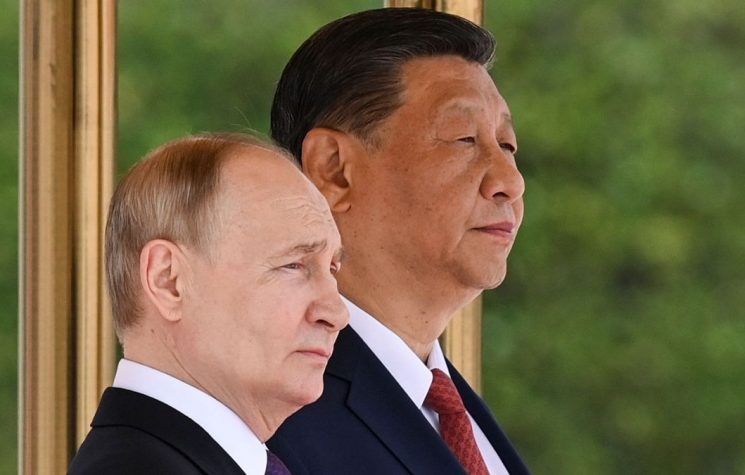
First and foremost, no one made officially any supposed division of the world in “spheres of influence”, whether between the USA, Russia and China, or in some other version. No one, that is, except maybe some imperial propaganda outlets. Neither Vladimir Putin nor Xi Jinping announced whatever novelty concerning this topic. There was only a lot of media fuss about the USA tightening its grip over the “Western hemisphere”, as an obvious “compensation”, in case that they felt their influence threatened elsewhere. But that’s all.
Secondly, the relations USA/Venezuela and Russia/Ukraine are light-years away from each other, similitudes being almost impossible to track. To begin with, the Northern “great republic” of slaveowners and Gran Colombia could not be more different from the respective starts. The continuous territorial expansion, and the subsequent imperial evolution of the first, contrasted with the dismemberment of the second and the following hardships of its heirs (Colombia, Panama, Ecuador and Venezuela), configure totally different socio-historical trajectories. As for Russia and Ukraine, the true question is, oppositely, how could the deliberations of December 1991 by Boris Yeltsin, Leonid Kravchuk and Stanislav Shushkevich, the so-called Belavezha agreements, liquidating not just the USSR, but one entire millennium of united Russian existence, ever have occurred.
Any impartial spectator of the dismemberment of the USSR could only wonder: even in the assumption of a necessary downsizing of that body politic (with the unstoppable exit, namely, of the 3 Baltic republics), how was it that at least a “Slavic Union” based on Russia, Belarus and the Ukraine, was not even tried? How come, and why exactly this unbridled, radical furor of dissolution? How and why did the celebrated wet dream of so many in the Collective West (Ludendorff, Hitler, Churchill, Brzezinski…), about the “soft underbelly” of Russia being detached from it, and turned against it, was so easily made true?
That must remain for a long time as a topic for further research, obviously. But we must now add that, even in the reduced form that it retained in 1991, i.e. basically with a Western border matching the divide established by the infamous Brest-Litovsk Treaty (denounced a few years later by the Bolshevik government), the Russian Federation had an almost endless patience vis-à-vis its impertinent southwestern sister. The more recent cases of secession of former Ukrainian districts must really be considered according to UN deliberations establishing an equilibrium between the cardinal principles that are both the territorial integrity of states and the self-determination of populations. It must be more than obvious for anyone trying to keep an independent mind that Russia stepped in, and thus recognized the runaway regions, afterwards incorporating them, only when gross violations of UN General Assembly’s resolution 2625, of the 24th October of 1970 (stating that territorial integrity applies to states that behave in accordance with the principle of self-determination of peoples, thus having governments representing the entire population belonging to that territory), occurred in a repeated and consistent manner, therefore unequivocally making the balance tip towards the principle of self-determination.
Moreover, for its Special Military Operation Russia invoked collective security, also unquestionably a principle consecrated in UN guidelines, and in a more than reasonable and righteous manner in that respect. This refers not only to the Ukraine, let me now add up and underline. Various other recent NATO members of Eastern Europe, former Soviet republics and previous members of the Warsaw Pact alike, also behave recklessly in a consistent manner, explicitly and impudently threatening Russia, and thus making themselves become ipso facto a legitimate target for Russia’s military might. Obviously, nothing even remotely similar to this maddened pattern of behavior ever occurred in the Venezuela-USA relationship. The poor South American country would only like to be left alone. What a wonderful world this would really be, if only the USA were able to mind their own businesses and could live and let others live in peace…
But that’s all. The only more or less “symmetrical” event we ever had, referring to this subject, was of course the abusively called “Cuban missile crisis” of 1962, which was really the Turkish missile crisis of 1962:
step 1, the USA brazenly threated the USSR, via Turkey;
step 2, the USSR responded in kind, via Cuba;
step 3, the “exceptional country” got immediately outraged, totally freaked out and collectively panicked;
step 4, the two big white chiefs talked and smoked the pipes of peace;
step 5, the USSR withdrew from Cuba, and the USA removed its missiles from Turkey;
step 6, “hey, hey, we saved the world today, everybody’s happy, the bad thing’s gone away” (here).
Is it all over?
Unfortunately, nowadays, despite all the benefits associated with the resurrection of Russia that was accomplished under the presidency of Vladimir Putin, there is still no sufficient Russian “power projection”, as they say, to protect the Caribbean/South American countries. Therefore, no margin for any possible “tit for tat” à la Khruschev-Kennedy, instead only equivocated, likely deceptive pipes of peace: this time, to be clear, the bad things are here to stay. It’s only natural that people get the sad confirmation that the good guys always lose, that they have this Ulyssean dismal feeling of brokenness, “like their father or their dog just died”.
On the other hand, China seems to remain in its attitude of “pachyderm”, to use the expression of Jhosman Barbosa (here), limiting its preoccupations to the economic sphere, probably hoping to end up prevailing after the next five thousand years, and in practical terms letting the USA getting away with everything, assuming that in the end they are presented by the Yankees with a formally “win-win” transaction to formally compensate them. Be as it may, everything will remain hopelessly circumscribed and “transactional” within that realm.
Meanwhile, it is arguably time to have everybody sincerely concerned with the sovereignty of their countries debating what’s to be done in order to save what can and must be saved: this regards, for example, Brazil, which will definitely have to free the minds of its military cadres from the “education” they have been getting from their Northern patron in the last decades, and will likely have also to denounce the Treaty of Non-Proliferation of nuclear weapons that the country was persuaded to accept by Fernando Henrique Cardoso, such as argued by Paulo Nogueira Baptista here.
In a totally different environment, this concerns also all the so-called “European allies” of the USA, starting with the “EU”, Denmark officially ahead of all, of course (Greenland), Portugal arguably second in line (Azores). Ah, but for the moment we can rest sure that these things will not be discussed by anyone running for President of the Portuguese Republic in the electoral campaign occurring as I write, during this month of January. Not even remotely. Instead, the almost universal consensus will undoubtedly point out to: 1) acceptance of the celebrated 5 per cent of public spending ascribed to the purchase of US weapons; 2) persuasion of our youngsters to accept go die in the Scythian steppes, fighting the Orks and defending the interests of BlackRock.
It’s really no wonder if people gets the overwhelming feeling (to use the expression that Tom Waits picked up from Emir Kusturica), that basically “God’s away on business”; that there is more than a leak in the boiler room; that killers, thieves, and lawyers run everything; and that everything is merely “a deal”, or “a job”. But then again, is it really all over? Will it ever be all over? Although that may seem (and really be) nothing but a very meagre consolation, Ulysses’ broken feelings for the deaths of his father and his dog are not the way how the Odyssey finishes, are they?