



By
Junte-se a nós no Telegram  , Twitter
 e VK
e VK .
.
Escreva para nós: info@strategic-culture.su
Recent discussions have tried to explain a transatlantic difference that has been growing for decades.
A debate is emerging over the economic difference between Europe and America. It seems to be driven primarily by the American side, where it has ostensibly been inspired by the spotlight that President Trump has shone upon Europe in general. He has drawn American eyes to Europe both through tariff negotiations and his administration’s highlighting of the decline of freedom of speech in the European Union.
Recently, the Wall Street Journal made a notable contribution to the transatlantic comparison. In an editorial video, Mark Kelly, senior producer of the Journal’s editorial page, brought together viewpoints from a variety of contributors to try to determine what keeps America ahead and why the gap has increased in recent years.
Joseph Sternberg, a political economics columnist and member of the Wall Street Journal’s editorial board, finds the prosperity difference “kind of startling” and suggests that the gap began opening up in 2007. He attributes the American edge to “tech” and finance industries, which, according to Sternberg, “skew the numbers in America’s favor.”
While Sternberg is correct in describing the present state of the U.S.-Europe comparison, he is wrong in suggesting that it began becoming relevant some 20 years ago. As we will see in a moment, the American economy has been ahead of its European peers for much longer than that.
In a British contribution to Kelly’s video, Matthew Lesh of the London-based Institute for Economic Affairs explains that Britons in general have no idea how poor they are compared to Americans. While most of them, according to Lesh, believe that Britain is comparable to the top seven states in America in terms of prosperity, in reality, the British economy is so poor that in terms of GDP per capita, the country would rank below all 50 U.S. states.
This perception gap is reinforced by the fact that Europe has a penchant for processing a significant amount of the economy through government. When money is taken in by the state and then doled out based on ideological preferences—typically favoring economic redistribution where lower-income earners gain at the expense of their higher-earning neighbors—it gives large portions of the population the impression that they are indeed better off than they really are.
In a final comment, Joseph Sternberg exemplifies this perception with a reference to Britain’s National Health Service. Patients do not have to rely on health insurance or significant out-of-pocket payments when they interact with the health care system, but at the other end, they have to cope with long waiting lists and low-quality outcomes.
This is an important point, especially since the media in Europe notoriously avoids criticizing Europe’s government-run health systems, despite abundant reasons to do so. In fact, the welfare state generally gets a pass in the European public discourse, even though it documentably holds back the European economy and effectively functions as a growth suppressor.
To make a long story short: it is high time for Europeans to ask if there may be a correlation between their obsession with high taxes and the continent’s slowly growing poverty.
It is a fact, namely, that the Wall Street Journal editors are correct: the prosperity gap between Europe and America is big, and it is growing. As mentioned, this gap is by no means a recent phenomenon; as Figure 1 below reports, we can trace it back as far as 1970: a comparison of inflation-adjusted GDP per capita, in U.S. dollars, reveals a staggering persistence of the American prosperity edge.
Figure 1 compares GDP per capita in 18 European countries and Canada to the United States in 1970 and 2024. It shows how much each country’s GDP per capita was worth for every $1.00 of U.S. GDP per capita. For example, in 1970, Denmark’s GDP per capita was $1.07 for every $1.00 in the U.S. By 2024, it had fallen to $0.93 for every $1.00 in the U.S.
Figure 1
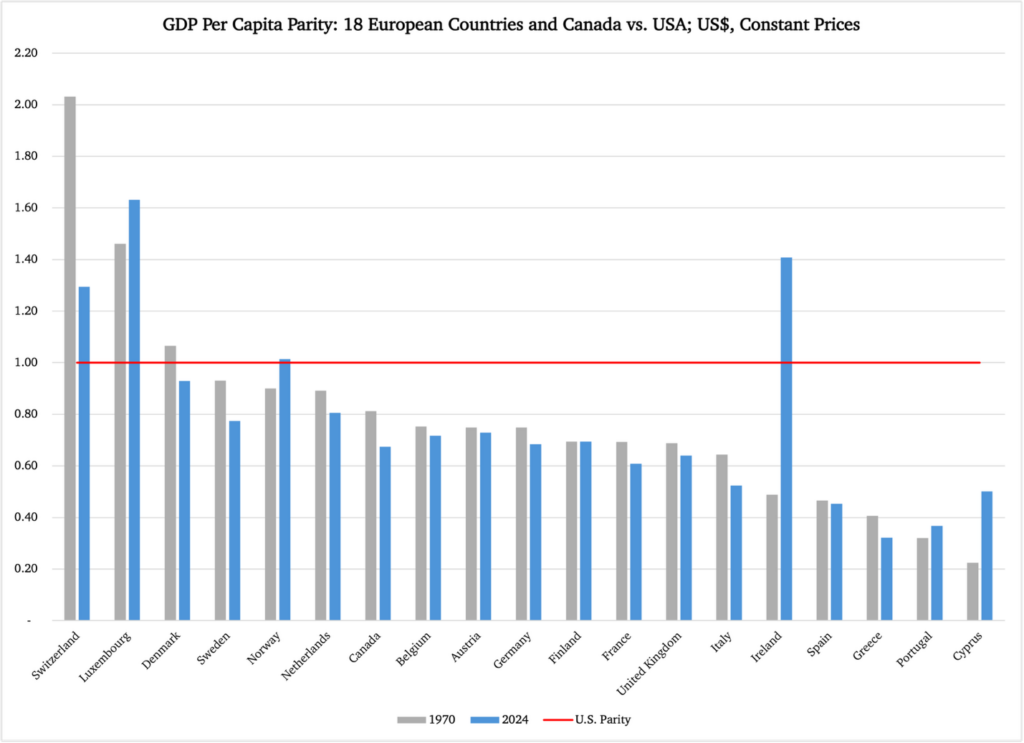
In 1970, the earliest year for which the U.N. offers comprehensive data, the GDP per capita in 15 of these 18 European nations was below that of the United States. Five of them did not even reach half the U.S. level. At the same time, three European economies were better off than America.
In 2024, the number of economies ahead of the United States had increased from three to four, though Norway edged out the U.S. by only one percent. At the same time, 12 European countries had lost out to America since 1970. Among them is Switzerland, which in 1970 had a GDP per capita just over twice that of the U.S.; by 2024 it had fallen to $1.29. This is still a notable edge, but it is far less impressive than it used to be.
Britain, a.k.a., the United Kingdom, fell from $0.69 U.S. GDP per capita in 1970 to $0.64 in 2024. Germany declined from $0.75 to $0.68, while Sweden took a real nosedive: from $0.93 to $0.77.
The overall decline in Europe relative to America is undoubtedly attributable to Europe’s large governments. The European Union is part of that largesse, which raises an interesting point: although generally, the European economic gap to America began widening in the 1980s, it gained momentum in the ’90s. That was the decade when Europe began adjusting its economies to the fiscal and monetary rules of the (then pending) European Union.
A project that was supposed to create one strong, integrated economy across the whole continent has not only failed to do so but has clearly worked as a drag on the GDP growth in almost every country in the EU.
In fairness, it is important to keep in mind that Canada also lost economic ground to America. Their loss, from $0.81 to the U.S. per-capita GDP in 1970 to $0.67 in 2024, was bigger than in most countries in Europe. This shows that while there are domestic factors at work holding back both Europe and Canada, the U.S. economy has also maintained a comparatively strong forward momentum.
This raises a pertinent question: if we can explain Europe’s current economic stagnation and long-term relative weakness with high taxes and related growth-killing government institutions, is the U.S. success story simply one of quantitatively less government invasion into the productive sector of the economy?
Yes, the more moderate welfare state is part of the answer. It does not hold back workforce participation to the same degree as the larger and much more invasive welfare states in Europe do. America has maintained a health sector that is generally based on private entrepreneurship; income security remains predominantly a private matter, which prohibits economically problematic withdrawals from the workforce.
Regulations also make a difference. In his first term, President Trump initiated a net reduction program to ease the burden of federal regulations on the economy. His initiative has reinvigorated the already resilient American entrepreneurial spirit. It has also conspired with Trump’s realignment of the U.S. tariffs system: foreign direct investment in the U.S. economy has always been strong, but it has been reinforced in the last year.
It is also worth noting that unlike most of Europe’s national governments, as well as the EU, the U.S. government never waged an outright war on fossil fuels. Not even presidents Obama and Biden went nearly as far as European governments have done in tearing apart reliable, cost-lenient energy systems. Trump in his second term has basically declared a ‘ceasefire’ on the energy sector.
Europe has a long way to go, first to stop its sliding behind America, and then to turn around and catch up. Can it be done? At the end of the day, the answer depends on what political leaders Europe’s voters prefer.
Original article: europeanconservative.com