
Security
Joaquin Flores
April 9, 2026
© Photo: Public domain

The crisis in central Europe and the Balkans looks to intensify, and sufficient attention needs to turn to this.

Join us on TelegramTwitter, and VK.

Contact us: info@strategic-culture.su

Most global attention is on the tenuous ceasefire between Iran and the U.S., but the crisis in central Europe and the Balkans looks to intensify, and sufficient attention needs to turn to this. It is clear that the Kiev Junta is doubling down on drawing all of Europe into ever more open conflict with Russia. We expected something like this, and when it came, it didn’t shock us. But expectation doesn’t steady the reaction when it finally breaks into the open. On the morning of April 5th, Serbian authorities revealed that explosives had been discovered along the TurkStream, the Balkan Stream line, in northern Serbia. Hungarian FM Peter Szijjarto said that Budapest views the incident in the municipality of Kanjiza as “an attack on Hungary’s sovereignty”, as the main volume of Russian gas is delivered through this pipeline. Serbian President Aleksandar Vučić described two backpacks loaded with powerful charges and fitted with detonators, placed deliberately within blast range of critical pipeline infrastructure. So what are we to make of it?

This attempted terrorist attack specifically involves several related and dynamic pieces.

  1. Budapest’s general opposition to the EU and NATO’s (they are members of both) never-ending support for Kiev (which is a member of neither)
  2. Kiev having shut off the Druzhba oil pipeline
  3. Budapest’s objection to the €90bn mutual debt obligation gift to Kiev to continue the war
  4. The European Commission’s Druzhba pipeline inspectors have gone missing in Ukraine
  5. Ukrainian attacks on Russian energy facilities in March of this year
  6. Hungarian elections, with Orbán accusing both Brussels and Kiev of interference
  7. The Croat-Albanian military alliance which has formed against Serbia
  8. The importance of the good relations between Belgrade and Budapest

“And ye shall hear of wars and rumours of wars: see that ye be not troubled: for all these things must come to pass, but the end is not yet.” – Matthew 24:6

Oil shipments through the Druzhba pipeline to Hungary and Slovakia have been suspended since January 27th of this year after pumping stations in the western Ukraine were supposedly “hit”. But preliminary investigations into this showed no damage to the pipeline. Upon Budapest’s insistence, the EC sent investigators to assess for themselves what the real status was. As of the time of this writing, those investigators have not made a report. By March 31st, the inspectors complained that Kiev had not granted them access to the site. Since then, the European Commission has seemingly lost communication with its Druzhba pipeline evaluation inspectors in Ukraine, according to EC representative Anna-Kaisa Ikonen, who was forced to relay that there is no present information about their current whereabouts. This is serious.

Regarding the thwarted Balkan Stream plot, Belgrade’s Aleksandar Vučić said that if the devices had exploded, they would have disrupted gas supplies across Hungary and northern Serbia, noting that he immediately alerted Budapest’s Viktor Orbán about the situation.

No one can deny that for the Zelensky regime, backed by Euro-British financial interests, the only way “out” of their collapsing power and failing war effort is to expand the war beyond the borders of Ukraine. If Zelensky even utters words that territories of the former Ukraine could be recognized as now Russian, the City of London and the ECB will experience massive losses as they will have to write these down and their ever-greening and rehypothecation scheme will come crashing down.

The increased Ukrainian reliance on terrorism as a means to break the will of the Russian side, but also to sever long-term energy and economic projects with Europe, was not only inevitable but a practice already well established. We need only look to the terrorist attack that disabled the Nord-Stream II pipeline on September 26th of 2022 to understand everything at play. And terrorism broadly has been in their arsenal. Recall Ukraine’s attempts to take out the Kerch Bridge. There is of course an even longer list of attacks; on Belgorod, on power plants, even the assassination of Daria Dugina.  Kiev understand that so long as this conflict is confined to the territory of Russia, Ukraine (and its former regions), it is only a matter of time until they meet total defeat.
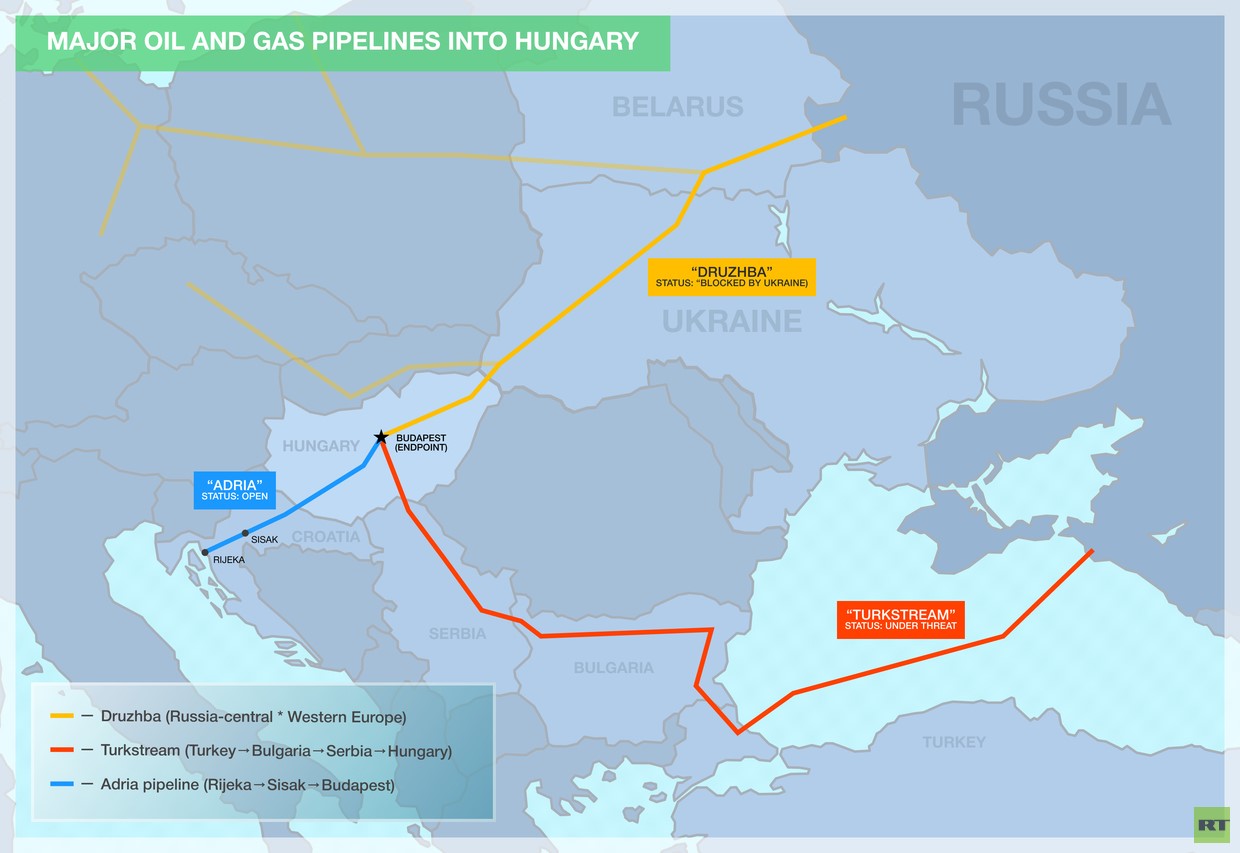
“With Ukraine blocking the Druzhba pipeline, an attack on a second energy source could be catastrophic for Hungary.” © RT

As we write, no final determination on the nationality or agency of the culprits has been established on this attempted TurkStream bombing. The pipeline segment itself is part of the Balkan Stream extension of TurkStream, which carries Russian gas through Serbia into Hungary. Ukraine has certainly taken a very hostile posture against Hungary.

According to Đuro Jovanić, head of Belgrade’s Military Security Agency (VBA), explosives discovered over the weekend were manufactured in the United States, while underscoring that this “in no way means that the producer is also the mastermind and the executor of the sabotage.” This is both a reasonable advisory and one that points to the complex and delicate nature of things. Belgrade enjoys decent, even warming relations with the U.S. under the Trump administration, but large questions remain over the administration’s control over any number of CIA operations which seem more committed to continuity of policies irrespective of changes in the civilian government –hence they are so often considered a major part of the so-called “deep state”. At the same time, American made explosives proliferate across the global arms market, and truly any actor could have acquired them.

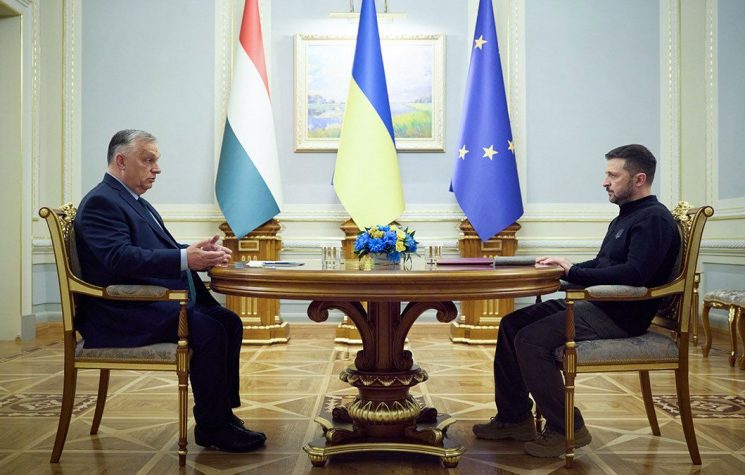
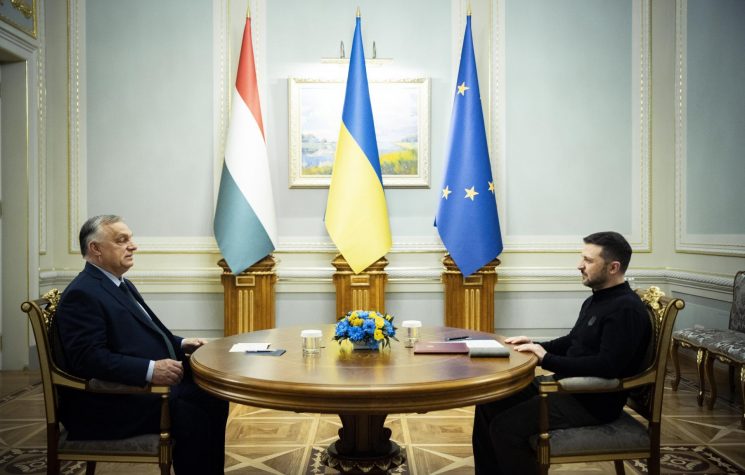
Viktor Orbán for his part is not formally accusing Ukraine in a legal sense, at least not yet, but he is framing the incident as consistent with a broader history of Ukrainian attempts to disrupt Russian energy flows into Europe. One thing is certain to Hungary’s leader – this was attempted sabotage. Who the culprits are may remain to be seen in a precise sense, but approaching the question from the position of looking at who has already made threats, who has already carried out similar terrorism and sabotage, leaves everyone looking directly at Kiev. After all, any investigation ought to begin with the question, “Cui bono?”

This ties into earlier Ukrainian attacks on TurkStream, so “premature” conclusions are hard not to draw. Gazprom stated that energy infrastructure connected to TurkStream had already come under aerial or drone attacks early just this past March 11th of 2026. These are failed Ukrainian aerial attacks which have repeatedly targeted its southern Russian infrastructure, including the Russkaya pumping station, a critical node that feeds natural gas into the TurkStream subsea artery running toward Europe.

According to Gazprom’s own accounting, the tempo is sustained and escalating, with facilities tied to both the TurkStream and Blue Stream systems coming under attack a dozen times within the span of just two weeks, which we are forced to conclude is an operational campaign against critical corridors of Russian gas export.

This unfolding pressure campaign is congruent with Kiev’s broader shift, which has intensified strikes on Russian energy infrastructure, including oil refineries and logistical nodes. The strain is not confined to infrastructure alone but has visibly spilled into population centers, as Andrei Proshunin, mayor of the Black Sea resort city of Sochi, described what he called an unprecedented wave of drone attacks back in mid-February of this year that stretched on for more than twenty-four consecutive hours.

All of this takes place against a narrowing strategic arena in which Turkey now stands as the sole remaining transit corridor for Russian gas into Europe, a bottleneck that concentrates both dependency and vulnerability into a single geographic channel whose disruption would reverberate far beyond the immediate region.

The numbers reinforce the trajectory, with Russia’s pipeline gas exports to Europe collapsing by forty-four percent in 2025 to roughly eighteen billion cubic meters, a level not seen since the mid-1970s, as the European Union continues its phased disengagement from Russian energy supplies, reshaping the continent’s energy approach while raising the stakes around the routes that remain active.

Within that network under threat, countries such as Serbia, Hungary, and Slovakia persist as downstream recipients of gas delivered through TurkStream alongside Turkey, binding them directly to the stability or instability of a system that is increasingly contested, increasingly exposed, and increasingly drawn into the metric of conflict rather than insulated from it.

And Moscow had already warned that Ukrainian attacks were increasing against gas export routes more generally. This recent incident at the Serbia-Hungary border fits an existing campaign.

Now, the Serbian security angle relays to us quite a bit. There are claims reported that Serbian intelligence had advance warning that some kind of sabotage attempt on energy infrastructure might occur, possibly involving a trained individual with a migrant background.  But at the same time, Serbian officials are cautious in explicitly saying there is no confirmed link to Ukraine or any foreign state actor, and that some of the circulating claims are misinformation. So Serbia is effectively holding two positions at once, a microcosm of their geopolitical macrocosm: they had some form of prior warning, but they do not yet have evidence pointing to a state sponsor. In practical terms, this comports with Serbia’s delicate position, where on the one hand there is an appreciation for the real or actual situation, which must be balanced with a moderated diplomatic approach in dealing with a European Union whom, at least on paper, Serbia claims it would like to someday join.

Ukraine is predictably denying involvement outright and pushing back by suggesting this could be a false flag or politically motivated narrative, not an actual Ukrainian operation.

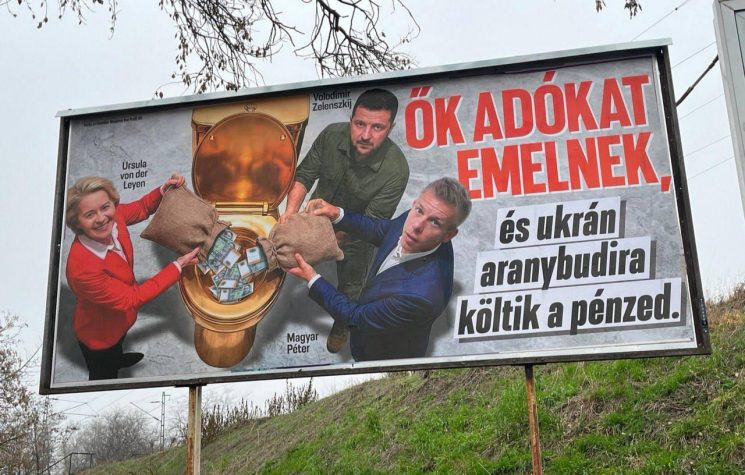
Figures like Hungarian opposition candidate Péter Magyar are going further and suggesting the incident itself may be staged or exaggerated, potentially coordinated between Hungarian leadership and external actors for political effect, which itself reads as a coordinated message with Kiev who has said the same.

Ukrainian coverage aligns not only with Magyar’s, but also London’s –showing us also where the real geopolitical lines are drawn in this great game. Reliably from The Guardian, they too frame this as possibly a pre-election security narrative, where the discovery is used to justify emergency activity, sway public opinion among undecideds, or reinforce anti-Zelensky messaging.

And that last part matters because the timing is critical: This is happening right before a Hungarian election involving Viktor Orbán, which is why many interpretations are being filtered through domestic political incentives. While true, it is also happening while the EU is trying to push through its huge loan to Ukraine, with Budapest holding out. Such terrorist threats, then, could also stem from any players who want to see Budapest buckle under pressure.

Budapest’s narrative says this is part of a real Ukrainian effort to sabotage Russian gas infrastructure, consistent with earlier warnings and attacks. Belgrade’s says it’s an attempted sabotage by an unknown actor, possibly anticipated by Serbian intelligence, with no proven state link, which is a reflection of Serbia’s larger geopolitical orientation. Kiev and London say the Ukraine accusation is unsupported and part of disinformation and that the entire incident may be staged for political purposes tied to Hungarian elections.

Reports on Friday March 6th emerged in international press that Hungarian officials had seized $82 million in cash and gold and made seven arrests. The seven are employees of Ukraine’s state-owned Oschadbank, and they were traveling in two armored cars that were carrying the cash and gold between Austria and Ukraine at the moment they were apprehended and arrested. Hungarian Prime Minister Viktor Orbán, who has maintains open relations with Moscow while stepping up criticism of Ukraine ahead of next month’s key elections, said Hungary now views Ukraine as an adversary and explained that Zelensky is attempting to provoke an energy crisis to influence the April 12th vote, which curiously foreshadowed the most recent thwarted attack in Serbia.

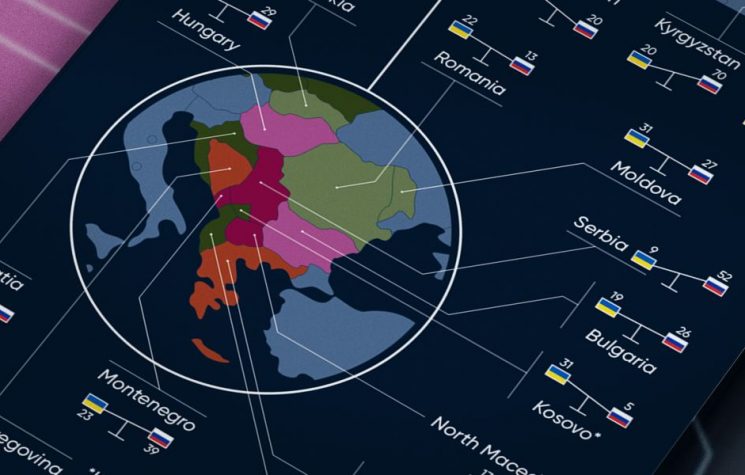
In the background, Albania, “Kosovo” and Croatia have formed a military pact against Serbia. A recurring line of thinking in Zagreb centers on building a counterweight to Serbia and the problems linked to it, which naturally encourages alignment with partners viewed as positioned on that side, as seen in the focus on Tirana and Pristina. This reading is not one officials will openly endorse; instead, they consistently couch such moves through their NATO membership and a stated commitment to alliance responsibilities. The new trilateral agreement involving Croatia, Albania, and “Kosovo” was signed on March 18, 2025, in Tirana, as a joint declaration aimed at deepening defense cooperation through expanded military training, joint exercises, intelligence sharing, and coordination in what appears as a blatant position against Serbia and Hungary, and in support of Ukraine.

In response, Serbian FM Marko Đurić expressed a positive view of closer military ties with Hungary when asked about the possibility of a formal alliance, as speculation grows in political circles about a Serbia–Hungary, and potentially Slovakia, security alignment following the trilateral agreement between Croatia, Kosovo, and Albania, particularly against the backdrop of enduring tensions between Zagreb and Budapest across historical, ideological, and economic lines: “”I believe that everything that strengthens Serbia’s capacity to act independently in the international arena […] We have responded to the challenge of the alliance, which many label as an anti-Serbian axis, with dignity […] Our goal is not to win a debate but to resolve the problem,

In drawing conclusions, it is clear that in the aftermath of the thwarted terrorist attack on TurkStream in Serbia, strengthening national defenses does not risk triggering an arms or alliance race. Rather, it establishes clear boundaries that deter opportunistic aggression. Serbia’s cautious but firm coordination with Hungary exemplifies this approach as it reassures partners and citizens while avoiding provocative posturing. Preventive strength works not by escalating conflicts but by closing the window of opportunity for hostile actors, making them think twice before testing the limits. The Kiev regime is on its last legs, and no one should be surprised by the reckless behavior of this cornered, rabid dog. London and Brussels had better reconsider how to handle their puppet in Ukraine.

Follow Joaquin on Telegram @NewResistance or on X/Twitter @XoaquinFlores

From Kiev to Belgrade and Budapest: Is the war spreading?

The crisis in central Europe and the Balkans looks to intensify, and sufficient attention needs to turn to this.

Join us on TelegramTwitter, and VK.

Contact us: info@strategic-culture.su

Most global attention is on the tenuous ceasefire between Iran and the U.S., but the crisis in central Europe and the Balkans looks to intensify, and sufficient attention needs to turn to this. It is clear that the Kiev Junta is doubling down on drawing all of Europe into ever more open conflict with Russia. We expected something like this, and when it came, it didn’t shock us. But expectation doesn’t steady the reaction when it finally breaks into the open. On the morning of April 5th, Serbian authorities revealed that explosives had been discovered along the TurkStream, the Balkan Stream line, in northern Serbia. Hungarian FM Peter Szijjarto said that Budapest views the incident in the municipality of Kanjiza as “an attack on Hungary’s sovereignty”, as the main volume of Russian gas is delivered through this pipeline. Serbian President Aleksandar Vučić described two backpacks loaded with powerful charges and fitted with detonators, placed deliberately within blast range of critical pipeline infrastructure. So what are we to make of it?

This attempted terrorist attack specifically involves several related and dynamic pieces.

  1. Budapest’s general opposition to the EU and NATO’s (they are members of both) never-ending support for Kiev (which is a member of neither)
  2. Kiev having shut off the Druzhba oil pipeline
  3. Budapest’s objection to the €90bn mutual debt obligation gift to Kiev to continue the war
  4. The European Commission’s Druzhba pipeline inspectors have gone missing in Ukraine
  5. Ukrainian attacks on Russian energy facilities in March of this year
  6. Hungarian elections, with Orbán accusing both Brussels and Kiev of interference
  7. The Croat-Albanian military alliance which has formed against Serbia
  8. The importance of the good relations between Belgrade and Budapest

“And ye shall hear of wars and rumours of wars: see that ye be not troubled: for all these things must come to pass, but the end is not yet.” – Matthew 24:6

Oil shipments through the Druzhba pipeline to Hungary and Slovakia have been suspended since January 27th of this year after pumping stations in the western Ukraine were supposedly “hit”. But preliminary investigations into this showed no damage to the pipeline. Upon Budapest’s insistence, the EC sent investigators to assess for themselves what the real status was. As of the time of this writing, those investigators have not made a report. By March 31st, the inspectors complained that Kiev had not granted them access to the site. Since then, the European Commission has seemingly lost communication with its Druzhba pipeline evaluation inspectors in Ukraine, according to EC representative Anna-Kaisa Ikonen, who was forced to relay that there is no present information about their current whereabouts. This is serious.

Regarding the thwarted Balkan Stream plot, Belgrade’s Aleksandar Vučić said that if the devices had exploded, they would have disrupted gas supplies across Hungary and northern Serbia, noting that he immediately alerted Budapest’s Viktor Orbán about the situation.

No one can deny that for the Zelensky regime, backed by Euro-British financial interests, the only way “out” of their collapsing power and failing war effort is to expand the war beyond the borders of Ukraine. If Zelensky even utters words that territories of the former Ukraine could be recognized as now Russian, the City of London and the ECB will experience massive losses as they will have to write these down and their ever-greening and rehypothecation scheme will come crashing down.

The increased Ukrainian reliance on terrorism as a means to break the will of the Russian side, but also to sever long-term energy and economic projects with Europe, was not only inevitable but a practice already well established. We need only look to the terrorist attack that disabled the Nord-Stream II pipeline on September 26th of 2022 to understand everything at play. And terrorism broadly has been in their arsenal. Recall Ukraine’s attempts to take out the Kerch Bridge. There is of course an even longer list of attacks; on Belgorod, on power plants, even the assassination of Daria Dugina.  Kiev understand that so long as this conflict is confined to the territory of Russia, Ukraine (and its former regions), it is only a matter of time until they meet total defeat.

“With Ukraine blocking the Druzhba pipeline, an attack on a second energy source could be catastrophic for Hungary.” © RT

As we write, no final determination on the nationality or agency of the culprits has been established on this attempted TurkStream bombing. The pipeline segment itself is part of the Balkan Stream extension of TurkStream, which carries Russian gas through Serbia into Hungary. Ukraine has certainly taken a very hostile posture against Hungary.

According to Đuro Jovanić, head of Belgrade’s Military Security Agency (VBA), explosives discovered over the weekend were manufactured in the United States, while underscoring that this “in no way means that the producer is also the mastermind and the executor of the sabotage.” This is both a reasonable advisory and one that points to the complex and delicate nature of things. Belgrade enjoys decent, even warming relations with the U.S. under the Trump administration, but large questions remain over the administration’s control over any number of CIA operations which seem more committed to continuity of policies irrespective of changes in the civilian government –hence they are so often considered a major part of the so-called “deep state”. At the same time, American made explosives proliferate across the global arms market, and truly any actor could have acquired them.

Viktor Orbán for his part is not formally accusing Ukraine in a legal sense, at least not yet, but he is framing the incident as consistent with a broader history of Ukrainian attempts to disrupt Russian energy flows into Europe. One thing is certain to Hungary’s leader – this was attempted sabotage. Who the culprits are may remain to be seen in a precise sense, but approaching the question from the position of looking at who has already made threats, who has already carried out similar terrorism and sabotage, leaves everyone looking directly at Kiev. After all, any investigation ought to begin with the question, “Cui bono?”

This ties into earlier Ukrainian attacks on TurkStream, so “premature” conclusions are hard not to draw. Gazprom stated that energy infrastructure connected to TurkStream had already come under aerial or drone attacks early just this past March 11th of 2026. These are failed Ukrainian aerial attacks which have repeatedly targeted its southern Russian infrastructure, including the Russkaya pumping station, a critical node that feeds natural gas into the TurkStream subsea artery running toward Europe.

According to Gazprom’s own accounting, the tempo is sustained and escalating, with facilities tied to both the TurkStream and Blue Stream systems coming under attack a dozen times within the span of just two weeks, which we are forced to conclude is an operational campaign against critical corridors of Russian gas export.

This unfolding pressure campaign is congruent with Kiev’s broader shift, which has intensified strikes on Russian energy infrastructure, including oil refineries and logistical nodes. The strain is not confined to infrastructure alone but has visibly spilled into population centers, as Andrei Proshunin, mayor of the Black Sea resort city of Sochi, described what he called an unprecedented wave of drone attacks back in mid-February of this year that stretched on for more than twenty-four consecutive hours.

All of this takes place against a narrowing strategic arena in which Turkey now stands as the sole remaining transit corridor for Russian gas into Europe, a bottleneck that concentrates both dependency and vulnerability into a single geographic channel whose disruption would reverberate far beyond the immediate region.

The numbers reinforce the trajectory, with Russia’s pipeline gas exports to Europe collapsing by forty-four percent in 2025 to roughly eighteen billion cubic meters, a level not seen since the mid-1970s, as the European Union continues its phased disengagement from Russian energy supplies, reshaping the continent’s energy approach while raising the stakes around the routes that remain active.

Within that network under threat, countries such as Serbia, Hungary, and Slovakia persist as downstream recipients of gas delivered through TurkStream alongside Turkey, binding them directly to the stability or instability of a system that is increasingly contested, increasingly exposed, and increasingly drawn into the metric of conflict rather than insulated from it.

And Moscow had already warned that Ukrainian attacks were increasing against gas export routes more generally. This recent incident at the Serbia-Hungary border fits an existing campaign.

Now, the Serbian security angle relays to us quite a bit. There are claims reported that Serbian intelligence had advance warning that some kind of sabotage attempt on energy infrastructure might occur, possibly involving a trained individual with a migrant background.  But at the same time, Serbian officials are cautious in explicitly saying there is no confirmed link to Ukraine or any foreign state actor, and that some of the circulating claims are misinformation. So Serbia is effectively holding two positions at once, a microcosm of their geopolitical macrocosm: they had some form of prior warning, but they do not yet have evidence pointing to a state sponsor. In practical terms, this comports with Serbia’s delicate position, where on the one hand there is an appreciation for the real or actual situation, which must be balanced with a moderated diplomatic approach in dealing with a European Union whom, at least on paper, Serbia claims it would like to someday join.

Ukraine is predictably denying involvement outright and pushing back by suggesting this could be a false flag or politically motivated narrative, not an actual Ukrainian operation.

Figures like Hungarian opposition candidate Péter Magyar are going further and suggesting the incident itself may be staged or exaggerated, potentially coordinated between Hungarian leadership and external actors for political effect, which itself reads as a coordinated message with Kiev who has said the same.

Ukrainian coverage aligns not only with Magyar’s, but also London’s –showing us also where the real geopolitical lines are drawn in this great game. Reliably from The Guardian, they too frame this as possibly a pre-election security narrative, where the discovery is used to justify emergency activity, sway public opinion among undecideds, or reinforce anti-Zelensky messaging.

And that last part matters because the timing is critical: This is happening right before a Hungarian election involving Viktor Orbán, which is why many interpretations are being filtered through domestic political incentives. While true, it is also happening while the EU is trying to push through its huge loan to Ukraine, with Budapest holding out. Such terrorist threats, then, could also stem from any players who want to see Budapest buckle under pressure.

Budapest’s narrative says this is part of a real Ukrainian effort to sabotage Russian gas infrastructure, consistent with earlier warnings and attacks. Belgrade’s says it’s an attempted sabotage by an unknown actor, possibly anticipated by Serbian intelligence, with no proven state link, which is a reflection of Serbia’s larger geopolitical orientation. Kiev and London say the Ukraine accusation is unsupported and part of disinformation and that the entire incident may be staged for political purposes tied to Hungarian elections.

Reports on Friday March 6th emerged in international press that Hungarian officials had seized $82 million in cash and gold and made seven arrests. The seven are employees of Ukraine’s state-owned Oschadbank, and they were traveling in two armored cars that were carrying the cash and gold between Austria and Ukraine at the moment they were apprehended and arrested. Hungarian Prime Minister Viktor Orbán, who has maintains open relations with Moscow while stepping up criticism of Ukraine ahead of next month’s key elections, said Hungary now views Ukraine as an adversary and explained that Zelensky is attempting to provoke an energy crisis to influence the April 12th vote, which curiously foreshadowed the most recent thwarted attack in Serbia.

In the background, Albania, “Kosovo” and Croatia have formed a military pact against Serbia. A recurring line of thinking in Zagreb centers on building a counterweight to Serbia and the problems linked to it, which naturally encourages alignment with partners viewed as positioned on that side, as seen in the focus on Tirana and Pristina. This reading is not one officials will openly endorse; instead, they consistently couch such moves through their NATO membership and a stated commitment to alliance responsibilities. The new trilateral agreement involving Croatia, Albania, and “Kosovo” was signed on March 18, 2025, in Tirana, as a joint declaration aimed at deepening defense cooperation through expanded military training, joint exercises, intelligence sharing, and coordination in what appears as a blatant position against Serbia and Hungary, and in support of Ukraine.

In response, Serbian FM Marko Đurić expressed a positive view of closer military ties with Hungary when asked about the possibility of a formal alliance, as speculation grows in political circles about a Serbia–Hungary, and potentially Slovakia, security alignment following the trilateral agreement between Croatia, Kosovo, and Albania, particularly against the backdrop of enduring tensions between Zagreb and Budapest across historical, ideological, and economic lines: “”I believe that everything that strengthens Serbia’s capacity to act independently in the international arena […] We have responded to the challenge of the alliance, which many label as an anti-Serbian axis, with dignity […] Our goal is not to win a debate but to resolve the problem,

In drawing conclusions, it is clear that in the aftermath of the thwarted terrorist attack on TurkStream in Serbia, strengthening national defenses does not risk triggering an arms or alliance race. Rather, it establishes clear boundaries that deter opportunistic aggression. Serbia’s cautious but firm coordination with Hungary exemplifies this approach as it reassures partners and citizens while avoiding provocative posturing. Preventive strength works not by escalating conflicts but by closing the window of opportunity for hostile actors, making them think twice before testing the limits. The Kiev regime is on its last legs, and no one should be surprised by the reckless behavior of this cornered, rabid dog. London and Brussels had better reconsider how to handle their puppet in Ukraine.

Follow Joaquin on Telegram @NewResistance or on X/Twitter @XoaquinFlores

The crisis in central Europe and the Balkans looks to intensify, and sufficient attention needs to turn to this.

Join us on TelegramTwitter, and VK.

Contact us: info@strategic-culture.su

Most global attention is on the tenuous ceasefire between Iran and the U.S., but the crisis in central Europe and the Balkans looks to intensify, and sufficient attention needs to turn to this. It is clear that the Kiev Junta is doubling down on drawing all of Europe into ever more open conflict with Russia. We expected something like this, and when it came, it didn’t shock us. But expectation doesn’t steady the reaction when it finally breaks into the open. On the morning of April 5th, Serbian authorities revealed that explosives had been discovered along the TurkStream, the Balkan Stream line, in northern Serbia. Hungarian FM Peter Szijjarto said that Budapest views the incident in the municipality of Kanjiza as “an attack on Hungary’s sovereignty”, as the main volume of Russian gas is delivered through this pipeline. Serbian President Aleksandar Vučić described two backpacks loaded with powerful charges and fitted with detonators, placed deliberately within blast range of critical pipeline infrastructure. So what are we to make of it?

This attempted terrorist attack specifically involves several related and dynamic pieces.

  1. Budapest’s general opposition to the EU and NATO’s (they are members of both) never-ending support for Kiev (which is a member of neither)
  2. Kiev having shut off the Druzhba oil pipeline
  3. Budapest’s objection to the €90bn mutual debt obligation gift to Kiev to continue the war
  4. The European Commission’s Druzhba pipeline inspectors have gone missing in Ukraine
  5. Ukrainian attacks on Russian energy facilities in March of this year
  6. Hungarian elections, with Orbán accusing both Brussels and Kiev of interference
  7. The Croat-Albanian military alliance which has formed against Serbia
  8. The importance of the good relations between Belgrade and Budapest

“And ye shall hear of wars and rumours of wars: see that ye be not troubled: for all these things must come to pass, but the end is not yet.” – Matthew 24:6

Oil shipments through the Druzhba pipeline to Hungary and Slovakia have been suspended since January 27th of this year after pumping stations in the western Ukraine were supposedly “hit”. But preliminary investigations into this showed no damage to the pipeline. Upon Budapest’s insistence, the EC sent investigators to assess for themselves what the real status was. As of the time of this writing, those investigators have not made a report. By March 31st, the inspectors complained that Kiev had not granted them access to the site. Since then, the European Commission has seemingly lost communication with its Druzhba pipeline evaluation inspectors in Ukraine, according to EC representative Anna-Kaisa Ikonen, who was forced to relay that there is no present information about their current whereabouts. This is serious.

Regarding the thwarted Balkan Stream plot, Belgrade’s Aleksandar Vučić said that if the devices had exploded, they would have disrupted gas supplies across Hungary and northern Serbia, noting that he immediately alerted Budapest’s Viktor Orbán about the situation.

No one can deny that for the Zelensky regime, backed by Euro-British financial interests, the only way “out” of their collapsing power and failing war effort is to expand the war beyond the borders of Ukraine. If Zelensky even utters words that territories of the former Ukraine could be recognized as now Russian, the City of London and the ECB will experience massive losses as they will have to write these down and their ever-greening and rehypothecation scheme will come crashing down.

The increased Ukrainian reliance on terrorism as a means to break the will of the Russian side, but also to sever long-term energy and economic projects with Europe, was not only inevitable but a practice already well established. We need only look to the terrorist attack that disabled the Nord-Stream II pipeline on September 26th of 2022 to understand everything at play. And terrorism broadly has been in their arsenal. Recall Ukraine’s attempts to take out the Kerch Bridge. There is of course an even longer list of attacks; on Belgorod, on power plants, even the assassination of Daria Dugina.  Kiev understand that so long as this conflict is confined to the territory of Russia, Ukraine (and its former regions), it is only a matter of time until they meet total defeat.

“With Ukraine blocking the Druzhba pipeline, an attack on a second energy source could be catastrophic for Hungary.” © RT

As we write, no final determination on the nationality or agency of the culprits has been established on this attempted TurkStream bombing. The pipeline segment itself is part of the Balkan Stream extension of TurkStream, which carries Russian gas through Serbia into Hungary. Ukraine has certainly taken a very hostile posture against Hungary.

According to Đuro Jovanić, head of Belgrade’s Military Security Agency (VBA), explosives discovered over the weekend were manufactured in the United States, while underscoring that this “in no way means that the producer is also the mastermind and the executor of the sabotage.” This is both a reasonable advisory and one that points to the complex and delicate nature of things. Belgrade enjoys decent, even warming relations with the U.S. under the Trump administration, but large questions remain over the administration’s control over any number of CIA operations which seem more committed to continuity of policies irrespective of changes in the civilian government –hence they are so often considered a major part of the so-called “deep state”. At the same time, American made explosives proliferate across the global arms market, and truly any actor could have acquired them.

Viktor Orbán for his part is not formally accusing Ukraine in a legal sense, at least not yet, but he is framing the incident as consistent with a broader history of Ukrainian attempts to disrupt Russian energy flows into Europe. One thing is certain to Hungary’s leader – this was attempted sabotage. Who the culprits are may remain to be seen in a precise sense, but approaching the question from the position of looking at who has already made threats, who has already carried out similar terrorism and sabotage, leaves everyone looking directly at Kiev. After all, any investigation ought to begin with the question, “Cui bono?”

This ties into earlier Ukrainian attacks on TurkStream, so “premature” conclusions are hard not to draw. Gazprom stated that energy infrastructure connected to TurkStream had already come under aerial or drone attacks early just this past March 11th of 2026. These are failed Ukrainian aerial attacks which have repeatedly targeted its southern Russian infrastructure, including the Russkaya pumping station, a critical node that feeds natural gas into the TurkStream subsea artery running toward Europe.

According to Gazprom’s own accounting, the tempo is sustained and escalating, with facilities tied to both the TurkStream and Blue Stream systems coming under attack a dozen times within the span of just two weeks, which we are forced to conclude is an operational campaign against critical corridors of Russian gas export.

This unfolding pressure campaign is congruent with Kiev’s broader shift, which has intensified strikes on Russian energy infrastructure, including oil refineries and logistical nodes. The strain is not confined to infrastructure alone but has visibly spilled into population centers, as Andrei Proshunin, mayor of the Black Sea resort city of Sochi, described what he called an unprecedented wave of drone attacks back in mid-February of this year that stretched on for more than twenty-four consecutive hours.

All of this takes place against a narrowing strategic arena in which Turkey now stands as the sole remaining transit corridor for Russian gas into Europe, a bottleneck that concentrates both dependency and vulnerability into a single geographic channel whose disruption would reverberate far beyond the immediate region.

The numbers reinforce the trajectory, with Russia’s pipeline gas exports to Europe collapsing by forty-four percent in 2025 to roughly eighteen billion cubic meters, a level not seen since the mid-1970s, as the European Union continues its phased disengagement from Russian energy supplies, reshaping the continent’s energy approach while raising the stakes around the routes that remain active.

Within that network under threat, countries such as Serbia, Hungary, and Slovakia persist as downstream recipients of gas delivered through TurkStream alongside Turkey, binding them directly to the stability or instability of a system that is increasingly contested, increasingly exposed, and increasingly drawn into the metric of conflict rather than insulated from it.

And Moscow had already warned that Ukrainian attacks were increasing against gas export routes more generally. This recent incident at the Serbia-Hungary border fits an existing campaign.

Now, the Serbian security angle relays to us quite a bit. There are claims reported that Serbian intelligence had advance warning that some kind of sabotage attempt on energy infrastructure might occur, possibly involving a trained individual with a migrant background.  But at the same time, Serbian officials are cautious in explicitly saying there is no confirmed link to Ukraine or any foreign state actor, and that some of the circulating claims are misinformation. So Serbia is effectively holding two positions at once, a microcosm of their geopolitical macrocosm: they had some form of prior warning, but they do not yet have evidence pointing to a state sponsor. In practical terms, this comports with Serbia’s delicate position, where on the one hand there is an appreciation for the real or actual situation, which must be balanced with a moderated diplomatic approach in dealing with a European Union whom, at least on paper, Serbia claims it would like to someday join.

Ukraine is predictably denying involvement outright and pushing back by suggesting this could be a false flag or politically motivated narrative, not an actual Ukrainian operation.

Figures like Hungarian opposition candidate Péter Magyar are going further and suggesting the incident itself may be staged or exaggerated, potentially coordinated between Hungarian leadership and external actors for political effect, which itself reads as a coordinated message with Kiev who has said the same.

Ukrainian coverage aligns not only with Magyar’s, but also London’s –showing us also where the real geopolitical lines are drawn in this great game. Reliably from The Guardian, they too frame this as possibly a pre-election security narrative, where the discovery is used to justify emergency activity, sway public opinion among undecideds, or reinforce anti-Zelensky messaging.

And that last part matters because the timing is critical: This is happening right before a Hungarian election involving Viktor Orbán, which is why many interpretations are being filtered through domestic political incentives. While true, it is also happening while the EU is trying to push through its huge loan to Ukraine, with Budapest holding out. Such terrorist threats, then, could also stem from any players who want to see Budapest buckle under pressure.

Budapest’s narrative says this is part of a real Ukrainian effort to sabotage Russian gas infrastructure, consistent with earlier warnings and attacks. Belgrade’s says it’s an attempted sabotage by an unknown actor, possibly anticipated by Serbian intelligence, with no proven state link, which is a reflection of Serbia’s larger geopolitical orientation. Kiev and London say the Ukraine accusation is unsupported and part of disinformation and that the entire incident may be staged for political purposes tied to Hungarian elections.

Reports on Friday March 6th emerged in international press that Hungarian officials had seized $82 million in cash and gold and made seven arrests. The seven are employees of Ukraine’s state-owned Oschadbank, and they were traveling in two armored cars that were carrying the cash and gold between Austria and Ukraine at the moment they were apprehended and arrested. Hungarian Prime Minister Viktor Orbán, who has maintains open relations with Moscow while stepping up criticism of Ukraine ahead of next month’s key elections, said Hungary now views Ukraine as an adversary and explained that Zelensky is attempting to provoke an energy crisis to influence the April 12th vote, which curiously foreshadowed the most recent thwarted attack in Serbia.

In the background, Albania, “Kosovo” and Croatia have formed a military pact against Serbia. A recurring line of thinking in Zagreb centers on building a counterweight to Serbia and the problems linked to it, which naturally encourages alignment with partners viewed as positioned on that side, as seen in the focus on Tirana and Pristina. This reading is not one officials will openly endorse; instead, they consistently couch such moves through their NATO membership and a stated commitment to alliance responsibilities. The new trilateral agreement involving Croatia, Albania, and “Kosovo” was signed on March 18, 2025, in Tirana, as a joint declaration aimed at deepening defense cooperation through expanded military training, joint exercises, intelligence sharing, and coordination in what appears as a blatant position against Serbia and Hungary, and in support of Ukraine.

In response, Serbian FM Marko Đurić expressed a positive view of closer military ties with Hungary when asked about the possibility of a formal alliance, as speculation grows in political circles about a Serbia–Hungary, and potentially Slovakia, security alignment following the trilateral agreement between Croatia, Kosovo, and Albania, particularly against the backdrop of enduring tensions between Zagreb and Budapest across historical, ideological, and economic lines: “”I believe that everything that strengthens Serbia’s capacity to act independently in the international arena […] We have responded to the challenge of the alliance, which many label as an anti-Serbian axis, with dignity […] Our goal is not to win a debate but to resolve the problem,

In drawing conclusions, it is clear that in the aftermath of the thwarted terrorist attack on TurkStream in Serbia, strengthening national defenses does not risk triggering an arms or alliance race. Rather, it establishes clear boundaries that deter opportunistic aggression. Serbia’s cautious but firm coordination with Hungary exemplifies this approach as it reassures partners and citizens while avoiding provocative posturing. Preventive strength works not by escalating conflicts but by closing the window of opportunity for hostile actors, making them think twice before testing the limits. The Kiev regime is on its last legs, and no one should be surprised by the reckless behavior of this cornered, rabid dog. London and Brussels had better reconsider how to handle their puppet in Ukraine.

Follow Joaquin on Telegram @NewResistance or on X/Twitter @XoaquinFlores

The views of individual contributors do not necessarily represent those of the Strategic Culture Foundation.

See also

See also

The views of individual contributors do not necessarily represent those of the Strategic Culture Foundation.