


As in Potsdam at the end of the Second World War, the only path forward now is working out the terms of Ukraine’s defeat. And there is still time to save lives, writes Stefan Moore.
By Stefan MOORE
Join us on Telegram , Twitter
 , and VK
 .
.
Contact us: info@strategic-culture.su
European leaders are in panic mode. They are scrambling to ensure that Trump’s 28-point peace plan that they believe favours Russia can be revised to give Ukrainian President Volodymyr Zelensky an equal say alongside Russian President Vladimir Putin.
This is delusional thinking. Whether or not Zelensky and his U.S./NATO allies, who have poured hundreds of billions of dollars into this conflict care to accept it, Russia is the indisputable victor in this terrible 14-year war, beginning with the 2014 Ukrainian civil war, which Russia entered in 2022.
Moscow will call the shots when it finally ends. As in Potsdam at the end of WWII, the only path forward now is working out the terms of defeat.
Those terms include Ukraine losing all or most of the four eastern oblasts – Donetsk, Lugansk, Zaporizhzhia and Kherson (amounting to roughly a third of its territory and population); an ironclad prohibition from joining NATO, which Russia correctly views as a hostile alliance; the reduction of its armed forces (the size to be negotiated) and the denazification of its military and government.
For those who believe this is an intolerable capitulation, it’s time to review the historical record.
Since the end of the Cold War, despite promises to Russia that it would not move “one inch eastward”, NATO has pushed up to Russia’s borders from Poland to the Baltic states and in 2008 invited Ukraine and Georgia to become members. The potentially devastating consequences of this expansion were signalled by the most senior U.S. diplomats at the time.
William Burns, the U.S. ambassador to Russia in 2008 warned in a cable published by WikiLeaks that Ukraine becoming a NATO member could lead to war with Russia in Ukraine, a prediction that eventually came true.
The architect of America’s Soviet containment policy, George Kennan, presciently warned as early as 1997 that “expanding NATO would be the most fateful error of American policy in the entire post-Cold War era.”
Not only were these words not heeded, but the West set out to weaken Russia in every way possible.
The Coup

The violent coup in Kiev, February 2014. (Mstyslav Chernov, Wikimedia Commons, CC BY-SA 3.0)
In 2014, the U.S. helped engineer a coup (revealed here, here, and here) to overthrow Ukraine’s democratically elected, Russia-friendly president Victor Yanukovych and install a Western-friendly regime. Billed in the Western media as a popular uprising for democracy, it led Ukraine on the path to civil war between the European-aligned west and the east which had closer ties to Russia.
The biggest losers in this adventure were the ethnic Russian people of Ukraine’s eastern region who opposed the coup and called for the creation of separate autonomous states. In response, Ukraine’s armed forces and its virulently anti-Russian neo-Nazi battalions went on the attack.
In what turned out to be a disingenuous attempt to resolve the conflict, Ukraine and Russia took part in the Minsk Accords (mediated by France and Germany with U.N. support).
Among other things, Minsk proposed autonomy of the ethnic-Russian regions of Donetsk and Lugansk within a federated state of Ukraine, and an understanding that Ukraine could not join NATO, an alliance that Russia correctly sees as an existential threat.
For those who fail to comprehend Russia’s insistence on the latter point, it would be equivalent to Mexico or Canada entering a security alliance with Russia that allowed them to station nuclear capable missiles on the U.S. border. One only has to recall the Cuban Missile Crisis to see how that worked out.
Had the western powers acted in good faith to resolve these issues at Minsk, history might have taken a different course. Instead, European leaders did everything they could to scuttle the Accords.
Later, former Germany’s Angela Merkel and then ex-French president Francois Hollande would publicly admit that they were just playing along to give NATO more time to arm Ukraine to defeat Russia – a battle they have been willing to fight to the last Ukrainian.
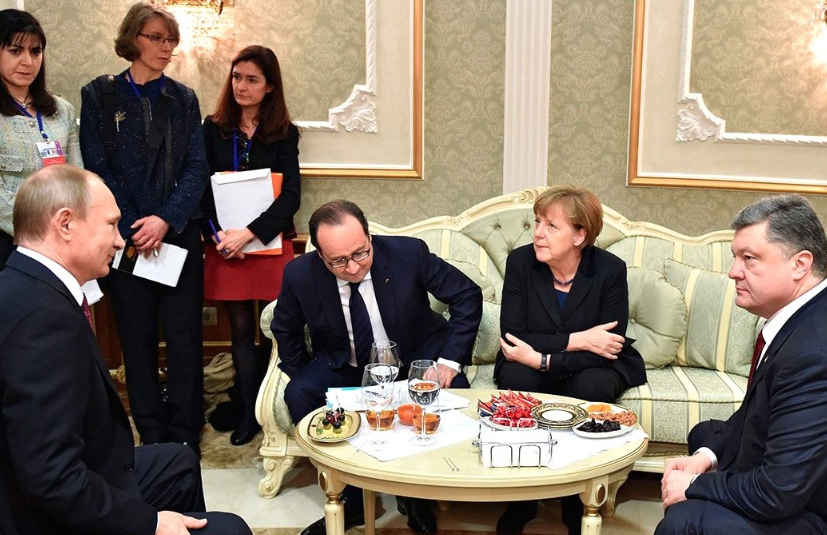
Feb. 12, 2015: Russian President Vladimir Putin, French President Francois Hollande, German Chancellor Angela Merkel, Ukrainian President Petro Poroshenko at the Normandy format talks in Minsk, Belarus. (Kremlin)
Between the time of the Minsk Accords in 2015 and Russia’s invasion of Ukraine in 2022, on behalf of the besieged population in the east, thousands of ethnic Russian civilians had been killed by Ukraine’s forces, teaching the Russian language had been prohibited, Russian churches had been outlawed and Russian language media had been severely restricted. (The U.N. Human Rights Office (OHCHR) says 3,106 civilians died in Donbass from 2014 until the end of 2021).
The Istanbul Denial
Yet, despite the setback following Minsk and just two months into Russia’s invasion, another opportunity to end the war was being negotiated between Russia and Ukraine in Istanbul.
The terms were similar to Minsk, but just as Ukraine was about to sign the agreement, U.K. Prime Minister Boris Johnson descended on Kiev on behalf of NATO to tell Zelensky to pull the plug — the U.S. and Europe would provide Ukraine with all the weapons it needed to continue to fight Russia.
So, four years on, here we are. Putin, fooled twice, has lost all trust in Western leaders and has no more time for their games. On the battlefield, Russia is in no rush; it is defeating Ukraine in a grinding war of attrition that by now is irreversibly in Russia’s favour.
Contrary to European leaders’ tough talk, Ukraine has nearly run out of trained soldiers, the U.S. has run out of ground war arms to give to Ukraine and, despite its belligerent rhetoric, Europe has run out of money to send to Kiev. (Meanwhile, revelations of corruption close in on Zelensky’s inner circle, claiming the resignation today of his chief of staff.)
The fall of Andriy Yermak – Zelensky’s fixer, enforcer, gatekeeper, and indispensable ally, isn’t a “corruption scandal.” It’s Washington slapping the table. NABU, the U.S.-trained attack dog of Ukrainian politics, didn’t raid the Presidential Office by accident. It raided to… pic.twitter.com/6k8cYOJ6I0
— THE ISLANDER (@IslanderWORLD) November 28, 2025
The tragedy is that all of this – the loss of over a million lives (mostly young Ukrainian and Russian men thrown into the meatgrinder of trench warfare), the fleeing of over 7 million Ukrainian refugees who are unlikely to ever return and the widespread destruction of Ukraine’s infrastructure – could have all been avoided.
The notion that the West came to the aid of Ukraine to defend democracy in the most corrupt and neo-Nazi infested country in Europe is as deceptive as it is laughable. This has always been a battle initiated by the U.S./NATO alliance to weaken Moscow, overthrow Putin and return the West to dominance over Russia like in the 1990s, with Ukraine as the unfortunate willing proxy.
It was sheer hubris and stupidity for the neocons in Washington and Brussels, pumped up with triumphalism after the fall of the Soviet Union, to think they could mould the post-Cold War world including Eurasia in their interests without disastrous consequences.
In the end, Ukraine will be defeated but there are no real winners.
Both Ukraine and Russia will take years to recover from the human and economic cost of this devastating war; Europe’s economy is in tatters with near negative growth, energy prices three times higher than before the destruction of Russia’s Nord Stream pipeline, and companies fleeing to produce offshore.
As for the U.S. , it has nothing to show other than public anger over the war, soaring national debt and increasing isolation as a global power.
As always, the biggest prize-winners are the global defence contractors whose profits have skyrocketed since the start of the war in Ukraine and Israel’s genocidal war in Gaza.
Original article: consortiumnews.com